


Pulse Generator Oscillator 32.768KHz by watch crystal
#pulse generator
#32.768KHz
#watch crystal
#CMOS
#binary counter
#stable frequency
#digital circuit
#clock signal
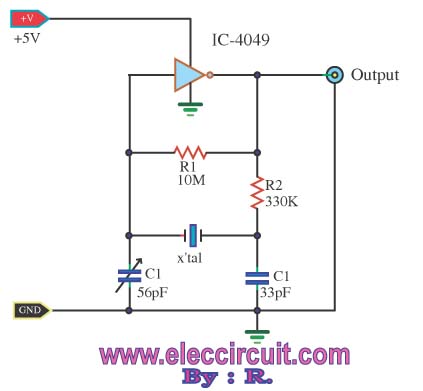
Description: A friend requires a pulse generator oscillator circuit that maintains a stable frequency of 32.768 kHz for a digital CMOS binary counter.
The pulse generator oscillator circuit designed to operate at a frequency of 32.768 kHz is commonly used in digital applications, particularly in timing devices and binary counters. This frequency is significant as it is derived from the division of the standard clock frequency of 2^15 Hz, making it ideal for applications such as real-time clocks and timers.
The circuit can be implemented using a variety of components, such as a crystal oscillator, which provides high stability and accuracy. A typical configuration includes a crystal resonator of 32.768 kHz, which is connected to an inverter or a CMOS oscillator IC. The inverter amplifies the signal and ensures that the output waveform is a square wave, suitable for driving the digital CMOS binary counter.
In addition to the crystal, passive components like resistors and capacitors are used to set the oscillation conditions. The selection of these components is crucial to achieve the desired frequency stability and waveform characteristics. For example, a capacitor may be connected in parallel with the crystal to enhance the stability of the oscillation.
The output of the pulse generator is typically a square wave signal, which can be fed directly into the clock input of the CMOS binary counter. This allows the counter to increment its value with each pulse, effectively counting in binary format. The design should also consider power supply requirements, ensuring that the circuit operates efficiently within the specified voltage range for the CMOS components.
Overall, this pulse generator oscillator circuit provides a reliable solution for generating a stable 32.768 kHz frequency, fulfilling the requirements of digital CMOS binary counters and other timing applications.My Friend need to like a Pulse Generator Oscillator circuit that stable frequency at 32.768KHz,for digital cmos binary counter, so he tell to me even low..
The pulse generator oscillator circuit designed to operate at a frequency of 32.768 kHz is commonly used in digital applications, particularly in timing devices and binary counters. This frequency is significant as it is derived from the division of the standard clock frequency of 2^15 Hz, making it ideal for applications such as real-time clocks and timers.
The circuit can be implemented using a variety of components, such as a crystal oscillator, which provides high stability and accuracy. A typical configuration includes a crystal resonator of 32.768 kHz, which is connected to an inverter or a CMOS oscillator IC. The inverter amplifies the signal and ensures that the output waveform is a square wave, suitable for driving the digital CMOS binary counter.
In addition to the crystal, passive components like resistors and capacitors are used to set the oscillation conditions. The selection of these components is crucial to achieve the desired frequency stability and waveform characteristics. For example, a capacitor may be connected in parallel with the crystal to enhance the stability of the oscillation.
The output of the pulse generator is typically a square wave signal, which can be fed directly into the clock input of the CMOS binary counter. This allows the counter to increment its value with each pulse, effectively counting in binary format. The design should also consider power supply requirements, ensuring that the circuit operates efficiently within the specified voltage range for the CMOS components.
Overall, this pulse generator oscillator circuit provides a reliable solution for generating a stable 32.768 kHz frequency, fulfilling the requirements of digital CMOS binary counters and other timing applications.My Friend need to like a Pulse Generator Oscillator circuit that stable frequency at 32.768KHz,for digital cmos binary counter, so he tell to me even low..
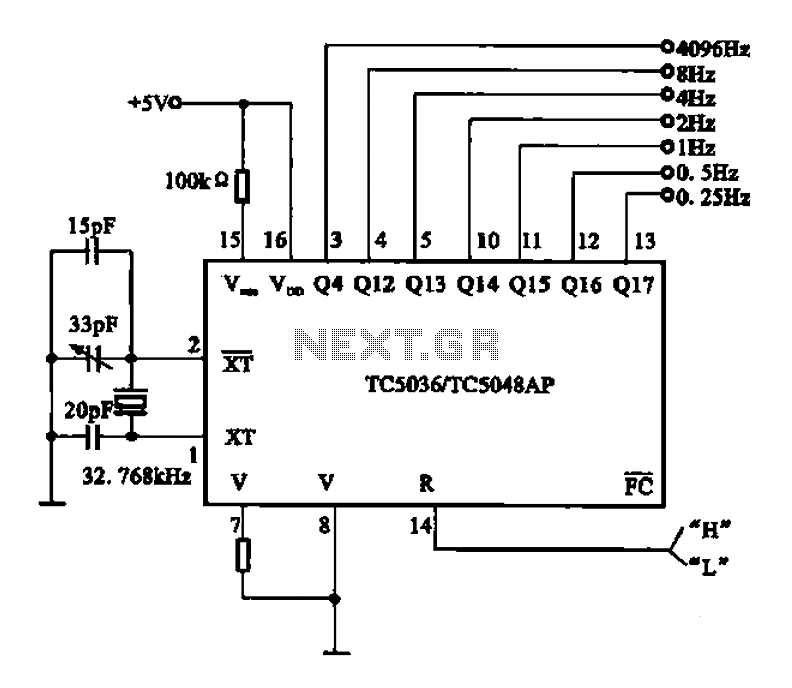
Reference time signal generation circuit 32.768kHz
32.768 kHz; In MP3/MP4 devices, mobile phones, laptops, and other digital products, a real-time clock signal generating circuit is utilized, primarily composed of crystal resonators and TC5036/TC5048AP chip oscillators. This setup produces a raw 32.768 kHz crystal oscillator signal, which...
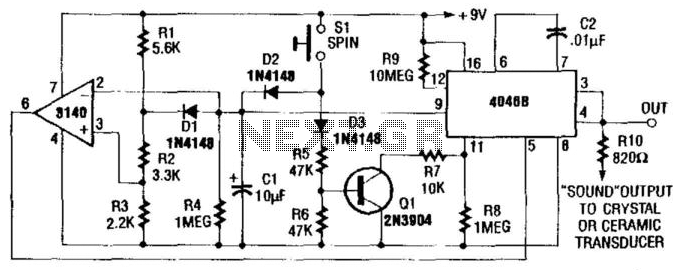
Run-Down Clock/Sound Generator
Used in electronic roulette or dice games, this circuit produces a clock signal that initially is several tens of kHz (depending on C2) and gradually decreases to zero in about 15 seconds, as C1 discharges through R4.
The described circuit is...
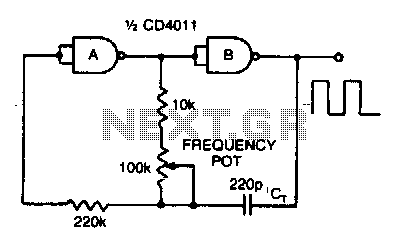
Cmos oscillator
Adjusting the 100 K ohm potentiometer modifies the discharge rate of capacitor Ct, thereby affecting the output frequency. A square wave output is produced. The maximum frequency achievable with CMOS technology is constrained to 2 MHz.
The circuit described involves a...
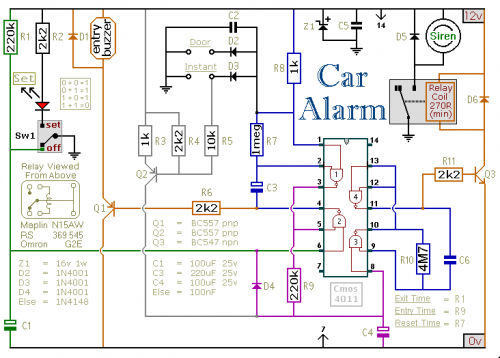
cmos based vehicle anti theft alarm
This car alarm circuit includes Exit and Entry delays, an instant alarm zone, an intermittent siren output, and an automatic reset function. By incorporating external relays, it is possible to immobilize the vehicle and activate the lights.
The car alarm circuit...
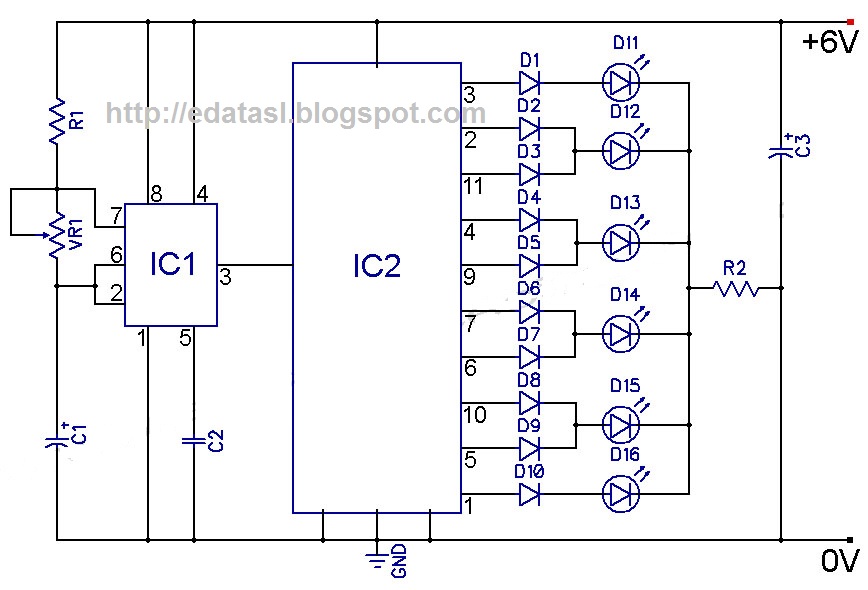
4017 CMOS Decade Counter
At the onset of the second clock cycle, the output labeled "0" transitions to a LOW state while the output labeled "1" transitions to a HIGH state. This sequence persists across ten outputs, eventually cycling back to output "0" on...
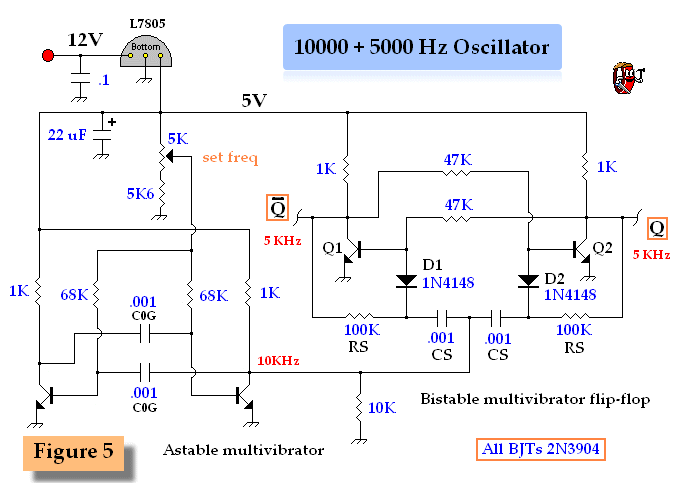
General Hobbyist Circuits
This circuit describes a simple 6-bit random number pseudo-generator used to study binary counters and, in particular, shift registers. Some basic background information about binary counters and shift registers is provided. In reality, there are dozens of different shift register...
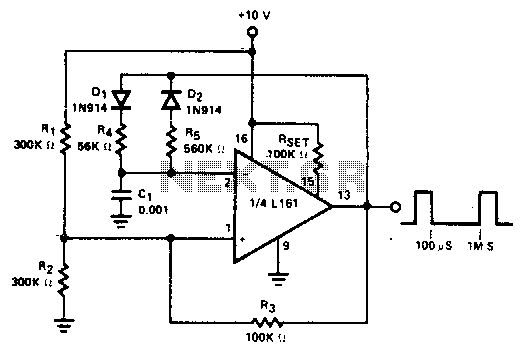
Pulse generator
The duty cycle of the output pulse is equal to R4/(R4 + R5) x 100%. For duty cycles of less than 50%, D1 can be eliminated and R2 increased. R4(eff) is the effective value of R4 in the circuit, while...
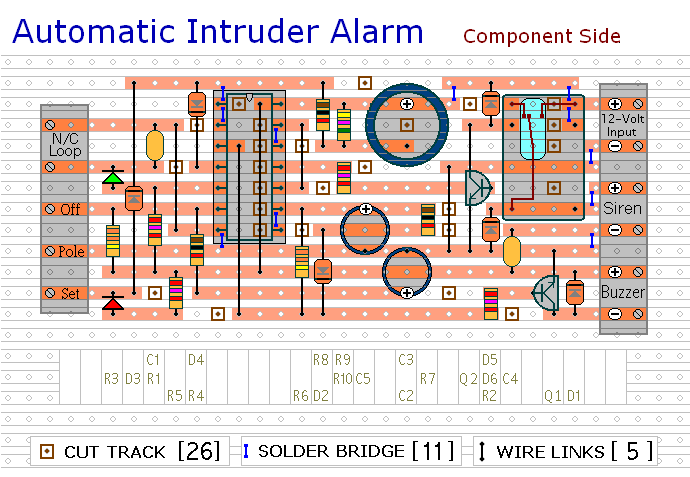
simpler cmos single zone alarm
This circuit includes automatic exit and entry delays, a timed bell cut-off, and a system reset feature. It is designed to work with standard normally-closed input devices such as magnetic reed contacts, micro switches, foil tape, and passive infrared sensors...

Cmos-oscillator
This circuit is guaranteed to oscillate at a frequency of approximately 2.2/(R1 x C) if R2 is greater than R1. Additionally, the number of gates can be reduced further by replacing gates 1 and 2 with a non-inverting gate.
The described...