


Quartz Crystal Oscillator and Quartz Crystals
#quartz crystal
#pierce oscillator
#harmonic oscillator
#overtone oscillator
#crystal oscillator
#frequency stability
#resonator
#electronics tutorial
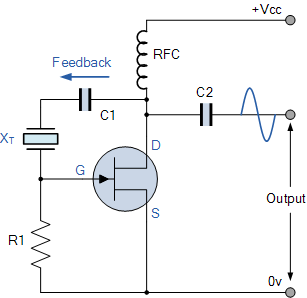
Description: Electronics tutorial about quartz crystal oscillators, including harmonic, overtone, Pierce oscillator, and crystal quartz oscillator circuits.
Quartz crystal oscillators are vital components in modern electronics, providing stable frequency references for a variety of applications. They utilize the piezoelectric properties of quartz crystals to generate oscillations at precise frequencies. The primary types of quartz crystal oscillators include harmonic, overtone, and Pierce oscillators, each with unique characteristics and applications.
Harmonic oscillators operate by using the fundamental frequency of the crystal, where the oscillation is maintained by the crystal's mechanical resonance. This type is commonly used in applications requiring low noise and high stability, such as in clocks and frequency synthesizers.
Overtone oscillators, on the other hand, exploit higher harmonics of the fundamental frequency. By utilizing overtones, these oscillators can achieve higher frequencies without the need for larger crystals. This allows for compact designs in applications like RF transmitters and receivers.
The Pierce oscillator is a specific configuration that employs a quartz crystal in a feedback loop with an amplifier. This design is known for its simplicity and effectiveness in generating stable oscillations. It is widely used in microcontroller applications and other digital circuits where precise timing is critical.
Crystal quartz oscillators can be integrated into circuits to provide clock signals for digital devices, ensuring synchronous operation. They are characterized by their small size, low power consumption, and high frequency stability, making them essential in telecommunications, computing, and consumer electronics.
In summary, quartz crystal oscillators are crucial for maintaining accurate timing and frequency control in electronic systems, with various configurations tailored to meet specific requirements across different applications.Electronics Tutorial about Quartz Crystal Oscillator including Harmonic, Overtone, Pierce Oscillator and Crystal Quartz Oscillator Circuits..
Quartz crystal oscillators are vital components in modern electronics, providing stable frequency references for a variety of applications. They utilize the piezoelectric properties of quartz crystals to generate oscillations at precise frequencies. The primary types of quartz crystal oscillators include harmonic, overtone, and Pierce oscillators, each with unique characteristics and applications.
Harmonic oscillators operate by using the fundamental frequency of the crystal, where the oscillation is maintained by the crystal's mechanical resonance. This type is commonly used in applications requiring low noise and high stability, such as in clocks and frequency synthesizers.
Overtone oscillators, on the other hand, exploit higher harmonics of the fundamental frequency. By utilizing overtones, these oscillators can achieve higher frequencies without the need for larger crystals. This allows for compact designs in applications like RF transmitters and receivers.
The Pierce oscillator is a specific configuration that employs a quartz crystal in a feedback loop with an amplifier. This design is known for its simplicity and effectiveness in generating stable oscillations. It is widely used in microcontroller applications and other digital circuits where precise timing is critical.
Crystal quartz oscillators can be integrated into circuits to provide clock signals for digital devices, ensuring synchronous operation. They are characterized by their small size, low power consumption, and high frequency stability, making them essential in telecommunications, computing, and consumer electronics.
In summary, quartz crystal oscillators are crucial for maintaining accurate timing and frequency control in electronic systems, with various configurations tailored to meet specific requirements across different applications.Electronics Tutorial about Quartz Crystal Oscillator including Harmonic, Overtone, Pierce Oscillator and Crystal Quartz Oscillator Circuits..
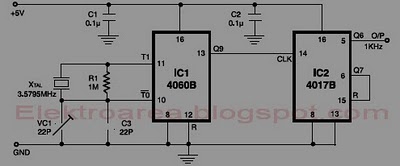
crystal base oscillator circuit
This circuit is designed for accurate time-base generation utilizing the commonly available 3.5795 MHz crystal, which is frequently used in telecommunication equipment. A crystal-based oscillator combined with a divider IC chain or a similar circuit, such as an ASIC, is...
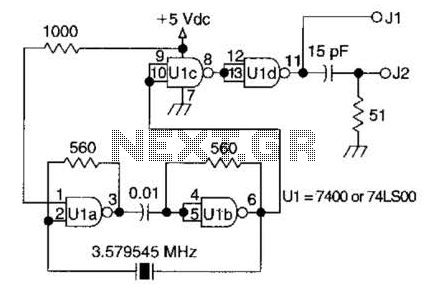
Wide-Range Crystal Oscillator Circuit
A circuit utilizing one 7400 TTL can operate with fundamental type crystals ranging from 1 to approximately 13 MHz. The output is rich in harmonics, making this oscillator suitable for calibration and testing applications.
The circuit in question employs a 7400...
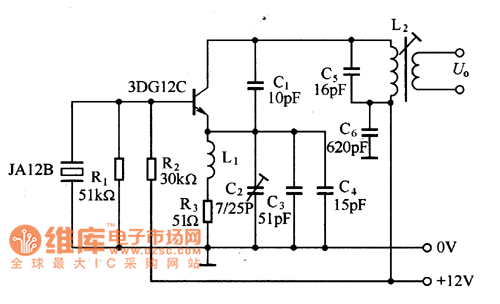
27MHz quartz crystal oscillator circuit
The 27MHz quartz crystal oscillator circuit is illustrated in figure 1. The biasing circuit consists of resistors R1, R2, and R3, while C6 serves as the bypass capacitor. The partial voltage circuit includes capacitors C1, C2, C3, and C4 to...
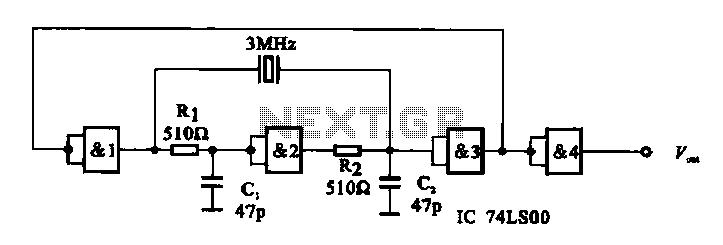
E crystal oscillator circuit composed of several gates
A crystal oscillator circuit is composed of several gates. Figure (A) illustrates a crystal oscillator circuit operating at 1 MHz, while Figure (B) depicts a 20 MHz crystal oscillator circuit. Figure (C) represents a variable crystal oscillator circuit with a...
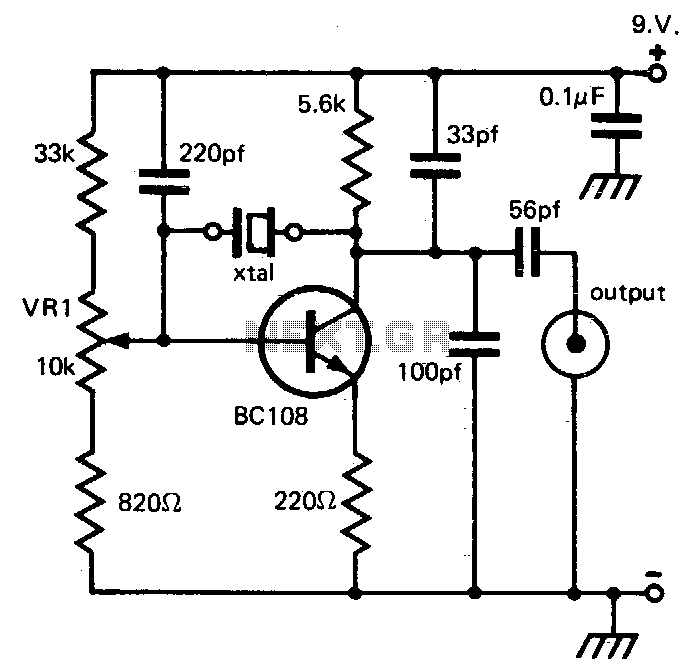
96Mhz crystal oscillator
This circuit provides reliable oscillation and an output close to one volt peak-to-peak. Power consumption is around 1 mA from a nine-volt supply.
The described circuit is likely a simple oscillator designed to generate a periodic waveform with a peak-to-peak voltage...
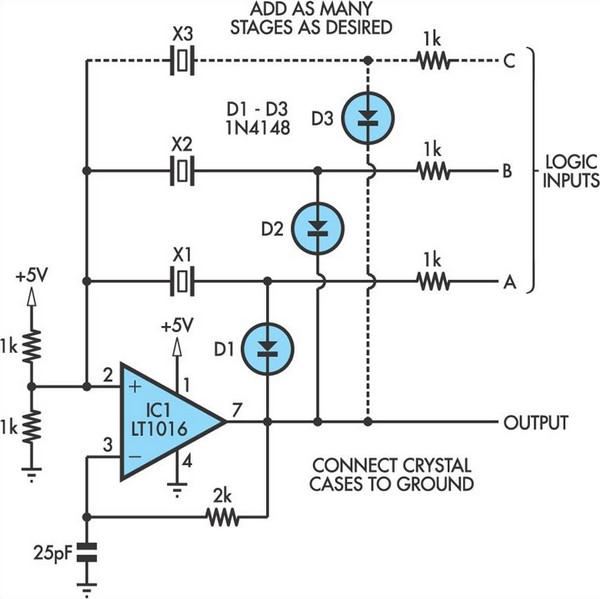
Switchable Output Crystal Oscillator
This oscillator circuit allows crystals to be electronically switched through logic commands. The circuit is best comprehended by initially disregarding all crystal components.
The oscillator circuit described functions as a frequency generator that utilizes the properties of quartz crystals to produce...
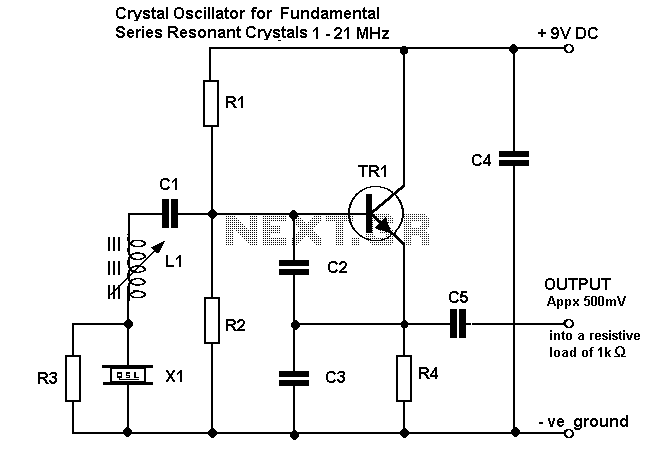
Collection of Crystal Oscillators
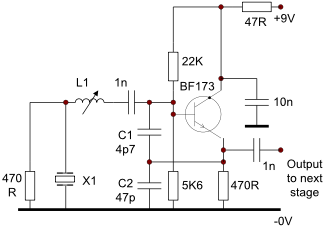
On following pages circuits are shown for 3rd overtone crystals 15 to 65MHz and 5th overtone crystals 60 to 105 MHz operating in their series resonant mode. In both of these circuits with the crystal short circuited, the oscillator should...
Solid State Circuits 2
This circuit operates effectively from low frequencies up to at least 120 MHz using series resonant crystals in their fundamental or overtone mode. The output can be obtained from the feedback tap, a low impedance winding on L2, or from...
Crystal Oscillator Circuit
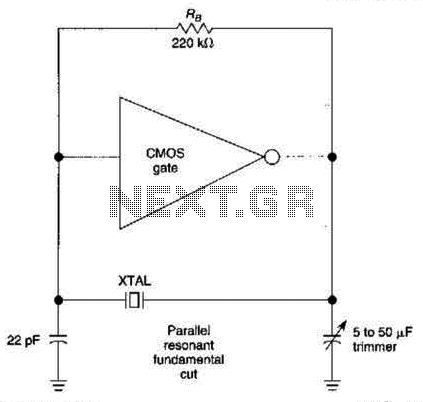
The CMOS amplifier is biased into the linear region by resistor RB. The pi-type crystal network (C1 and C2, and XTAL) provides the 180-degree phase shift at the resonant frequency, which causes the circuit to oscillate.
The described circuit utilizes a...