


Sawtooth Wave Generator
#sawtooth wave
#wave generator
#electronic circuit simulator
#signal generation
#function generator
#electronics design
#circuit simulation
#waveform generation
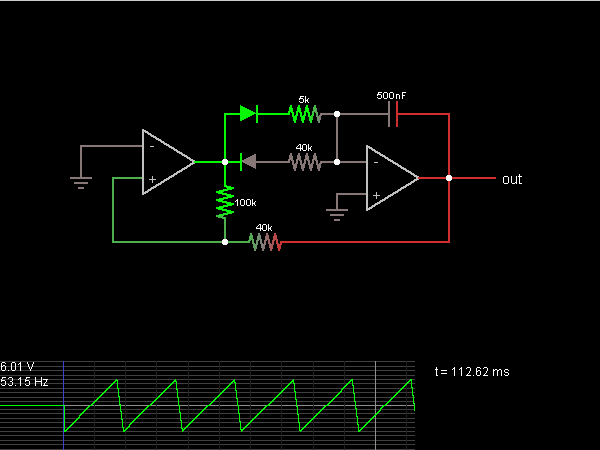
Description: This is the sawtooth wave generator circuit diagram, accompanied by a detailed explanation of its operational principles. An electronic circuit simulator is available to assist in designing the sawtooth wave generator circuit and simulating it online for enhanced understanding.
The sawtooth wave generator is an essential circuit used in various applications, including audio synthesis, signal modulation, and timing applications. The fundamental operation of this circuit is based on the linear charging and rapid discharging of a capacitor.
The core components typically include a resistor, a capacitor, and an operational amplifier or a transistor, depending on the design requirements. The capacitor charges through the resistor, creating a linear voltage increase over time. Once the voltage across the capacitor reaches a predefined threshold, a comparator or a transistor switches states, rapidly discharging the capacitor to initiate the next cycle of the waveform.
The frequency of the sawtooth wave can be adjusted by varying the resistor and capacitor values, allowing for flexibility in output frequency. The output can be taken from the junction of the resistor and capacitor or directly from the output of the comparator or transistor.
In a typical schematic, the power supply is connected to the operational amplifier or transistor, providing the necessary voltage levels for operation. The output waveform is characterized by a linear rise followed by a sharp drop, which is the defining feature of the sawtooth wave.
This circuit can be simulated using electronic circuit simulation software, which provides a visual representation of the waveform and allows for real-time adjustments to component values. This simulation capability aids in understanding the behavior of the circuit under various conditions and assists in troubleshooting and optimization before physical implementation.This is the Sawtooth Wave Generator circuit diagram with the detailed explanation of its working principles. The electronic circuit simulator helps you to design the Sawtooth Wave Generator circuit and to simulate it online for better understanding..
The sawtooth wave generator is an essential circuit used in various applications, including audio synthesis, signal modulation, and timing applications. The fundamental operation of this circuit is based on the linear charging and rapid discharging of a capacitor.
The core components typically include a resistor, a capacitor, and an operational amplifier or a transistor, depending on the design requirements. The capacitor charges through the resistor, creating a linear voltage increase over time. Once the voltage across the capacitor reaches a predefined threshold, a comparator or a transistor switches states, rapidly discharging the capacitor to initiate the next cycle of the waveform.
The frequency of the sawtooth wave can be adjusted by varying the resistor and capacitor values, allowing for flexibility in output frequency. The output can be taken from the junction of the resistor and capacitor or directly from the output of the comparator or transistor.
In a typical schematic, the power supply is connected to the operational amplifier or transistor, providing the necessary voltage levels for operation. The output waveform is characterized by a linear rise followed by a sharp drop, which is the defining feature of the sawtooth wave.
This circuit can be simulated using electronic circuit simulation software, which provides a visual representation of the waveform and allows for real-time adjustments to component values. This simulation capability aids in understanding the behavior of the circuit under various conditions and assists in troubleshooting and optimization before physical implementation.This is the Sawtooth Wave Generator circuit diagram with the detailed explanation of its working principles. The electronic circuit simulator helps you to design the Sawtooth Wave Generator circuit and to simulate it online for better understanding..
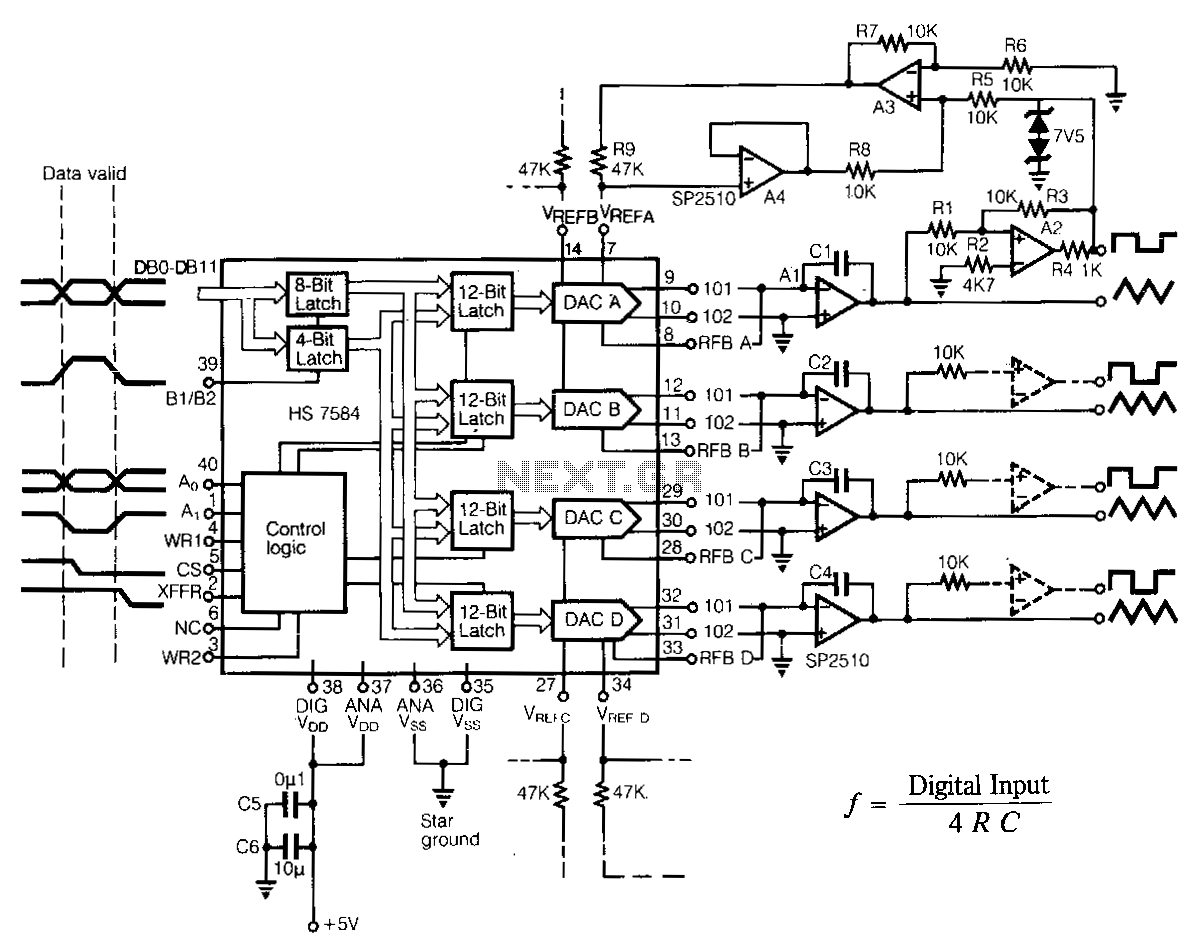
Triangle-square-wave-generator
The programmable multiple output generator provides control signals for the data converter automated test equipment (ATE). Major performance criteria include simple interfaces with various microprocessor systems, low power consumption, stable output timing relationships, and minimal board space requirements. For schematic...
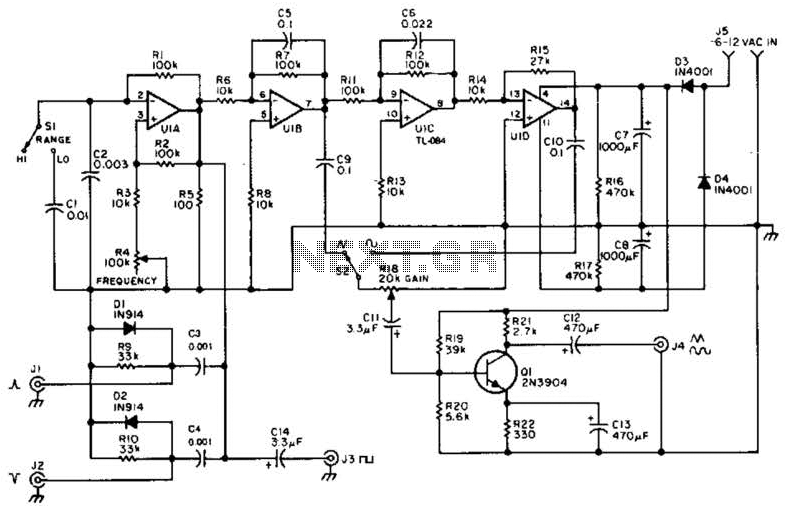
Function Generator Circuit
A quad op-amp serves as the core component of this function generator. U1A produces a square wave, which is outputted to J8. J1 and J2 are pulse outputs derived from differentiating the square wave. The integrator U1B creates a triangle...
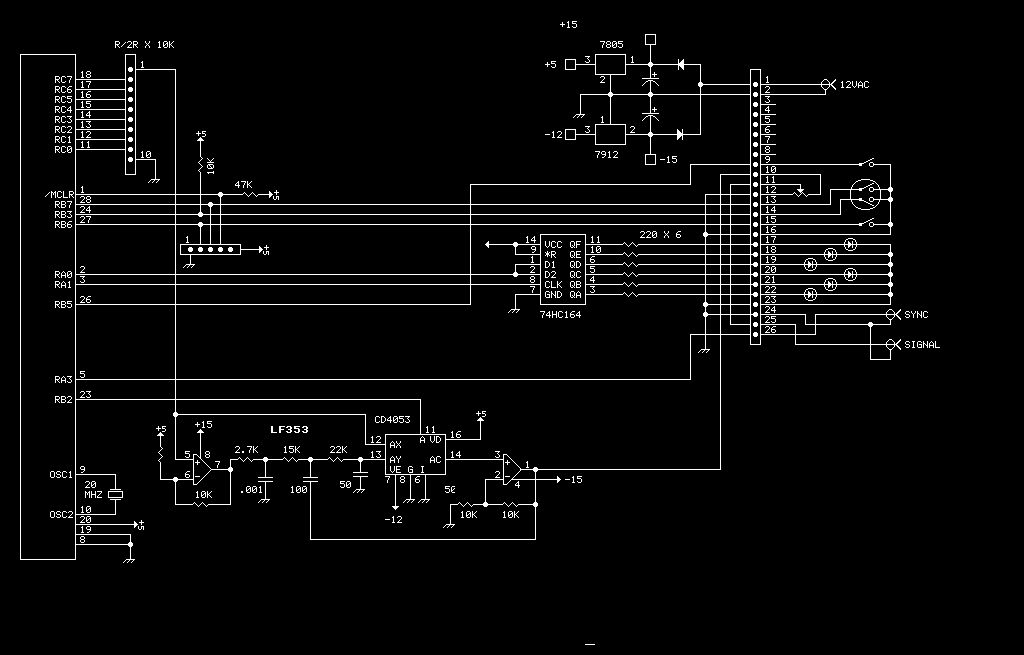
Function Generator Sine / Triangle / Square / Saw ( PIC16F870 )
After the recent demise of our multifunction signal generator, we decided to make one of our own. The circuit uses a PIC16F870 (about $3), an R/2R resistor ladder network (for a real fast and cheap D/A), and a few other...
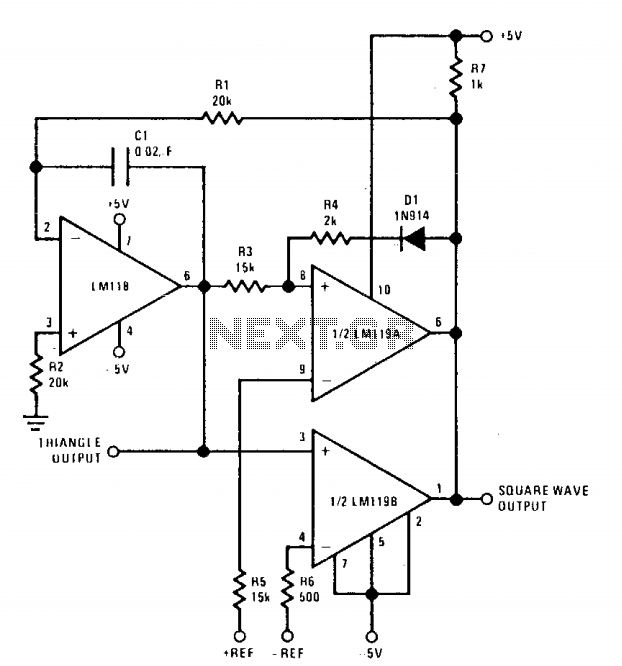
Precise wave generator
The positive and negative peak amplitudes can be controlled with an accuracy of approximately ±0.01 V through a DC input. Additionally, the output frequency and symmetry are easily adjustable. The oscillator is composed of an integrator and two comparators; one...
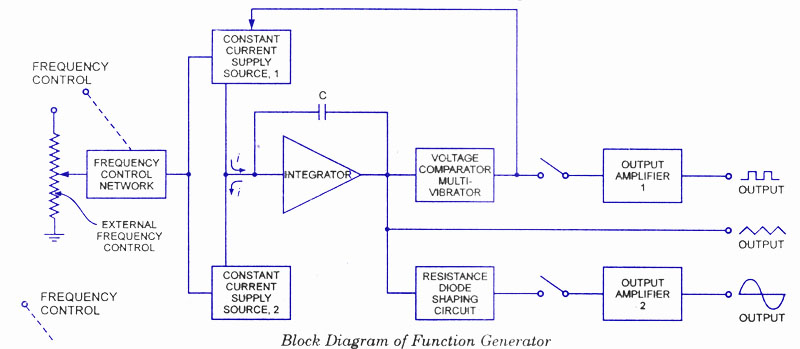
Function Generators
A function generator is a signal source capable of producing various types of waveforms as its output signal. The most common output waveforms include sine waves, triangular waves, square waves, and sawtooth waves. The frequencies of these waveforms can be...
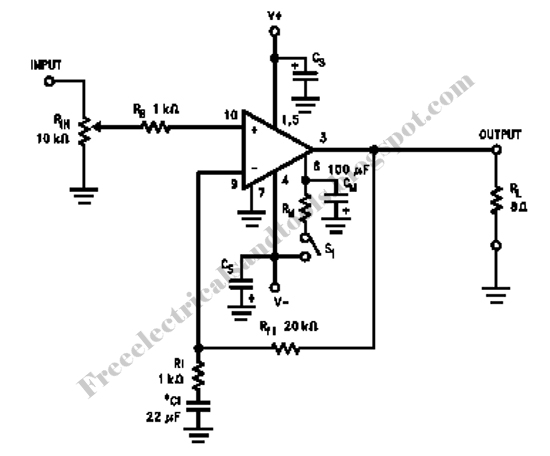
Simple Function Generator Circuit
This is a design circuit for a simple function generator. Built around a single 8038 waveform generator IC, this circuit produces sine, square, or triangle waves from 20Hz to 200kHz in four switched ranges. There are both high and low-level...
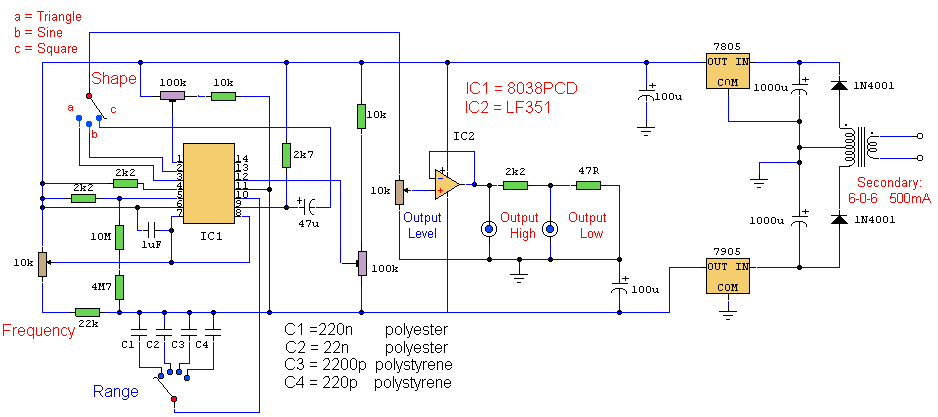
Function Generator
This circuit is built around a single 8038 waveform generator integrated circuit (IC), capable of producing sine, square, or triangle waves across four switched frequency ranges from 20Hz to 200kHz. It features both high and low-level outputs, which can be...
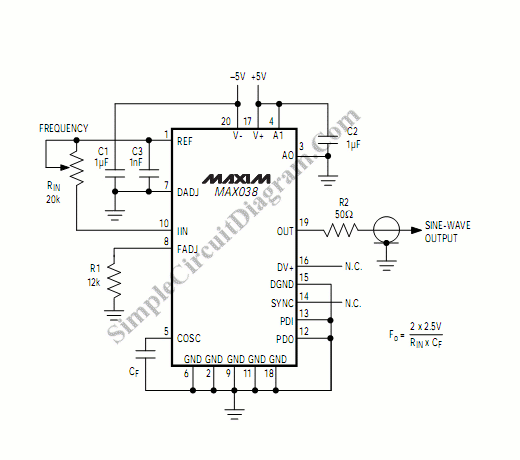
High Frequency Function Generator Using MAX038
A function generator that operates within a frequency range of 0.1 Hz to 20 MHz can be constructed using the MAX038 integrated circuit chip. This represents a straightforward implementation of a high-performance signal generator.
The MAX038 is a high-speed precision function...
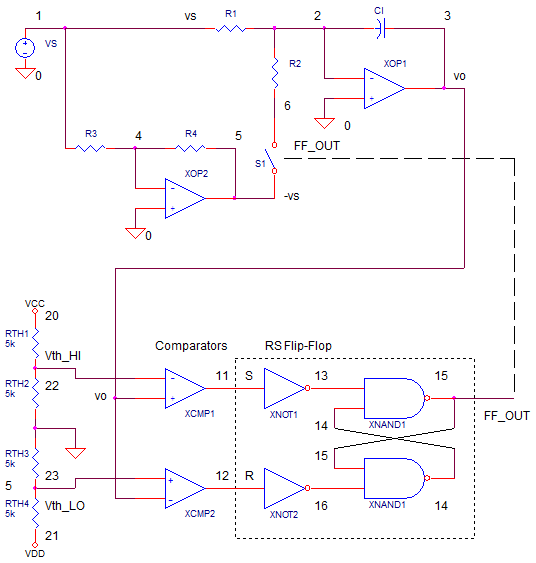
Function Generator 1
At some point, one may have encountered the function generator in a laboratory setting. By simply adjusting the waveform selector knob, a triangle, square, or sine wave is generated at the output. Another knob allows for the frequency of the...