


UJT RELAXATION OSCILLATOR
#UJT
#relaxation oscillator
#transistor
#trigger
#waveform generation
#electronics
#circuit design
#emitter
#base
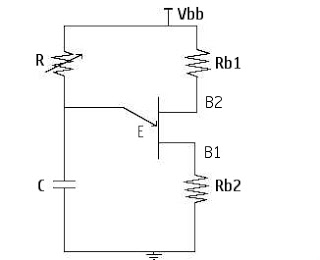
Description: At the point Vp, the emitter triggers and turns the UJT (Uni-Junction Transistor) ON. Up to this point, the emitter is isolated and does not conduct, resulting in no current conduction between Base1 and Base2.
The operation of the Uni-Junction Transistor (UJT) is characterized by its unique structure and behavior, which is particularly useful in timing and triggering applications. The UJT consists of a single n-type semiconductor bar with two p-type regions, referred to as Base1 and Base2. The emitter terminal is connected to the n-type material and plays a crucial role in the device's operation.
When the voltage at the emitter reaches a specific threshold, denoted as Vp, the UJT becomes active. Prior to reaching this voltage, the emitter remains isolated from the two bases, preventing any current flow. The isolation ensures that the device remains in a non-conductive state, which is essential for its function in timing circuits and oscillator applications.
Once the voltage at the emitter exceeds the threshold value, the UJT turns ON, allowing current to flow between the emitter and Base1 or Base2. This transition marks the beginning of the conduction phase, where the UJT can be used to trigger other devices or control circuits. The characteristics of the UJT, including its negative resistance region, allow it to oscillate or switch, making it a valuable component in various electronic applications.
In practical applications, the UJT can be used in relaxation oscillators, pulse generators, and timing circuits. The precise control of the conduction state based on the emitter voltage makes it an essential component in designing circuits that require timing and triggering functionalities. Understanding the behavior of the UJT during the transition from non-conductive to conductive states is crucial for engineers when integrating this device into electronic systems.At the point Vp the Emitter triggers and TURN the ujt ON, until this point ; the emitter is isolated(doesnt conduct) from the transistor so no Current Conduction occurs between Base1 and Base2.
The operation of the Uni-Junction Transistor (UJT) is characterized by its unique structure and behavior, which is particularly useful in timing and triggering applications. The UJT consists of a single n-type semiconductor bar with two p-type regions, referred to as Base1 and Base2. The emitter terminal is connected to the n-type material and plays a crucial role in the device's operation.
When the voltage at the emitter reaches a specific threshold, denoted as Vp, the UJT becomes active. Prior to reaching this voltage, the emitter remains isolated from the two bases, preventing any current flow. The isolation ensures that the device remains in a non-conductive state, which is essential for its function in timing circuits and oscillator applications.
Once the voltage at the emitter exceeds the threshold value, the UJT turns ON, allowing current to flow between the emitter and Base1 or Base2. This transition marks the beginning of the conduction phase, where the UJT can be used to trigger other devices or control circuits. The characteristics of the UJT, including its negative resistance region, allow it to oscillate or switch, making it a valuable component in various electronic applications.
In practical applications, the UJT can be used in relaxation oscillators, pulse generators, and timing circuits. The precise control of the conduction state based on the emitter voltage makes it an essential component in designing circuits that require timing and triggering functionalities. Understanding the behavior of the UJT during the transition from non-conductive to conductive states is crucial for engineers when integrating this device into electronic systems.At the point Vp the Emitter triggers and TURN the ujt ON, until this point ; the emitter is isolated(doesnt conduct) from the transistor so no Current Conduction occurs between Base1 and Base2.
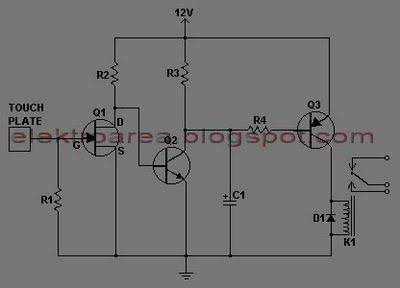
touch switch circuit with 3 transistors
This document describes a series of touch switches that utilize only three transistors. These touch-based transistor switches can activate a load simply by the user touching a metal plate. They are designed to directly switch a relay, enabling operation with...
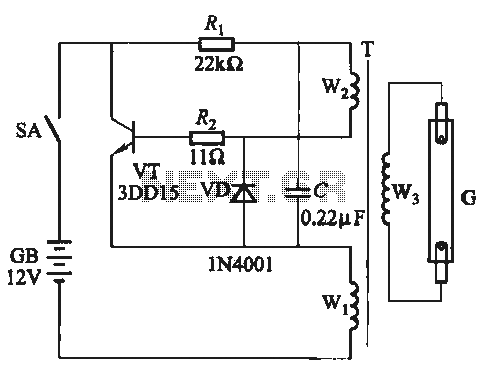
A five inverter circuit
A self-excited transistor inverter circuit is designed for improved performance and features a relatively simple schematic. It is suitable for driving fluorescent lamps with a power rating between 8 to 40 watts. This inverter can operate stably even when the...
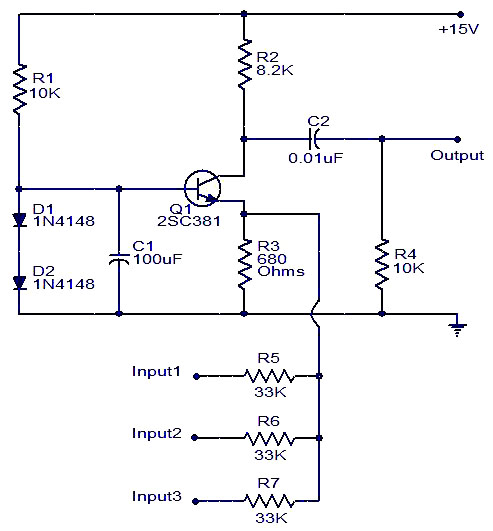
Single transistor audio mixer
Numerous audio mixer circuits have been published; however, this particular design is among the simplest. This straightforward audio mixer circuit utilizes only a single transistor. The base-emitter junction of the transistor is biased with diodes D1 and D2. The signals...
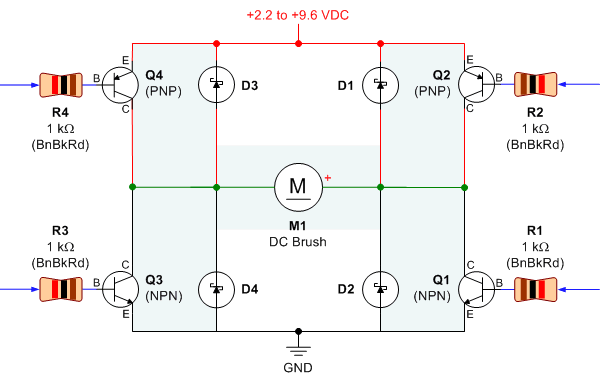
Bipolar Transistor HBridge Motor Driver
Schematic, breadboard photo, parts list, and results of several transistor variations on the classic bipolar H-bridge motor driver circuit.
The classic bipolar H-bridge motor driver circuit is a widely used configuration that allows for the control of DC motors in both...
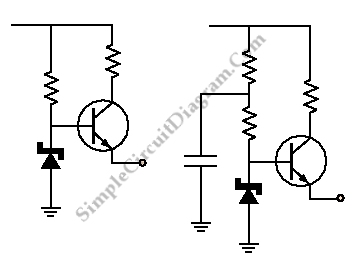
Transistor Buffer for Zener Diode Voltage Regulator
Buffering for the zener diode is achieved through the impedance matching and current amplifying features of the emitter follower, which draws less current from the zener.
Buffering in electronic circuits is essential for ensuring that the performance of one component does...
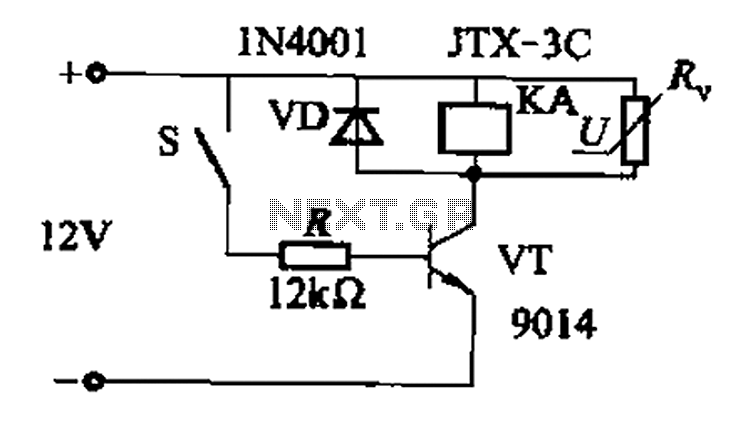
Fast response time of the control transistor circuit b
In a concrete circuit relay application, the transistor VT functions as a high-speed, high-voltage switch. The voltage requirement for switching is 5 to 10 times the rated voltage of the solenoid valve. The circuit is designed for a fast response...
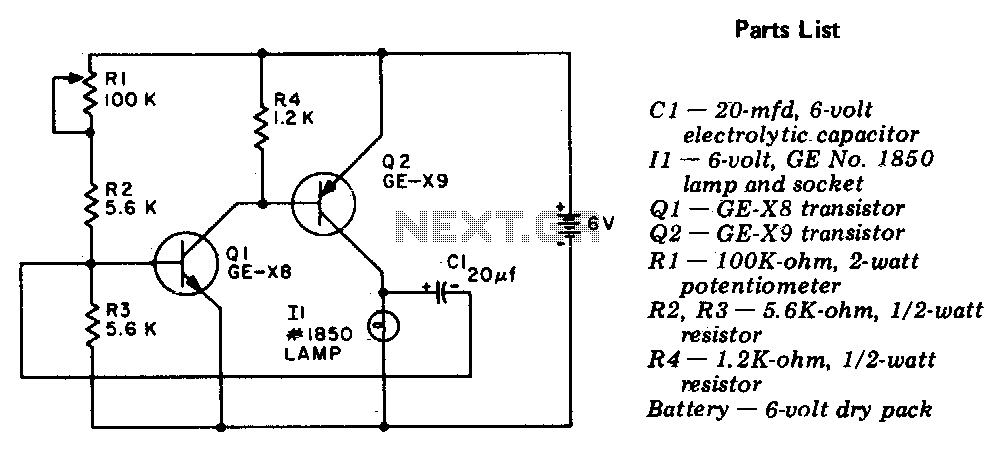
Flasher-light control
The circuit is a two-stage, direct-coupled transistor amplifier configured as a free-running multivibrator. Both the flash duration and flash interval can be adjusted by turning the potentiometer, R1.
The described circuit operates as a two-stage, direct-coupled transistor amplifier, functioning as a...
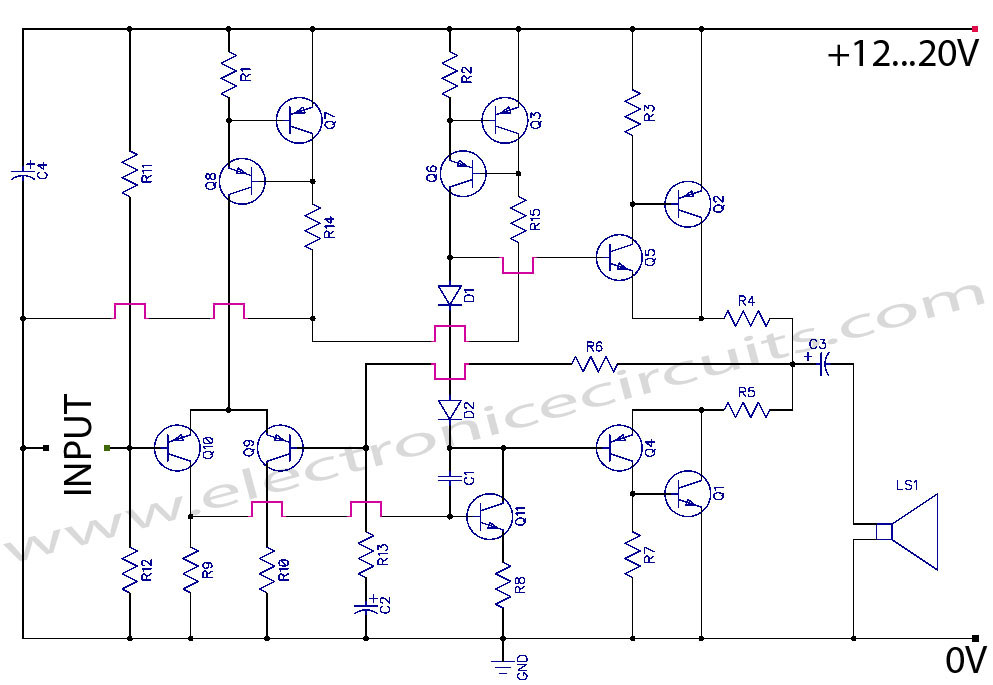
transistor power amplifier circuit diagram
Discrete Class AB Transistor Audio Power Amplifier Circuit Diagram. This is a Class AB transistor power amplifier. It is a simple amplifier to...
A Class AB transistor audio power amplifier is designed to provide high-quality amplification for audio signals while maintaining...
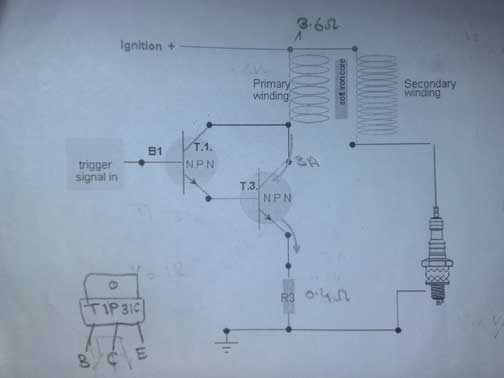
transistor ignition shematic 3
A request for assistance has been made regarding the development of a transistor ignition system to replace the point breaker in a motorcycle. The individual has researched extensively online but has not found a simple and effective circuit. The available...