


Using a VCXO (Voltage-Controlled Crystal Oscillator) as a Clock (CLK) Generator
#VCXO
#clock generator
#voltage-controlled
#crystal oscillator
#frequency adjustment
#digital applications
#control voltage
#timing circuits
#signal generation

Description: The term VCXO refers to a Voltage Controlled Crystal Oscillator. The frequency of this oscillator can be fine-tuned by varying the control voltage. VCXO clock generators are utilized in a range of applications, including digital telecommunications.
VCXO circuits are essential in applications where precise frequency control is required. They are commonly employed in telecommunications, where synchronization of signals is critical. The voltage-controlled aspect of the VCXO allows for dynamic adjustments, making them suitable for systems that require frequency modulation or correction in real-time.
A typical VCXO circuit consists of a crystal, an oscillator circuit, and a control voltage input. The crystal provides a stable frequency reference, while the oscillator circuit generates the output signal. The control voltage input allows for frequency adjustments within a specified range, which is determined by the design of the oscillator and the characteristics of the crystal.
In practice, the performance of a VCXO is characterized by its frequency stability, tuning range, and phase noise. The tuning range is the extent to which the frequency can be adjusted by the control voltage, while phase noise affects the signal integrity and can impact the performance of the overall system.
VCXOs can be implemented in various configurations, including standalone modules or integrated within larger systems. The choice of components, such as the type of crystal and the design of the oscillator circuit, can significantly influence the performance characteristics of the VCXO.
Overall, VCXOs play a pivotal role in modern electronic systems where precise timing and synchronization are paramount, making them a valuable component in the design of reliable and efficient electronic devices.The term VCXO stands for Voltage Control Crystal Oscillator. The frequency of such an oscillator can be adjusted by a small amount through changing the control voltage. VCXO CLK generators have been used in various applications, such as digital T..
VCXO circuits are essential in applications where precise frequency control is required. They are commonly employed in telecommunications, where synchronization of signals is critical. The voltage-controlled aspect of the VCXO allows for dynamic adjustments, making them suitable for systems that require frequency modulation or correction in real-time.
A typical VCXO circuit consists of a crystal, an oscillator circuit, and a control voltage input. The crystal provides a stable frequency reference, while the oscillator circuit generates the output signal. The control voltage input allows for frequency adjustments within a specified range, which is determined by the design of the oscillator and the characteristics of the crystal.
In practice, the performance of a VCXO is characterized by its frequency stability, tuning range, and phase noise. The tuning range is the extent to which the frequency can be adjusted by the control voltage, while phase noise affects the signal integrity and can impact the performance of the overall system.
VCXOs can be implemented in various configurations, including standalone modules or integrated within larger systems. The choice of components, such as the type of crystal and the design of the oscillator circuit, can significantly influence the performance characteristics of the VCXO.
Overall, VCXOs play a pivotal role in modern electronic systems where precise timing and synchronization are paramount, making them a valuable component in the design of reliable and efficient electronic devices.The term VCXO stands for Voltage Control Crystal Oscillator. The frequency of such an oscillator can be adjusted by a small amount through changing the control voltage. VCXO CLK generators have been used in various applications, such as digital T..
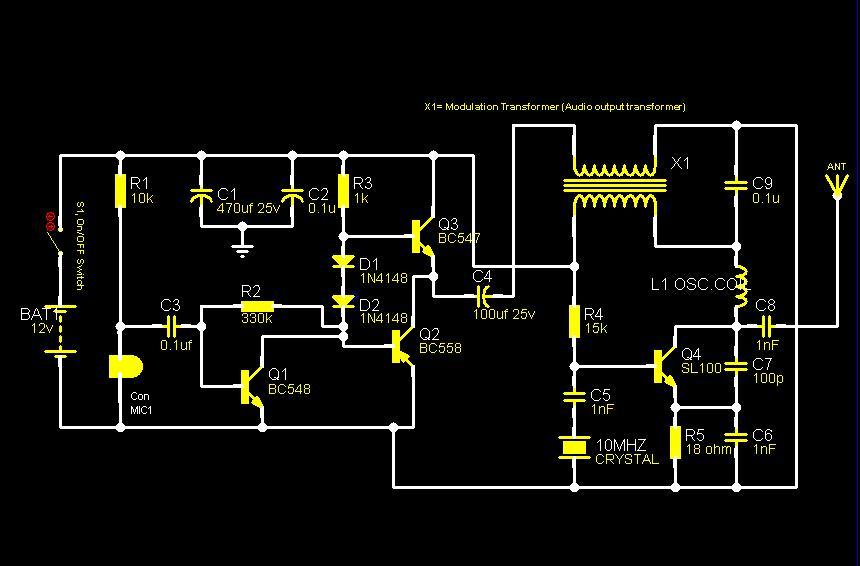
150mW Crystal AM Transmitter PCB
The core component of this circuit is a crystal oscillator utilizing a 10MHz crystal to generate a highly stable carrier frequency. The sound signal from a condenser microphone is amplified by an amplifier circuit comprised of transistors Q1, Q2, and...
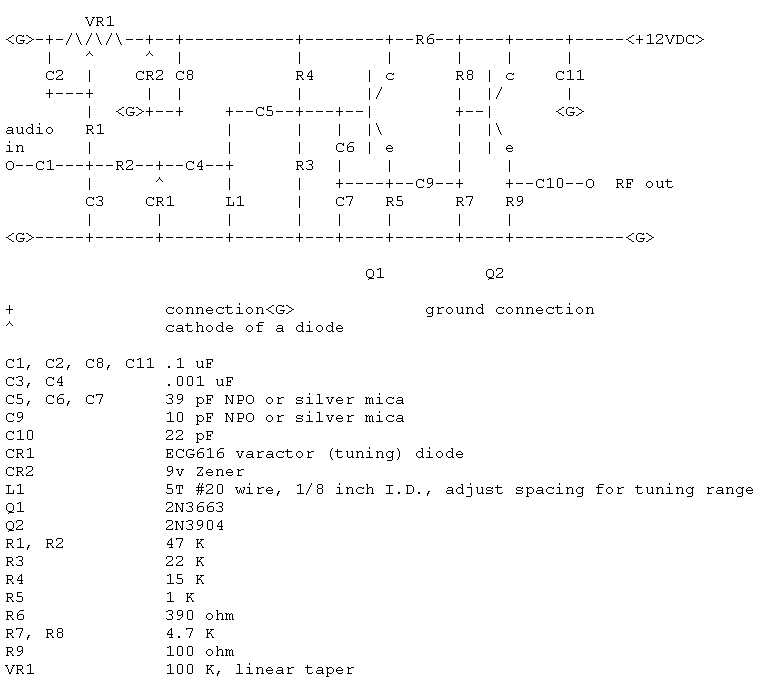
Crystal Oscillator II
The world is full of xtal oscillators twiddled by digital designers lacking in the analog design knowledge necessary. Just look at all the PC real time clocks that lags or leads by several minutes per day. And they eat backup...
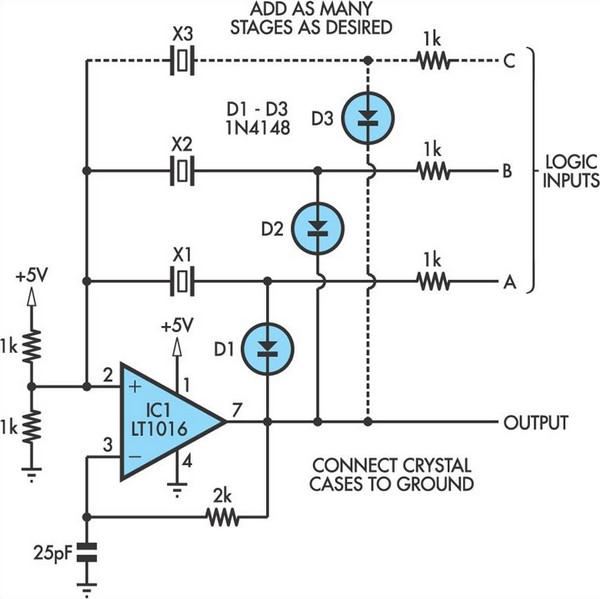
Switchable Output Crystal Oscillator
This oscillator circuit allows crystals to be electronically switched through logic commands. The circuit is best comprehended by initially disregarding all crystal components.
The oscillator circuit described functions as a frequency generator that utilizes the properties of quartz crystals to produce...
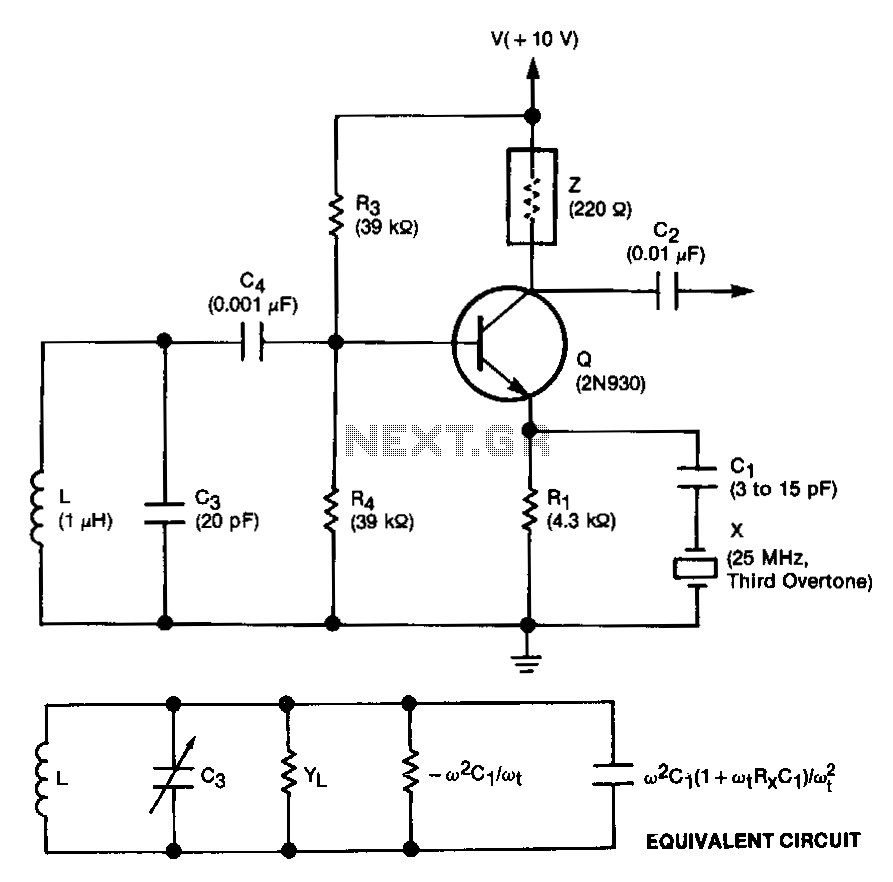
Crystal-controlled-reflection-oscillator
This unit is easily tunable and stable, consumes minimal power, and is more cost-effective than other types of oscillators that operate at similar frequencies. This unique combination of features is made possible by a design concept that involves operating the...
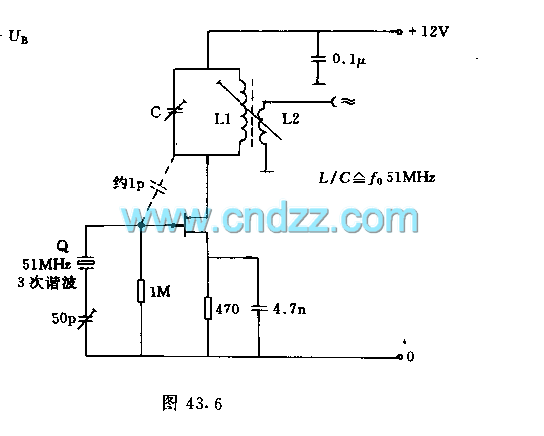
Crystal quartz crystal oscillator circuit using FET
A crystal oscillator operates at a frequency of 51 MHz, which corresponds to the third harmonic of a 17 MHz fundamental frequency. Depending on the specific structure used, the drain-gate capacitance can be selected within a range of 0.5 to...
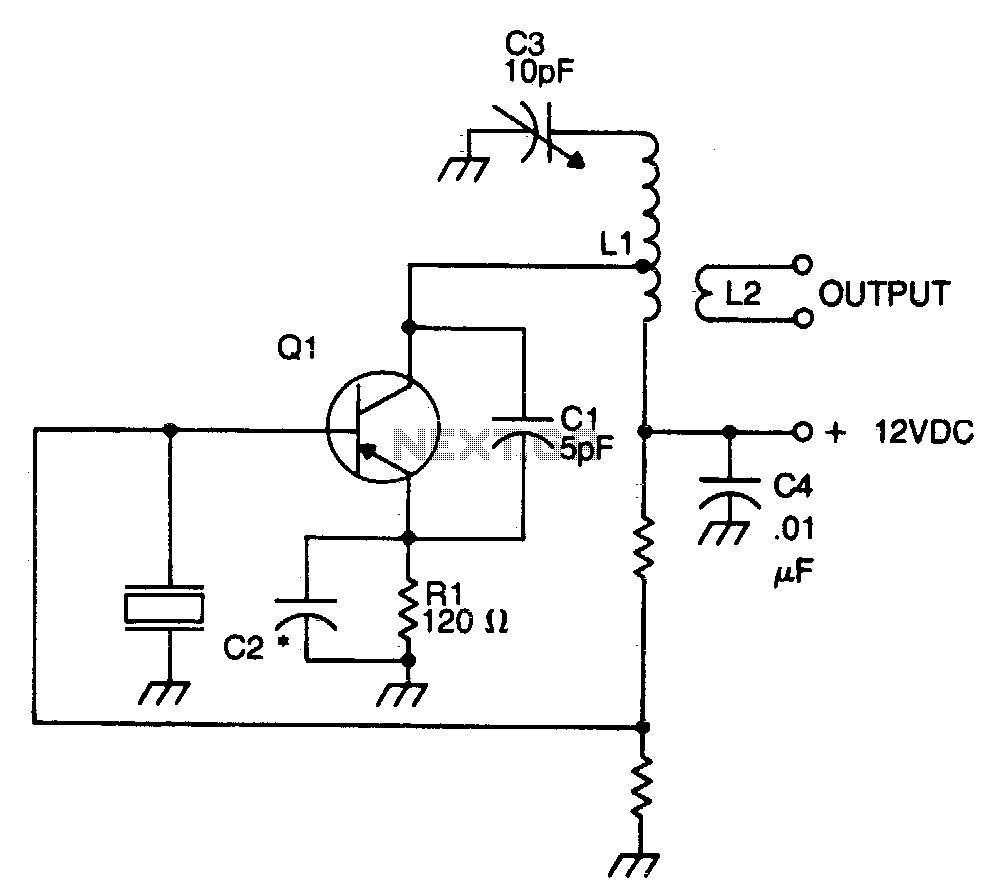
Overtone crystal oscillator
The crystal element in this circuit is connected directly between the base and ground. Capacitor C1 is utilized to enhance feedback due to the internal capacitances of the transistor. This capacitor should be positioned as close as possible to the...
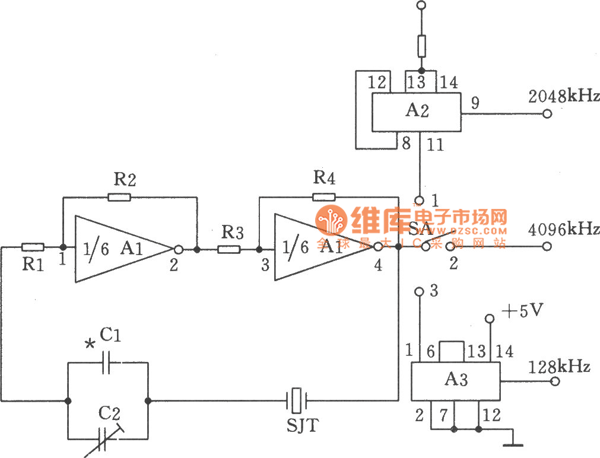
Mutiple Output Crystal Oscillator Sensor
The figure illustrates a multiple output crystal oscillator, which primarily consists of three gates of Al, four resistors, two capacitors, and a crystal. Resistors R1 to R4 offset two inverters within the linear range and are connected between pin 4...
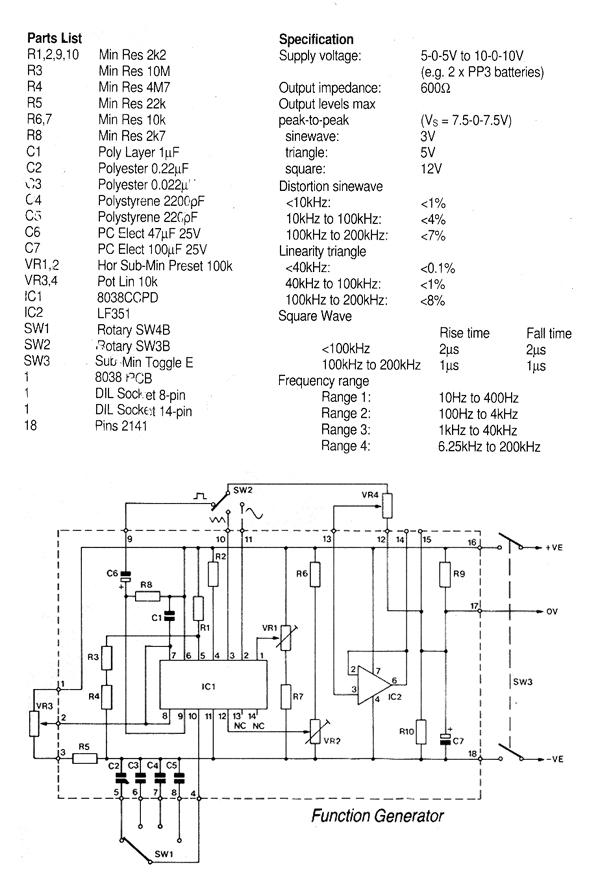
oscillator circuits
This generally results in a square wave if the frequency of oscillation is low enough relative to the amplifier's bandwidth. The schematic of a crystal-controlled oscillator features a low-frequency sine wave oscillator characterized by low distortion, wideband operation, and crystal...
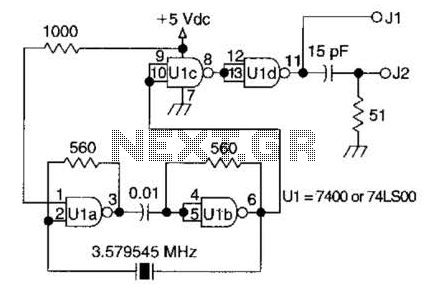
Wide-Range Crystal Oscillator Circuit
A circuit utilizing one 7400 TTL can operate with fundamental type crystals ranging from 1 to approximately 13 MHz. The output is rich in harmonics, making this oscillator suitable for calibration and testing applications.
The circuit in question employs a 7400...