


Varactor - tuned 10MHz ceramic resonator oscillator circuit diagram
#varactor
#ceramic resonator
#10MHz
#field effect transistor
#oscillator
#fixed bias
#feedback
#high impedance
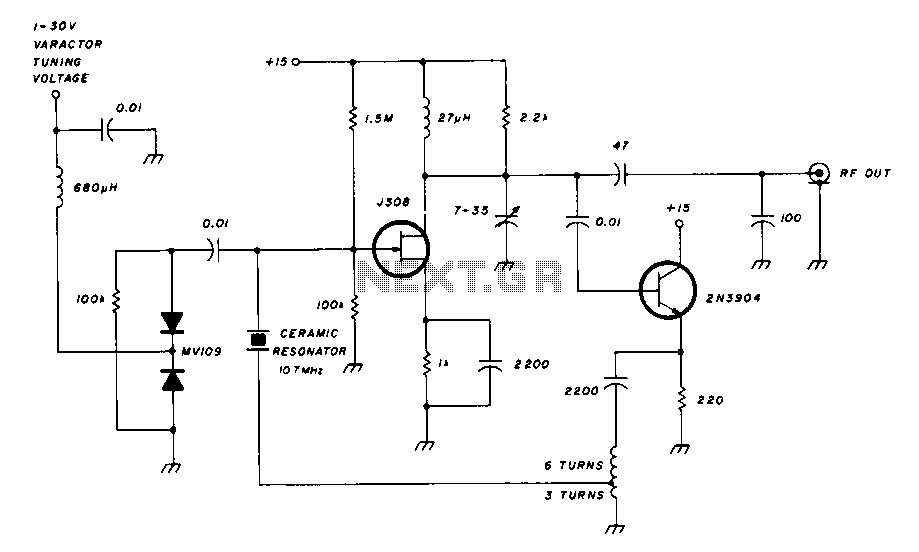
Description: A field effect transistor amplifier features a fixed bias input source with feedback, resulting in very high input impedance and low capacitance. It drives a field effect transistor or emitter follower, despite having a very low output impedance, utilizing a transformer with a 3:1 turns ratio for the supply. It was observed that the impedance of a ceramic resonator is only a few ohms at its lowest.
The field effect transistor (FET) amplifier operates by leveraging the high input impedance characteristics of FETs, which minimizes the loading effect on the preceding circuit stage. The fixed bias configuration ensures stable operation by maintaining a constant gate-source voltage, thus providing reliable amplification. The feedback mechanism employed in this design enhances linearity and bandwidth, further improving performance.
The low capacitance of the amplifier is advantageous in high-frequency applications, as it allows for faster signal response and reduced phase distortion. The output stage, which can be configured as an emitter follower, provides a low output impedance. This characteristic is particularly useful for driving loads directly without significant voltage drop or signal degradation.
To further enhance the amplifier's performance, a transformer with a 3:1 turns ratio is incorporated into the power supply circuit. This transformer step-down configuration reduces the voltage while maintaining adequate current levels, ensuring efficient operation of the FET amplifier. The low output impedance of the amplifier facilitates compatibility with various load types, making it versatile in different applications.
The mention of a ceramic resonator with a low impedance of only a few ohms highlights the importance of impedance matching in circuit design. Proper matching is essential to maximize power transfer and minimize reflections in RF and audio applications. The overall design emphasizes the need for careful consideration of component selection and circuit topology to achieve optimal performance in field effect transistor amplification.Field effect transistor amplifier has fixed bias input source with feedback. Therefore, the input impedance is very high and very low capacitance. Drive a field effect transist or emitter follower, even though the output impedance is very low, and with 3: 1 turns ratio of a transformer for the supply. It found that only a few ohms impedance ceramic resonator lowest.
The field effect transistor (FET) amplifier operates by leveraging the high input impedance characteristics of FETs, which minimizes the loading effect on the preceding circuit stage. The fixed bias configuration ensures stable operation by maintaining a constant gate-source voltage, thus providing reliable amplification. The feedback mechanism employed in this design enhances linearity and bandwidth, further improving performance.
The low capacitance of the amplifier is advantageous in high-frequency applications, as it allows for faster signal response and reduced phase distortion. The output stage, which can be configured as an emitter follower, provides a low output impedance. This characteristic is particularly useful for driving loads directly without significant voltage drop or signal degradation.
To further enhance the amplifier's performance, a transformer with a 3:1 turns ratio is incorporated into the power supply circuit. This transformer step-down configuration reduces the voltage while maintaining adequate current levels, ensuring efficient operation of the FET amplifier. The low output impedance of the amplifier facilitates compatibility with various load types, making it versatile in different applications.
The mention of a ceramic resonator with a low impedance of only a few ohms highlights the importance of impedance matching in circuit design. Proper matching is essential to maximize power transfer and minimize reflections in RF and audio applications. The overall design emphasizes the need for careful consideration of component selection and circuit topology to achieve optimal performance in field effect transistor amplification.Field effect transistor amplifier has fixed bias input source with feedback. Therefore, the input impedance is very high and very low capacitance. Drive a field effect transist or emitter follower, even though the output impedance is very low, and with 3: 1 turns ratio of a transformer for the supply. It found that only a few ohms impedance ceramic resonator lowest.
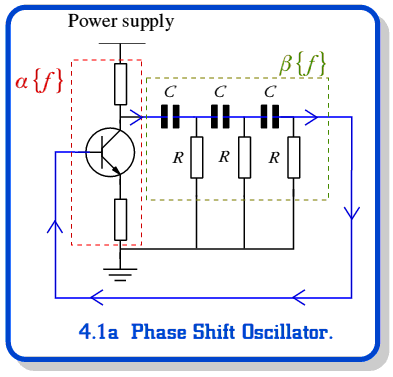
Oscillator Fundamentals
A feedback oscillator employs positive feedback to sustain oscillation. Essentially, an oscillator functions as an amplifier that incorporates feedback.
A feedback oscillator is a critical component in various electronic applications, utilizing the principle of positive feedback to generate continuous waveforms. The...
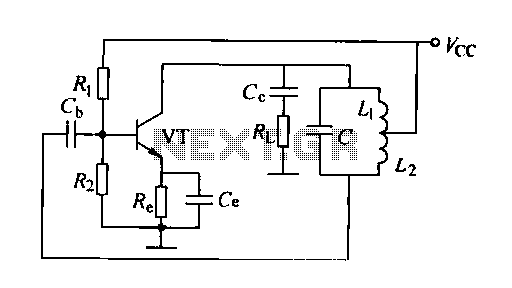
Inductance feedback oscillator circuit
A feedback oscillator circuit utilizing inductance is presented, featuring the 3DG3 transistor. The component parameters reference values include: 1) transistors 3DG6, 2) resistances R1 at 91 kΩ, R2 at 11 kΩ, and R3 unspecified, 3) capacitance values of C at...
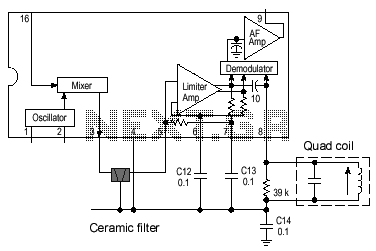
Ceramic resonator oscillator
This receiver is MC3371. Pin 16 is the RF input to the mixer and pin 1 and pin 2 is the local oscillator. The product comes out at pin 3. Imagine you want to receive at 100MHz. The local oscillator...
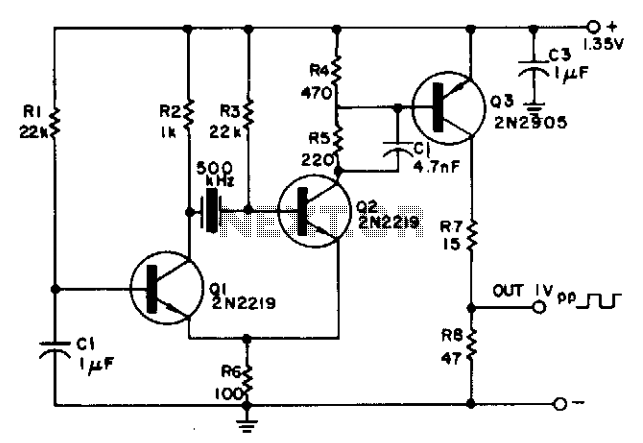
Oscillator operates from one cell
The circuit is powered by a single 1.35 V mercury cell and provides a 1 V square-wave output. The crystal acts as a tuned circuit between transistors Q1 and Q2, which are connected in a common-emitter configuration. Positive feedback is...
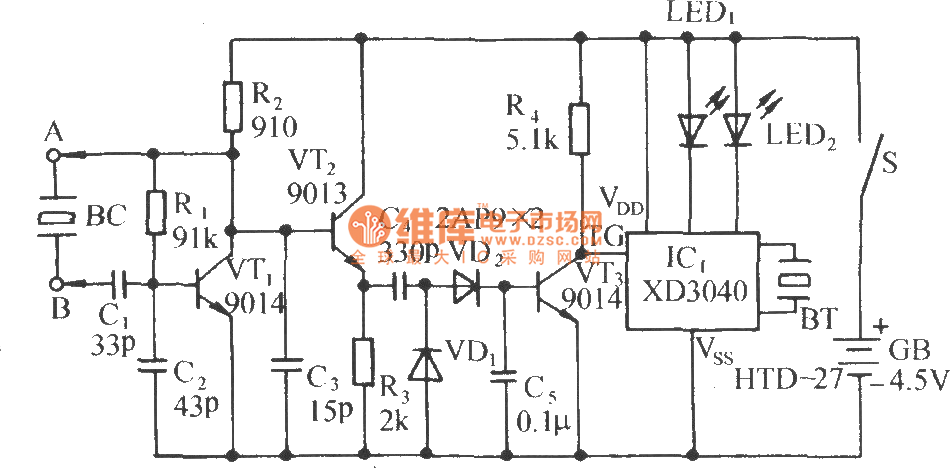
Acousto-optic detector circuit to measure the crystal
The circuit consists of a capacitance three-point oscillator, an isolation level, a voltage doubler rectifier circuit, a stereo sound circuit, and a flash display circuit. It can detect the quality of a crystal; a good crystal will emit a "Didi"...
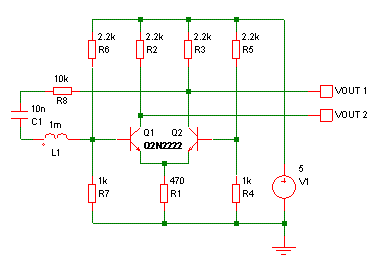
why doesnt this circuit oscillate
The buba oscillator initially failed to oscillate. The first step is to check the fundamental components, as minor errors in the values of capacitors, resistors, and inductors can significantly impact performance. It is advisable to measure component values with a...
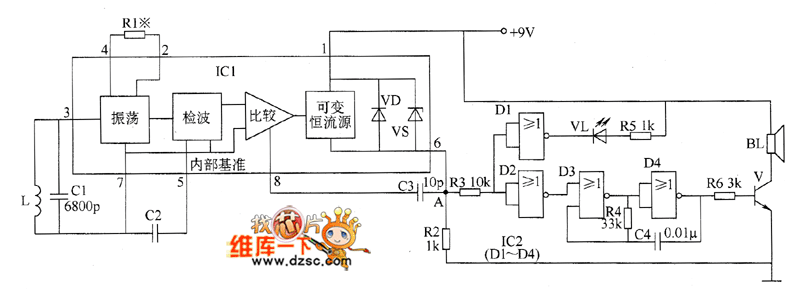
Metal detector circuit diagram 5
The metal detector circuit comprises an oscillator and a sound-light alarm circuit. The oscillator circuit includes an inductor (L), a capacitor (C1), a sensor switch integrated circuit (IC1) that integrates the oscillator, detector, comparator circuit, and peripheral components. The sound-light...
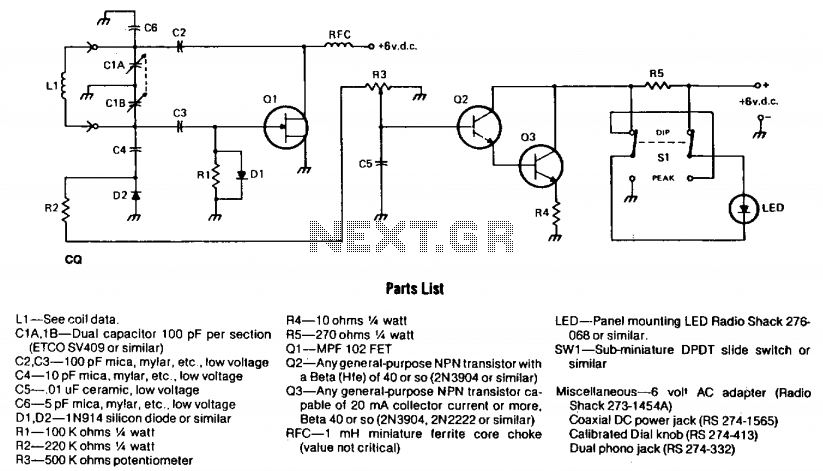
Little dipper
The circuit consists of two fundamental components: the oscillator and the detector. The oscillator employs a Field Effect Transistor (FET) in a Colpitts configuration. The energy circulating within the oscillator's tank is coupled through capacitor C4 to the detector circuit,...
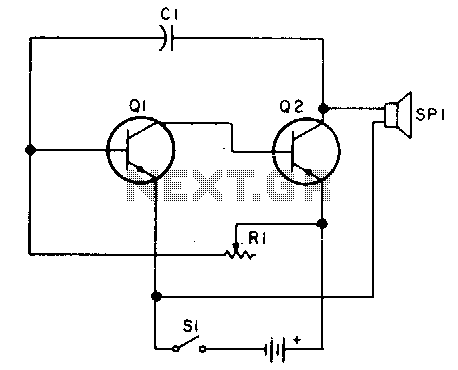
Code practice oscillator II
Oscillator, operates with 2 to 12 volts DC (optimal performance is achieved at 9 to 12 volts for maximum volume and clear keying). Additionally, R1 can be substituted with a 500K potentiometer, allowing the circuit to sweep across the entire...