


Voltage-controlled oscillator
#VCO
#frequency modulation
#voltage control
#FM
#phase modulation
#electronic oscillator
#signal generator
#RF
#analog circuit
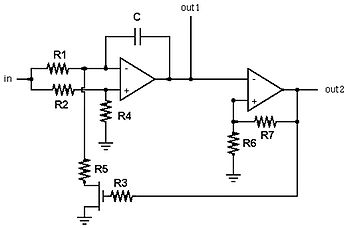
Description: A voltage-controlled oscillator (VCO) is an electronic oscillator designed to control its oscillation frequency through a voltage input. The oscillation frequency is varied by the applied DC voltage, and modulating signals can also be introduced to the VCO for frequency modulation (FM) or phase modulation (PM). A VCO with a digital pulse output may have its repetition rate (FSK, PSK) or pulse width modulated (PWM). Harmonic oscillators produce a sinusoidal waveform and comprise an amplifier that supplies sufficient gain and a resonant circuit that feeds back the signal to the input. Oscillation occurs at the resonant frequency where positive gain is achieved around the loop. Examples of harmonic oscillators include crystal oscillators and LC-tank oscillators. If part of the resonant circuit's capacitance is provided by a varactor diode, the frequency can be varied by the voltage applied to that diode. Relaxation oscillators can generate sawtooth or triangular waveforms and are commonly found in monolithic integrated circuits (ICs). These oscillators can deliver a wide range of operational frequencies with minimal external components. Relaxation oscillator VCOs can take on three topologies: 1) grounded-capacitor VCOs, 2) emitter-coupled VCOs, and 3) delay-based ring VCOs. The first two types operate similarly, where the duration in each state depends on the time required for a current to charge or discharge a capacitor. The delay-based ring VCO operates differently; in this configuration, the gain stages are arranged in a ring, and the output frequency depends on the delay in each stage. A disadvantage of harmonic oscillator VCOs is their limited implementation in monolithic ICs, whereas relaxation oscillator VCOs are more suitable for this technology and offer broader tunability over frequencies. For high-frequency VCOs, a varicap diode is typically used as the voltage-controlled element in an LC tank circuit. In contrast, low-frequency VCOs may employ other methods to vary frequency, such as adjusting the charging rate of a capacitor via a voltage-controlled current source. A voltage-controlled crystal oscillator (VCXO) is utilized when precise frequency adjustments are necessary, typically varying by only a few tens of parts per million (ppm) due to the high Q factor of crystals, which limits the range of frequency "pulling." To reduce radio-frequency interference generated by the oscillator, varying voltage can be applied to its control input, thus dispersing the interference spectrum. A temperature-compensated VCXO (TCVCXO) includes components that partially correct the crystal's frequency dependence on temperature, allowing for stabilization in applications where temperature fluctuations occur, such as heat buildup in transmitters. Key design factors for a VCO include tuning range, tuning gain, and phase noise, with low phase noise being generally preferred. The phase noise is influenced by the transistor's flicker noise corner frequency, the loaded Q of the resonator, and the final signal-to-noise ratio. The most commonly used VCO circuits are the Clapp and Colpitts oscillators, with the Colpitts oscillator being the more widely utilized due to its similar configuration. A clock generator is a type of oscillator that provides a timing signal to synchronize operations.
A voltage-controlled oscillator (VCO) is an essential component in various electronic applications, including communication systems, signal processing, and frequency synthesis. Its ability to adjust frequency based on a voltage input allows for dynamic control in circuits requiring precise timing and modulation. The architecture of a VCO can be broadly classified into harmonic and relaxation types, each with distinct operational characteristics.
Harmonic oscillators, such as crystal and LC-tank oscillators, leverage feedback mechanisms to maintain oscillation at a resonant frequency. The feedback loop's gain must exceed unity to sustain oscillation, and the resonant circuit's quality factor (Q) plays a critical role in determining the oscillator's frequency stability and phase noise performance. The integration of varactor diodes into these circuits enables voltage-dependent capacitance, facilitating frequency tuning.
On the other hand, relaxation oscillators are favored in integrated circuit implementations due to their simplicity and ability to generate non-sinusoidal waveforms like triangular and sawtooth shapes. Their design typically involves a charging and discharging capacitor, where the time constant dictates the oscillation period. The delay-based ring VCO topology, characterized by its circular arrangement of gain stages, offers unique advantages in terms of compactness and frequency scalability, making it suitable for high-speed applications.
Voltage-controlled crystal oscillators (VCXOs) and temperature-compensated VCXOs (TCVCXOs) are specialized variants that address specific frequency stability requirements. The precision of a VCXO is limited by the crystal's high Q factor, which restricts the frequency adjustment range to a few ppm. TCVCXOs enhance frequency stability across varying temperatures, making them ideal for applications sensitive to thermal variations.
In conclusion, the design and selection of a VCO are influenced by factors such as phase noise, tuning range, and operational frequency requirements. The choice between harmonic and relaxation oscillator configurations will depend on the specific application demands, including integration feasibility and frequency modulation capabilities.A voltage-controlled oscillator or VCO is an electronic oscillator designed to be controlled in oscillation frequency by a voltage input. The frequency of oscillation is varied by the applied DC voltage, while modulating signals may also be fed into the VCO to cause frequency modulation (FM) or phase modulation (PM); a VCO with digital pulse
output may similarly have its repetition rate (FSK, PSK) or pulse width modulated (PWM). Harmonic oscillators generate a sinusoidal waveform. They consist of an amplifier that provides adequate gain and a resonant circuit that feeds back signal to the input. Oscillation occurs at the resonant frequency where a positive gain arises around the loop. Some examples of harmonic oscillators are crystal oscillators and LC-tank oscillators. When part of the resonant circuit`s capacitance is provided by a varactor diode, the voltage applied to that diode varies the frequency.
Relaxation oscillators can generate a sawtooth or triangular waveform. They are commonly used in monolithic integrated circuits (ICs). They can provide a wide range of operational frequencies with a minimal number of external components. Relaxation oscillator VCOs can have three topologies: 1) grounded-capacitor VCOs, 2) emitter-coupled VCOs, and 3) delay-based ring VCOs.
The first two of these types operate similarly. The amount of time in each state depends on the time for a current to charge or discharge a capacitor. The delay-based ring VCO operates somewhat differently however. For this type, the gain stages are connected in a ring. The output frequency is then a function of the delay in each of stages. A disadvantage of harmonic oscillator VCOs is that they cannot be easily implemented in monolithic ICs.
Relaxation oscillator VCOs are better suited for this technology. Relaxation VCOs are also tunable over a wider range of frequencies. For high-frequency VCOs the voltage-controlled element is commonly a varicap diode connected as part of an LC tank circuit. For low-frequency VCOs, other methods of varying the frequency (such as altering the charging rate of a capacitor by means of a voltage controlled current source ) are used.
See Function generator. A voltage-controlled crystal oscillator (VCXO) is used when the frequency of operation needs to be adjusted only finely. The frequency of a voltage-controlled crystal oscillator can be varied only by typically a few tens of parts per million (ppm), because the high Q factor of the crystals allows "pulling" over only a small range of frequencies.
Where the oscillator drives equipment that may generate radio-frequency interference, adding a varying voltage to its control input can disperse the interference spectrum to make it less objectionable. See spread-spectrum clock generation. A temperature-compensated VCXO (TCVCXO) incorporates components that partially correct the dependence on temperature of the resonant frequency of the crystal.
A smaller range of voltage control then suffices to stabilize the oscillator frequency in applications where temperature varies, such as heat buildup inside a transmitter. Tuning range, tuning gain and phase noise are the most important factors of the basic design of a VCO.
Generally low phase noise is preferred in the VCO. The important elements that determine the phase noise of an oscillator are the transistor`s flicker noise corner frequency, the loaded Q of the resonator and the final signal to noise ratio. Most commonly used VCO circuits are the Clapp and Colpitts oscillators. The more widely used oscillator of the two is Colpitts and these oscillators are very similar in configuration.
A clock generator is an oscillator that provides a timing signal to synchronize operations
A voltage-controlled oscillator (VCO) is an essential component in various electronic applications, including communication systems, signal processing, and frequency synthesis. Its ability to adjust frequency based on a voltage input allows for dynamic control in circuits requiring precise timing and modulation. The architecture of a VCO can be broadly classified into harmonic and relaxation types, each with distinct operational characteristics.
Harmonic oscillators, such as crystal and LC-tank oscillators, leverage feedback mechanisms to maintain oscillation at a resonant frequency. The feedback loop's gain must exceed unity to sustain oscillation, and the resonant circuit's quality factor (Q) plays a critical role in determining the oscillator's frequency stability and phase noise performance. The integration of varactor diodes into these circuits enables voltage-dependent capacitance, facilitating frequency tuning.
On the other hand, relaxation oscillators are favored in integrated circuit implementations due to their simplicity and ability to generate non-sinusoidal waveforms like triangular and sawtooth shapes. Their design typically involves a charging and discharging capacitor, where the time constant dictates the oscillation period. The delay-based ring VCO topology, characterized by its circular arrangement of gain stages, offers unique advantages in terms of compactness and frequency scalability, making it suitable for high-speed applications.
Voltage-controlled crystal oscillators (VCXOs) and temperature-compensated VCXOs (TCVCXOs) are specialized variants that address specific frequency stability requirements. The precision of a VCXO is limited by the crystal's high Q factor, which restricts the frequency adjustment range to a few ppm. TCVCXOs enhance frequency stability across varying temperatures, making them ideal for applications sensitive to thermal variations.
In conclusion, the design and selection of a VCO are influenced by factors such as phase noise, tuning range, and operational frequency requirements. The choice between harmonic and relaxation oscillator configurations will depend on the specific application demands, including integration feasibility and frequency modulation capabilities.A voltage-controlled oscillator or VCO is an electronic oscillator designed to be controlled in oscillation frequency by a voltage input. The frequency of oscillation is varied by the applied DC voltage, while modulating signals may also be fed into the VCO to cause frequency modulation (FM) or phase modulation (PM); a VCO with digital pulse
output may similarly have its repetition rate (FSK, PSK) or pulse width modulated (PWM). Harmonic oscillators generate a sinusoidal waveform. They consist of an amplifier that provides adequate gain and a resonant circuit that feeds back signal to the input. Oscillation occurs at the resonant frequency where a positive gain arises around the loop. Some examples of harmonic oscillators are crystal oscillators and LC-tank oscillators. When part of the resonant circuit`s capacitance is provided by a varactor diode, the voltage applied to that diode varies the frequency.
Relaxation oscillators can generate a sawtooth or triangular waveform. They are commonly used in monolithic integrated circuits (ICs). They can provide a wide range of operational frequencies with a minimal number of external components. Relaxation oscillator VCOs can have three topologies: 1) grounded-capacitor VCOs, 2) emitter-coupled VCOs, and 3) delay-based ring VCOs.
The first two of these types operate similarly. The amount of time in each state depends on the time for a current to charge or discharge a capacitor. The delay-based ring VCO operates somewhat differently however. For this type, the gain stages are connected in a ring. The output frequency is then a function of the delay in each of stages. A disadvantage of harmonic oscillator VCOs is that they cannot be easily implemented in monolithic ICs.
Relaxation oscillator VCOs are better suited for this technology. Relaxation VCOs are also tunable over a wider range of frequencies. For high-frequency VCOs the voltage-controlled element is commonly a varicap diode connected as part of an LC tank circuit. For low-frequency VCOs, other methods of varying the frequency (such as altering the charging rate of a capacitor by means of a voltage controlled current source ) are used.
See Function generator. A voltage-controlled crystal oscillator (VCXO) is used when the frequency of operation needs to be adjusted only finely. The frequency of a voltage-controlled crystal oscillator can be varied only by typically a few tens of parts per million (ppm), because the high Q factor of the crystals allows "pulling" over only a small range of frequencies.
Where the oscillator drives equipment that may generate radio-frequency interference, adding a varying voltage to its control input can disperse the interference spectrum to make it less objectionable. See spread-spectrum clock generation. A temperature-compensated VCXO (TCVCXO) incorporates components that partially correct the dependence on temperature of the resonant frequency of the crystal.
A smaller range of voltage control then suffices to stabilize the oscillator frequency in applications where temperature varies, such as heat buildup inside a transmitter. Tuning range, tuning gain and phase noise are the most important factors of the basic design of a VCO.
Generally low phase noise is preferred in the VCO. The important elements that determine the phase noise of an oscillator are the transistor`s flicker noise corner frequency, the loaded Q of the resonator and the final signal to noise ratio. Most commonly used VCO circuits are the Clapp and Colpitts oscillators. The more widely used oscillator of the two is Colpitts and these oscillators are very similar in configuration.
A clock generator is an oscillator that provides a timing signal to synchronize operations
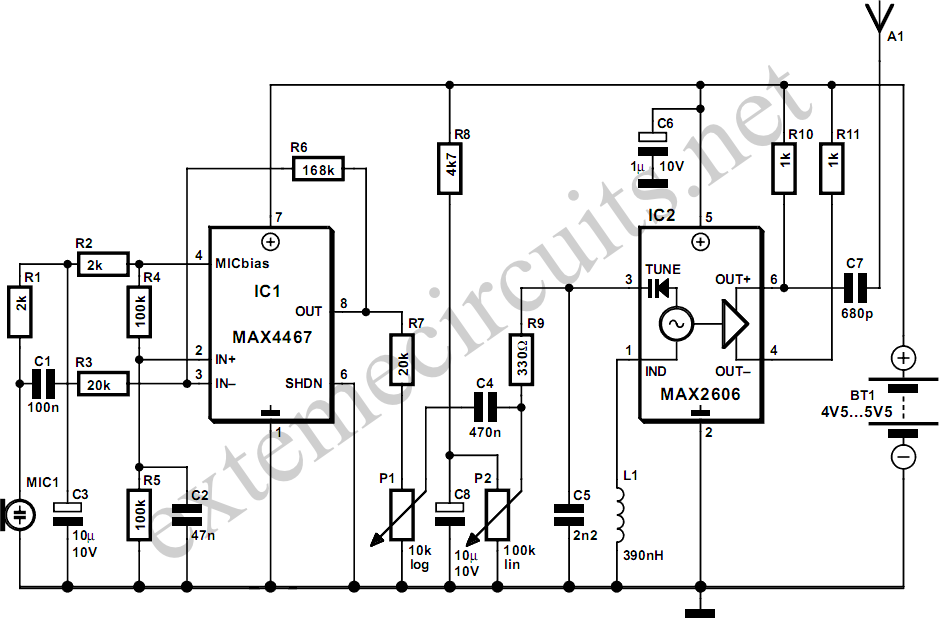
FM Wireless Microphone
This project is a simple, inexpensive, and engaging circuit designed for home experimenters or hobbyists. It functions as a basic transmitter capable of transmitting speech over a short distance, effectively serving as a cordless microphone. The circuit employs two integrated...
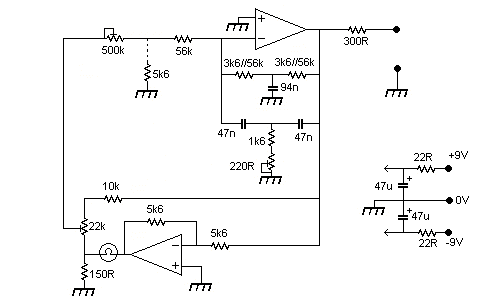
Signal Generator circuit
The output level was set to 3.8V peak to peak. The initial objective was to compare several different operational amplifiers (op-amps) before further optimizing the circuit. The op-amps evaluated were the TL072, LM4562, and OPA2134. The distortion spectra are presented...
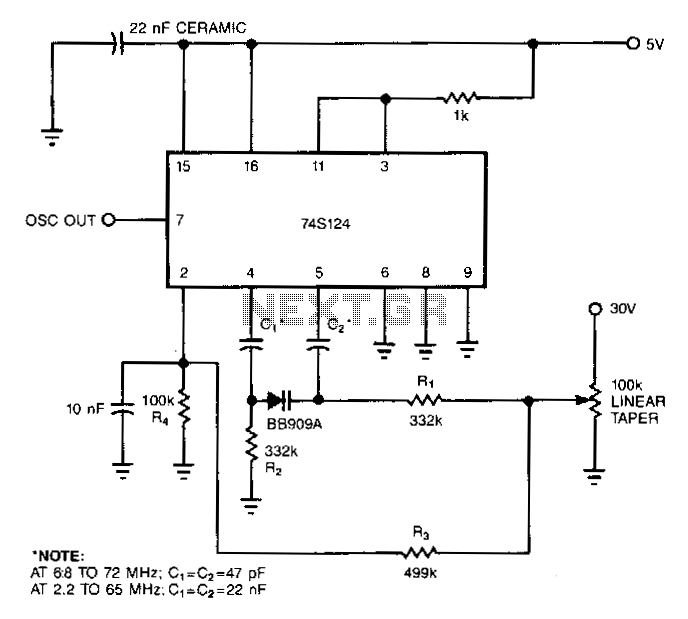
Variable-capacitance-diode-sparked-vco
A 7415124 multivibrator can be converted into a wideband voltage-controlled oscillator (VCO) by substituting the conventional fixed capacitor with a variable-capacitance diode. The primary drawback of this configuration is the 30-V biasing voltage required by the diode. Capacitors C1 and...
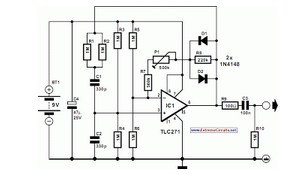
Mini Audio Signal Generator
A small audio test generator is very useful for quickly tracing a signal through an audio unit. Its main purpose is speed rather than refinement.
An audio test generator is an essential tool in the field of audio engineering, primarily...
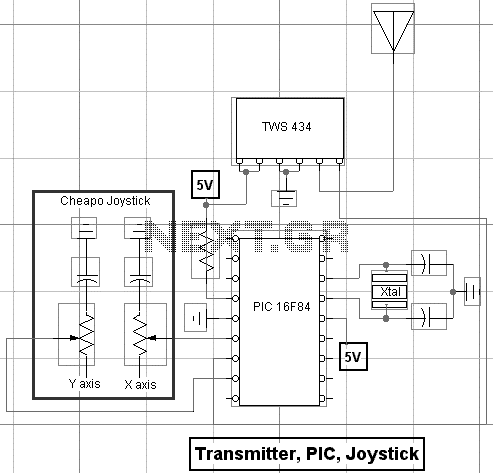
Building an RF Remote Control System For Robotics Control
With a handful of inexpensive components, a little creativity, and the power of PicBasic, you can build some pretty outstanding robotics creations as Rob Arnold proves with his Ruf-Bot project. RF remote control is just way too cool not to...
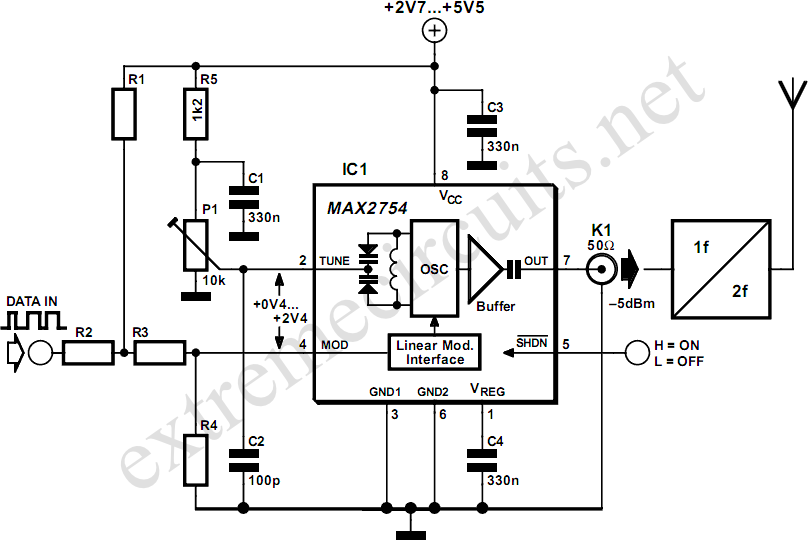
1.2GHz VCO With Linear Modulation circuit using MAX2754
High-frequency voltage-controlled oscillators (VCOs) are challenging to construct, which is why Maxim has developed the integrated 1.2 GHz oscillator, the MAX2754. The center frequency is adjustable via the TUNE input, while a linear modulation input allows for frequency modulation. This...
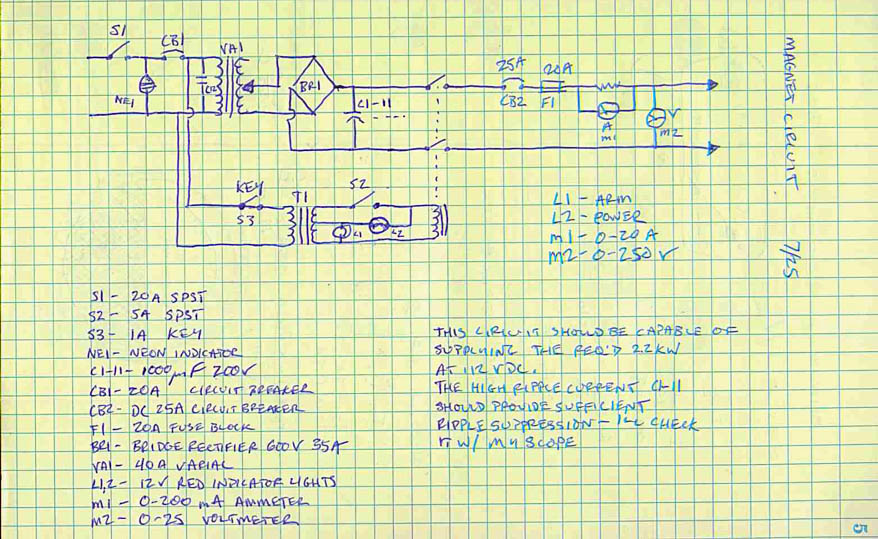
Cyclotron II
The white feedthroughs are for connecting the RF high voltage to the D's (not shown). The copper pipe perpendicular to the main pipe serves as the vacuum line. The D's are equipped with screw posts on the side for connecting...
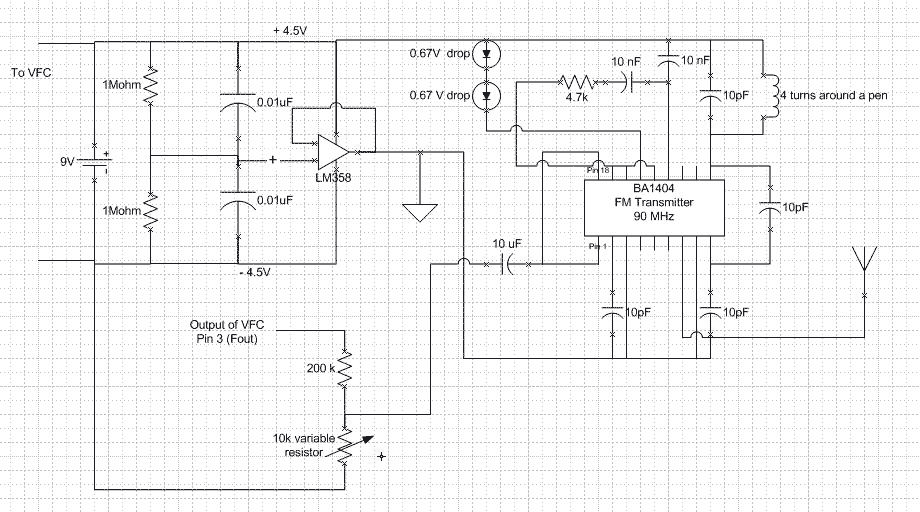
FM Electrocardiogram Monitor with LM331/LM231
V_logic is connected to the power supply Vs and all ground are connected to the negative terminal of the battery. Fout is a square wave of varying frequency with a maximum amplitude of Vs. A voltage divider is needed (200k...
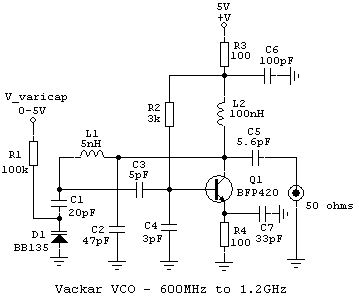
High Frequency VCO Design
This note will review the process by which Voltage Controlled Oscillator (VCO) designers select their oscillator's topology and devices based on performance requirements, component types, and DC power requirements. Basic oscillator design specifications typically necessitate a specific output power into...