


4 Amps Universal PSU
#universal power supply
#L200 regulator
#pass transistor
#4 amps
#voltage regulator
#high current
#DC power supply
#electronic components
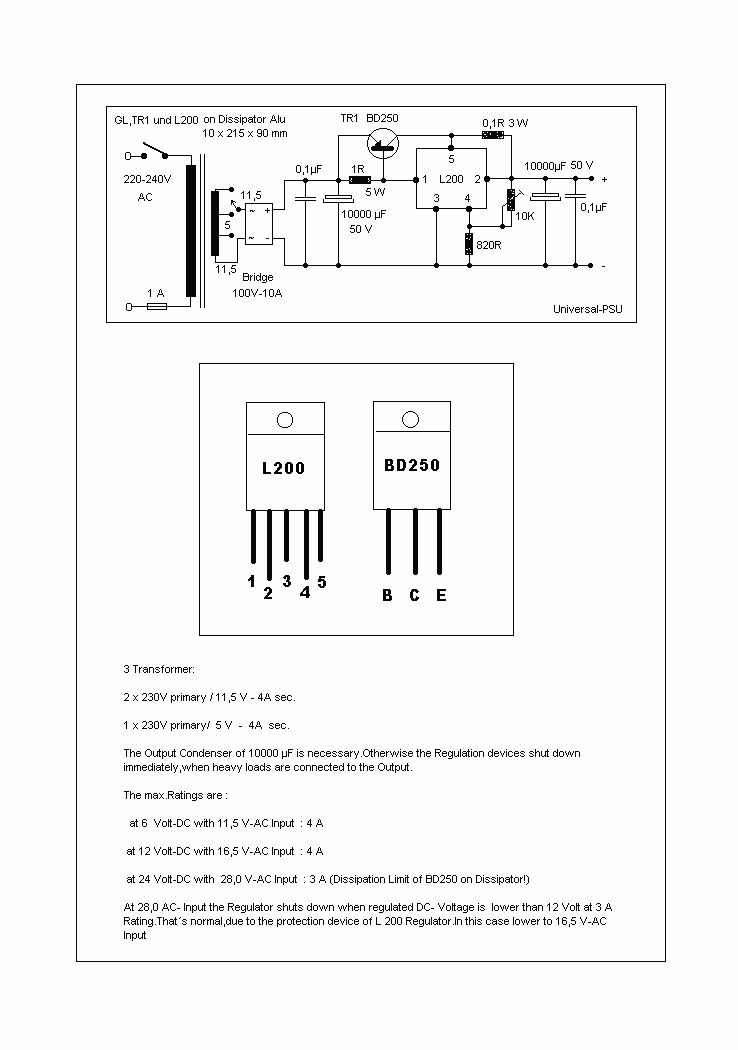
Description: A Universal Power supply based on the L200 regulator, which includes an outboard pass transistor to boost output currents up to 4 amps.
The described universal power supply utilizes the L200 voltage regulator, renowned for its versatility in providing adjustable output voltages. The L200 can deliver regulated output voltages ranging from 3V to 32V, depending on the external components used in the circuit. This regulator is particularly useful in applications requiring a stable voltage source with variable output capabilities.
In this configuration, an outboard pass transistor is employed to enhance the current output capability of the power supply. This transistor operates in conjunction with the L200 regulator, allowing the overall circuit to supply up to 4 amps of output current. The use of a pass transistor is critical in applications where higher current is needed beyond the native capabilities of the L200, which typically supports a maximum output current of around 1.5A.
The schematic of the power supply includes several key components:
1. **Input Capacitor**: A large electrolytic capacitor is connected at the input to filter any high-frequency noise and stabilize the input voltage.
2. **L200 Voltage Regulator**: This integrated circuit is the heart of the power supply, providing the necessary regulation. It requires a few external resistors to set the desired output voltage level.
3. **Pass Transistor**: A suitable NPN transistor (such as a TIP3055 or similar) is connected in such a way that it can handle the additional load current. The base of the transistor is connected to the output of the L200, allowing it to turn on and off based on the load requirements.
4. **Output Capacitor**: A capacitor is placed at the output to further smooth out the voltage and improve transient response.
5. **Protection Diodes**: Diodes may be included to protect against reverse polarity and to prevent damage from inductive loads.
Additionally, the circuit may feature a thermal shutdown mechanism to prevent overheating, especially when operating at maximum current. A heat sink is typically attached to the pass transistor to dissipate heat generated during operation.
This universal power supply design is suitable for various applications, including powering analog circuits, microcontrollers, and other electronic devices requiring a stable and adjustable power source. Proper layout and component selection are essential to ensure reliable performance and efficiency of the power supply.A Universal Power supply based on the L200 regulator, which includes an outboard pass transistor to boost output currents up to 4 amps.
The described universal power supply utilizes the L200 voltage regulator, renowned for its versatility in providing adjustable output voltages. The L200 can deliver regulated output voltages ranging from 3V to 32V, depending on the external components used in the circuit. This regulator is particularly useful in applications requiring a stable voltage source with variable output capabilities.
In this configuration, an outboard pass transistor is employed to enhance the current output capability of the power supply. This transistor operates in conjunction with the L200 regulator, allowing the overall circuit to supply up to 4 amps of output current. The use of a pass transistor is critical in applications where higher current is needed beyond the native capabilities of the L200, which typically supports a maximum output current of around 1.5A.
The schematic of the power supply includes several key components:
1. **Input Capacitor**: A large electrolytic capacitor is connected at the input to filter any high-frequency noise and stabilize the input voltage.
2. **L200 Voltage Regulator**: This integrated circuit is the heart of the power supply, providing the necessary regulation. It requires a few external resistors to set the desired output voltage level.
3. **Pass Transistor**: A suitable NPN transistor (such as a TIP3055 or similar) is connected in such a way that it can handle the additional load current. The base of the transistor is connected to the output of the L200, allowing it to turn on and off based on the load requirements.
4. **Output Capacitor**: A capacitor is placed at the output to further smooth out the voltage and improve transient response.
5. **Protection Diodes**: Diodes may be included to protect against reverse polarity and to prevent damage from inductive loads.
Additionally, the circuit may feature a thermal shutdown mechanism to prevent overheating, especially when operating at maximum current. A heat sink is typically attached to the pass transistor to dissipate heat generated during operation.
This universal power supply design is suitable for various applications, including powering analog circuits, microcontrollers, and other electronic devices requiring a stable and adjustable power source. Proper layout and component selection are essential to ensure reliable performance and efficiency of the power supply.A Universal Power supply based on the L200 regulator, which includes an outboard pass transistor to boost output currents up to 4 amps.
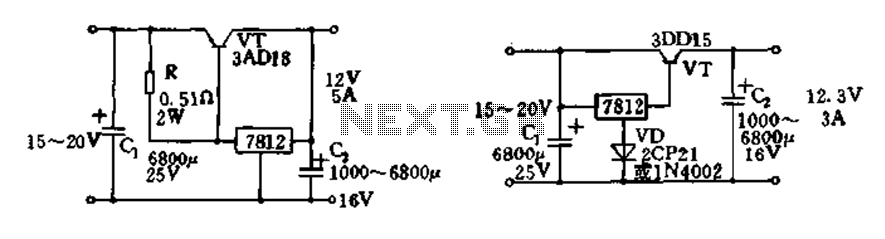
Expand integrated three-terminal regulator block circuit output current method
Expand integrated three-terminal regulator block circuit output current method
The integrated three-terminal regulator is a versatile component commonly used in power supply circuits to provide a stable output voltage. This regulator typically consists of three terminals: input, output, and ground. The...
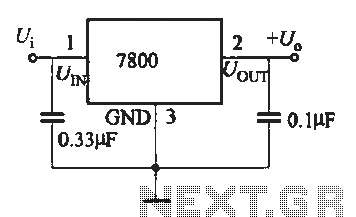
Three-terminal voltage regulator integrated fixed a typical wiring circuit
A fixed three-terminal integrated voltage regulator can be directly employed in various electronic devices as a voltage regulator. It features internal protections such as overcurrent protection, thermal protection, and safe operating area protection, making the circuit easy to use, safe,...
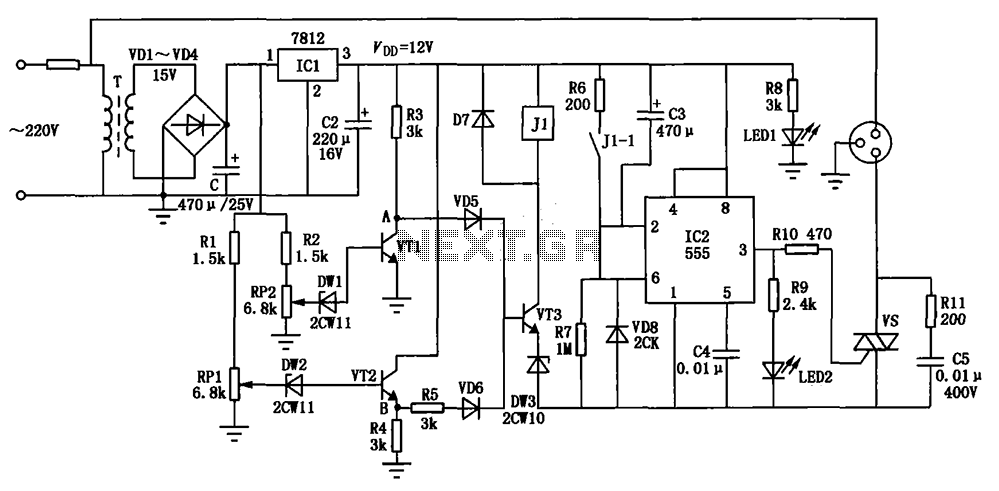
Multifunction appliance protection circuit diagram
The circuit consists of a DC voltage regulator, a delay circuit, and protection mechanisms for overvoltage and undervoltage. It utilizes the LM7812 integrated voltage regulator to provide a stable 12V output. The protection circuit samples voltage using R2 and potentiometer...
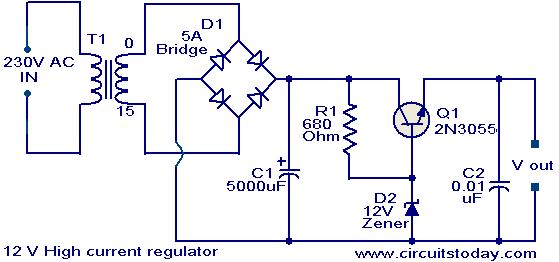
12 V High current regulator
This voltage regulator circuit can deliver up to 3A at a 12V output voltage. The circuit can be used when a current exceeding 3A is required for regulation. Integrated circuit (IC) regulators with such high current ratings are relatively difficult...
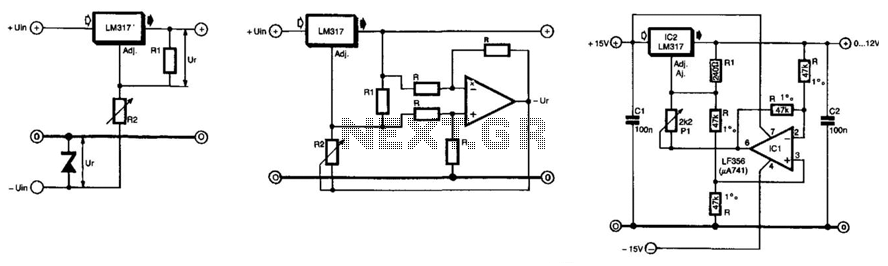
Regulator Circuit
The unique feature of this regulator is that the output voltage can be adjusted down to 0 V. The regulation is provided by an integrated regulator type LM317. Typically, in supplies that can be adjusted to 0 V, this IC...
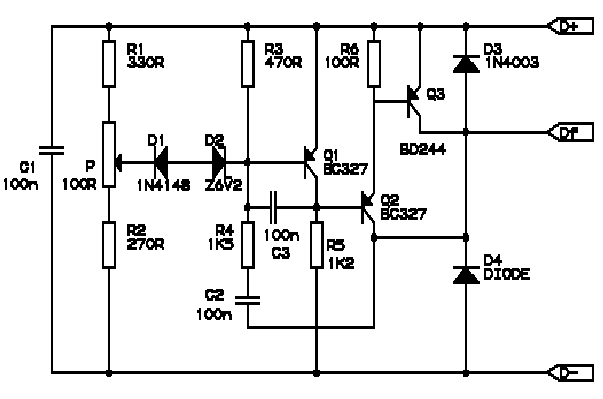
BMW R Series Motorcycle Regulator Schematic
Correctly adjusted, the voltage on the pot wiper is slightly less than half D+ (appx. 0.47*D+) and Q1 will conduct if (D+)-(Vp) > 6.2 + 0.7 + 0.7, or 0.53*(D+) > 7.6V, (D+) > 14.3V. If D+ is lower than...
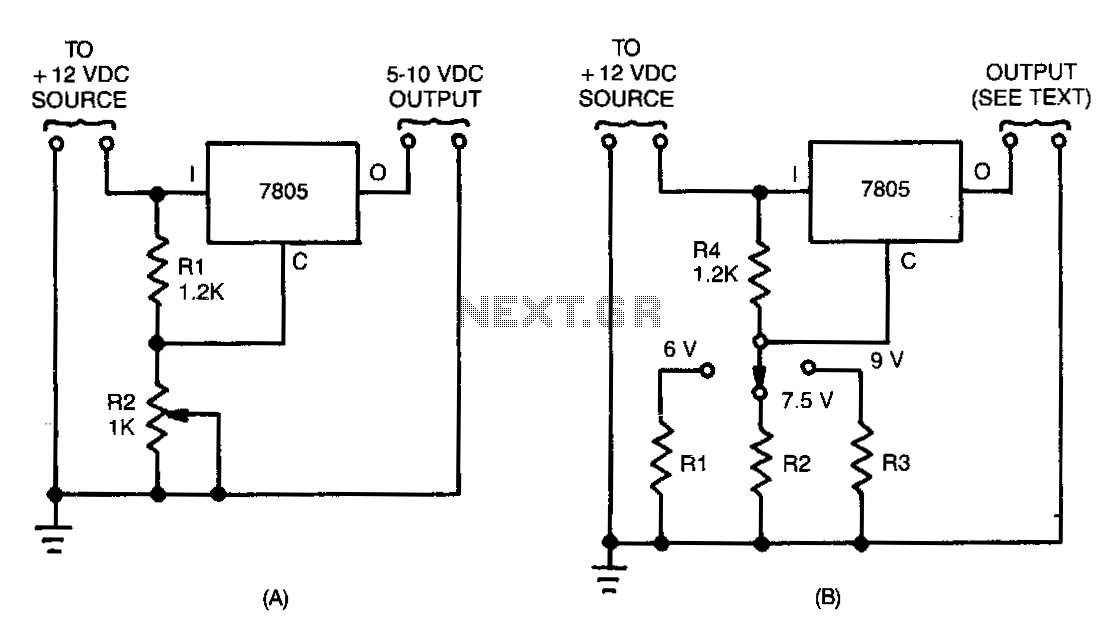
12-16V-converter
Many devices operate from a car's 12-V electrical system. Some require 12 V, while others need a lower voltage. An automobile battery's output can vary from 12 to 13.8 V under normal circumstances. The load requirements of the device may...
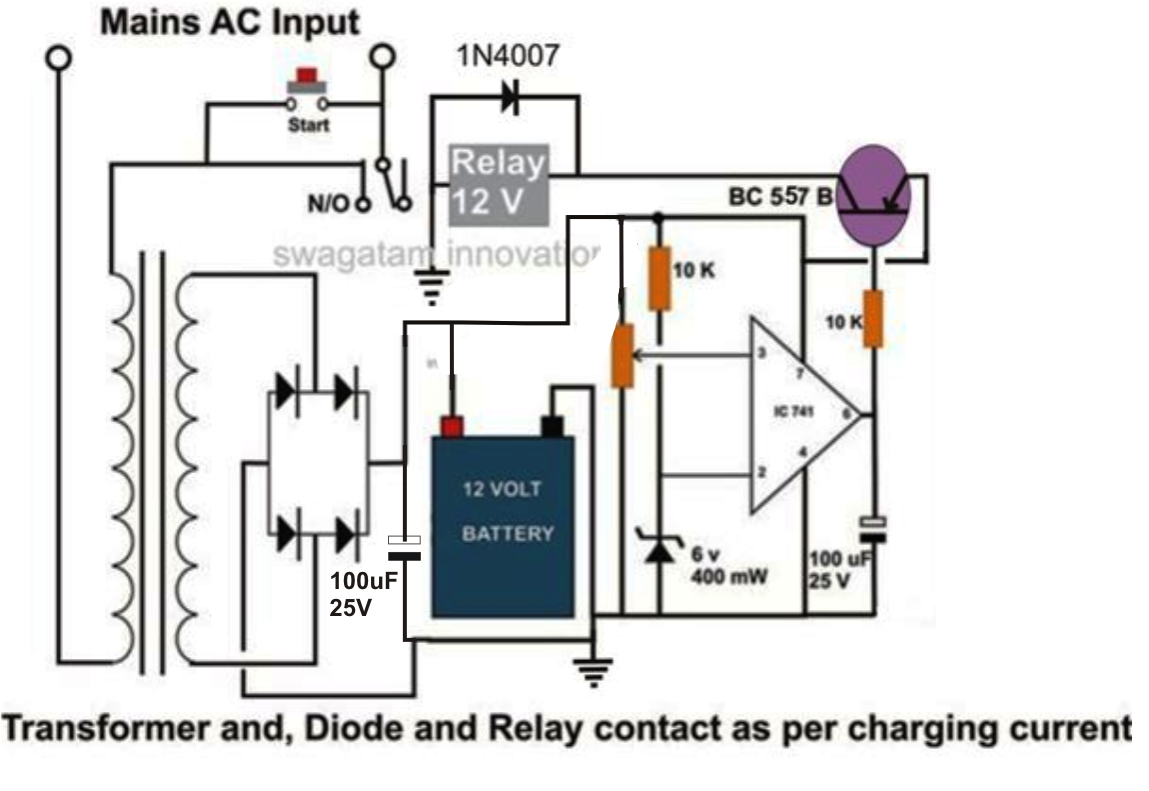
high current 10 to 20 amp automatic
This design is intended for charging high-capacity lead-acid batteries in the range of 100 to 200 Ah. The system operates automatically, disconnecting power from both the battery and itself once the battery is fully charged. For simplicity, a filter capacitor...
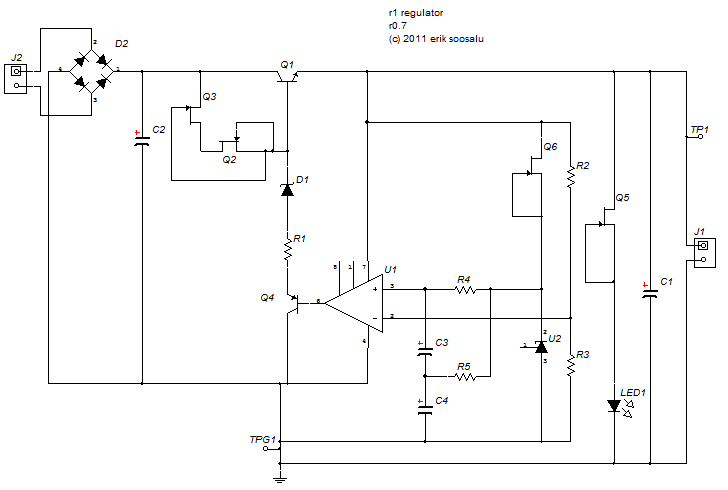
A TREAD sized regulator
The size of the tread was 5 cm by 3 cm. The current design measures 5 cm by 3.3 cm. The regulator's foundation is based on Walt Jung's 1997 article, "Regulator Excels in Noise and Line Rejection," with modifications derived...