


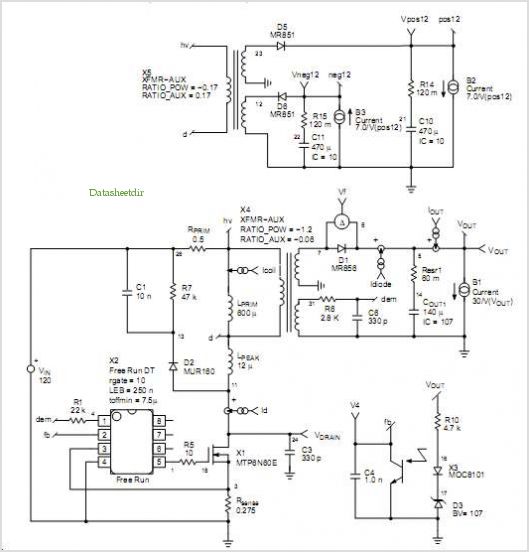
A 75 W Tv Power Supply Operating In Quasi-square Wave Resonant Mode Using Ncp1207 Controller
#TV power supply
#NCP1207
#quasi-square wave
#resonant mode
#75W
#switching power supply
#controller
#electronics
#circuit design
#application note
Description: This application note demonstrates a simple 8-direction digital compass application utilizing Zilog's Z8 Encore!® MCU and an external compass sensor hardware. Communication ports are provided for the digital compass to receive commands and send status via the I2C bus as well as UART to and from an external host. Based on the commands received, the digital compass toggles an output that generates an interrupt for a specific direction. This application note includes the schematics and software necessary to implement the digital compass application. Additionally, it offers host-side Application Programming Interfaces (APIs) for communication with the Z8 Encore! MCU-based digital compass. The host can be any processor equipped with UART and/or I2C peripherals; however, the APIs are specifically designed for use with the Z8 Encore! MCU as an external host.
The digital compass application described employs the Zilog Z8 Encore!® microcontroller, which serves as the core processing unit. The Z8 Encore!® is characterized by its low power consumption and efficient processing capabilities, making it suitable for portable applications. The external compass sensor, likely based on MEMS technology, provides accurate directional data, which is essential for navigation applications.
The communication between the digital compass and the external host is facilitated through two primary interfaces: I2C and UART. The I2C bus is a multi-master, multi-slave, packet-switched, single-ended, serial communication bus that enables multiple devices to communicate with the microcontroller. This bus is particularly advantageous for connecting multiple sensors or peripherals in a compact system. The UART, on the other hand, is a simpler, point-to-point communication protocol that allows for straightforward serial data transmission.
The application note specifies that upon receiving specific commands from the host, the digital compass can toggle outputs to signal interrupts, thereby allowing the host to react to changes in direction. This feature is critical for applications that require real-time responsiveness, such as robotics or mobile devices.
The provided schematics illustrate the connections between the Z8 Encore!® MCU, the external compass sensor, and the communication interfaces. The software implementation is designed to handle commands efficiently and manage data transmission over both I2C and UART. The APIs facilitate interaction with the digital compass, allowing developers to integrate the compass functionality into their applications seamlessly.
In summary, this application note serves as a comprehensive guide for developers looking to implement an 8-direction digital compass using the Zilog Z8 Encore!® MCU, providing both the hardware schematics and the necessary software tools to achieve effective communication and operation.This Application Note demonstrates a simple 8-direction digital compass application using Zilog`s Z8 Encore! ® MCU and an external sensor- compass hardware. Communication ports are pro- vided for the digital compass to receive commands and send status on the I 2 C bus as well as the UART from/to an external host.
According to the command received , the digital compass toggles an output that generates an interrupt for a specific direction. This Application Note provides the schematics and software to implement the Digital Compass appli- cation. It also provides host-side Application Pro- gramming Interface (APIs) to communicate with the Z8 Encore!
MCU-based digital compass. The host CAN be any processor with UART and/or I 2 C peripherals. However, the APIs are written based on using Z8 Encore! MCU as an external host.
The digital compass application described employs the Zilog Z8 Encore!® microcontroller, which serves as the core processing unit. The Z8 Encore!® is characterized by its low power consumption and efficient processing capabilities, making it suitable for portable applications. The external compass sensor, likely based on MEMS technology, provides accurate directional data, which is essential for navigation applications.
The communication between the digital compass and the external host is facilitated through two primary interfaces: I2C and UART. The I2C bus is a multi-master, multi-slave, packet-switched, single-ended, serial communication bus that enables multiple devices to communicate with the microcontroller. This bus is particularly advantageous for connecting multiple sensors or peripherals in a compact system. The UART, on the other hand, is a simpler, point-to-point communication protocol that allows for straightforward serial data transmission.
The application note specifies that upon receiving specific commands from the host, the digital compass can toggle outputs to signal interrupts, thereby allowing the host to react to changes in direction. This feature is critical for applications that require real-time responsiveness, such as robotics or mobile devices.
The provided schematics illustrate the connections between the Z8 Encore!® MCU, the external compass sensor, and the communication interfaces. The software implementation is designed to handle commands efficiently and manage data transmission over both I2C and UART. The APIs facilitate interaction with the digital compass, allowing developers to integrate the compass functionality into their applications seamlessly.
In summary, this application note serves as a comprehensive guide for developers looking to implement an 8-direction digital compass using the Zilog Z8 Encore!® MCU, providing both the hardware schematics and the necessary software tools to achieve effective communication and operation.This Application Note demonstrates a simple 8-direction digital compass application using Zilog`s Z8 Encore! ® MCU and an external sensor- compass hardware. Communication ports are pro- vided for the digital compass to receive commands and send status on the I 2 C bus as well as the UART from/to an external host.
According to the command received , the digital compass toggles an output that generates an interrupt for a specific direction. This Application Note provides the schematics and software to implement the Digital Compass appli- cation. It also provides host-side Application Pro- gramming Interface (APIs) to communicate with the Z8 Encore!
MCU-based digital compass. The host CAN be any processor with UART and/or I 2 C peripherals. However, the APIs are written based on using Z8 Encore! MCU as an external host.
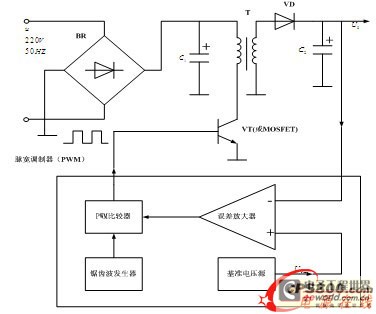
Design and simulation study of anti exciting type switching power supply of single-end
The energy conservation provided by switching power supplies has garnered significant attention due to its substantial economic benefits, leading to rapid adoption across various sectors. With the swift advancement in power technology, high-frequency operation has become a prevailing trend in...
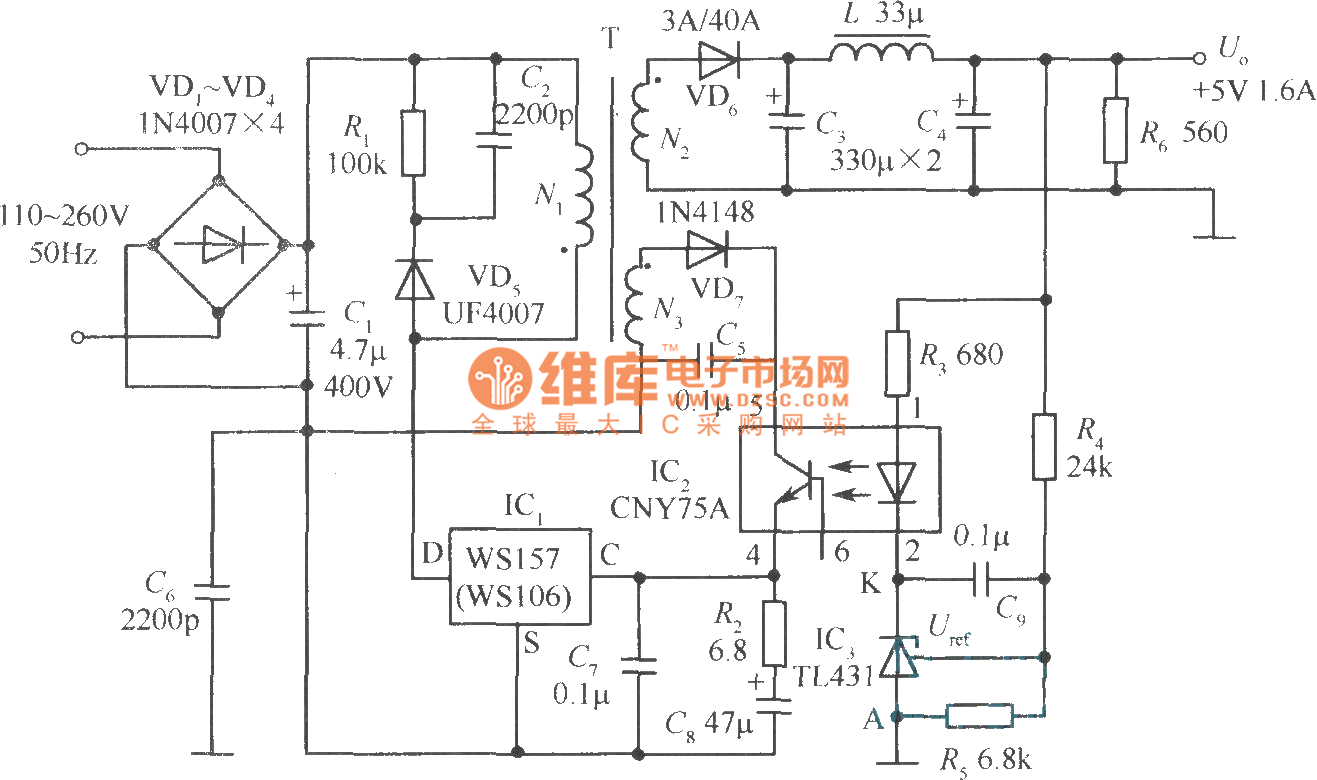
+5V 1.6A precision switching power supply circuit
The +5V, 1.6A precision switching power supply circuit is depicted in the figure. This circuit utilizes a photoelectric coupler (CNY75A) and an adjustable precision parallel regulator (TIA31). R3 serves as the current limiting resistor, while R4 and R5 function as...
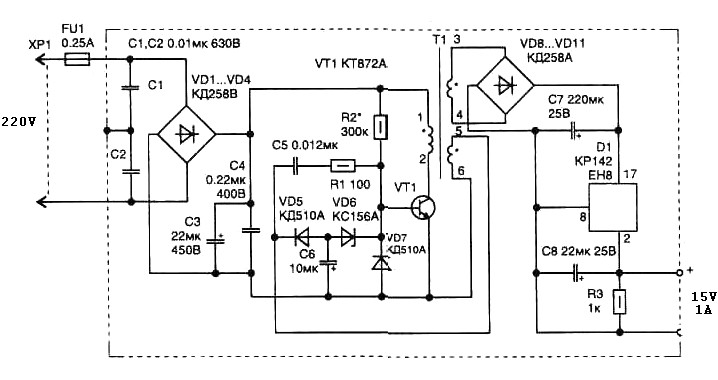
15 Watt switching power supply
A 15 Watt switching power supply schematic diagram features a pulse transformer T1 constructed on a ferrite core M2500NMS-2 or M2000NM9, with a Sh5h5 size (cross-section of the magnetic coils at the location of 5G—5 mm with a gap in...
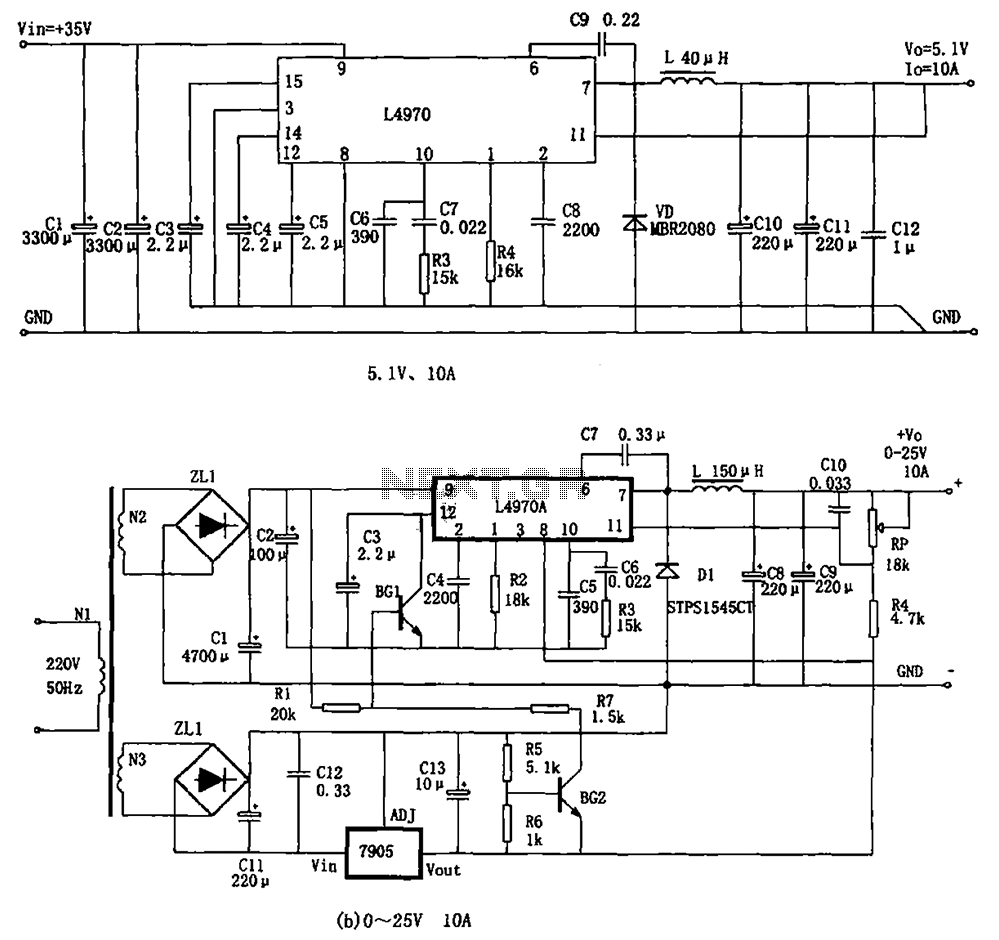
By the high-power switching power supply L4970A
The L4970A power switching supply is a high-power monolithic integrated switching regulator, packaged in a SIP-15 format. It has specific characteristics: (1) The input voltage must be at least 11V, typically ranging from 15V to 40V; (2) The output voltage...
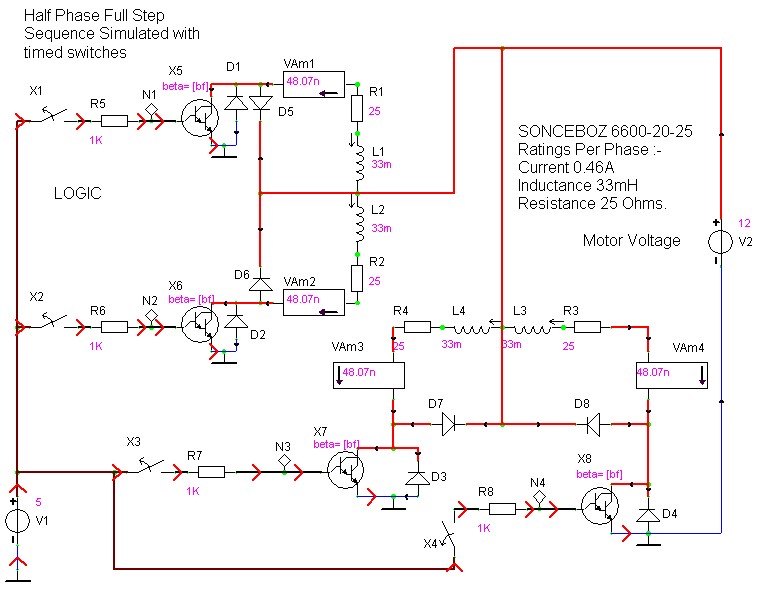
case stepper
Beige Bag Software has been offering affordable and innovative circuit design tools since 1990. B2 Spice provides schematics as well as analog, digital, and mixed-mode electronic circuit simulation. It integrates with EAGLE and CADSTAR PCB software.
B2 Spice is a powerful...
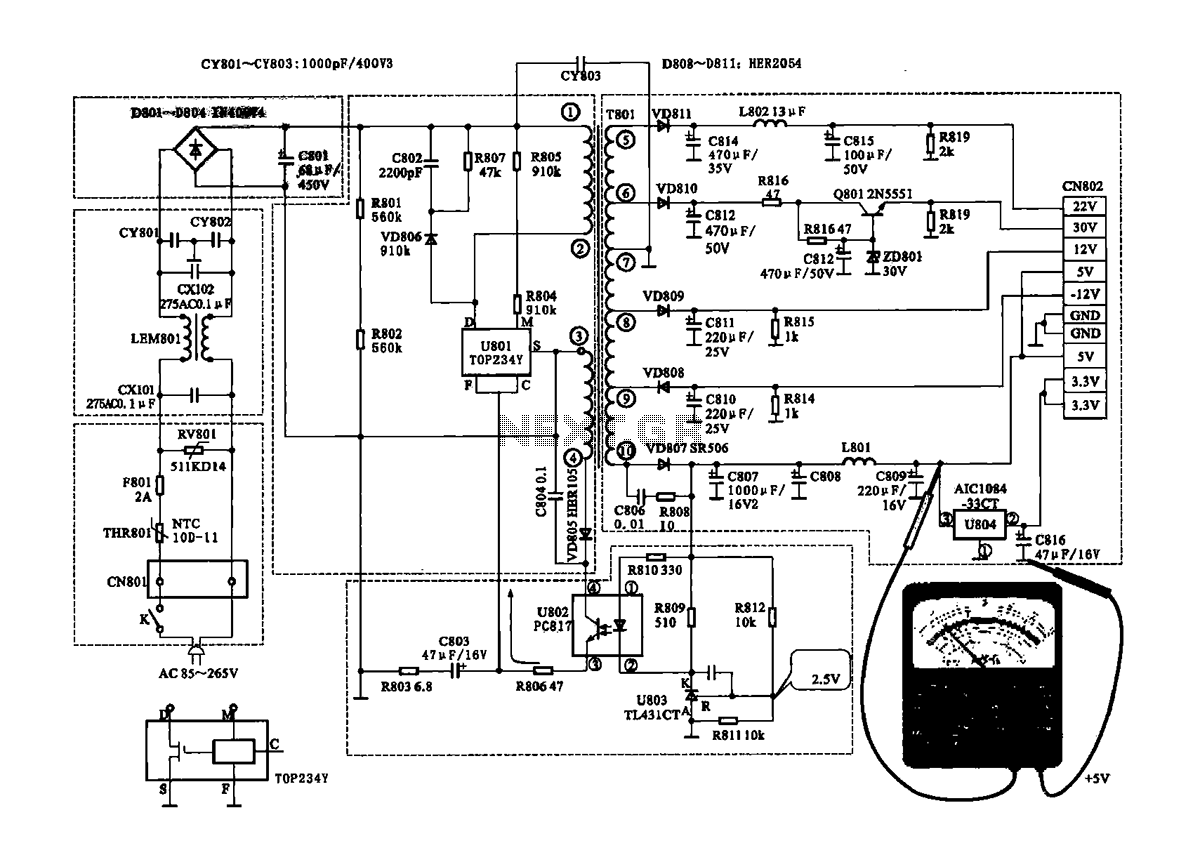
Coship CDVB3188V receiver switching power supply circuit
The Coship CDVB3188V receiver features a switching power supply circuit similar to the CDVB3188C model. The circuit includes several key components: an AC input circuit, an anti-jamming filter circuit, a complete flow filter circuit, and a switching oscillation circuit. (1)...
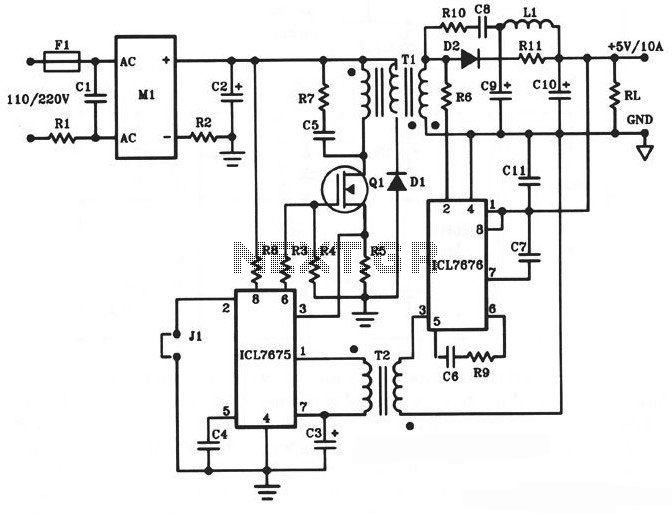
5V/10A 50W Offline Switching Power Supply
The following diagram illustrates a 50W offline switching power supply circuit design. This circuit is powered by a MOSFET, specifically the BUZ80A/IXTP4N8 for a 220V AC voltage input and the GE IRF823 for a 110V AC voltage input. The output...
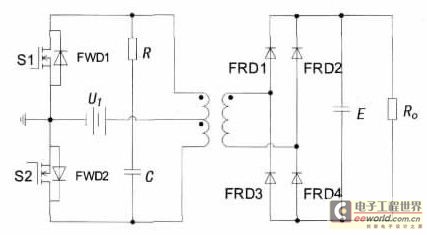
24VDC-220VDC vehicle carried switching power supply based on inverter circuit
With the increase in the variety of modern electrical equipment for vehicles and the rise in power levels, there is a growing demand for different types of power supplies, including AC and DC sources. The power system needs to utilize...
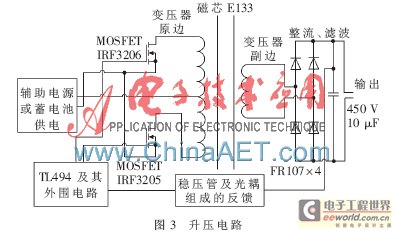
The multi-channel segregation with backup battery exports the switching power supply
With the rapid development of the social economy, the demand for electric energy continues to increase. In light of the diminishing availability of non-renewable energy sources, such as fossil fuels, many countries are recognizing the importance of energy conservation and...