


Full-wave Phase Control Using Lower Voltage DIAC
#DIAC
#phase control
#trigger diode
#breakdown voltage
#alternating current
#full-wave
#voltage regulation
#circuit protection
#electronics
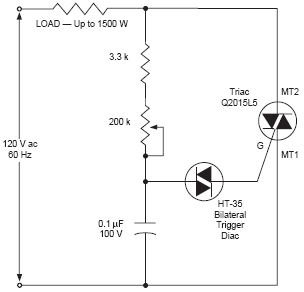
Description: The DIAC, or diode for alternating current, is a trigger diode that conducts current only after its breakdown voltage has been momentarily exceeded. Most DIACs are utilized in applications requiring a switching function in AC circuits.
The DIAC is a semiconductor device that operates in a bidirectional manner, allowing current to flow in both directions once the applied voltage surpasses a specified threshold known as the breakdown voltage. This characteristic makes the DIAC particularly useful in various applications, including light dimmers, motor speed controls, and over-voltage protection circuits.
A typical DIAC consists of four layers of semiconductor material, forming a p-n-p-n structure. When the voltage across the device exceeds the breakdown voltage, the DIAC transitions from a non-conductive state to a conductive state, allowing current to pass through. This transition is often used to trigger other components in a circuit, such as triacs or thyristors, which can control larger loads.
In practical applications, the DIAC is often used in conjunction with other components such as resistors and capacitors to form timing circuits or to create specific trigger conditions. The device is characterized by its ability to provide a sharp switching action, making it suitable for applications where precise control of voltage and current is essential.
The DIAC is typically packaged in a variety of forms, including through-hole and surface-mount options, allowing for flexibility in circuit design. Its robust nature and ability to withstand high voltages make it a reliable choice for many electronic applications.The DIAC, or diode for alternating current, is a trigger diode that conducts current only after its breakdown voltage has been exceeded momentarily. Most DIAC..
The DIAC is a semiconductor device that operates in a bidirectional manner, allowing current to flow in both directions once the applied voltage surpasses a specified threshold known as the breakdown voltage. This characteristic makes the DIAC particularly useful in various applications, including light dimmers, motor speed controls, and over-voltage protection circuits.
A typical DIAC consists of four layers of semiconductor material, forming a p-n-p-n structure. When the voltage across the device exceeds the breakdown voltage, the DIAC transitions from a non-conductive state to a conductive state, allowing current to pass through. This transition is often used to trigger other components in a circuit, such as triacs or thyristors, which can control larger loads.
In practical applications, the DIAC is often used in conjunction with other components such as resistors and capacitors to form timing circuits or to create specific trigger conditions. The device is characterized by its ability to provide a sharp switching action, making it suitable for applications where precise control of voltage and current is essential.
The DIAC is typically packaged in a variety of forms, including through-hole and surface-mount options, allowing for flexibility in circuit design. Its robust nature and ability to withstand high voltages make it a reliable choice for many electronic applications.The DIAC, or diode for alternating current, is a trigger diode that conducts current only after its breakdown voltage has been exceeded momentarily. Most DIAC..
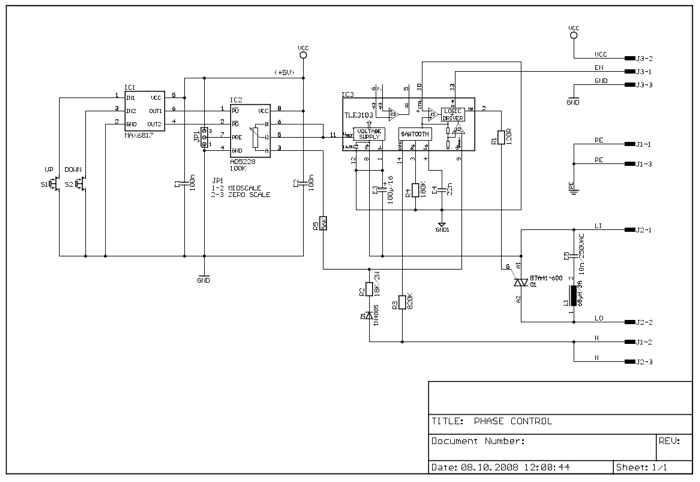
2500W Phase Control Circuit Schematic
The following circuit illustrates a 2500W Phase Control Circuit Schematic. Features include a ground-tied trigger output that is disabled, and a low voltage input.
The 2500W Phase Control Circuit is designed to regulate the power delivered to a load by controlling...
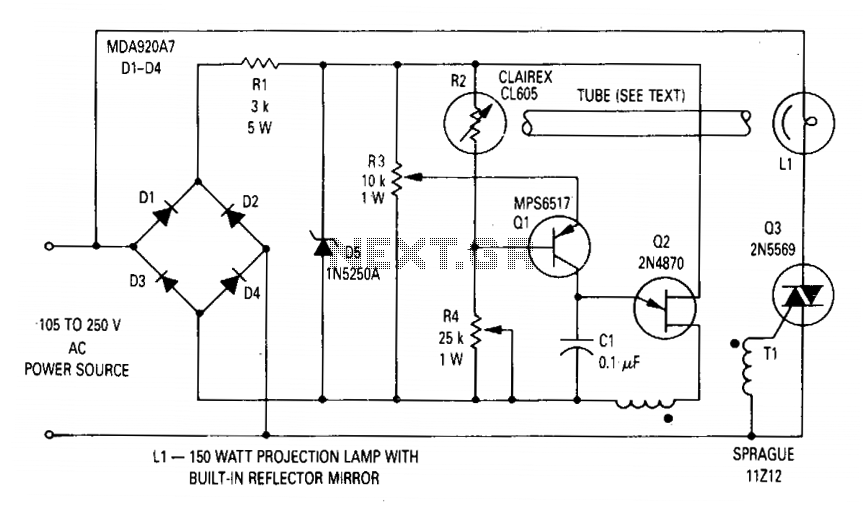
Voltage regulator for projection lamp
The circuit regulates the RMS output voltage across a load, specifically a projection lamp, to 100 volts ±2% for input voltages ranging from 105 to 250 volts AC. This regulation is achieved by indirectly sensing the light output of lamp...
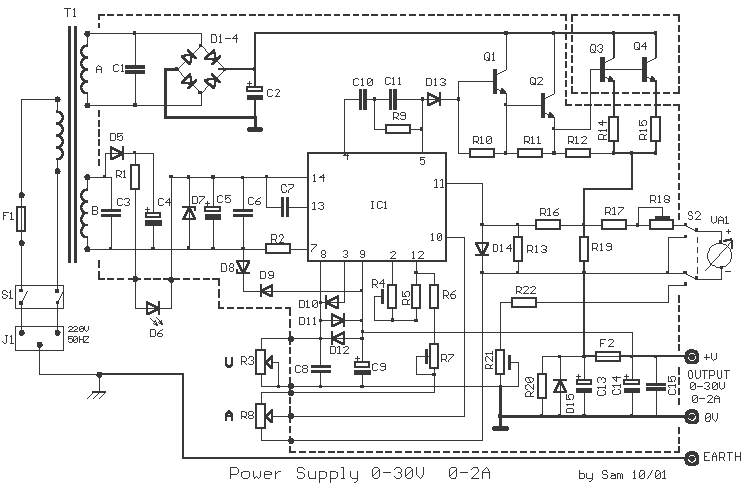
Power Supply 0-30V / 0-2A
The basic requirements for a laboratory power supply are to provide the necessary voltages and currents with low output resistance, low noise, minimal ripple, and good stabilization. These requirements are addressed within the circuit design. Many power supplies incorporate electronic...
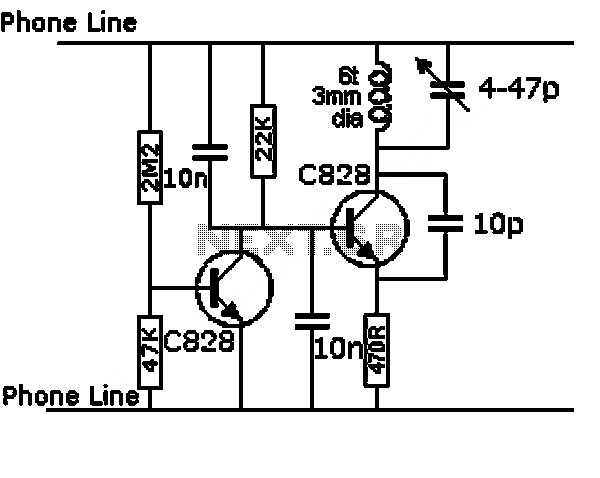
phase control circuit
This is a simple design schematic for a phase control circuit that regulates the power delivered to an AC load. The phase control circuit modifies the AC waveform, allowing for variations such as full cycle, half cycle, zero cycle, or...
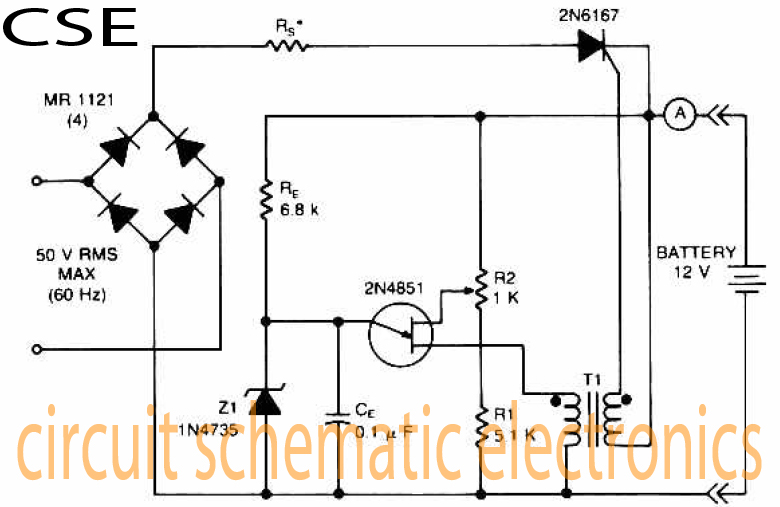
Variable charger circuit Schematic Diagram
The accumulator charger circuit must provide a voltage that matches the specifications of the batteries being charged. For a 12-volt accumulator, the output voltage should not exceed 12 volts, nor should it fall significantly below this threshold. Failure to maintain...
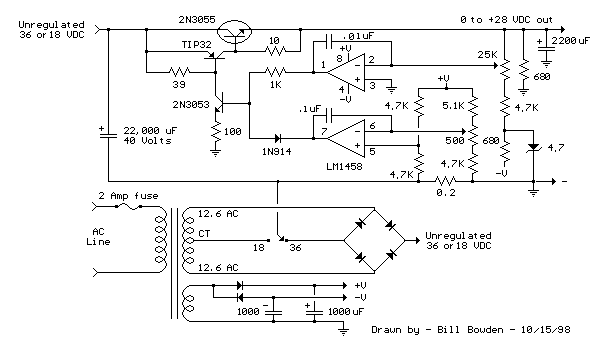
Current and Variable Voltage Power Supply
Another adjustment of application operational amplifiers to adapt a power supply is apparent below. The power supply requires an additional adjustment to supply the op-amps with a bipolar voltage (+/- 8 volts), and the negative voltage is also used to...
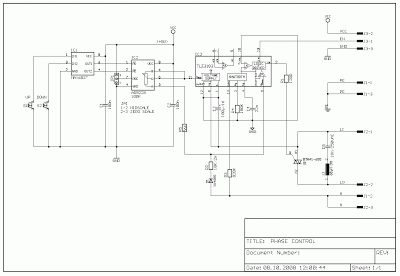
2500w phase control
This circuit controls resistive and inductive loads up to 2,500W. Its main functional device is an integrated phase control circuit, the Siemens TLE3103. It includes its own power supply, a zero-voltage crossing detector circuit, and a logic driver. An additional...
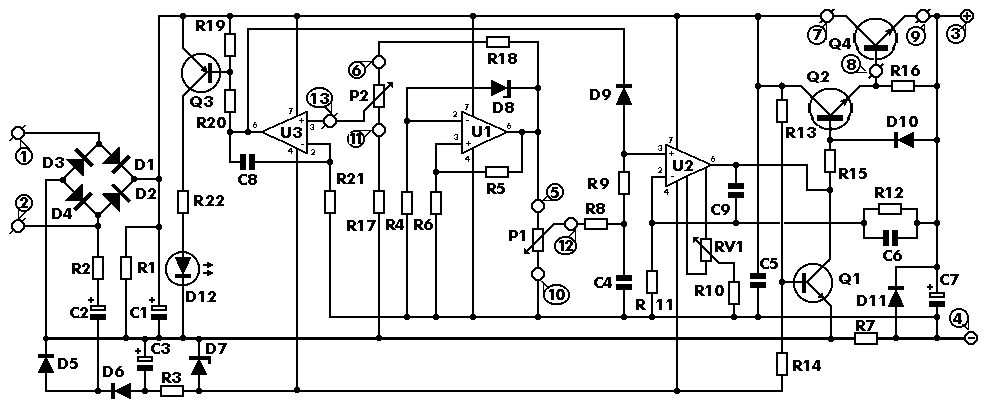
0-30 VDC Stabilized Power Supply with Current Control 0.002-3 A
The circuit begins with a step-down mains transformer featuring a secondary winding rated at 24 V/3 A, which connects across the input points at pins 1 and 2. The quality of the output supply is directly related to the transformer's...
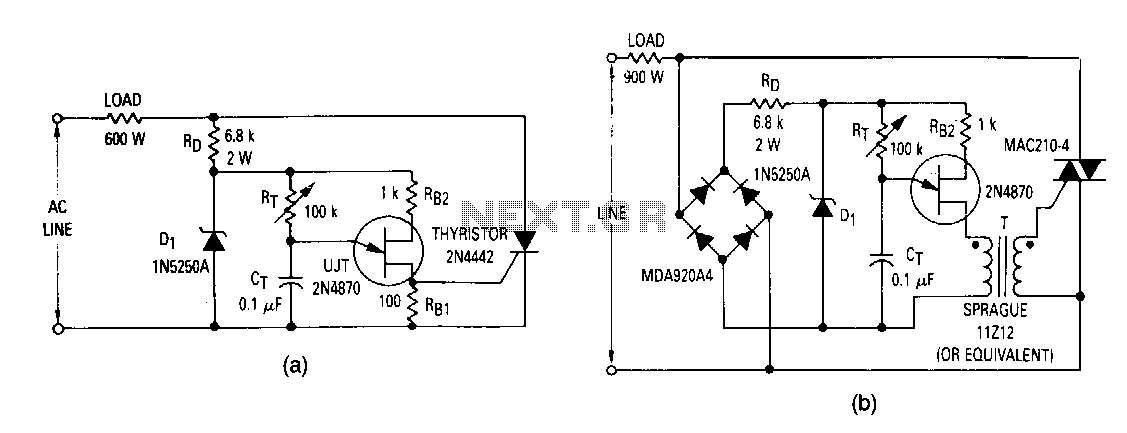
Phase Control Circuit
The most elementary application is a half-wave control circuit. The thyristor is acting both as a power control device and as a rectifier, providing variable power to the load during the positive half cycle and no power to the load...