


IBM ThinkPad T40 Power Control Circuit With MAX1631 IC
#MAX1631
#IBM ThinkPad T40
#power control
#multi-output
#low-noise
#laptop power
#voltage regulation
#DC-DC converter
#power management
#battery power
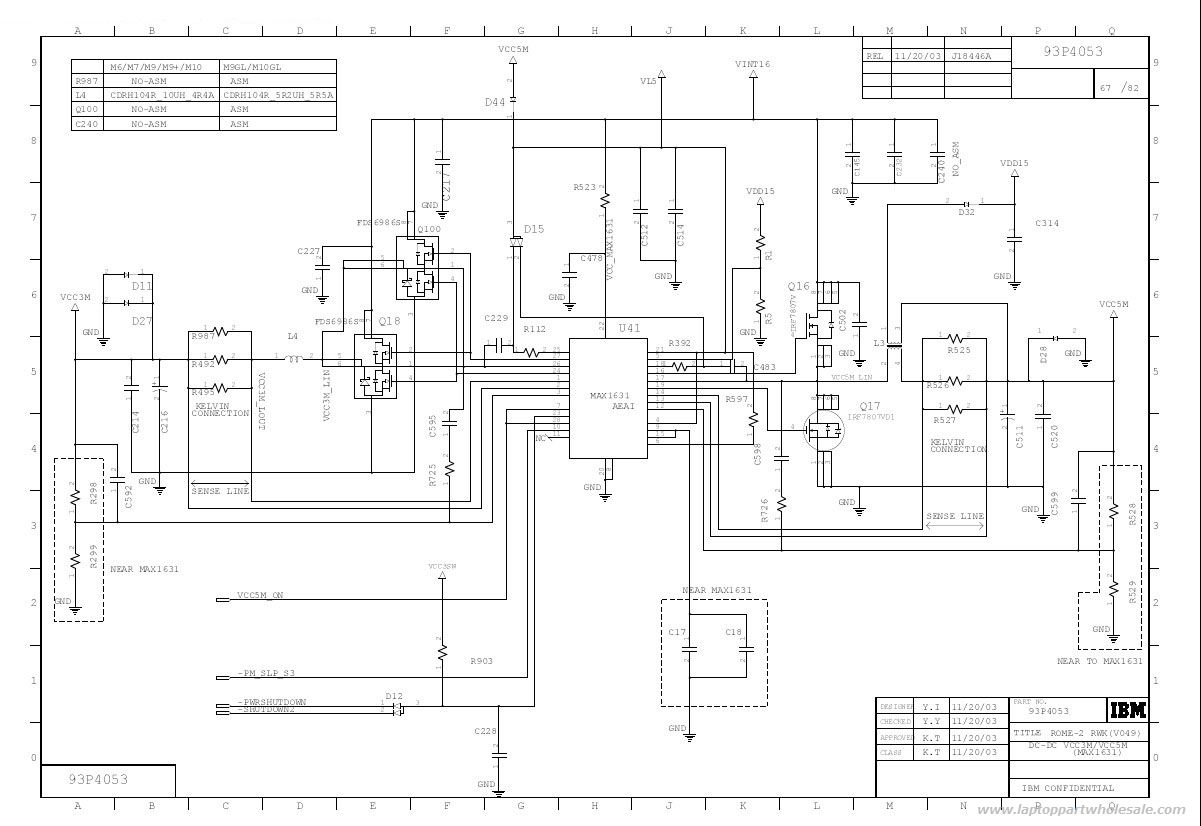
Description: This is an IBM ThinkPad T40 power control circuit. This circuit is based on the MAX1631 IC, which is a multi-output, low-noise power supply.
The IBM ThinkPad T40 power control circuit utilizes the MAX1631 integrated circuit (IC) to provide stable and efficient power management for the laptop. The MAX1631 is designed to deliver multiple output voltages, which are essential for powering various components within the laptop, such as the CPU, memory, and peripheral devices.
The circuit typically includes several key components: the MAX1631 IC itself, input and output capacitors, resistors for voltage setting, and possibly inductors for filtering purposes. The IC operates by receiving a single input voltage, which it regulates down to the required output levels. It features low quiescent current, making it suitable for battery-operated devices where power efficiency is critical.
In this application, the MAX1631 can be configured to provide multiple output voltages, which may include 5V, 3.3V, and 1.8V, depending on the specific needs of the components being powered. The outputs are typically designed with low dropout characteristics, ensuring that the voltages remain stable even under varying load conditions.
To implement this circuit, careful attention must be paid to the layout to minimize noise and ensure proper thermal management. The use of bypass capacitors close to the IC pins is crucial for filtering high-frequency noise, while larger output capacitors can help maintain voltage stability during transient loads.
Overall, the MAX1631-based power control circuit in the IBM ThinkPad T40 is a critical component that ensures reliable operation and performance of the laptop by providing the necessary power with low noise and high efficiency.This is a IBM ThinkPad T40 Power control circuit. This circuit based on the MAX1631 IC. MAX1631 IC is a Multi-Output, Low-Noise Power-Supply ..
The IBM ThinkPad T40 power control circuit utilizes the MAX1631 integrated circuit (IC) to provide stable and efficient power management for the laptop. The MAX1631 is designed to deliver multiple output voltages, which are essential for powering various components within the laptop, such as the CPU, memory, and peripheral devices.
The circuit typically includes several key components: the MAX1631 IC itself, input and output capacitors, resistors for voltage setting, and possibly inductors for filtering purposes. The IC operates by receiving a single input voltage, which it regulates down to the required output levels. It features low quiescent current, making it suitable for battery-operated devices where power efficiency is critical.
In this application, the MAX1631 can be configured to provide multiple output voltages, which may include 5V, 3.3V, and 1.8V, depending on the specific needs of the components being powered. The outputs are typically designed with low dropout characteristics, ensuring that the voltages remain stable even under varying load conditions.
To implement this circuit, careful attention must be paid to the layout to minimize noise and ensure proper thermal management. The use of bypass capacitors close to the IC pins is crucial for filtering high-frequency noise, while larger output capacitors can help maintain voltage stability during transient loads.
Overall, the MAX1631-based power control circuit in the IBM ThinkPad T40 is a critical component that ensures reliable operation and performance of the laptop by providing the necessary power with low noise and high efficiency.This is a IBM ThinkPad T40 Power control circuit. This circuit based on the MAX1631 IC. MAX1631 IC is a Multi-Output, Low-Noise Power-Supply ..
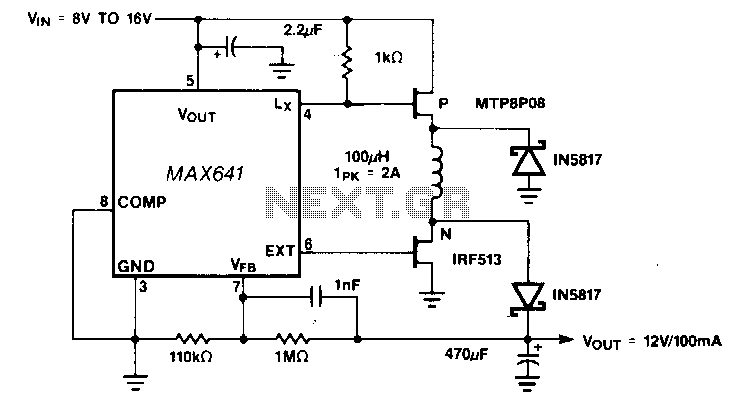
Step-up-down-dc-dc-converter
Positive output step-up and step-down converters have a common limitation in that neither can handle input voltages that are both greater than or less than the output. For example, when converting a 12-V sealed lead-acid battery to a regulated +12...
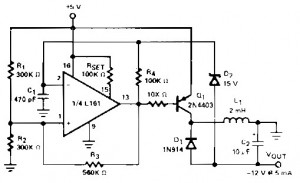
regulated dc to dc converter
A regulated DC to DC converter utilizing the Micro Power Quad Comparator L161 integrated circuit, which features ultra-low power consumption. This circuit is designed to convert 5V DC to 12V DC at a current output of 5mA.
The circuit employs the...
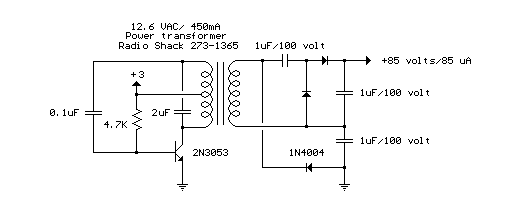
dc to dc converter
The circuit is a DC to DC converter utilizing a standard 12 VAC center-tapped power transformer configured as a blocking oscillator. Although the circuit exhibits low efficiency, it generates a high voltage suitable for low power applications. The input battery...
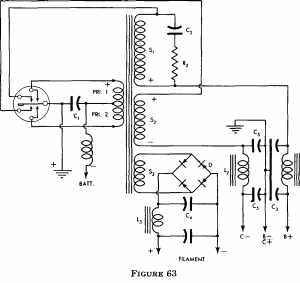
power supply design
The more one understands about any subject, the more interesting it becomes. As this article is read, it will be found that the subject of...
A comprehensive electronic schematic typically involves various components, each serving a specific function in the overall...
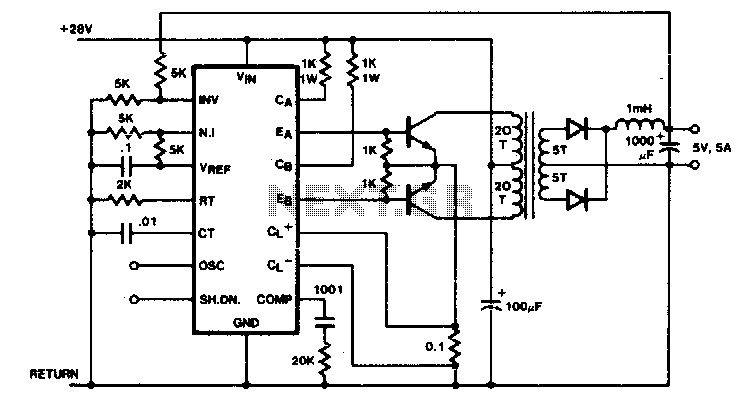
DC-DC regulating converter
Push-pull outputs are utilized in this transformer-coupled DC-DC regulating converter. It is important to note that the oscillator must be configured to operate at twice the desired output frequency, as the SGI 524's internal flip-flop divides the frequency by two...
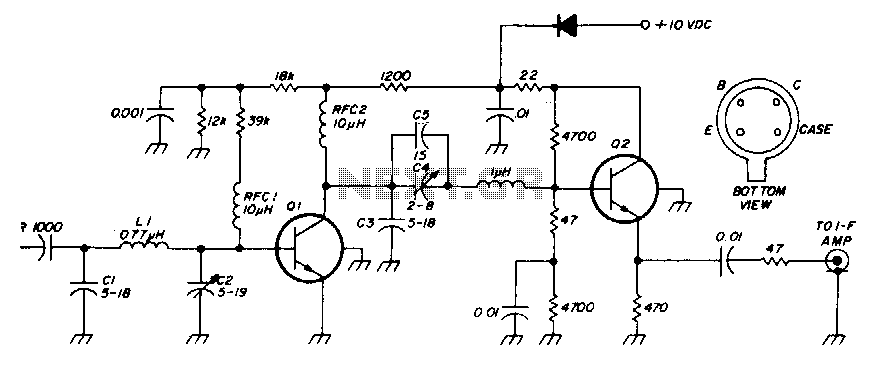
Low-noise 30Mhz preamplifier
The low-noise preamplifier features a noise figure of 1 dB at 30 MHz and a 3 dB bandwidth of 10 MHz. The gain is 19 dB. The total current drain with a +10 volt supply is 13 mA. The resistors...
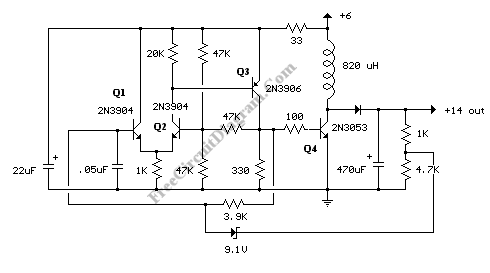
Transformerless Voltage Booster Circuit: A DC-DC Step-Up Switching Regulator Using Transistors
A DC-to-DC step-up converter is typically implemented using a transformer, which converts DC voltage to AC voltage, steps it up with the transformer, and then rectifies and filters the output to achieve a higher DC voltage. However, a voltage can...
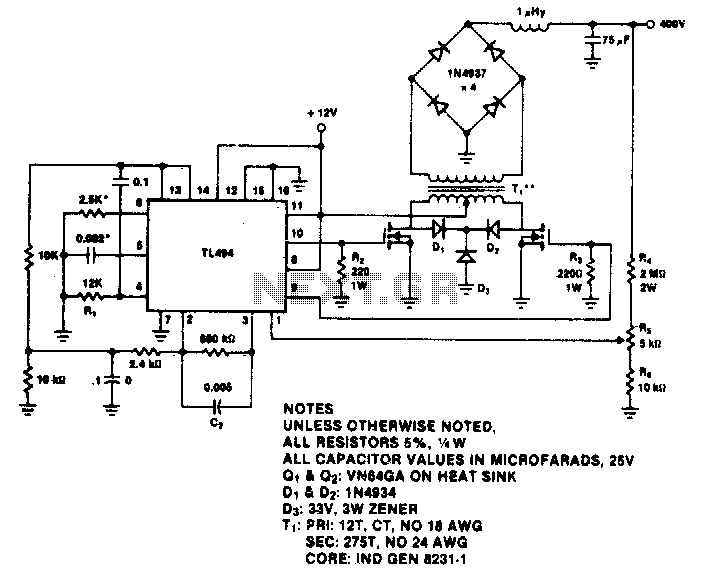
400V-60W push-pull DC-DC converter
The TL494 switching regulator controls the operating frequency and regulates output voltage. The switching frequency is approximately 100 kHz for the specified values. Output regulation typically varies by 15% from no-load to full 60 W.
The TL494 is a versatile integrated...
Voltage Regulators
Until Willow Garage was acquired, there was work as a Web Robotics Engineer. This title reflects a role as a full-stack engineer focused on real-time, distributed robot control. Notable projects include an XML-RPC server and client for Node.js, a deprecated...