


Ncp1027: 16 W 12 Vdc Modem Power Supply
#NCP1027
#modem power supply
#DC/DC converter
#flyback structure
#external transformer
#high voltage
#feedback network
#12Vdc
#16W
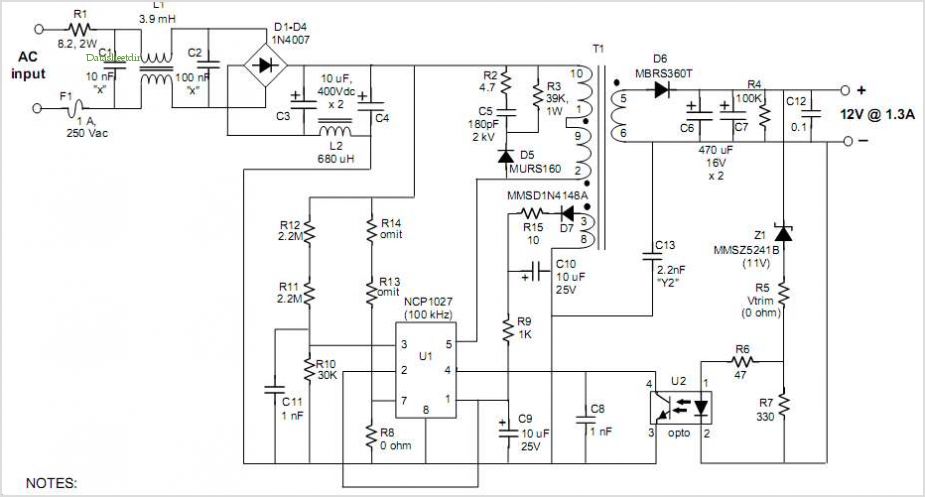
Description: The NCP5080 is a high-voltage boost driver specifically designed for Xenon power flashes. It features a built-in DC/DC converter that utilizes a flyback topology, allowing for the use of an external transformer to meet various high-voltage requirements. An external feedback network enables dynamic adjustment of the output voltage.
The NCP5080 operates by converting a lower input voltage to a higher output voltage, making it suitable for applications requiring high energy bursts, such as camera flash systems. The flyback converter design is advantageous due to its ability to isolate the output from the input, providing safety and flexibility in circuit design.
The external transformer plays a crucial role in the voltage boost process, allowing for customization based on the specific voltage requirements of the Xenon flash application. The choice of transformer affects the efficiency and performance of the circuit, necessitating careful selection based on the application's power demands.
The external feedback network is essential for maintaining stable output voltage under varying load conditions. By adjusting the feedback parameters, the output voltage can be fine-tuned, ensuring optimal performance across different operational scenarios. This feature is particularly important in applications where consistent flash intensity is required.
In summary, the NCP5080 provides a robust solution for high-voltage boost applications, with its flyback converter architecture and external feedback capabilities allowing for flexibility and adaptability in design.The NCP5080 product is a high voltage boost driver dedicated to the Xenon power flashes. The built-in DC/DC converter is based on a flyback structure with an external transformer to adapt any range of high voltage demand. The external feedback network makes possible to dynamically adjust the output voltage.
The NCP5080 operates by converting a lower input voltage to a higher output voltage, making it suitable for applications requiring high energy bursts, such as camera flash systems. The flyback converter design is advantageous due to its ability to isolate the output from the input, providing safety and flexibility in circuit design.
The external transformer plays a crucial role in the voltage boost process, allowing for customization based on the specific voltage requirements of the Xenon flash application. The choice of transformer affects the efficiency and performance of the circuit, necessitating careful selection based on the application's power demands.
The external feedback network is essential for maintaining stable output voltage under varying load conditions. By adjusting the feedback parameters, the output voltage can be fine-tuned, ensuring optimal performance across different operational scenarios. This feature is particularly important in applications where consistent flash intensity is required.
In summary, the NCP5080 provides a robust solution for high-voltage boost applications, with its flyback converter architecture and external feedback capabilities allowing for flexibility and adaptability in design.The NCP5080 product is a high voltage boost driver dedicated to the Xenon power flashes. The built-in DC/DC converter is based on a flyback structure with an external transformer to adapt any range of high voltage demand. The external feedback network makes possible to dynamically adjust the output voltage.
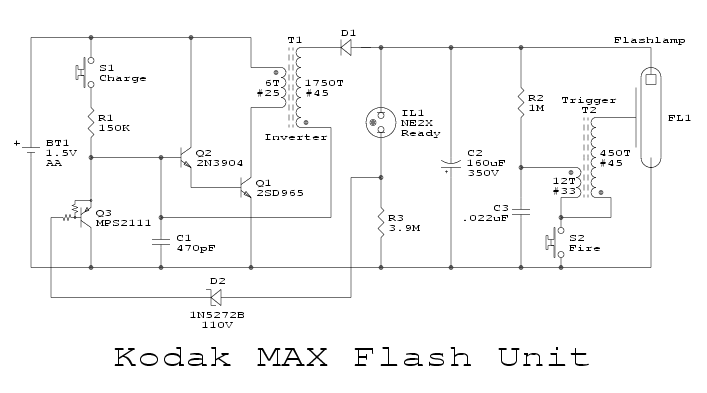
Salvaging Interesting Gadgets Components and Subsystems
The high voltage power supply is likely capable of delivering between 12 to 30 kVDC at a current of 1 or 2 mA. This output is suitable for various high voltage applications, including experiments, plasma globes, negative ion and ozone...
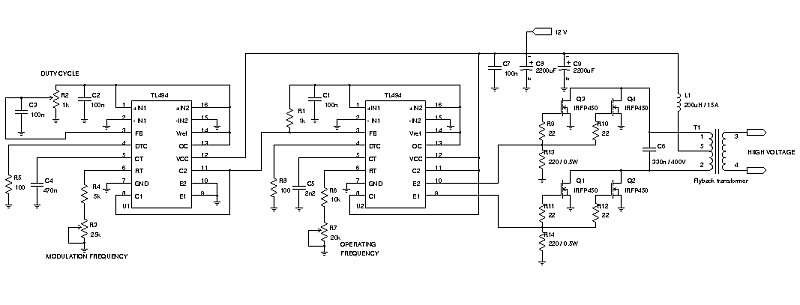
Portable Jacobs Ladder
Portable Jacob's Ladder circuit designed specifically for experimental purposes.
The Portable Jacob's Ladder circuit is an intriguing project that demonstrates the principles of high-voltage arc generation. This circuit is typically utilized in educational settings or experimental demonstrations, showcasing the behavior of...
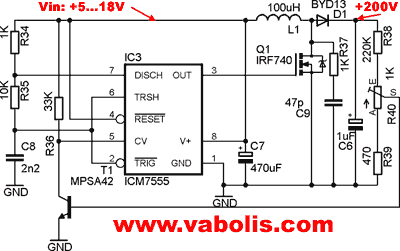
Nixie low voltage PSU
Occasionally, a small high-voltage power supply is required for various projects without the need for specialized transformers or specific chips. A simple circuit diagram for a classical step-up converter based on the widely used 555 timer was found online. The...
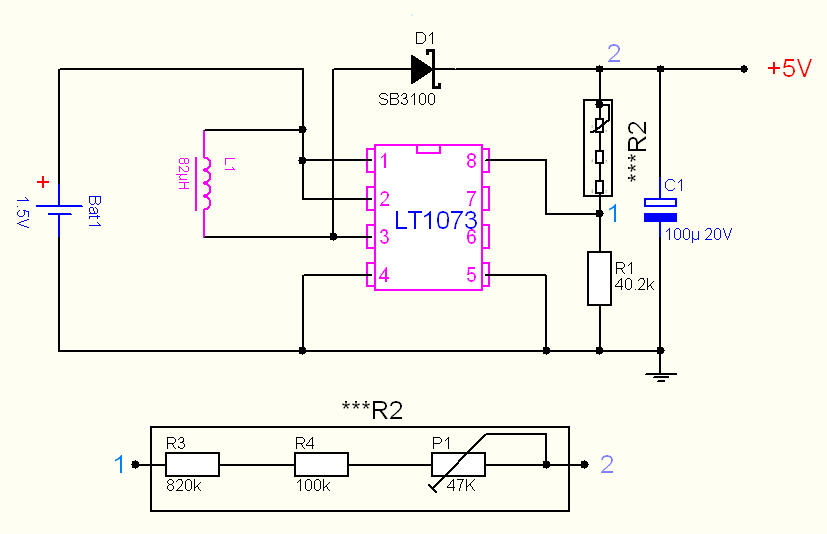
1.5V to 5V/12V DC/DC Converter with LT1073
A compact DC/DC converter designed to provide either 5V or 12V output using the LT1073 integrated circuit (IC). This IC is available in three versions based on the desired output voltage, with two options providing fixed outputs of 5V and...
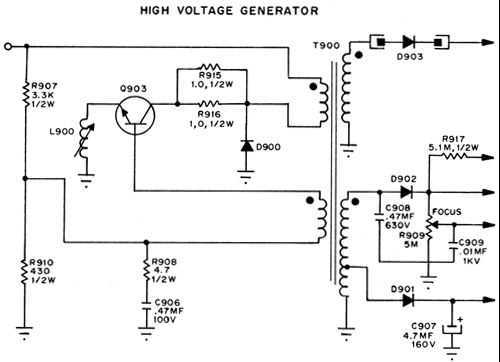
High Voltafe Generator
This is a series regulator with Q900 being the control element, Q901 a driver, and Q902 an error amp. ZD900 forms the emitter reference voltage source. Since the generated high voltage and other voltages are linked by means of the...
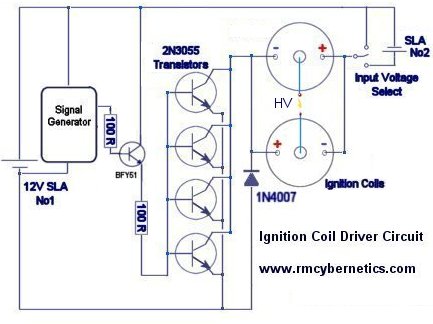
Gray Tube Replication 6
Has anyone tried colliding two high voltage potentials in a grey tube? Wiring two identical...
The concept of colliding two high voltage potentials within a grey tube involves creating a controlled environment where electrical discharge can occur. This setup typically requires...
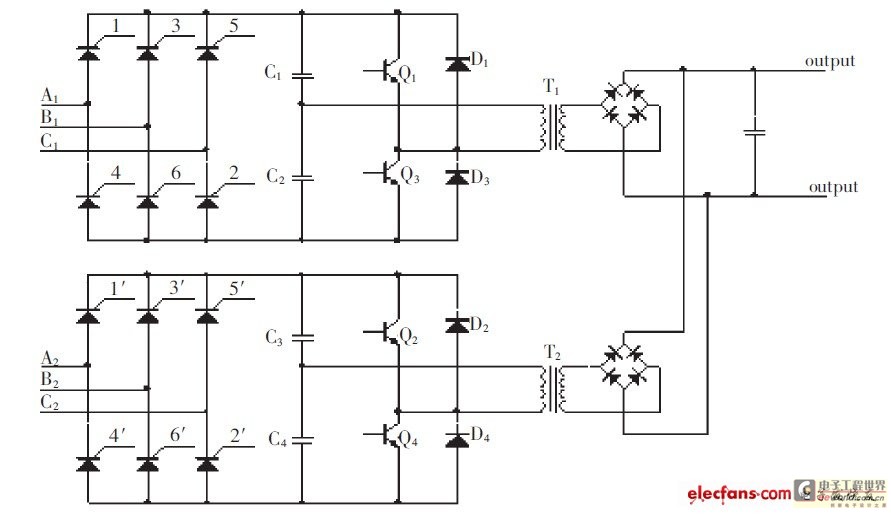
High-pressure direct current power supply scheme of the new low ripple
The high-pressure direct current power supply has become increasingly widespread. This system outputs in parallel with double-channel power to achieve low ripple direct current. In situations where gas switching tube frequency is limited, this method can generate low ripple direct...
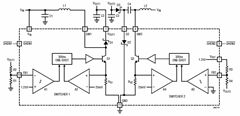
High Efficiency LT3463A Dual Micropower DC/DC Converters Block Diagram and Datasheet
A constant off-time control that provides high efficiency over a wide range of output current can be utilized by the LT3463A dual micropower DC/DC converters with internal Schottky diodes, as detailed in the following circuit diagram and the datasheet.
The LT3463A...
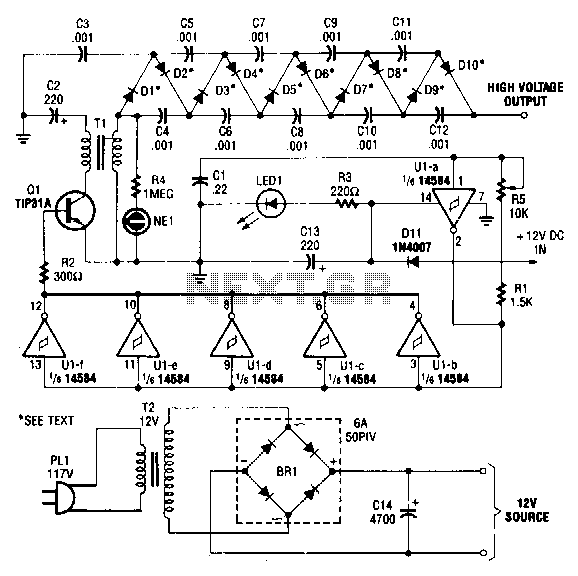
High-voltage-dc-generator
This circuit is powered by a 12-V DC power supply. The input to the circuit is amplified to generate a 10,000-V DC output. The output of the up-converter is subsequently directed into a 10-stage high-voltage multiplier to achieve a final...