


Six output DC regulator sepic design using LTM8008
#SEPIC converter
#LTM8008
#DC regulator
#multiple outputs
#current-mode architecture
#compact design
#fixed frequency
#voltage regulation
#power electronics
#module
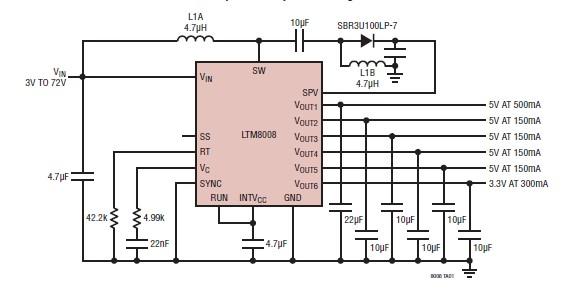
Description: A simple and compact power supply electronic project can be designed using the LTM8008 Module SEPIC converter, which includes six post-regulators. This setup provides six outputs capable of delivering varying output currents for some of the outputs. The SEPIC controller's fixed frequency, current-mode architecture ensures stable operation across a broad range of supply and output voltages. Additionally, it incorporates soft-start and frequency foldback functions to limit inductor current during startup and in the event of output short-circuit conditions.
The LTM8008 is a highly integrated power management solution that simplifies the design of power supply systems. The SEPIC (Single-Ended Primary-Inductor Converter) topology allows for both step-up and step-down voltage conversion, making it versatile for applications requiring different voltage levels. The module's ability to maintain stable output under varying load conditions is crucial in applications where power supply reliability is paramount.
The six post-regulators can be configured to provide different voltage levels and current ratings, accommodating various load requirements. Each output can be independently regulated, allowing for flexibility in powering multiple devices simultaneously. The fixed frequency operation of the SEPIC converter minimizes electromagnetic interference (EMI), which is beneficial in sensitive electronic environments.
Soft-start functionality is essential for preventing inrush current that could damage components during startup. The LTM8008's soft-start feature gradually ramps up the output voltage, ensuring that connected loads are not subjected to sudden surges. Furthermore, the frequency foldback mechanism is a protective measure that reduces the switching frequency in response to overcurrent conditions, thereby limiting the inductor current and preventing overheating or damage.
In summary, the LTM8008 Module SEPIC converter, with its six post-regulators, offers a robust solution for creating a compact power supply with multiple outputs. Its design emphasizes stability, flexibility, and protection, making it suitable for a wide range of electronic applications.Using the LTM8008 Module SEPIC converter with six post regulators can be designed a very simple compact power supply electronic project, that has six outputs that can provide different output current for some of outputs. The SEPIC controller`s fixed frequency, current-mode architecture results in stable operation over a wide range of supply an
d output voltages and features soft-start and frequency foldback functions to limit inductor current during start-up and output short-circuit.
The LTM8008 is a highly integrated power management solution that simplifies the design of power supply systems. The SEPIC (Single-Ended Primary-Inductor Converter) topology allows for both step-up and step-down voltage conversion, making it versatile for applications requiring different voltage levels. The module's ability to maintain stable output under varying load conditions is crucial in applications where power supply reliability is paramount.
The six post-regulators can be configured to provide different voltage levels and current ratings, accommodating various load requirements. Each output can be independently regulated, allowing for flexibility in powering multiple devices simultaneously. The fixed frequency operation of the SEPIC converter minimizes electromagnetic interference (EMI), which is beneficial in sensitive electronic environments.
Soft-start functionality is essential for preventing inrush current that could damage components during startup. The LTM8008's soft-start feature gradually ramps up the output voltage, ensuring that connected loads are not subjected to sudden surges. Furthermore, the frequency foldback mechanism is a protective measure that reduces the switching frequency in response to overcurrent conditions, thereby limiting the inductor current and preventing overheating or damage.
In summary, the LTM8008 Module SEPIC converter, with its six post-regulators, offers a robust solution for creating a compact power supply with multiple outputs. Its design emphasizes stability, flexibility, and protection, making it suitable for a wide range of electronic applications.Using the LTM8008 Module SEPIC converter with six post regulators can be designed a very simple compact power supply electronic project, that has six outputs that can provide different output current for some of outputs. The SEPIC controller`s fixed frequency, current-mode architecture results in stable operation over a wide range of supply an
d output voltages and features soft-start and frequency foldback functions to limit inductor current during start-up and output short-circuit.
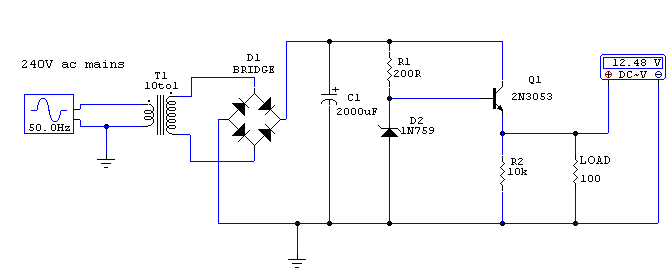
Regulated 12 Volt Supply
This circuit utilizes a 13-volt zener diode (D2) for voltage regulation. Approximately 0.7 volts are dropped across the base-emitter junction of the transistors, resulting in a higher current output of 12.3 volts. The circuit is capable of supplying loads up...

capacitor Explaining a car voltage regulator circuit
The circuit regulates approximately 12V from the car battery down to 5V for use by an Atmel AVR microcontroller. The presence of two capacitors on each side of the linear regulator LM7805 raises questions regarding their purpose. It is suggested...
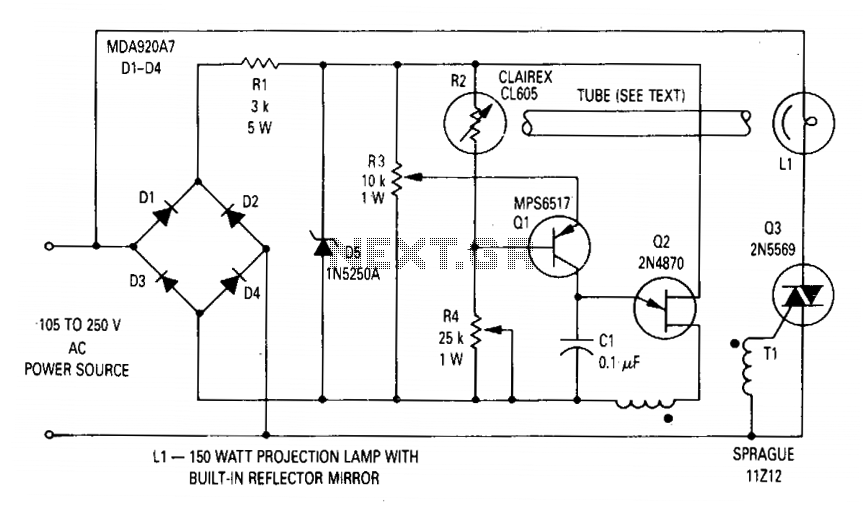
Voltage regulator for projection lamp
The circuit regulates the RMS output voltage across a load, specifically a projection lamp, to 100 volts ±2% for input voltages ranging from 105 to 250 volts AC. This regulation is achieved by indirectly sensing the light output of lamp...
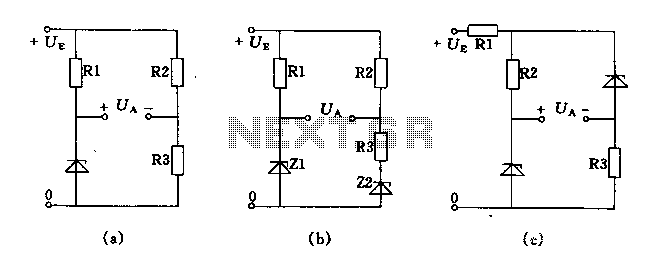
Bridge voltage regulator circuit diagram using the
The circuit depicted in Figures A, B, and C demonstrates a high voltage coefficient. When the regulator resistance \( r_z \) is held constant, the bridge configuration achieves an infinite voltage coefficient. In Figure A, the load circuit is connected...
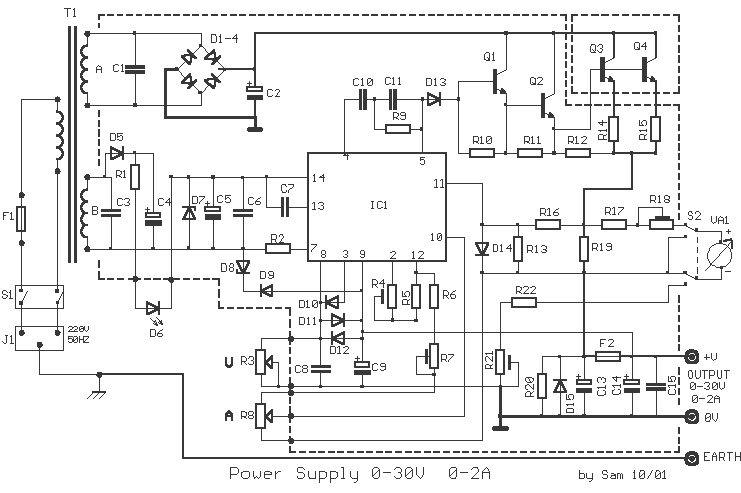
Power Supply 0-30V / 0-2A
The basic requirements for a laboratory power supply are to provide the necessary voltages and currents with low output resistance, low noise, minimal ripple, and good stabilization. These requirements are addressed within the circuit design. Many power supplies incorporate electronic...
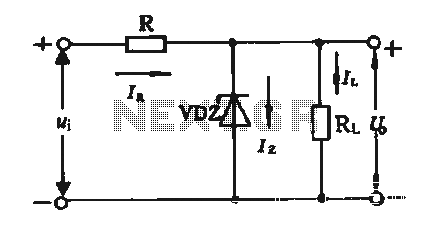
Regulator circuit silicon resistor formed
The simple voltage regulator circuit consists of a silicon regulator and a resistor. It is designed to rectify and filter DC voltage, as illustrated in the accompanying figure. The voltage regulator is connected in parallel with the load, and the...
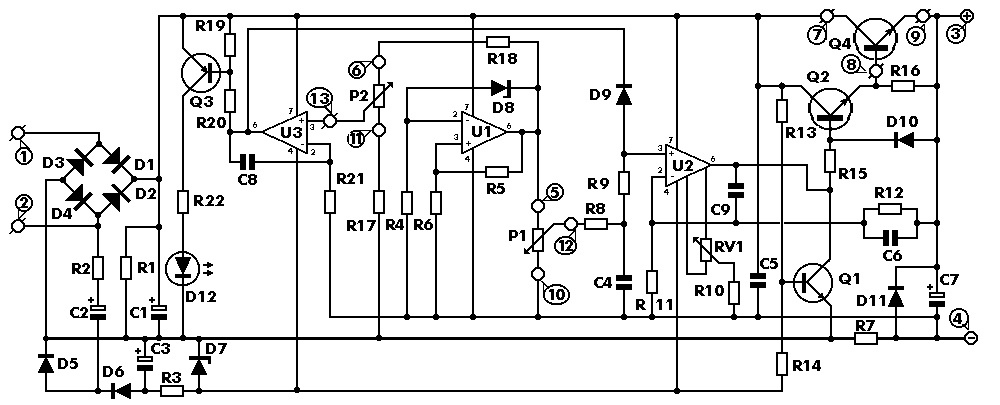
0-30 VDC Stabilized Power Supply with Current Control 0.002-3 A
The circuit begins with a step-down mains transformer featuring a secondary winding rated at 24 V/3 A, which connects across the input points at pins 1 and 2. The quality of the output supply is directly related to the transformer's...
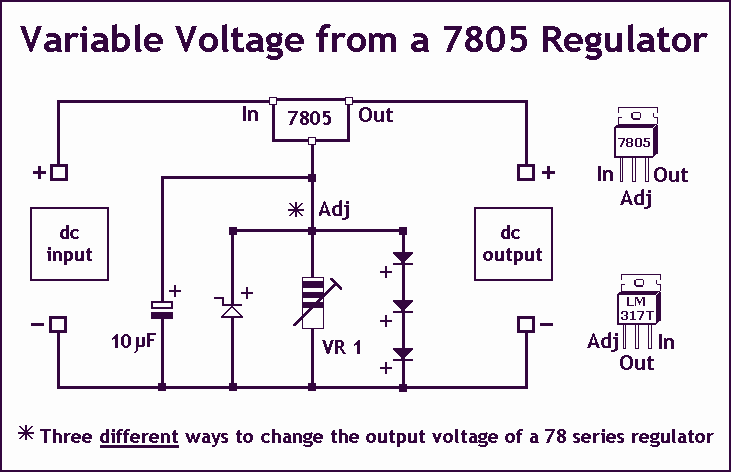
Variable Voltage Regulation
Controlling the output voltage from a regulator can be made variable in three ways:
1. Using a fixed reference zener diode to increase the output by the value of the zener
2. A variable resistor for variable output, note that...
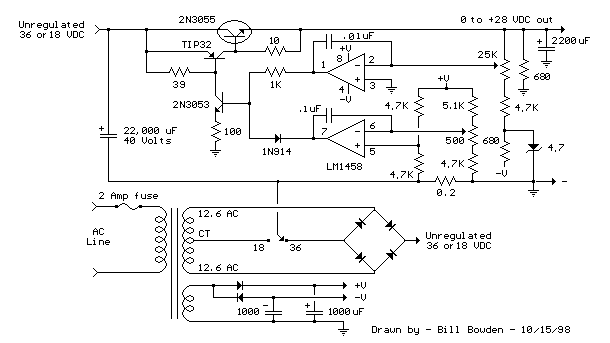
Variable Voltage and Current Power Supply circuit
An alternative approach to utilizing operational amplifiers (op-amps) for power supply regulation is presented. This method necessitates an additional winding on the power transformer to provide the op-amps with a bipolar voltage of +/- 8 volts. The negative voltage generated...