


Stock dial telephone line power supply circuit diagram
#telephone
#CMOS RAM
#dialer
#voltage regulator
#line power
#keypad
#circuit diagram
#electronics
#communication
#analog
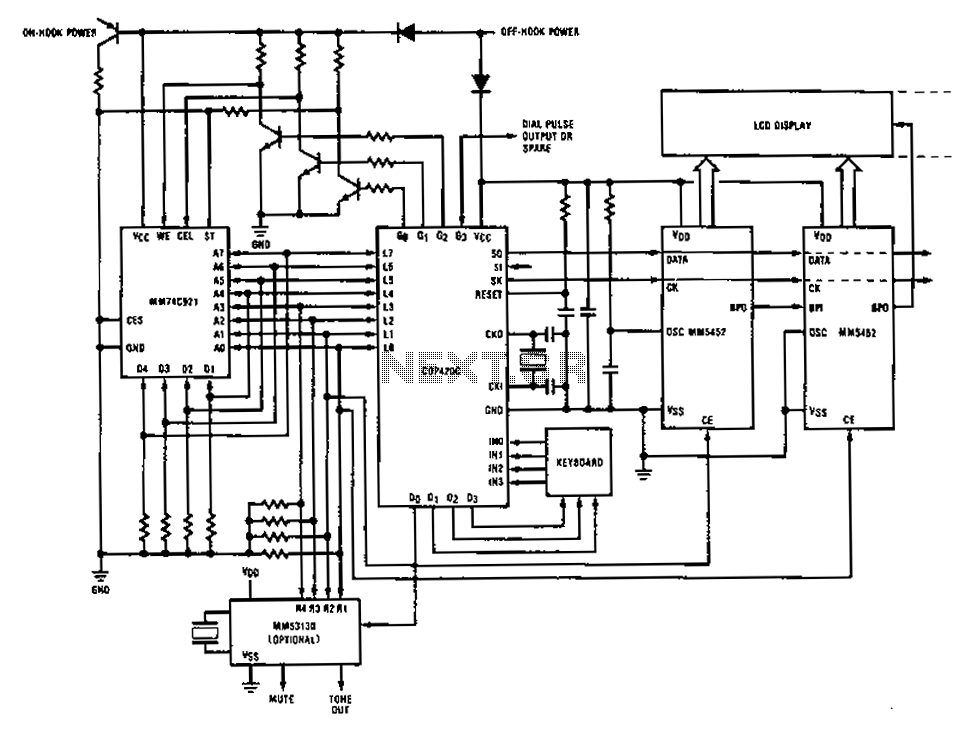
Description: A compilation of dial phone numbers, including 15 commonly used libraries and the dialed number, is stored in standard CMOS RAM. A single-button keypad facilitates the input of a phone number, which can be dialed directly or stored in RAM for automatic dialing.
The circuit design involves a standard CMOS RAM chip responsible for storing up to 15 frequently used phone numbers in a binary format. Each phone number is typically represented as a series of digits, and the RAM allows for easy retrieval and storage of these numbers. The keypad interface consists of a single-button input that enables users to input a phone number directly. When the button is pressed, the circuit captures the number entered and temporarily stores it in RAM.
The automatic dialing feature is facilitated by a microcontroller that interfaces with both the RAM and the telephone line. Upon storing a number in RAM, the microcontroller can initiate a dialing sequence by sending the appropriate signals to the telephone line. The design may also include a debounce circuit to ensure that a single button press is registered accurately, preventing multiple inputs from being registered due to mechanical bounce.
Power supply considerations are crucial for this circuit, with a regulated power source required to ensure stable operation of the CMOS RAM and microcontroller. Additional components such as resistors and capacitors may be employed for signal conditioning and noise reduction.
Overall, this schematic provides a user-friendly solution for dialing frequently used phone numbers, enhancing efficiency and convenience in telecommunication. Compilation dial phone numbers with 15 commonly used libraries (plus number dialed) are stored in a standard CMOS RAM, one button keypad makes typing a phone number can be dial ed directly and, or may make the phone are stored in RAM and then automatically dialed.
The circuit design involves a standard CMOS RAM chip responsible for storing up to 15 frequently used phone numbers in a binary format. Each phone number is typically represented as a series of digits, and the RAM allows for easy retrieval and storage of these numbers. The keypad interface consists of a single-button input that enables users to input a phone number directly. When the button is pressed, the circuit captures the number entered and temporarily stores it in RAM.
The automatic dialing feature is facilitated by a microcontroller that interfaces with both the RAM and the telephone line. Upon storing a number in RAM, the microcontroller can initiate a dialing sequence by sending the appropriate signals to the telephone line. The design may also include a debounce circuit to ensure that a single button press is registered accurately, preventing multiple inputs from being registered due to mechanical bounce.
Power supply considerations are crucial for this circuit, with a regulated power source required to ensure stable operation of the CMOS RAM and microcontroller. Additional components such as resistors and capacitors may be employed for signal conditioning and noise reduction.
Overall, this schematic provides a user-friendly solution for dialing frequently used phone numbers, enhancing efficiency and convenience in telecommunication. Compilation dial phone numbers with 15 commonly used libraries (plus number dialed) are stored in a standard CMOS RAM, one button keypad makes typing a phone number can be dial ed directly and, or may make the phone are stored in RAM and then automatically dialed.
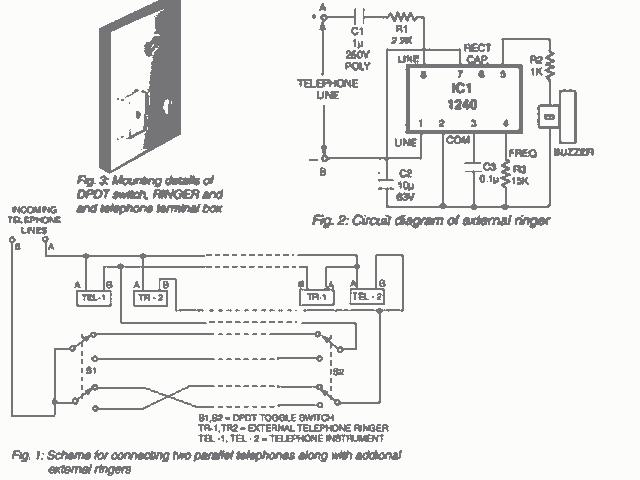
Privacy in parallel telephone line
Often a need arises for connection of two telephone instruments in parallel to one line. But it creates quite a few problems in their proper performance, such as overloading and overhearing of the conversation by an undesired person. In order...
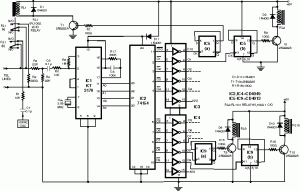
3170 IC For Telephone Remote Control Circuit
This circuit below shows a teleremote circuit that enables the switching on and off of appliances through telephone lines. It can be used.
The teleremote circuit operates by utilizing telephone lines to control electrical appliances remotely. The primary components of this...
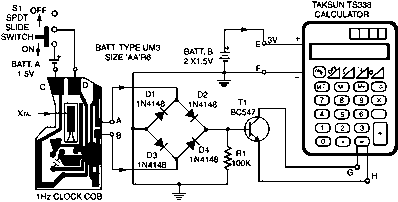
Telephone call meter circuit
In this circuit, a simple calculator, in conjunction with a COB (chip-on-board) from an analogue quartz clock, is used to make a telephone call meter. The calculator enables conversion of STD/ISD calls to local call equivalents and always displays current...
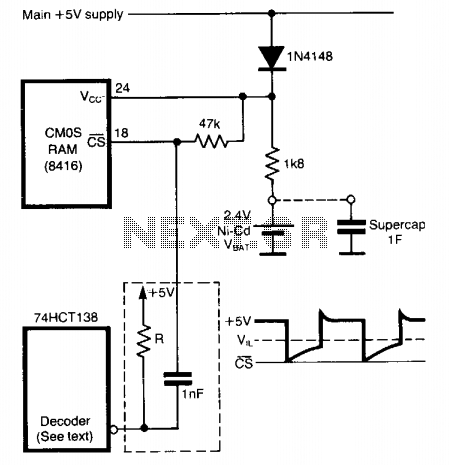
Stand-by power for non-volatile cmos rams
To prevent data loss when a CMOS RAM transitions from normal operation (Vcc = 5 volts) to standby mode (Vcc = VBAT), it is crucial to maintain the CS pin close to the Vcc rail at all times. This is...
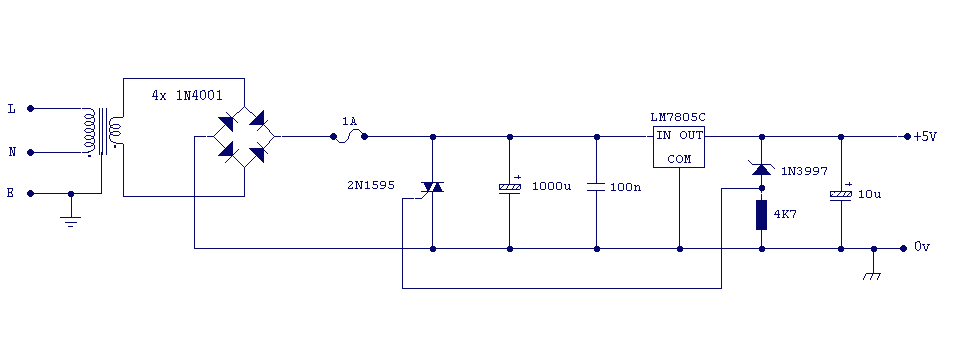
Logic PSU with Overvoltage Protection
The 5 volt regulated power supply for TTL and 74LS series integrated circuits has to be very precise and tolerant of voltage transients. These ICs are easily damaged by short voltage spikes. A fuse will blow when its current rating...
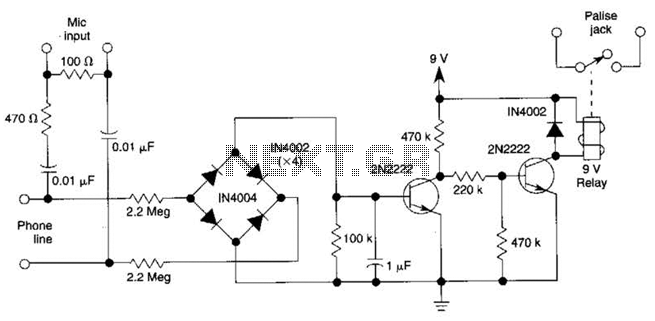
Telephone Call Recording Circuit Circuit
The DC voltage on a telephone line typically ranges from 45 to 50 V when on-hook and drops to around 6 V when off-hook. This circuit utilizes the voltage drop to activate a relay, which in turn controls a cassette...
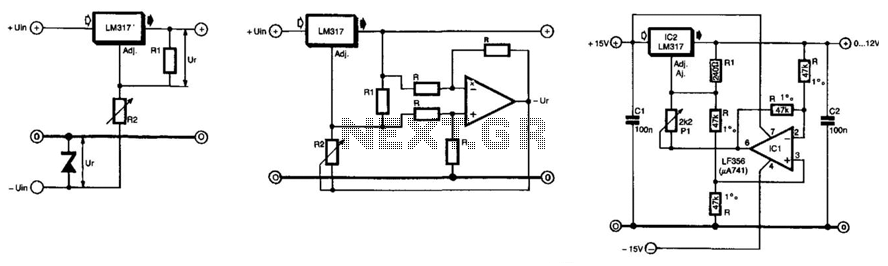
Regulator Circuit
The unique feature of this regulator is that the output voltage can be adjusted down to 0 V. The regulation is provided by an integrated regulator type LM317. Typically, in supplies that can be adjusted to 0 V, this IC...
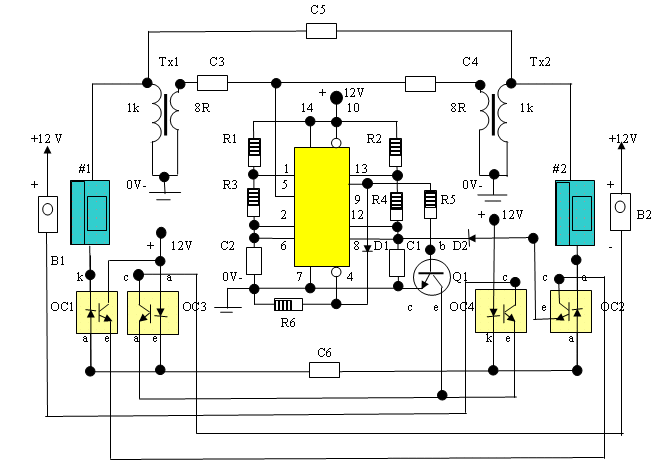
The Original 2 Phone Link=
This circuit initiated the development of various Link Telephone Intercom designs. Originally created in 1996 using heavy-duty relays and contact banks, it was updated last year to incorporate IC1 in place of a simpler transistor multivibrator. All relays and contact...
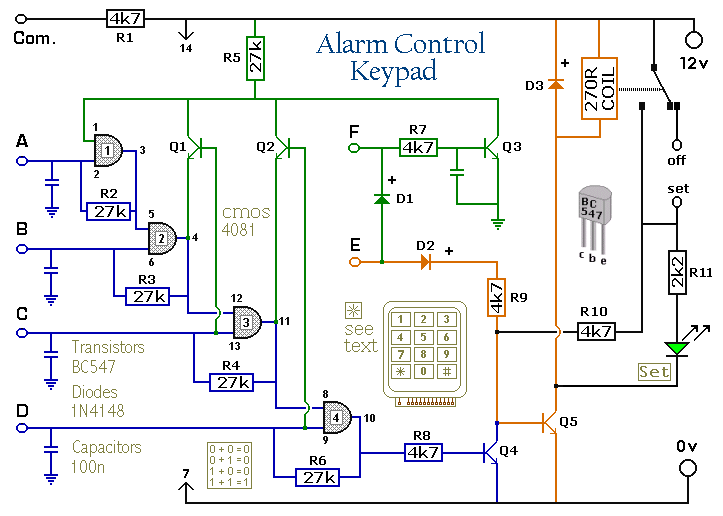
Enhanced 4 Digit Alarm Keypad
The Keypad must be the kind with a common terminal and a separate connection for each key. On a 12-key pad, look for 13 terminals. The matrix type with 7 terminals will NOT do. The Alarm is set by pressing...