


60 TO 72MHz VIDEO AND SOUND RECEIVER AND IF SYSTEM
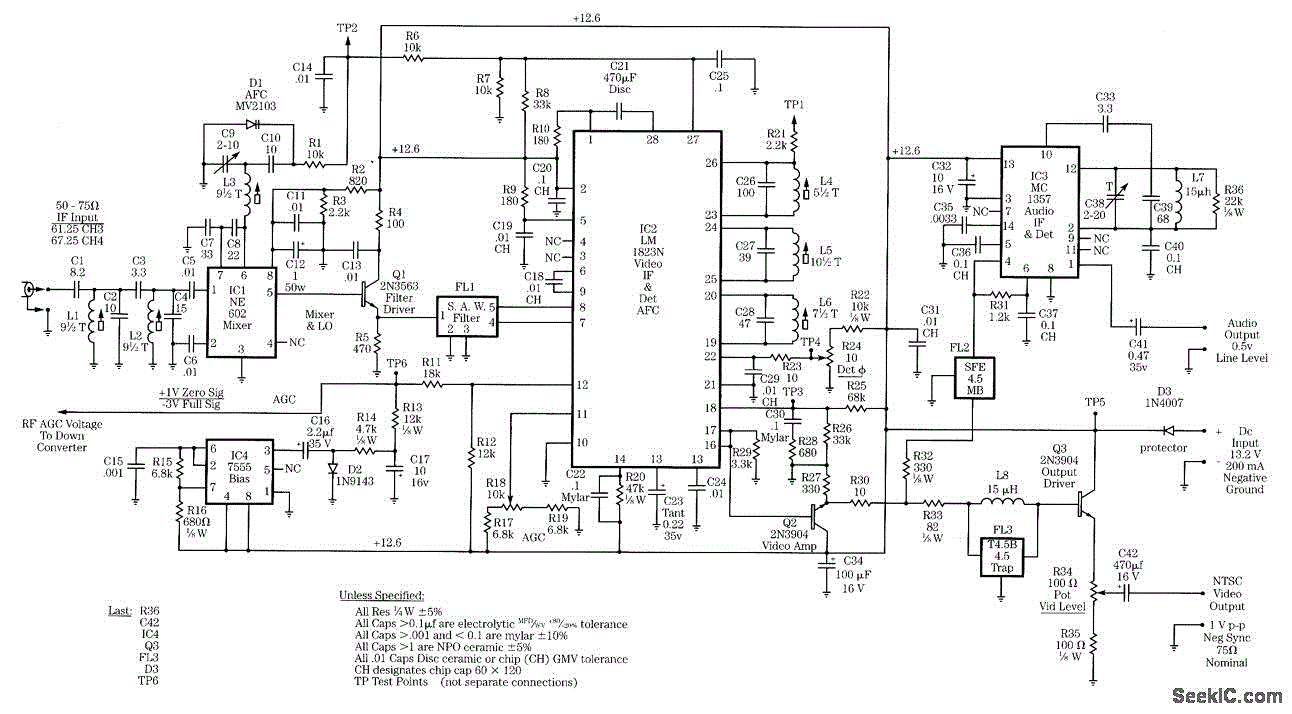
Description: This intermediate frequency (IF) system employs a NE602 oscillator/mixer to convert VHF television signals ranging from 60 to 72 MHz (channel 13 or channel 4 under the U.S. NTSC standard) down to 45 MHz. A surface acoustic wave (SAW) filter is incorporated to provide bandpass filtering, followed by an LM1823 integrated circuit that handles video IF, automatic gain control (AGC), automatic frequency control (AFC), and detection. The recovered video signal is directed to a sound trap and a 4.5 MHz sound takeoff filter. The processed video is then sent to the output emitter follower stage.
The described IF system is a crucial component in the processing of VHF television signals, particularly for applications that require precise signal conversion and filtering. The NE602 oscillator/mixer serves as the heart of the system, effectively translating the incoming VHF signals to a lower intermediate frequency of 45 MHz, which is more manageable for subsequent processing. This frequency conversion is essential for reducing the effects of noise and interference that can impact higher frequency signals.
The SAW filter is instrumental in ensuring that only the desired frequency range is passed through, thereby enhancing the selectivity of the system. SAW filters are known for their high performance and compact size, making them ideal for modern electronic applications. Following the filtering stage, the LM1823 IC performs multiple functions, including amplification and demodulation of the video signal. The integrated nature of the LM1823 allows for a reduction in component count and simplifies the design.
The recovered video signal is then routed through a sound trap, which is designed to eliminate any unwanted audio frequencies that may interfere with the video signal. The 4.5 MHz sound takeoff filter extracts the audio component from the video signal, allowing for separate processing of the audio and video paths. Finally, the output emitter follower stage provides a high input impedance and low output impedance, ensuring that the video signal can be effectively transmitted to the next stage of the system without degradation.
Overall, this IF system exemplifies a well-engineered approach to VHF signal processing, integrating advanced components to achieve high performance in video and audio signal handling.This IF system uses a NE602 oscillator/mixer to convert VHF TV signals of 60 to 72 MHz (channe13 or channel4 under the U.S. NTSC) to 45 MHz. An SAW filter is used to provide bandpass filtering, followed by an LM1823 video IF/AGC/AFC/detector IC.
Recovered video is fed to a sound trap and 4.5-MHz sound takeoff filter. Video is fed to the output emitter follow..
The described IF system is a crucial component in the processing of VHF television signals, particularly for applications that require precise signal conversion and filtering. The NE602 oscillator/mixer serves as the heart of the system, effectively translating the incoming VHF signals to a lower intermediate frequency of 45 MHz, which is more manageable for subsequent processing. This frequency conversion is essential for reducing the effects of noise and interference that can impact higher frequency signals.
The SAW filter is instrumental in ensuring that only the desired frequency range is passed through, thereby enhancing the selectivity of the system. SAW filters are known for their high performance and compact size, making them ideal for modern electronic applications. Following the filtering stage, the LM1823 IC performs multiple functions, including amplification and demodulation of the video signal. The integrated nature of the LM1823 allows for a reduction in component count and simplifies the design.
The recovered video signal is then routed through a sound trap, which is designed to eliminate any unwanted audio frequencies that may interfere with the video signal. The 4.5 MHz sound takeoff filter extracts the audio component from the video signal, allowing for separate processing of the audio and video paths. Finally, the output emitter follower stage provides a high input impedance and low output impedance, ensuring that the video signal can be effectively transmitted to the next stage of the system without degradation.
Overall, this IF system exemplifies a well-engineered approach to VHF signal processing, integrating advanced components to achieve high performance in video and audio signal handling.This IF system uses a NE602 oscillator/mixer to convert VHF TV signals of 60 to 72 MHz (channe13 or channel4 under the U.S. NTSC) to 45 MHz. An SAW filter is used to provide bandpass filtering, followed by an LM1823 video IF/AGC/AFC/detector IC.
Recovered video is fed to a sound trap and 4.5-MHz sound takeoff filter. Video is fed to the output emitter follow..
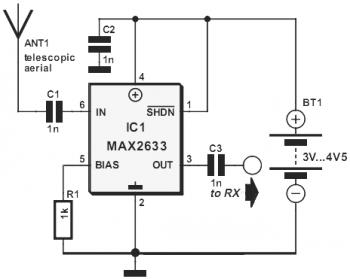
vhf rf preamp 100 175 mhz with max2633
This diagram represents a VHF RF preamplifier circuit operating within the frequency range of 100-175 MHz using a single MAX2633 chip. The circuit is suitable for the entire VHF broadcast and PMR band (100-175 MHz) and can be constructed easily...
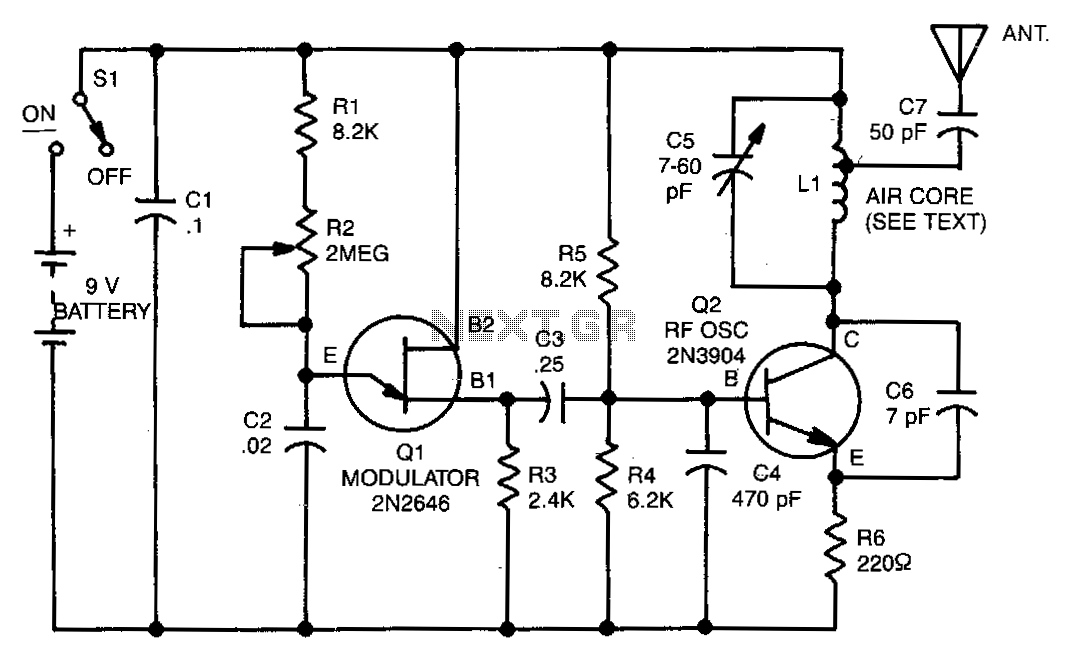
Vhf-tone-transmitter
The range of this transmitter is approximately 50 feet with a short whip antenna. The tone generator consists of a unijunction transistor (Q1) along with resistors R1, R2, R3, and capacitor C2. Transistor Q1 operates by pulsing on and off...
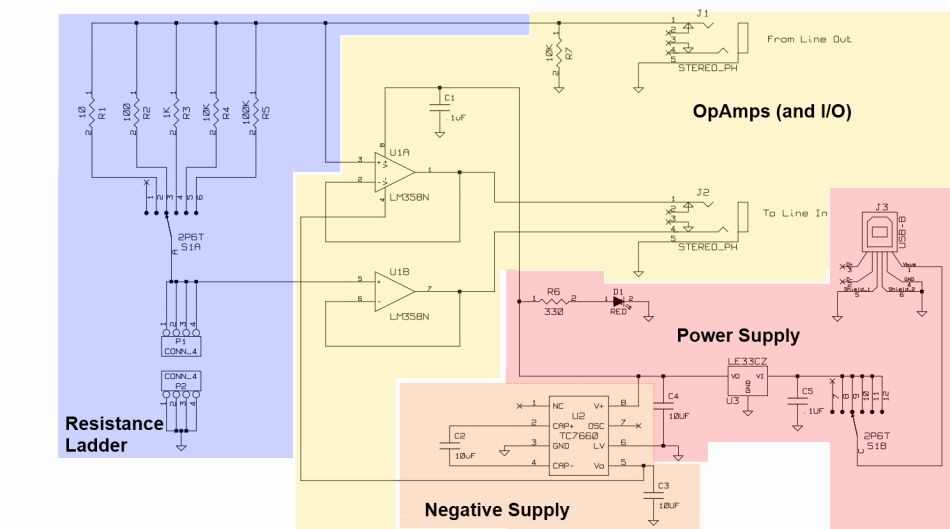
SR 6m/2m Converter
This kit, designed by Jan G0BBL and implemented and distributed by Tony KB9YIG, is a plug-in board for the Softrock Lite + Xtall RX V9.0 that down-converts VHF signals in the 2m and 6m bands to HF signals that can...
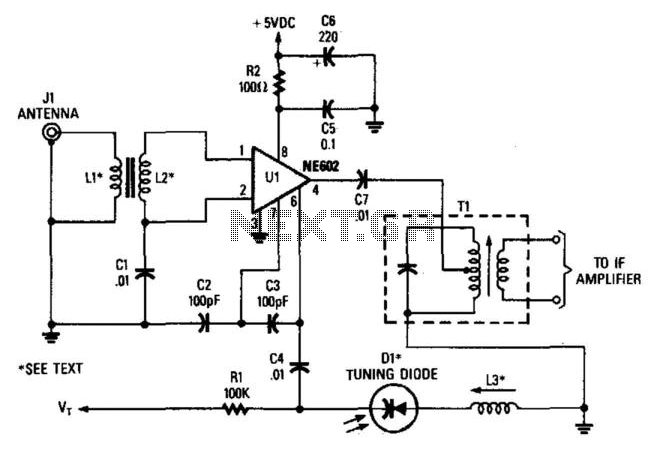
Receiver Frequency-Converter Stage
In this configuration, the NE602 serves as a frequency converter in a superheterodyne front-end setup. L1 and L2 form a broadband toroidal transformer, although a tuned transformer may also be utilized. The supply voltage ranges from +5 to +9 VDC....
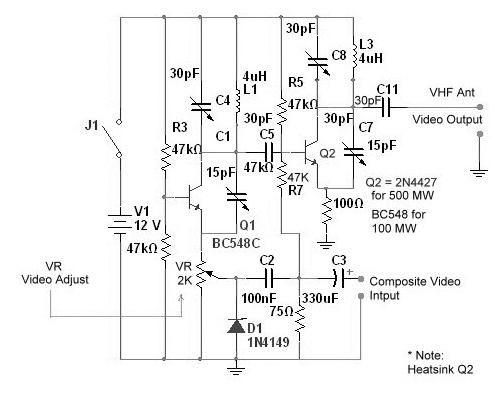
500 mW VHF Video Transmitter
Tuned circuits consist of C4, L1, C8, L3, and two 15 pF trimmer capacitors positioned across the collectors and emitters of both transistors. Other NPN transistors such as BC54, 2N3642, and 2N3643 may also be suitable. The circuit is designed...
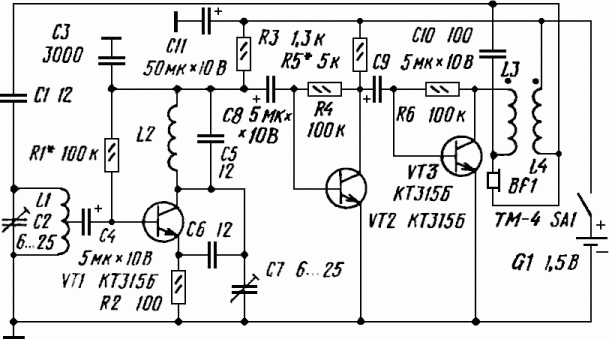
Simple VHF FM radio
The RF stage of the receiver utilizes a transistor VT1, functioning as both a mixer and a local oscillator while also serving as a synchronous detector. A headphone cable acts as an antenna, capturing signals that are directed to the...
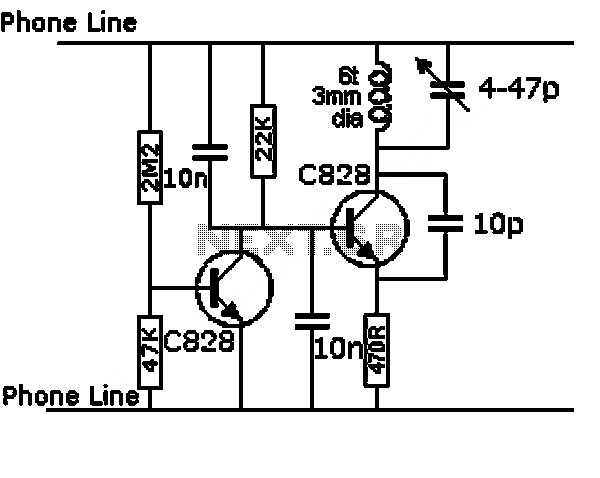
vhf video transmitter circuit
This is a simple circuit design for a video transmitter capable of radiating signals up to 50 meters. The video transmitter can be connected to a camera as a source and allows viewing on a VHF channel analog television. The...
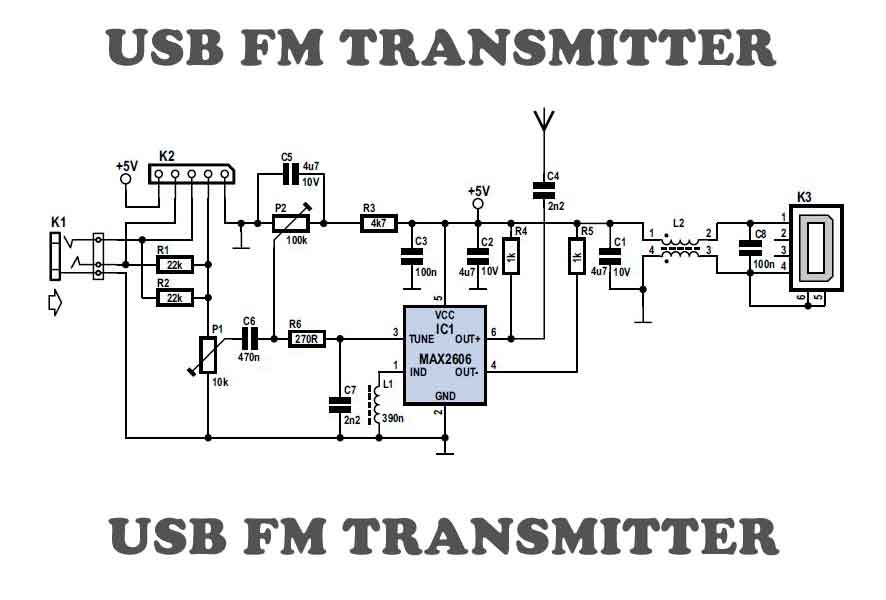
MAX2606 VHF FM Transmitter
To test VHF receivers independently from local radio stations, a frequency-modulated oscillator is required, covering the range of 89.5 to 108 MHz. Building such an oscillator with discrete components is challenging. The MAX260x series from Maxim offers five integrated oscillator...
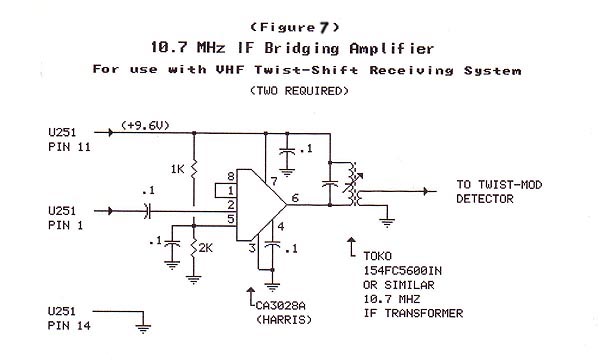
VHF Twist-Shift Keying Rotation-Shift Keying Orthogonal BPSK Twist Modulation Motorola SyntorX
The material in this section demonstrates the construction of the Twist-Shift system for VHF utilizing commonly available surplus land mobile VHF transceivers that have been modified to operate on the 2-meter ham band. The radios employed in this project were...