


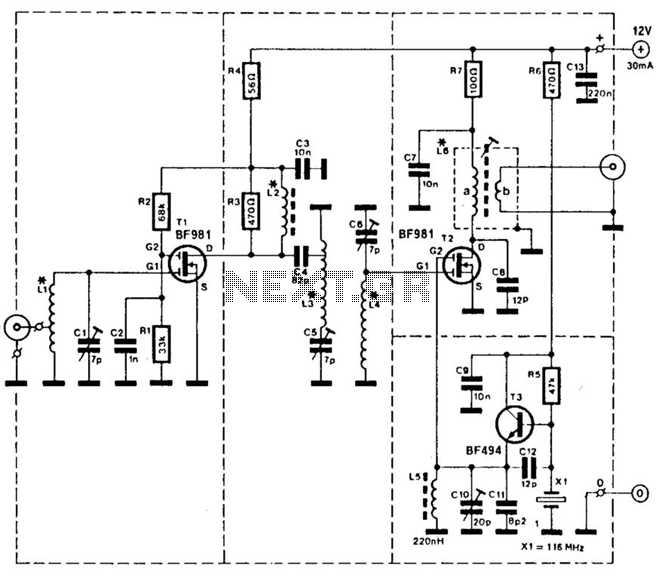
800 To 1000Mhz Scanner Converter Circuit
#scanner
#converter
#GASFET
#800MHz
#1000MHz
#reception
#frequency range
#high sensitivity
#RF front end
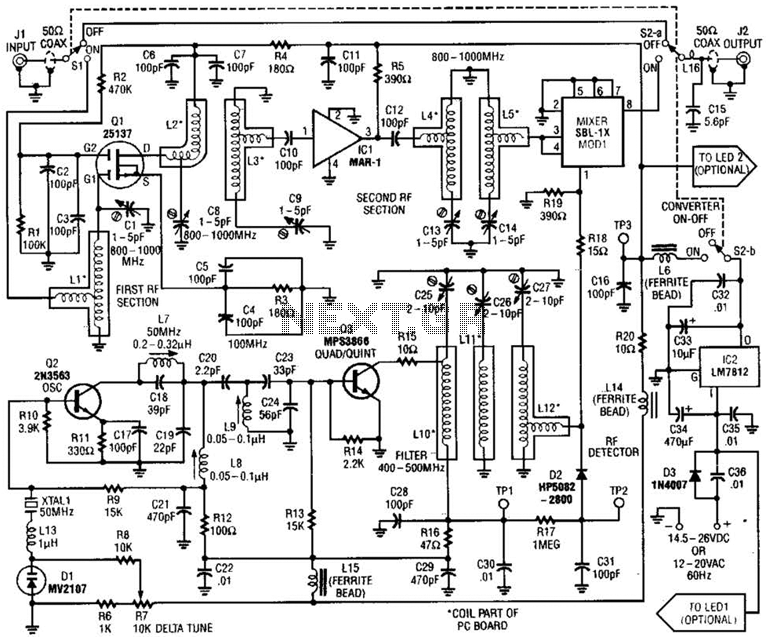
Description: This converter allows the reception of frequencies ranging from 800 to 1000 MHz on any scanner that operates within the 400 to 500 MHz range. The converter can be configured to cover either the 800 to 900 MHz band or, with readjustment, the 900 to 1000 MHz band. The sensitivity is significantly enhanced due to the use of a GASFET front end. For optimal performance, it is recommended that the scanner be of a programmable type.
The described frequency converter is designed to facilitate the reception of specific frequency bands by utilizing advanced electronic components and configurations. It operates effectively within the 800 to 1000 MHz range, which is particularly useful for applications such as communications monitoring, emergency services, and other radio frequency activities.
The GASFET (Gallium Arsenide Field-Effect Transistor) front end is a critical component in enhancing the sensitivity of the converter. GASFETs are known for their low noise characteristics and high gain, making them ideal for RF applications where signal integrity is paramount. This allows the converter to detect weaker signals that may be present within the specified frequency ranges.
The ability to switch between the 800 to 900 MHz and 900 to 1000 MHz bands provides flexibility for users, allowing them to tailor the device to their specific needs. This can be achieved through a simple readjustment process, which may involve tuning capacitors or inductors within the circuit to optimize performance for the desired frequency range.
For best results, the use of a programmable scanner is advised. Programmable scanners offer the capability to store multiple frequencies and settings, allowing users to quickly switch between different channels and bands. This feature is particularly beneficial in environments where quick adjustments are necessary, such as during emergency response operations or when monitoring multiple communication channels.
Overall, this converter serves as a versatile and efficient tool for expanding the frequency coverage of compatible scanners, enhancing their functionality and effectiveness in various applications. This converter enables reception of 800 to 1000 MHz on any scanner covering the 400 to 500-MHz range. The converter can be set up to cover either 800 to 900 MHz or by readjustment 900 to 1000 MHz. Sensitivity is very high because of the GASFET front end. For best results, the scanner should be of a programmable variety.
The described frequency converter is designed to facilitate the reception of specific frequency bands by utilizing advanced electronic components and configurations. It operates effectively within the 800 to 1000 MHz range, which is particularly useful for applications such as communications monitoring, emergency services, and other radio frequency activities.
The GASFET (Gallium Arsenide Field-Effect Transistor) front end is a critical component in enhancing the sensitivity of the converter. GASFETs are known for their low noise characteristics and high gain, making them ideal for RF applications where signal integrity is paramount. This allows the converter to detect weaker signals that may be present within the specified frequency ranges.
The ability to switch between the 800 to 900 MHz and 900 to 1000 MHz bands provides flexibility for users, allowing them to tailor the device to their specific needs. This can be achieved through a simple readjustment process, which may involve tuning capacitors or inductors within the circuit to optimize performance for the desired frequency range.
For best results, the use of a programmable scanner is advised. Programmable scanners offer the capability to store multiple frequencies and settings, allowing users to quickly switch between different channels and bands. This feature is particularly beneficial in environments where quick adjustments are necessary, such as during emergency response operations or when monitoring multiple communication channels.
Overall, this converter serves as a versatile and efficient tool for expanding the frequency coverage of compatible scanners, enhancing their functionality and effectiveness in various applications. This converter enables reception of 800 to 1000 MHz on any scanner covering the 400 to 500-MHz range. The converter can be set up to cover either 800 to 900 MHz or by readjustment 900 to 1000 MHz. Sensitivity is very high because of the GASFET front end. For best results, the scanner should be of a programmable variety.
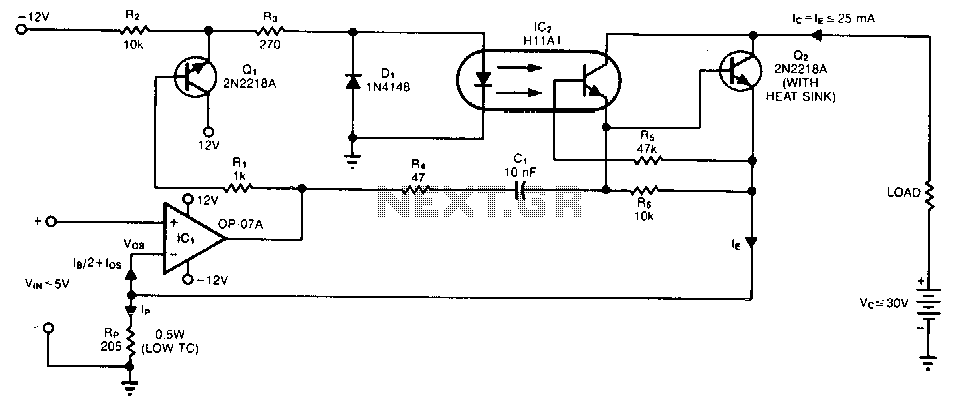
Zero-error-converter
A single programming resistor (Rp) provides an output current range of approximately six decades. It is important to note that the temperature coefficient (TC) of this resistor can introduce potential errors, as it dissipates 125 mW when the junction linearity...
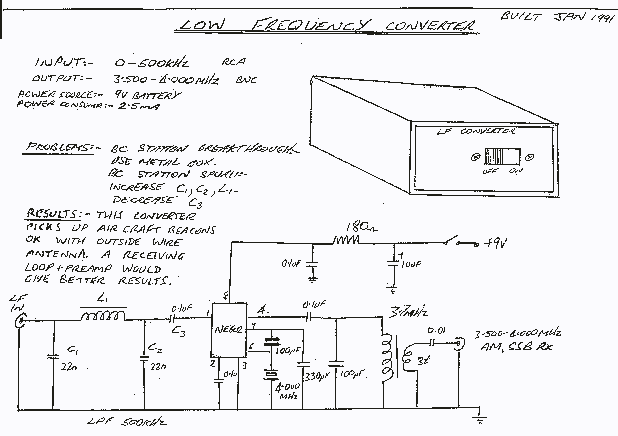
500kHz to 4 MHz Converter
This converter allows reception of signals below 500 kHz on a 3.5 to 4 MHz HF receiver. It should therefore be useful for those with receivers that do not receive the lower frequencies. Again the converter uses the popular NE602...
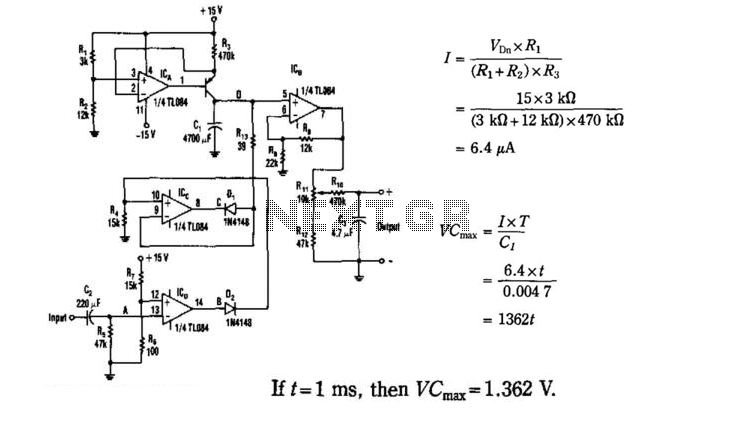
Period-To-Voltage Converter
The input signal drives the ICD. Because the positive input (V+) of the ICD is slightly offset to +0.1 V, its steady-state output will be around +13 V. This voltage is sent to the ICC through D2, which sets the...
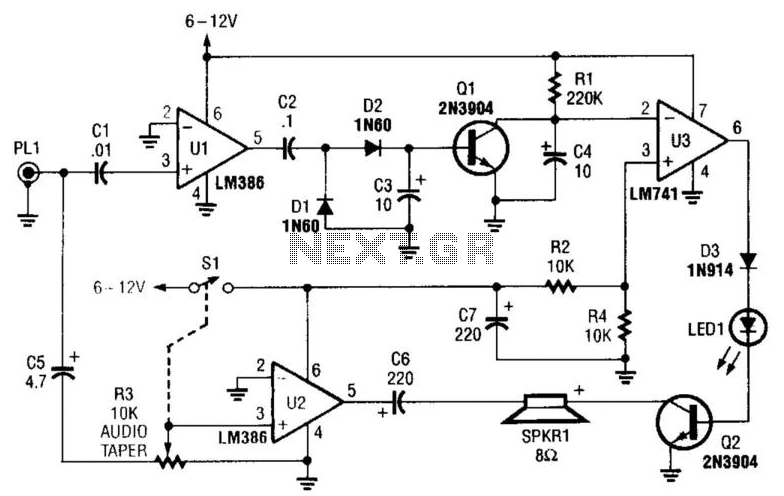
Scanner Voice Squelch
This circuit detects the presence of audio (voice) on the output of a scanner. If the scanner stops on a "dead carrier" or noise, the circuit mutes the speaker to avoid annoying noise. An operational amplifier amplifies speech and drives...
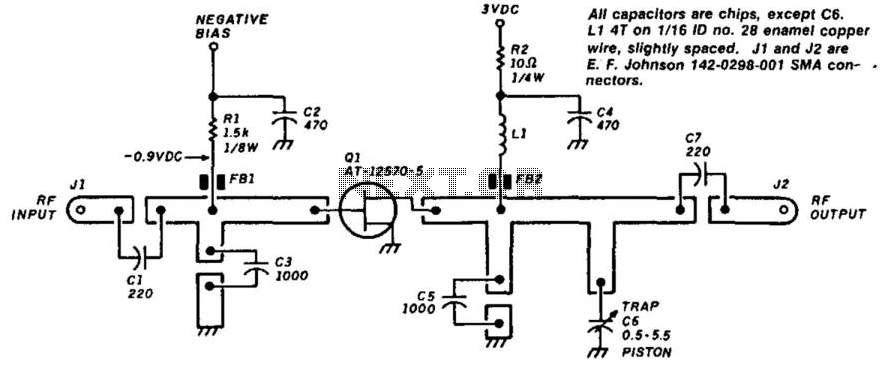
Gasfet Frequency Doubler
This circuit will produce over +10 dBm in the 1800-3000 MHz range. Drive power is 7 dBm in the 900 to 1500 MHz range. The PC board is G-10 epoxy double-sided. Artwork is shown above, as well as parts placement....
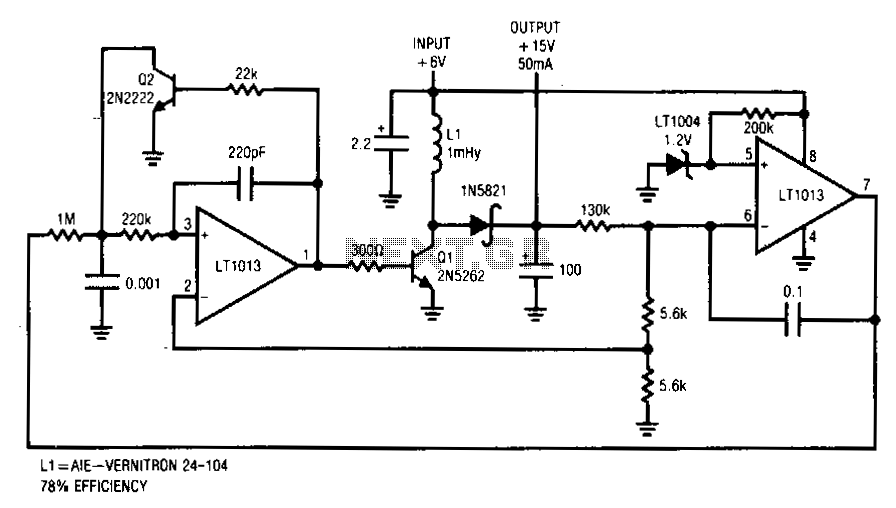
Regulated-driven-converter
This converter delivers up to 50 mA from a 6-V battery with 78% efficiency. This flyback converter functions by feedback-controlling the frequency of inductive flyback events. The inductor's output is rectified and filtered to de-bias the feedback loop to establish...
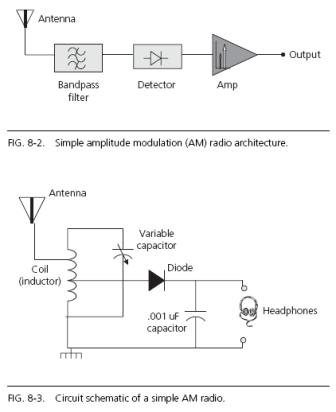
Understand Radio Architectures
The fundamental operation of an RF front end is straightforward: it detects and processes radio waves transmitted at a specific known frequency or range of frequencies and modulation format. The modulation carries information of interest, such as voice, audio, data,...
Understand Radio Architectures
The fundamental operation of an RF front end is straightforward: it detects and processes radio waves transmitted at a specific known frequency or range of frequencies and modulation format. The modulation carries information of interest, such as voice, audio, data,...
2Meter Converter
This converter allows a receiver that operates within the frequency range of 28 to 32 MHz to receive signals from the 144 to 148 MHz amateur band. It utilizes a BF981 dual-gate MOSFET to provide RF gain, which is then...