


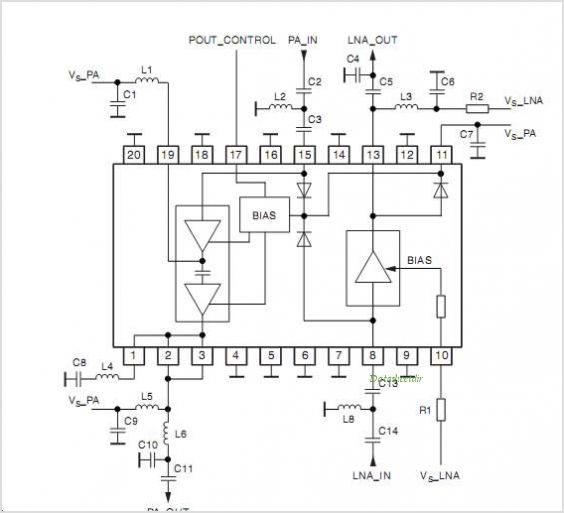
ATR0981 ATR0981 UHF SiGe Front-end IC
Description: In certain instances, appliances and equipment can function when supplied with two different levels of AC line voltage at their main terminals (120 V or 240 V). This is why it is common for appliances and equipment to include mechanical selectors or switches to choose the required voltage level. However, these types of equipment can suffer significant damage if the selector is not positioned correctly. To mitigate these issues, Thyristors can be employed as a solution for creating automatic voltage selectors, thereby reducing the risk of equipment damage due to overvoltage or undervoltage conditions supplied by the AC line. Thyristors can take various forms, yet they share common characteristics. All are solid-state switches that act as open circuits capable of withstanding the rated voltage until triggered. Once triggered, Thyristors become low-impedance current paths and maintain this state (i.e., conduction) until the current ceases or falls below a minimum threshold known as the holding level. A practical application of Triacs is as a direct substitute for mechanical selectors, relays, or switches. In this context, the Triac provides on/off control, and its power-regulating capabilities are not utilized. The control circuitry for these applications is typically straightforward, making these circuits beneficial in scenarios where simplicity and reliability are crucial.
Thyristors, particularly Triacs, serve as vital components in automatic voltage selection systems. These systems are designed to detect the incoming AC line voltage and adjust the operational state of the connected appliance accordingly. The automatic voltage selector circuit typically consists of a voltage sensing circuit, which monitors the line voltage levels and compares them against predetermined thresholds. When the voltage level is detected as either above or below the acceptable range, the control circuitry triggers the Thyristor, allowing current to flow through the appropriate load.
The implementation of Triacs in these circuits enhances reliability and efficiency. Triacs can handle bidirectional current, making them suitable for AC applications. They are often paired with zero-crossing detection circuits, which ensure that the Triac is triggered at the point where the AC waveform crosses zero volts, reducing electromagnetic interference and stress on the components.
In addition to their use in automatic voltage selectors, Thyristors are also utilized in various other applications such as light dimmers, motor speed controls, and heating control systems. Their ability to manage high power loads while providing precise control makes them an ideal choice for modern electronic designs. Furthermore, the simplicity of the control circuitry allows for easy integration into existing systems, promoting widespread adoption in both industrial and consumer applications. Overall, Thyristors represent a robust solution for managing AC line voltage, ensuring the safety and longevity of connected appliances and equipment.In some cases, appliances and equipment are able to operate when supplied by two different levels of AC line voltage to their main terminals (120 V or 240 V). This is why, it is very common that appliances and equipment have mechanical selectors or switches as an option for selecting the level of voltage needed.
Nevertheless, it is also very commo n that these types of equipment CAN suffer extensive damage caused for not putting the selector in the right position. To prevent these kind of problems, Thyristors CAN be used as a solution for making Automatic voltage selectors in order to avoid possibilities of equipment damage due to over or low voltages AC line supplied to them.
Thyristors CAN take many forms, but they have certain things in common. All of them are solid state switches, which act as open circuits capable of withstanding the rated voltage until triggered. When they are triggered, Thyristors become low impedance current paths and remain in that condition (i.
e. conduction) until the current either stops or drops below a minimum value called the holding level. A useful application of Triacs is a direct replacement for mechanical selectors, relays or switches. In this application, the Triac furnishes on ’off control and the power regulating ability of the Triac is not utilized. The control circuitry for these applications is usually very simple and these circuits are useful in applications where simplicity and reliability are important.
In addition, as is
Thyristors, particularly Triacs, serve as vital components in automatic voltage selection systems. These systems are designed to detect the incoming AC line voltage and adjust the operational state of the connected appliance accordingly. The automatic voltage selector circuit typically consists of a voltage sensing circuit, which monitors the line voltage levels and compares them against predetermined thresholds. When the voltage level is detected as either above or below the acceptable range, the control circuitry triggers the Thyristor, allowing current to flow through the appropriate load.
The implementation of Triacs in these circuits enhances reliability and efficiency. Triacs can handle bidirectional current, making them suitable for AC applications. They are often paired with zero-crossing detection circuits, which ensure that the Triac is triggered at the point where the AC waveform crosses zero volts, reducing electromagnetic interference and stress on the components.
In addition to their use in automatic voltage selectors, Thyristors are also utilized in various other applications such as light dimmers, motor speed controls, and heating control systems. Their ability to manage high power loads while providing precise control makes them an ideal choice for modern electronic designs. Furthermore, the simplicity of the control circuitry allows for easy integration into existing systems, promoting widespread adoption in both industrial and consumer applications. Overall, Thyristors represent a robust solution for managing AC line voltage, ensuring the safety and longevity of connected appliances and equipment.In some cases, appliances and equipment are able to operate when supplied by two different levels of AC line voltage to their main terminals (120 V or 240 V). This is why, it is very common that appliances and equipment have mechanical selectors or switches as an option for selecting the level of voltage needed.
Nevertheless, it is also very commo n that these types of equipment CAN suffer extensive damage caused for not putting the selector in the right position. To prevent these kind of problems, Thyristors CAN be used as a solution for making Automatic voltage selectors in order to avoid possibilities of equipment damage due to over or low voltages AC line supplied to them.
Thyristors CAN take many forms, but they have certain things in common. All of them are solid state switches, which act as open circuits capable of withstanding the rated voltage until triggered. When they are triggered, Thyristors become low impedance current paths and remain in that condition (i.
e. conduction) until the current either stops or drops below a minimum value called the holding level. A useful application of Triacs is a direct replacement for mechanical selectors, relays or switches. In this application, the Triac furnishes on ’off control and the power regulating ability of the Triac is not utilized. The control circuitry for these applications is usually very simple and these circuits are useful in applications where simplicity and reliability are important.
In addition, as is
RF OSCILLATOR CIRCUITS
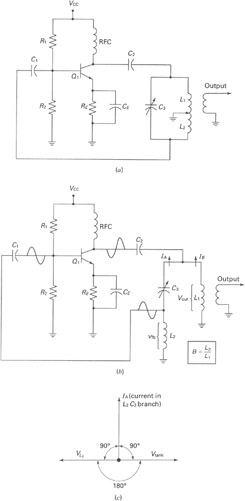
A widely recognized circuit is the Hartley oscillator, which is characterized by a tapped coil within the LC tank circuit. The tap point of the coil is grounded. The oscillator's amplifier section functions as a common-emitter amplifier, resulting in the...
UHF Antenna Booster
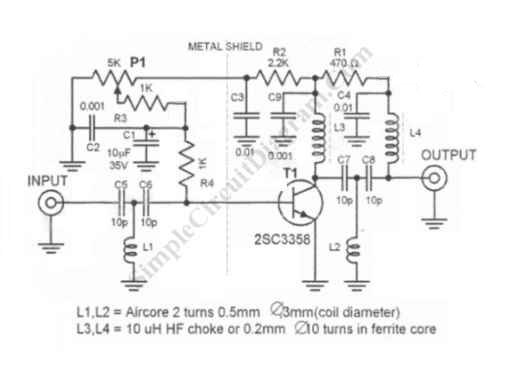
This antenna signal booster is designed for TV receivers operating in the UHF band (400-850 MHz) and provides an amplification of approximately 10 to 15 dB. The schematic diagram of the circuit indicates that special attention is necessary for the...
IC Voltage Regulators-withCircuit - Design & Theory
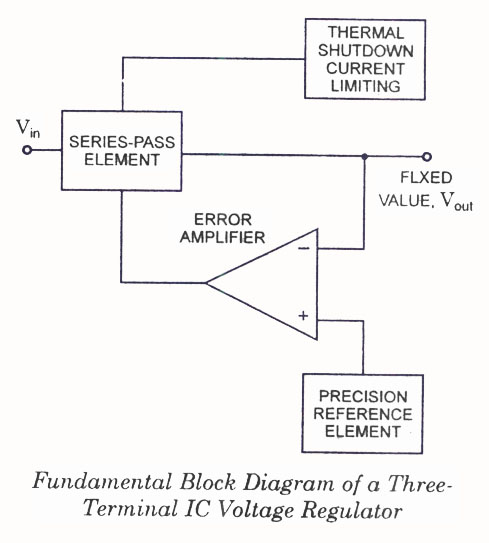
IC Voltage Regulators - Circuit diagram and block diagram of linear, fixed, adjustable (positive and negative), and switching voltage regulators.
IC voltage regulators are essential components in electronic circuits, providing stable output voltages from a varying input voltage source. They can...
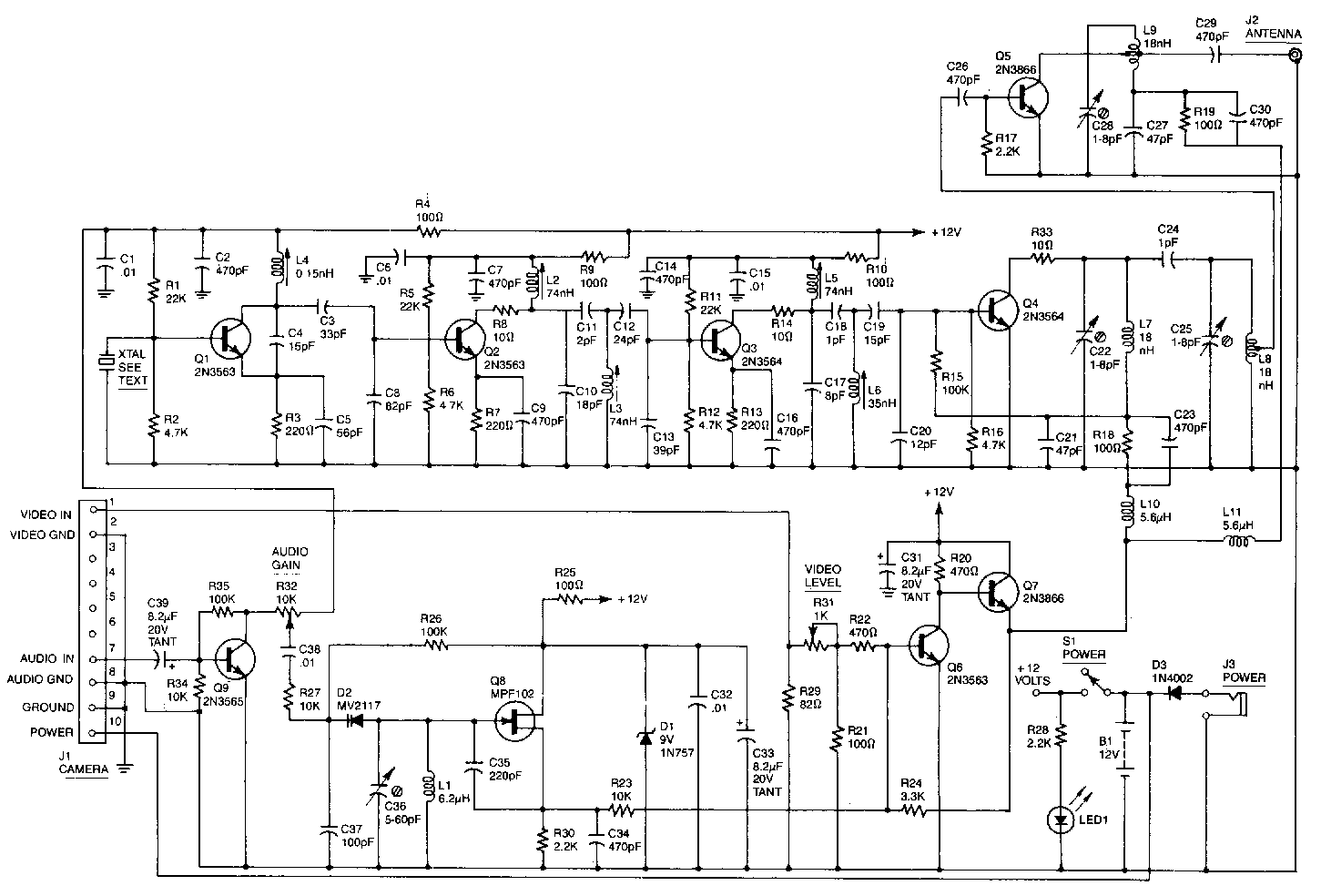
Wireless video camera link
This high-performance video camera link transmits signals from a video camera to a VCR or from a VCR to TVs throughout a home. The initial stage of the RF chain features a crystal-controlled oscillator, Q1, operating at a frequency range...
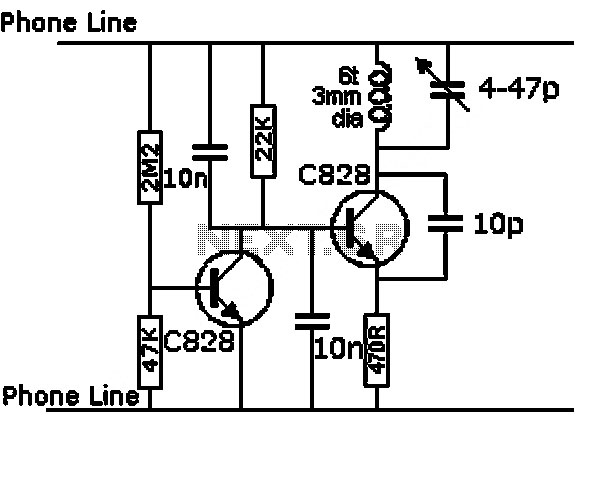
uhf tv transmitter circuit
This is a design circuit for a UHF transmitter. The TV transmitter operates within the UHF frequency range of 470-580 MHz, specifically on channels 21-34. It can transmit signals over distances of 30-100 meters using a cable length of 10-20...
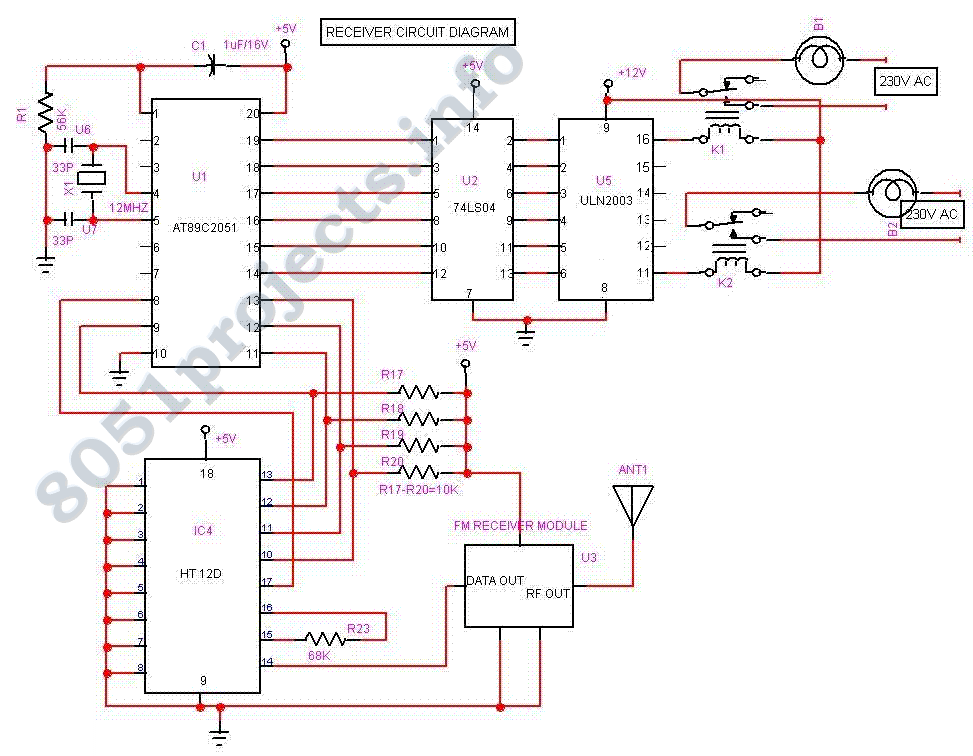
RF Remote control
The Project Long Range Remote Control can be used to remotely control a number of Electrical or Electronic Gadgets connected to it. Unlike Infra Red remote control, this Project employs FM transmission and Reception, and hence it can be used...
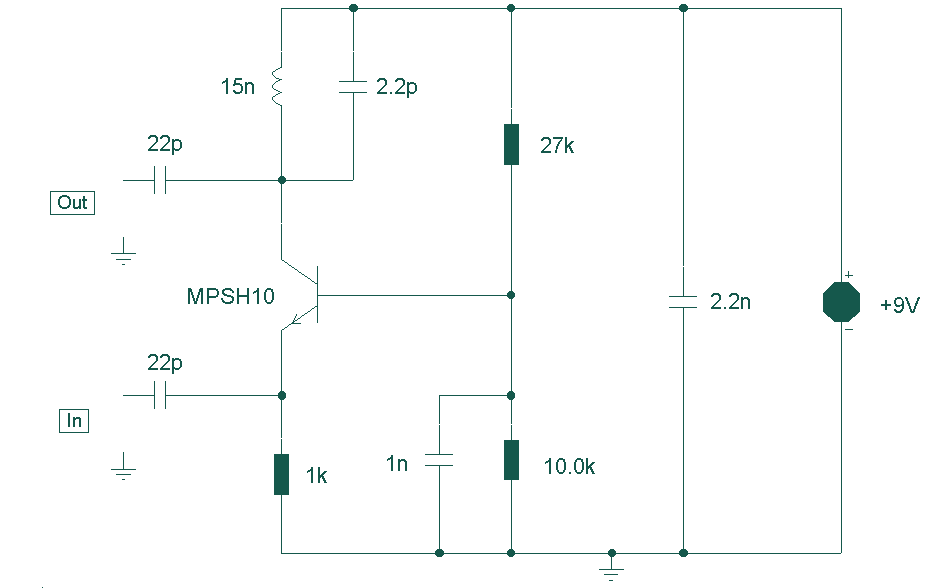
UHF Preamplifier
This circuit is designed to work at UHF frequencies in the range 450-800MHz. It has a gain of around 10dB and is suitable for boosting weak TV signals. The circuit is shown below.
The described circuit operates within the Ultra High...
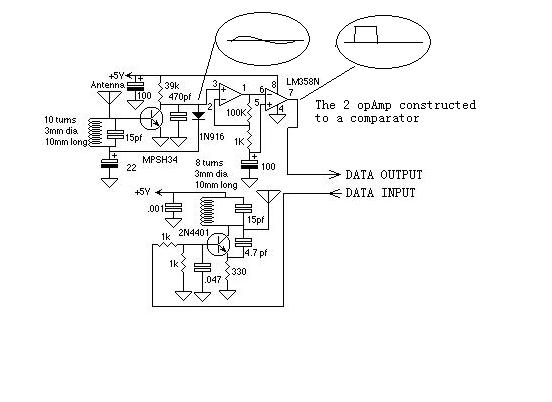
RF communication use a sample circuit(example in AVR)
Even including labor, the actual cost of purchasing, stocking, assembly, assembly errors, more expensive PCBs (with additional holes and larger sizes), and the increased difficulty in tuning would likely result in significantly higher expenses.
The analysis of costs associated with electronic...
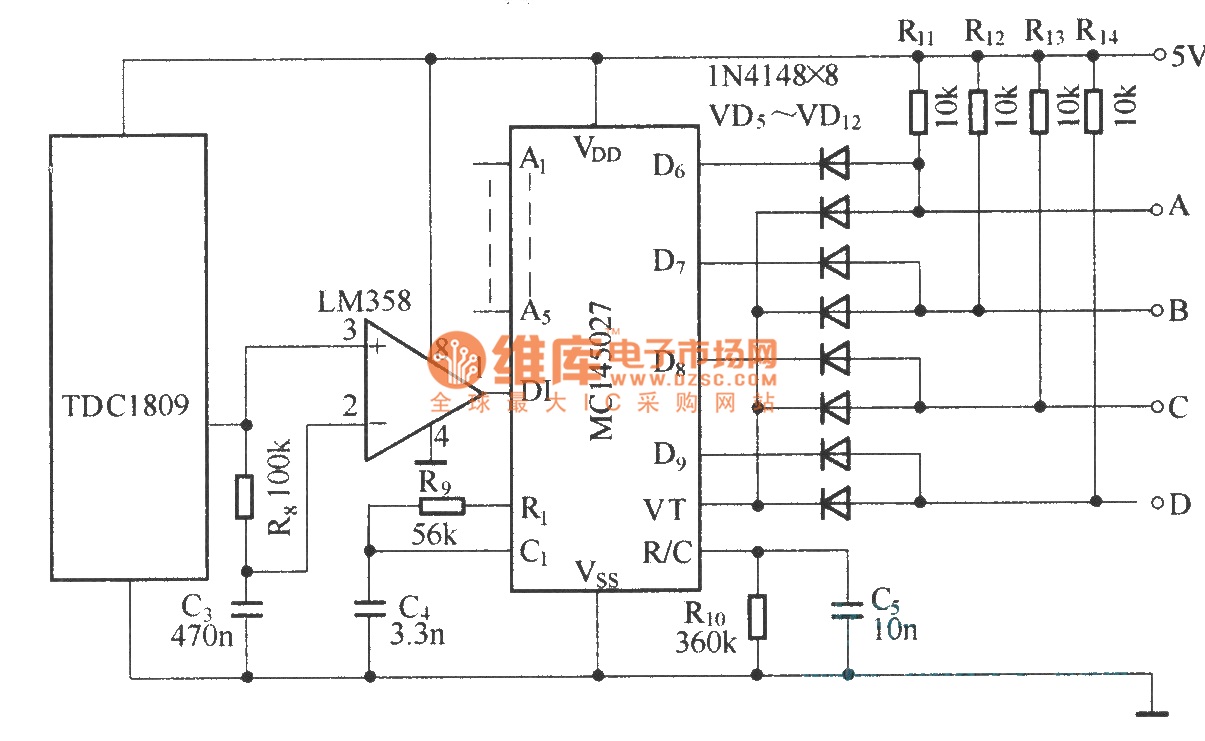
Composed of TDC1808/TDC1809 digital coding control circuit diagram
The TDC1808/TDC1809 is a pair of wireless remote control transmitter and receiver components. They utilize an internal antenna to transmit both digital and analog signals. These components are suitable for various wireless remote control devices. Key features include compact size,...