


Deluxe Radar Detector
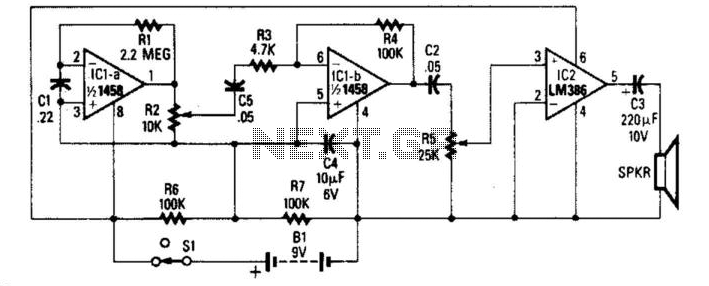
Description: This simple radar detector includes an audio amplifier for driving a loudspeaker. It uses an operational amplifier as a detector of microwave signals.
The radar detector circuit primarily consists of an operational amplifier (op-amp), which functions as the core component for detecting microwave signals. The op-amp is configured in a manner that allows it to amplify the weak microwave signals received by the antenna. The circuit typically includes an antenna designed to capture microwave frequencies, which are then fed into the input of the op-amp.
The output from the op-amp is connected to an audio amplifier stage, which is responsible for driving a loudspeaker. This audio amplifier can be a simple transistor-based amplifier or an integrated circuit designed for audio applications. The amplified audio signal is then sent to the loudspeaker, producing a sound that indicates the presence of microwave signals.
To ensure optimal performance, the circuit may include additional components such as resistors and capacitors that set the gain of the op-amp and filter out unwanted noise. Power supply considerations are also crucial; the circuit requires a stable voltage source to ensure proper operation of the op-amp and audio amplifier.
Overall, this radar detector design allows for effective detection of microwave signals, providing audible alerts through the loudspeaker, which can be particularly useful in various applications such as speed detection in law enforcement or monitoring in industrial settings. This simple radar detector includes an audio amplifier for driving a loud speaker. As in Fig. 69-1, it uses an op amp as a detector of microwave signals.
The radar detector circuit primarily consists of an operational amplifier (op-amp), which functions as the core component for detecting microwave signals. The op-amp is configured in a manner that allows it to amplify the weak microwave signals received by the antenna. The circuit typically includes an antenna designed to capture microwave frequencies, which are then fed into the input of the op-amp.
The output from the op-amp is connected to an audio amplifier stage, which is responsible for driving a loudspeaker. This audio amplifier can be a simple transistor-based amplifier or an integrated circuit designed for audio applications. The amplified audio signal is then sent to the loudspeaker, producing a sound that indicates the presence of microwave signals.
To ensure optimal performance, the circuit may include additional components such as resistors and capacitors that set the gain of the op-amp and filter out unwanted noise. Power supply considerations are also crucial; the circuit requires a stable voltage source to ensure proper operation of the op-amp and audio amplifier.
Overall, this radar detector design allows for effective detection of microwave signals, providing audible alerts through the loudspeaker, which can be particularly useful in various applications such as speed detection in law enforcement or monitoring in industrial settings. This simple radar detector includes an audio amplifier for driving a loud speaker. As in Fig. 69-1, it uses an op amp as a detector of microwave signals.
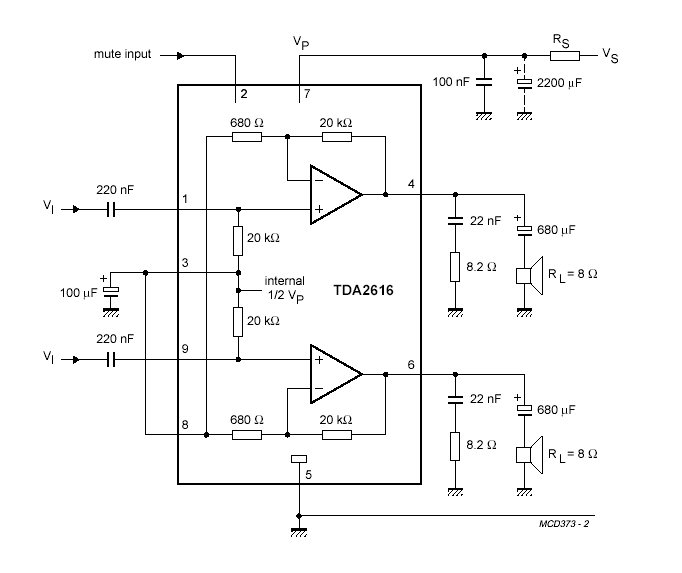
Stereo Audio Amplifier with TDA2616
A power amplifier was constructed during secondary school using transistors. The circuit offered limited power and featured a poorly designed PCB. Concurrently, access to the TDA1524 datasheet, a tone and volume control circuit, led to the decision to create a...
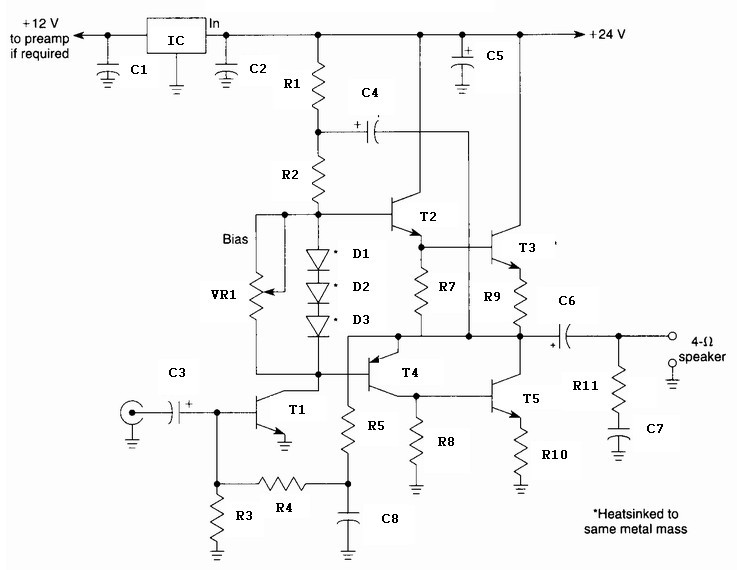
10 Watt Audio Amplifier
A 10 Watt audio amplifier circuit diagram is presented. This circuit serves as a general-purpose 10-W power audio amplifier, suitable for medium power applications or for use in modulation within AM transmitters. To achieve higher power levels, up to 30...
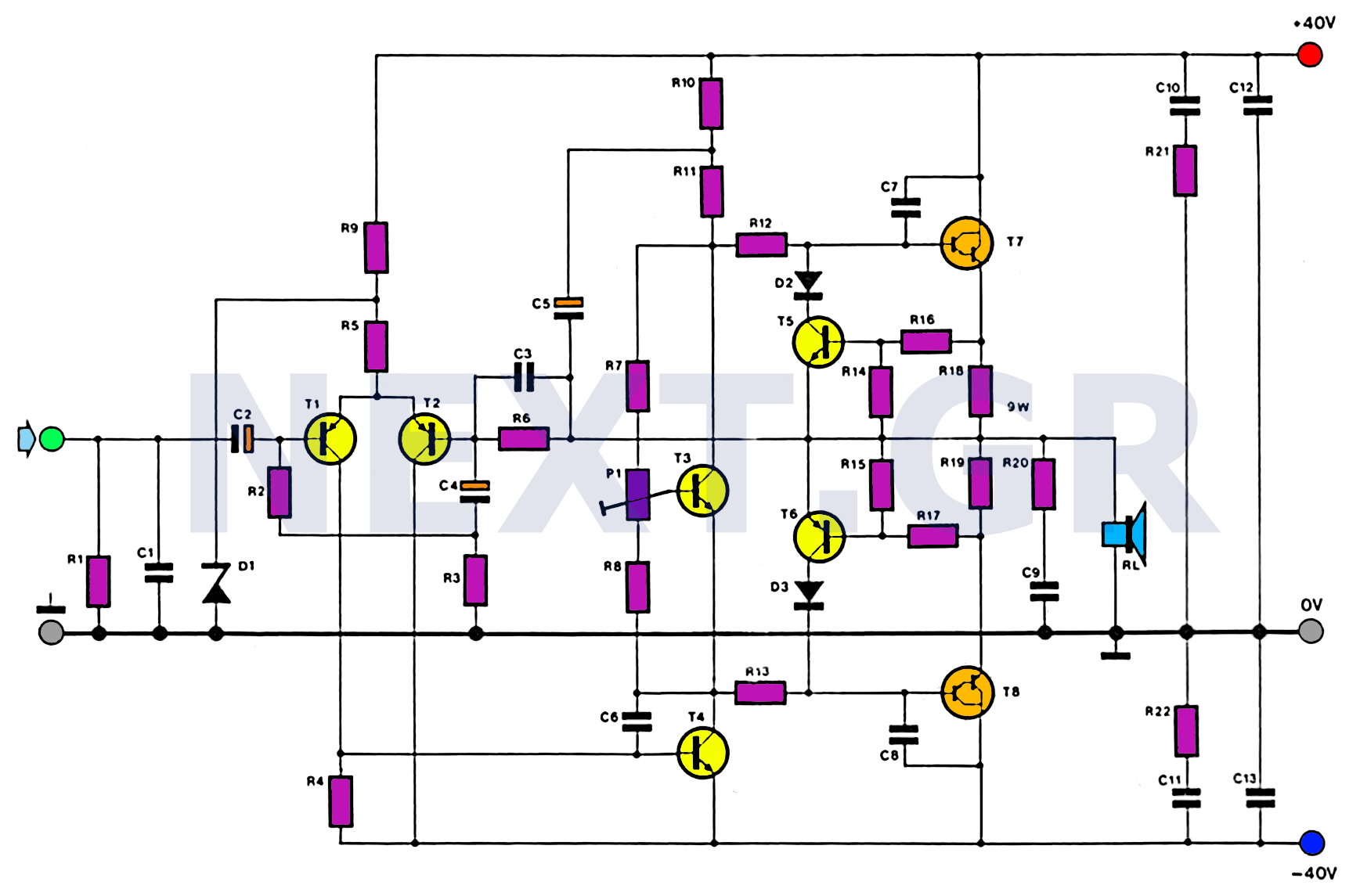
100W HiFi Audio Amplifier Circuit
This amplifier is designed with the following specifications: distortion less than 0.1% at full power of 100W even at 20KHz, with power attributed to an extended bandwidth. The output transistors are protected against short circuits, and the power supply is...
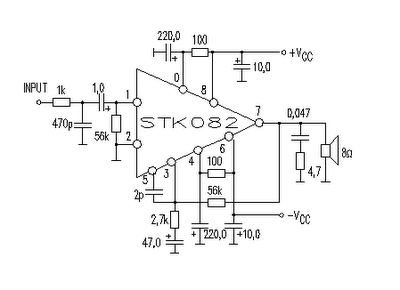
35w audio amplifier circuit by stk082
This amplifier circuit is suitable for home power audio devices. The STK082 amplifier specifications suggest that it can operate with supply voltages of up to ±43V. However, it is advisable to use no more than ±25V for 8-ohm loads, although...
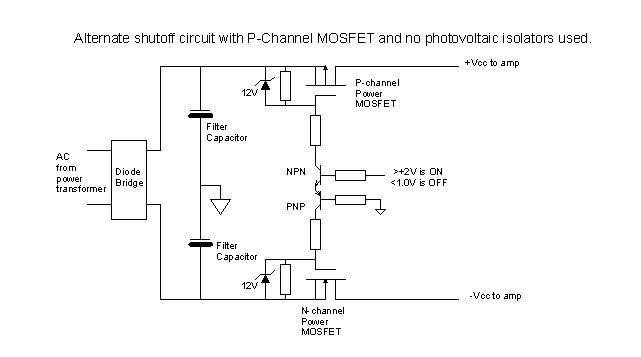
A DC Fault Protection Circuit for Audio Amplifiers
The standard Class AB audio power amplifier allows for direct coupling of the amplifier's output to speakers. This is beneficial as it eliminates capacitors or transformers that could compromise sound quality. The speakers are connected directly to the amplifying devices....
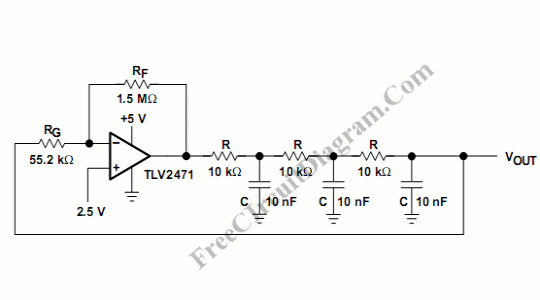
op amp Op amp analysis question
The circuit was reverse engineered from old equipment. The operational amplifier stage appears to function as a comparator or oscillator, comparing a time-varying voltage $V_0$, influenced by capacitors, against a 2.5 V reference from a square wave generator with a...
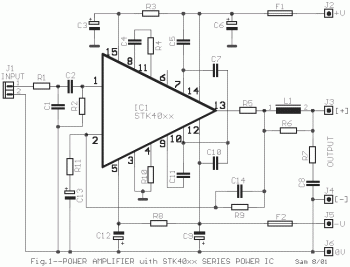
Power Audio Amplifier based on STK400xx
This is a power audio amplifier circuit based on the STK400xx series. It provides high-quality sound and is cost-effective, as the STK40xx series is affordably priced. The circuit can be easily constructed using only a few external components. The STKxxxx...
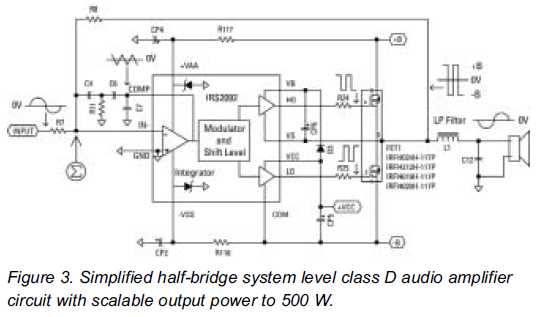
Class D Audio Amplifier Matches Class AB With Higher Efficiency
Class D audio amplifiers are now prepared to replace Class AB amplifiers. An integrated high-voltage audio driver simplifies the design and construction of high-power audio systems.
Class D audio amplifiers, also known as switching amplifiers, utilize pulse-width modulation (PWM) to convert...
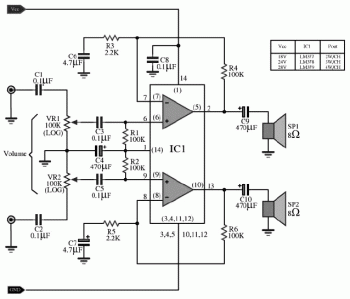
Stereo OTL Audio Amplifier
The following diagram illustrates the circuit of a Stereo OTL Audio Amplifier. It is based on an integrated circuit (IC), making the circuit design straightforward. The amplifier project can utilize ICs such as LM379, LM377, or LM378. According to the...