


Foxhunt FM Transmitter Circuit
#FM transmitter
#144 MHz
#fox hunt
#amateur radio
#hidden transmitter
#homebrewed receivers
#2 meter band
#RF circuit

Description: This 2-meter 144 MHz fox hunt transmitter is utilized in amateur competitions where participants seek to locate a concealed transmitter using primarily homebrewed receivers.
The 144 MHz fox hunt transmitter is designed for use in amateur radio competitions, commonly referred to as "fox hunting." This activity involves participants, known as "hunters," who attempt to locate a hidden transmitter, or "fox," using direction-finding techniques. The transmitter operates on the 2-meter band, which is a popular frequency range for amateur radio operators.
Key components of the transmitter may include a microcontroller to control the transmission intervals, a power amplifier to boost the signal, and an antenna optimized for 144 MHz operation. The transmitter typically emits a series of beeps or tones at regular intervals, allowing hunters to triangulate its position based on signal strength and direction.
In constructing the transmitter, careful consideration should be given to the power output, which is often limited to comply with amateur radio regulations. The circuit may also incorporate features such as a low-power mode to extend battery life and a simple user interface for setting transmission parameters.
Overall, this fox hunt transmitter serves as an engaging tool for amateur radio enthusiasts, promoting skills in radio direction finding and fostering community interaction through competitive events.This 2 meter 144 MHz fox hunt transmitter is used in amateur competitions where a hidden transmitter is to be ""hunted"" using mostly homebrewed receivers an..
The 144 MHz fox hunt transmitter is designed for use in amateur radio competitions, commonly referred to as "fox hunting." This activity involves participants, known as "hunters," who attempt to locate a hidden transmitter, or "fox," using direction-finding techniques. The transmitter operates on the 2-meter band, which is a popular frequency range for amateur radio operators.
Key components of the transmitter may include a microcontroller to control the transmission intervals, a power amplifier to boost the signal, and an antenna optimized for 144 MHz operation. The transmitter typically emits a series of beeps or tones at regular intervals, allowing hunters to triangulate its position based on signal strength and direction.
In constructing the transmitter, careful consideration should be given to the power output, which is often limited to comply with amateur radio regulations. The circuit may also incorporate features such as a low-power mode to extend battery life and a simple user interface for setting transmission parameters.
Overall, this fox hunt transmitter serves as an engaging tool for amateur radio enthusiasts, promoting skills in radio direction finding and fostering community interaction through competitive events.This 2 meter 144 MHz fox hunt transmitter is used in amateur competitions where a hidden transmitter is to be ""hunted"" using mostly homebrewed receivers an..

SMD FM Transmitter
Construct a low-power FM transmitter using surface-mount devices (SMD) that can be received by a standard FM radio. Soldering surface-mounted devices is relatively straightforward. Many small FM transmitter designs exist, but they often have issues. Firstly, an audio amplifier is...
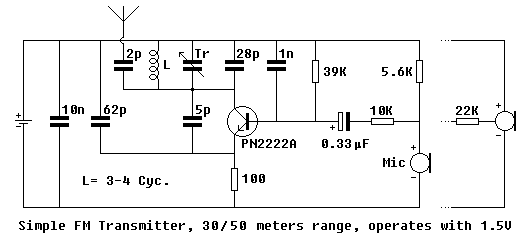
Simple FM Transmitter
A simple FM transmitter utilizing a single transistor. Mini FM transmitters are commonly regarded as one of the fundamental circuit types for beginners in amateur electronics. When constructed correctly, they offer clear wireless sound transmission via a standard FM radio...
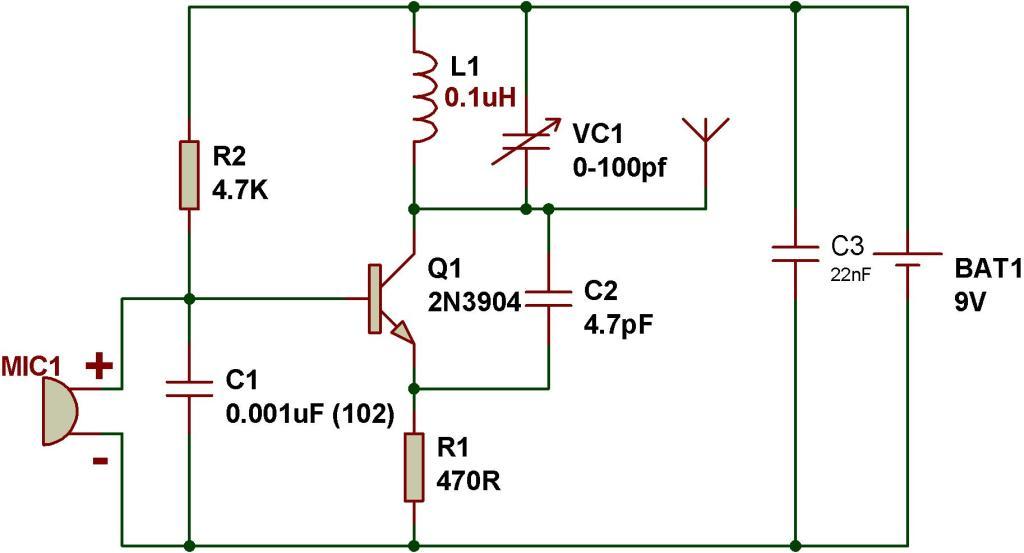
simple steps for making fm transmitter
This tutorial outlines the construction of a simple FM transmitter utilizing a single transistor. The project requires minimal components, making it suitable for beginners. Before proceeding, refer to the schematic provided below, which details the components necessary for building the...
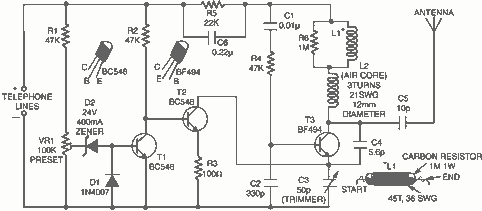
Phone line FM transmitter
Here is a simple yet very useful circuit which can be used to eavesdrop on a telephone conversation. The circuit can also be used as a wireless telephone amplifier. One important feature of this circuit is that the circuit derives...
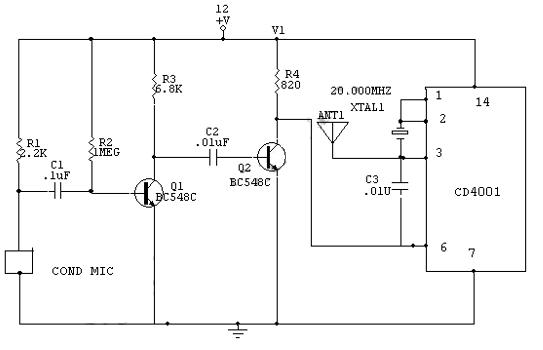
FM And AM Digital IC
This is a transmitter circuit that can transmit both FM and AM signals simultaneously at two different frequencies: FM at 100 MHz and AM at 20 MHz.
The described transmitter circuit is designed to operate at two distinct frequency bands,...
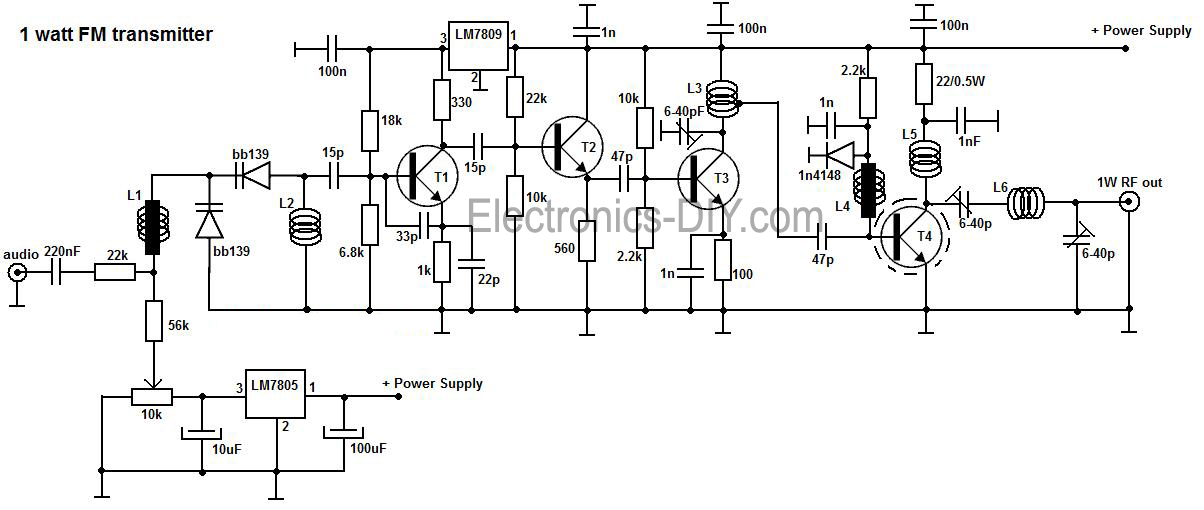
1W FM Transmitter
This is a simple 1-watt FM transmitter circuit that is easy to construct. It consists of four transistors, one of which serves as a stable oscillator. This is followed by a buffer stage to minimize frequency variations when adjusting the...

FM Audio Transmitter Circuit
Operating radio transmitters without a license is illegal in most countries, so caution is advised with transmitter circuits. This FM low-power circuit is designed to operate within the 87-108 MHz band II, providing a range of approximately 20 to 30...
FM Telephone Bug
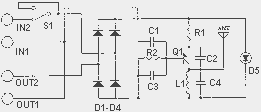
Here is a simple transmitter that when connected to a phone line, will transmit anything on that line (except the dial tone) to any FM radio. The frequency can be tuned from 88 to about 94 MHz and the range...
AB4YD Amateur Radio Page
This project was inspired by a series of QST articles by Hayward, W1PH. The design is based on his April 1962 article, "Have You Tried 160 Lately." The rig features a simple, single-band configuration utilizing 6V6 tubes with regulated voltages,...