


G0MRF 29.45 MHz Receiver Project
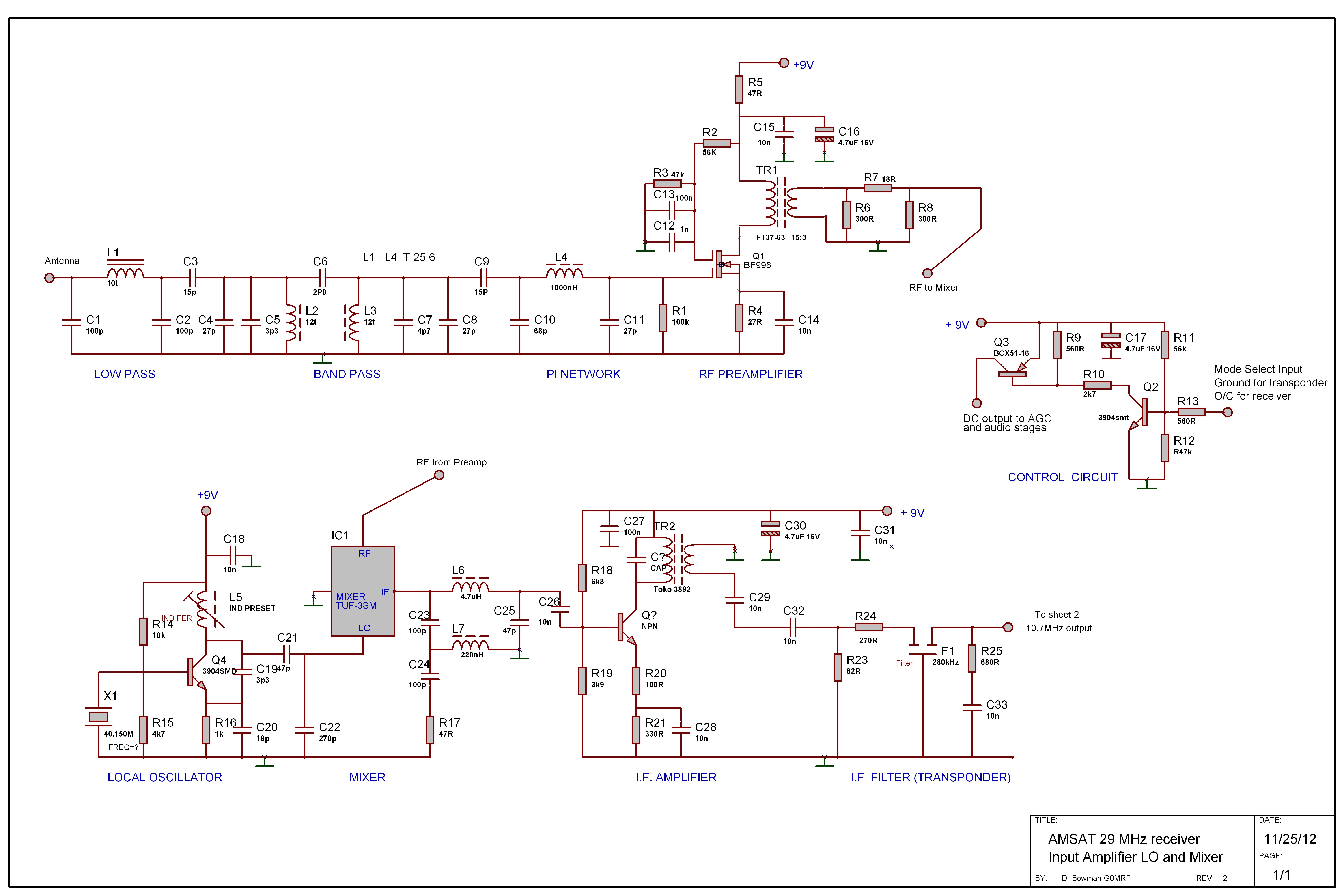
Description: In 2007 and 2008, AMSAT-UK dedicated significant effort to a proposal for the European Space Agency (ESA) to include an Amateur Radio payload on the mass dummy during the maiden flight of the VEGA launcher. This initiative was referred to as iSTAR (Integrated Suite for Teaching and Amateur Radio).
The iSTAR project aimed to incorporate an Amateur Radio payload designed to facilitate educational opportunities and promote interest in radio communications among enthusiasts and students. The payload's integration into the VEGA launcher represented a strategic move to leverage space technology for educational purposes, aligning with AMSAT-UK's mission to advance amateur radio and satellite communications.
The VEGA launcher, known for its versatility and reliability, was chosen as the vehicle for this initiative, emphasizing the potential of small satellite missions in educational outreach. The iSTAR payload was intended to provide practical hands-on experience for students and educators, fostering skills in radio operations, satellite communications, and STEM (science, technology, engineering, and mathematics) disciplines.
The proposal included detailed plans for the payload's design, operational capabilities, and potential applications. By utilizing the VEGA launcher, AMSAT-UK aimed to demonstrate the feasibility of deploying amateur radio technology in space, thereby inspiring a new generation of radio amateurs and engineers.
Overall, the iSTAR initiative reflects a commitment to innovation in education and the promotion of amateur radio as a valuable tool for learning and exploration in the context of space technology.In 2007/8 AMSAT-UK put considerable work into a proposal to the European Space Agency (ESA) to place an Amateur Radio payload on the mass dummy on the maiden flight of the VEGA launcher. Known as iSTAR (Integrated Suite for Teaching and Amateur Radio) it was planned to use.
The iSTAR project aimed to incorporate an Amateur Radio payload designed to facilitate educational opportunities and promote interest in radio communications among enthusiasts and students. The payload's integration into the VEGA launcher represented a strategic move to leverage space technology for educational purposes, aligning with AMSAT-UK's mission to advance amateur radio and satellite communications.
The VEGA launcher, known for its versatility and reliability, was chosen as the vehicle for this initiative, emphasizing the potential of small satellite missions in educational outreach. The iSTAR payload was intended to provide practical hands-on experience for students and educators, fostering skills in radio operations, satellite communications, and STEM (science, technology, engineering, and mathematics) disciplines.
The proposal included detailed plans for the payload's design, operational capabilities, and potential applications. By utilizing the VEGA launcher, AMSAT-UK aimed to demonstrate the feasibility of deploying amateur radio technology in space, thereby inspiring a new generation of radio amateurs and engineers.
Overall, the iSTAR initiative reflects a commitment to innovation in education and the promotion of amateur radio as a valuable tool for learning and exploration in the context of space technology.In 2007/8 AMSAT-UK put considerable work into a proposal to the European Space Agency (ESA) to place an Amateur Radio payload on the mass dummy on the maiden flight of the VEGA launcher. Known as iSTAR (Integrated Suite for Teaching and Amateur Radio) it was planned to use.
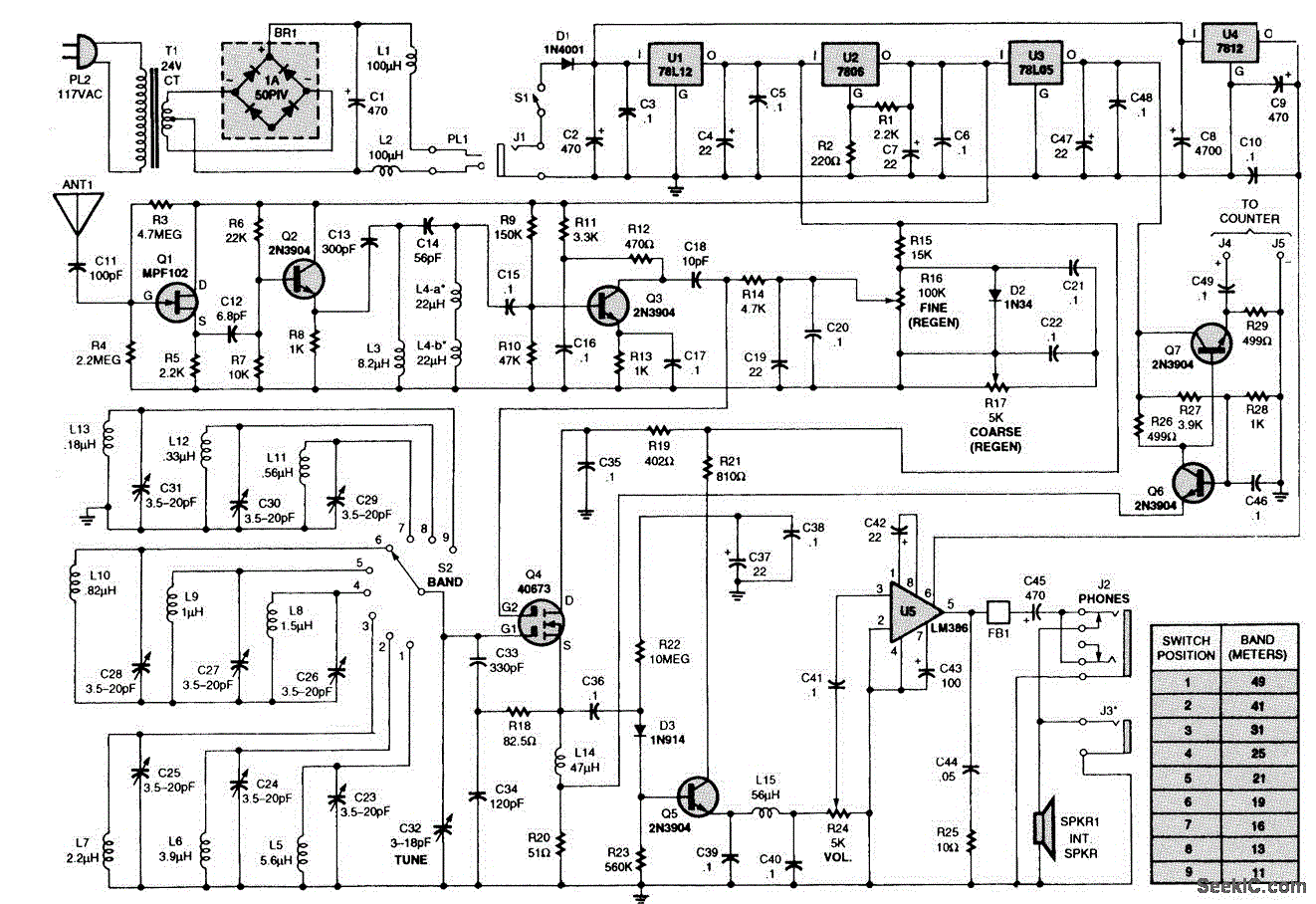
REGENERATIVE_SHORTWAVE_RECEIVER
The receiver consists of multiple subassemblies, including an active antenna, an amplifier featuring regeneration control and band-switching circuitry, an AM detector, a power amplifier, and an output device such as an internal speaker, external speaker, or headphones. Additionally, it is...
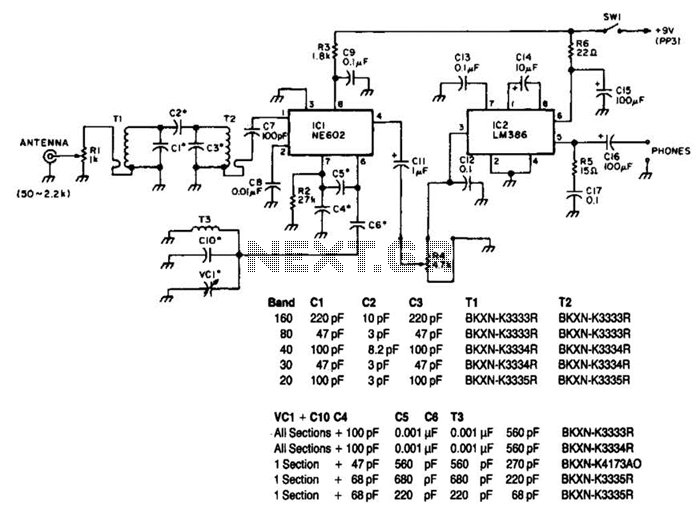
Conversion Receiver For 160 To 20M Circuit
Note that T1 and T2 are TOKO components, including part numbers for the coils T1 and T2. The direct-conversion receiver shown utilizes a double-tuned input network made from readily available TOKO coils. IC1, an NE602, serves as a voltage-controlled oscillator...
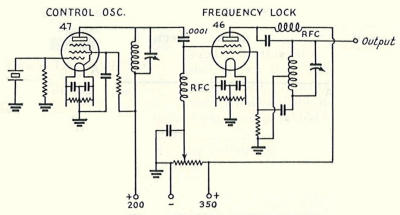
The Crystalizer
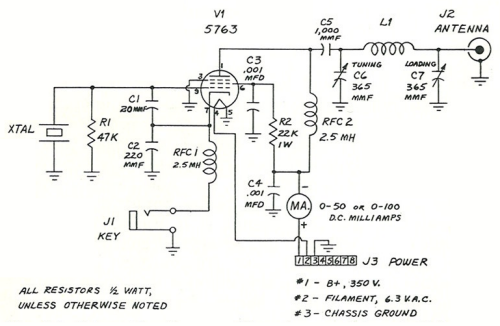
A classic amateur radio transmitter topology, known as the oscillator-amplifier (often referred to as master oscillator, power amplifier, or MOPA), utilizes one tube for frequency control and another for RF power amplification. In its quartz-crystal-controlled form, it typically allows operation...
The Second W9VES
The amateur radio call sign W9VES has been assigned to only two individuals, of whom the second is the author. The first holder was the author's maternal uncle, Phil Simmons, and the author enjoys amateur radio in his memory. By...
3-Wire Receiver/Message Demuxer
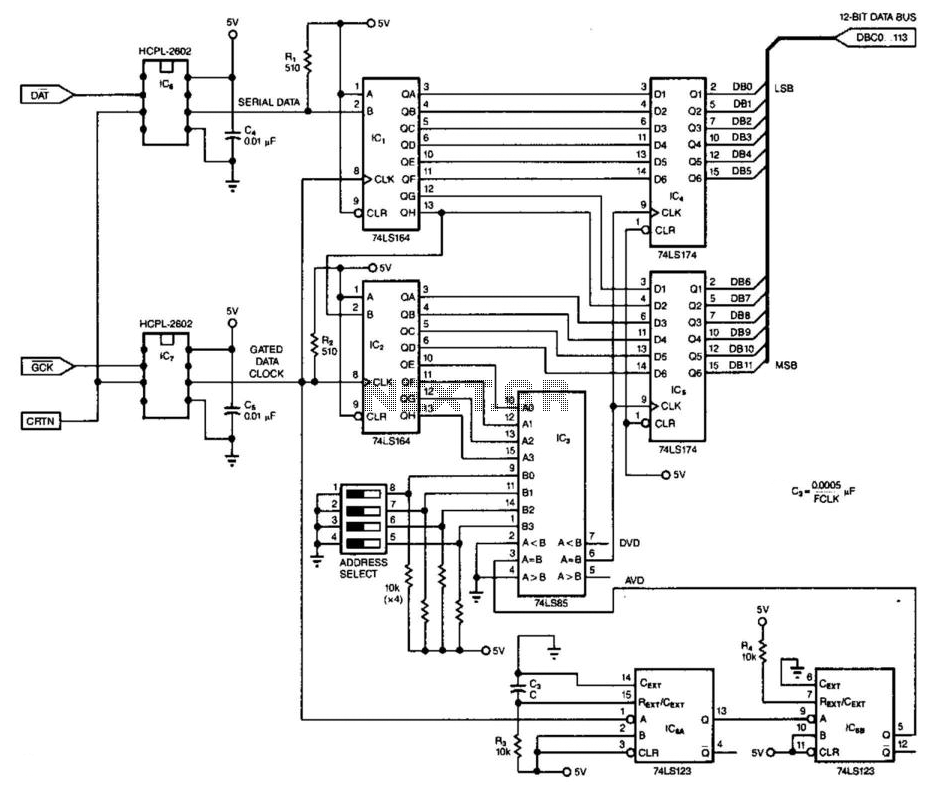
This 3-wire receiver verifies the initial four data bits of 16 received bits against a predetermined address. If the two match, the remaining 12 bits are stored in two 6-bit flip-flop registers. The design can utilize either CMOS or TTL...
LW, MW and SW bands Receiver
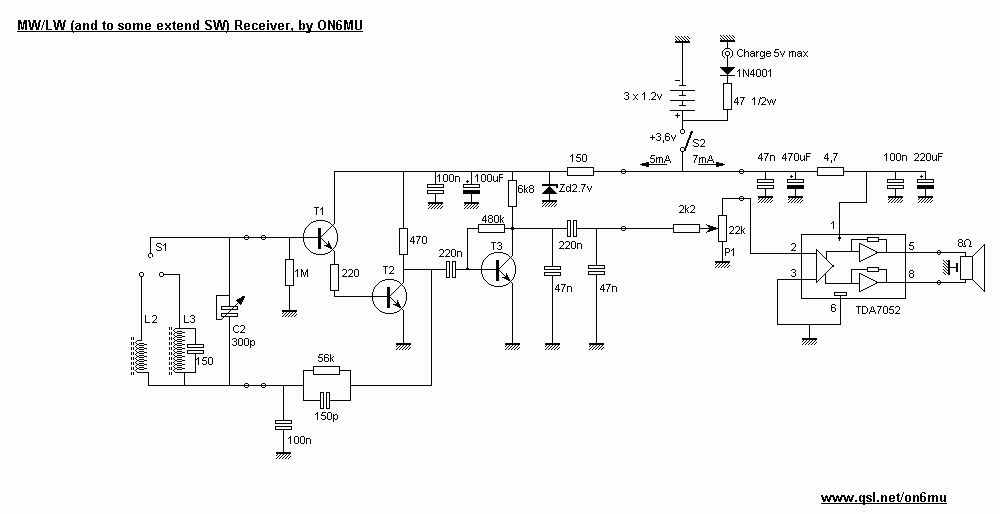
This is a compact three transistor regenerative general coverage receiver with fixed feedback. It's based on the principle of the ZN414 only much higher coverage. The sensitivity and selectivity is relatively good (especially on the LF and MW bands) as...
Simple receiver with microvolt sensitivity
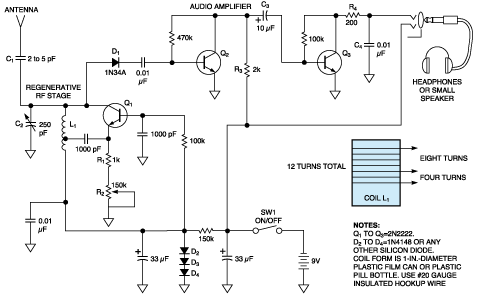
The three-transistor circuit costs less than $10 to build, uses commonly available components, and consumes less than 10 mA from a single 9V battery. By winding coil L1 as shown, the circuit can receive signals in the 5 to 15...
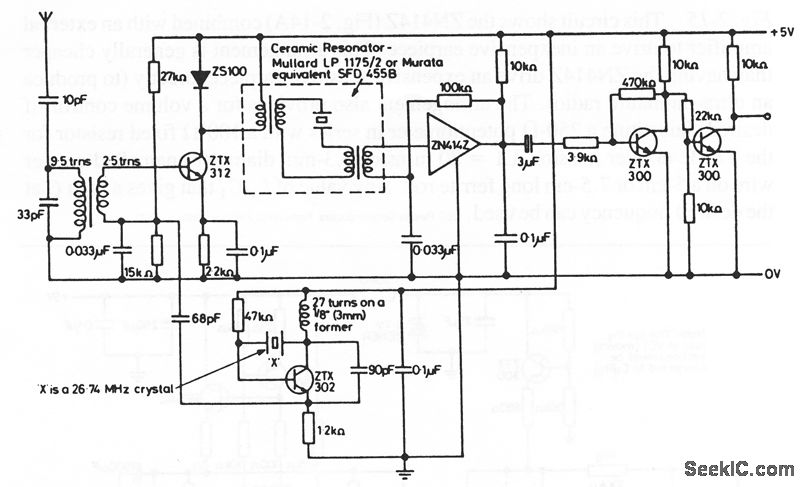
ZS100 Connection Signal
The following circuit illustrates a Noisy Regen Receiver Circuit Diagram. Features include its application in model remote-control systems and its operation as a 27-MHz superheterodyne receiver.
The Noisy Regen Receiver is a type of radio receiver that utilizes regenerative feedback to...
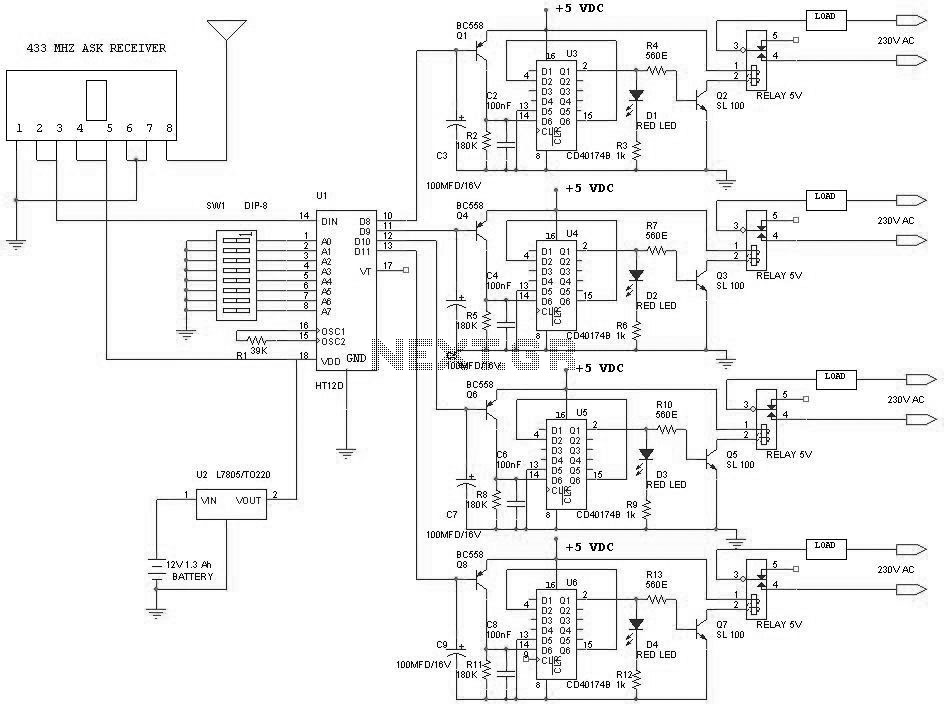
remote control circuit through radio
This project outlines a simple remote control system utilizing RF communication without a microcontroller. The remote is designed to operate various home appliances such as televisions, fans, and lights, providing convenience by allowing users to control devices from a distance...