


The FM modulation circuit of crystal oscillator
#FM modulation
#crystal oscillator
#frequency modulation
#LC oscillating circuit
#RF circuit
#signal modulation
#frequency stability
#wireless communication
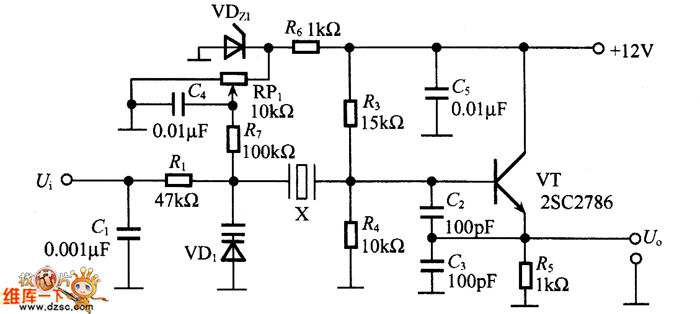
Description: The figure illustrates the FM modulation circuit of a crystal oscillator. FM modulation can be achieved through direct and indirect methods. The direct FM method involves directly altering the frequency of the oscillating circuit. While this approach is straightforward, it has limitations due to the nature of the LC oscillating circuit, where bias effects can be significant and stability is relatively weak. Consequently, the frequency is susceptible to various influencing factors.
The FM modulation circuit using a crystal oscillator serves as a critical component in communication systems, providing a stable frequency source for modulating signals. In this circuit, the crystal oscillator generates a precise frequency, which is then modulated using frequency modulation techniques. The direct FM method modifies the frequency of the oscillator by varying the voltage applied to the circuit, which in turn changes the capacitance or inductance within the LC circuit.
The circuit typically consists of a crystal resonator, an LC tank circuit, and an active component such as a transistor or operational amplifier. The crystal resonator ensures that the oscillator operates at a specific frequency with high stability. The LC tank circuit, composed of an inductor and capacitor, determines the resonant frequency and is crucial for the modulation process.
In direct FM, the modulation index, which indicates the extent of frequency deviation from the carrier frequency, is influenced by the amplitude of the input modulation signal. As the modulation signal varies, it alters the frequency of the oscillator, producing a frequency-modulated output. However, the sensitivity of the circuit to bias and environmental conditions can lead to frequency drift, which may require additional stabilization techniques such as temperature compensation or feedback mechanisms.
Indirect FM methods, while more complex, can provide improved stability and reduced susceptibility to bias effects. These methods involve the use of phase-locked loops or other frequency synthesis techniques to achieve modulation without directly altering the oscillator's frequency.
Overall, the FM modulation circuit of a crystal oscillator is an essential element in modern communication systems, balancing simplicity and performance while addressing the challenges associated with frequency stability and bias effects.In the figure is the FM modulation circuit of crystal oscillator. FM modulation has direct and indirect FM ways, the direct FM method is to directly change the frequency of the oscillating circuit, it`s simple, but as it is the LC oscillating circuit, the bias is kind of noticeable, and the stability is weak, i.e the frequency is easy to be affected by the..
The FM modulation circuit using a crystal oscillator serves as a critical component in communication systems, providing a stable frequency source for modulating signals. In this circuit, the crystal oscillator generates a precise frequency, which is then modulated using frequency modulation techniques. The direct FM method modifies the frequency of the oscillator by varying the voltage applied to the circuit, which in turn changes the capacitance or inductance within the LC circuit.
The circuit typically consists of a crystal resonator, an LC tank circuit, and an active component such as a transistor or operational amplifier. The crystal resonator ensures that the oscillator operates at a specific frequency with high stability. The LC tank circuit, composed of an inductor and capacitor, determines the resonant frequency and is crucial for the modulation process.
In direct FM, the modulation index, which indicates the extent of frequency deviation from the carrier frequency, is influenced by the amplitude of the input modulation signal. As the modulation signal varies, it alters the frequency of the oscillator, producing a frequency-modulated output. However, the sensitivity of the circuit to bias and environmental conditions can lead to frequency drift, which may require additional stabilization techniques such as temperature compensation or feedback mechanisms.
Indirect FM methods, while more complex, can provide improved stability and reduced susceptibility to bias effects. These methods involve the use of phase-locked loops or other frequency synthesis techniques to achieve modulation without directly altering the oscillator's frequency.
Overall, the FM modulation circuit of a crystal oscillator is an essential element in modern communication systems, balancing simplicity and performance while addressing the challenges associated with frequency stability and bias effects.In the figure is the FM modulation circuit of crystal oscillator. FM modulation has direct and indirect FM ways, the direct FM method is to directly change the frequency of the oscillating circuit, it`s simple, but as it is the LC oscillating circuit, the bias is kind of noticeable, and the stability is weak, i.e the frequency is easy to be affected by the..
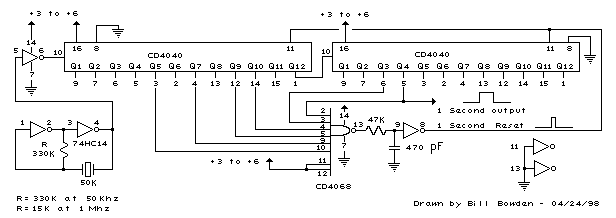
1 Second Time Base From Crystal Oscillator
The schematic below illustrates the division of a crystal oscillator signal by the crystal frequency to obtain an accurate 1-second time base with a precision of 0.01%. Two cascaded 12-stage counters (CD4040) form a 24-stage binary counter, and the appropriate...
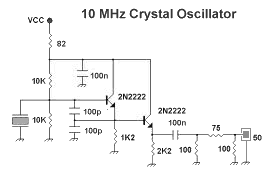
Crystal Oscillator Circuit
A crystal oscillator circuit is a straightforward oscillator circuit that can be easily understood through its schematic diagram. It serves as a replacement for a conventional oscillator network, which typically consists of an LC combination. This simplicity is also evident...
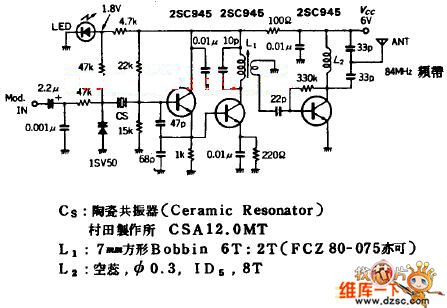
FM modulation circuit diagram using ceramic resonator
The quartz crystal oscillator circuit is highly advantageous in terms of frequency stability. Even the Voltage-Controlled Crystal Oscillator (VCXO) circuit, which allows for significant frequency changes, typically experiences only about a 1% variation. However, the linear range of control voltage...
Colpitts Crystal Oscillator
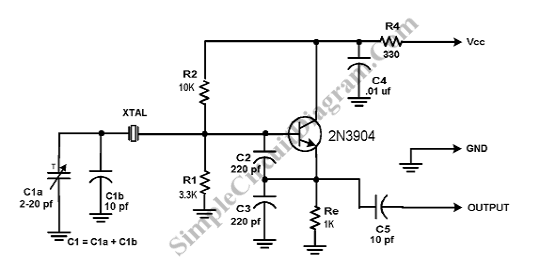
A Crystal Colpitts oscillator can be constructed using a parallel mode crystal and a transistor. The circuit is depicted in the accompanying figure. In this configuration, an inductance is utilized.
The Crystal Colpitts oscillator is a type of electronic oscillator that...
Crystal quartz crystal oscillator circuit using FET
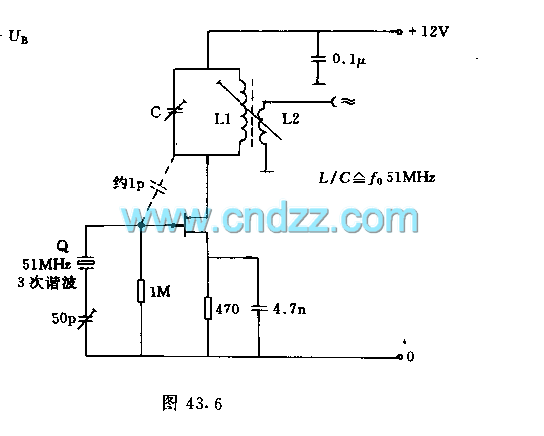
A crystal oscillator operates at a frequency of 51 MHz, which corresponds to the third harmonic of a 17 MHz fundamental frequency. Depending on the specific structure used, the drain-gate capacitance can be selected within a range of 0.5 to...
The FV-1 Crystal Oscillator
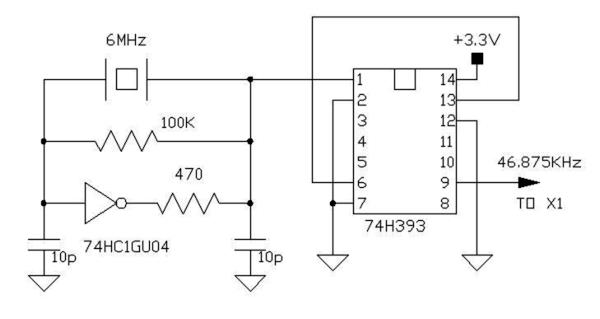
The FV-1 features internal circuitry that supports an external crystal, ideally a 32.768 kHz watch crystal. These crystals are very affordable and readily available. While other frequencies are available, they are not as cost-effective or common. If the system incorporating...
Crystal Oscillators
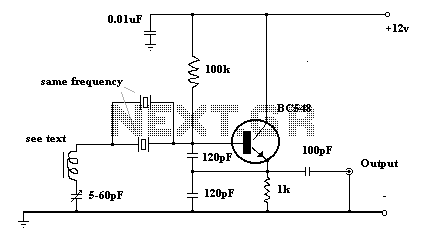
The schematic illustrates the division of a crystal oscillator signal by the crystal frequency to achieve a precise 1-second time base with an accuracy of 0.01%. Two cascaded 12-stage counters (CD4040) create a 24-stage binary counter, with specific bits gated...
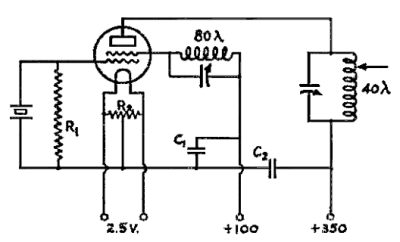
Tri-Tet Oscillator
QST's latest development, the Tri-tet oscillator, has finally made the single-tube crystal transmitter a practical option. It is now feasible to operate effectively on two, and occasionally three, amateur bands using a single crystal. This particular device signifies the onset...
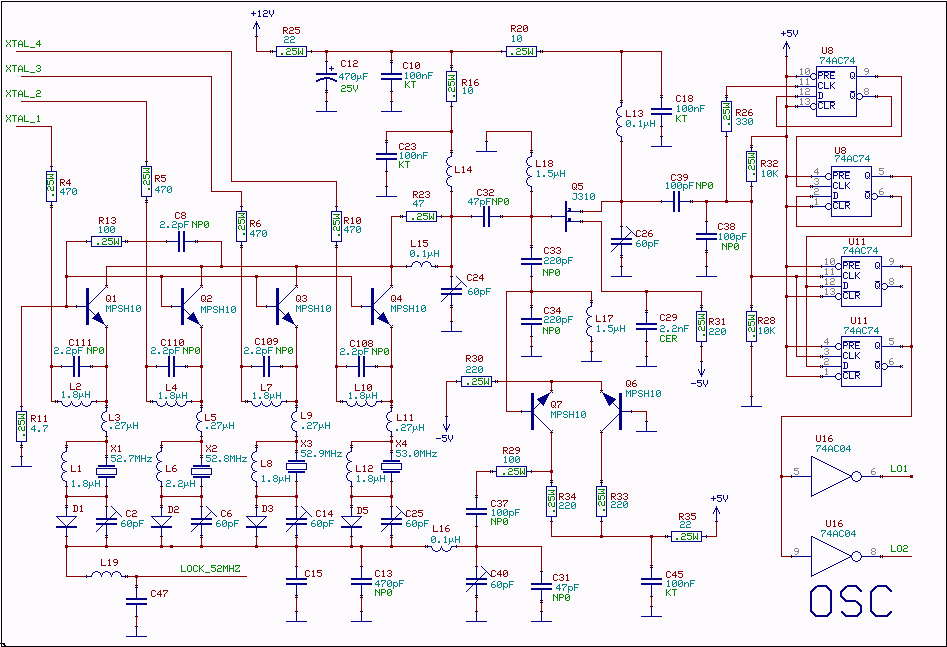
The local oscillator for 10.7 to 2.5MHz conversion
A 52 MHz third overtone crystal typically has a series resonance impedance of 30 ohms as per manufacturer specifications. The crystals utilized in the prototypes exhibit nearly ten times lower series resistance but are significantly more expensive. An oscillator can...