


The MAX2681 SiGe Downconverter Mixer Tuned for GPS Front Ends
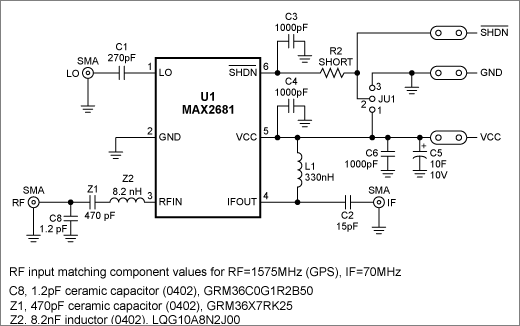
Description: This application note presents the component values and measured performance for the MAX2681 mixer IC when tuned for GPS operation at 1575 MHz.
The MAX2681 is a high-performance mixer integrated circuit designed for use in GPS applications, particularly at the frequency of 1575 MHz, which is the standard frequency for GPS signals. The application note outlines the specific component values that optimize the performance of the MAX2681 in this operational context.
Key aspects of the design include the selection of external components such as resistors, capacitors, and inductors, which are crucial for achieving the desired gain, noise figure, and linearity. The application note also details the measured performance metrics, including conversion gain, input and output return loss, and intermodulation distortion, which are critical for assessing the mixer’s effectiveness in real-world GPS signal processing.
For optimal performance, attention must be given to the layout of the circuit board, as parasitic capacitance and inductance can significantly affect the performance at high frequencies. The application note may also provide recommendations for shielding and grounding techniques to minimize interference and enhance signal integrity.
Overall, the MAX2681 mixer IC is a vital component in GPS receiver design, and understanding its component values and performance characteristics is essential for engineers working in this field.This application note presents the component values and measured performance for the MAX2681 mixer IC when tuned for GPS operation at 1575MHz..
The MAX2681 is a high-performance mixer integrated circuit designed for use in GPS applications, particularly at the frequency of 1575 MHz, which is the standard frequency for GPS signals. The application note outlines the specific component values that optimize the performance of the MAX2681 in this operational context.
Key aspects of the design include the selection of external components such as resistors, capacitors, and inductors, which are crucial for achieving the desired gain, noise figure, and linearity. The application note also details the measured performance metrics, including conversion gain, input and output return loss, and intermodulation distortion, which are critical for assessing the mixer’s effectiveness in real-world GPS signal processing.
For optimal performance, attention must be given to the layout of the circuit board, as parasitic capacitance and inductance can significantly affect the performance at high frequencies. The application note may also provide recommendations for shielding and grounding techniques to minimize interference and enhance signal integrity.
Overall, the MAX2681 mixer IC is a vital component in GPS receiver design, and understanding its component values and performance characteristics is essential for engineers working in this field.This application note presents the component values and measured performance for the MAX2681 mixer IC when tuned for GPS operation at 1575MHz..
GPS Synchronised Clock
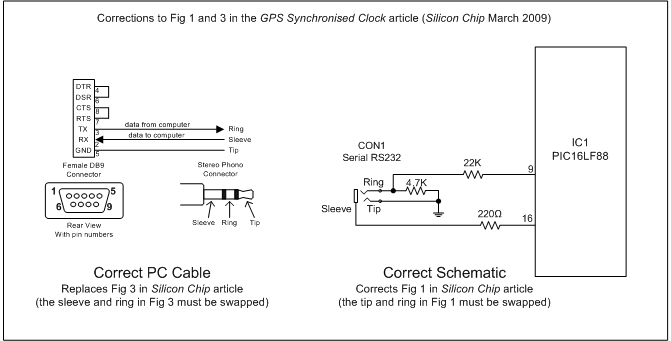
This project replaces the electronics in a standard quartz wall clock with a circuit that uses GPS satellites to obtain precise time.
The proposed project involves the modification of a conventional quartz wall clock by integrating a GPS-based timing circuit. The...

Compact DJ Station
The mixer is equipped with two stereo phono inputs and two stereo line-level inputs, along with a single stereo mixing channel. It includes a microphone input and a stereo main output with adjustable gain. The general circuit diagram displays all...

LED RF Signal Strength Meter
RF Signal Strength Meter circuits are popular RF measurement devices. This circuit is one of the simplest but very useful circuits that satisfies your desired accuracy. The heart of measurement is high accuracy but easy to use Logarithmic Detector AD8313...
Modulation monitor
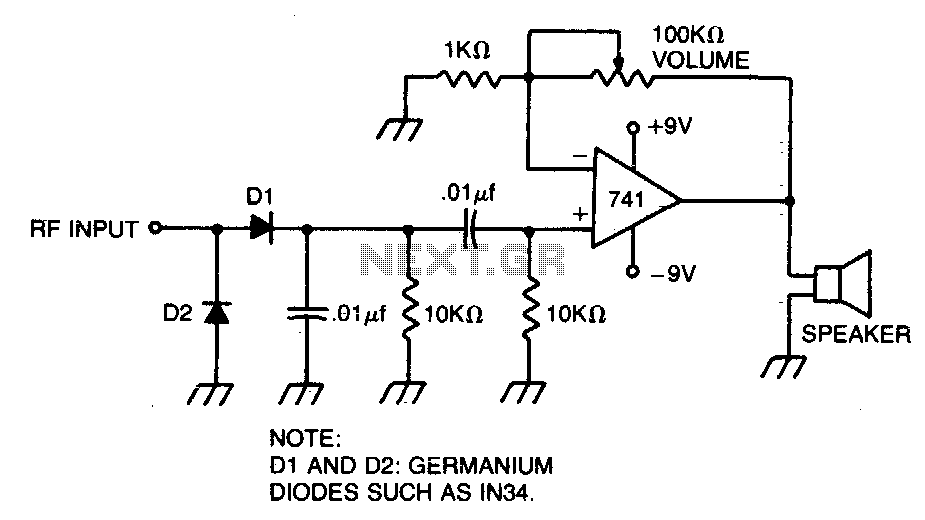
A broad-tuned receiver demodulates the RF signal picked up by a loosely coupled wire placed near the transmitting antenna.
The broad-tuned receiver operates by utilizing a loosely coupled wire antenna, which is strategically positioned in proximity to the transmitting antenna. This...
RF oscillator uses current-feedback op amp
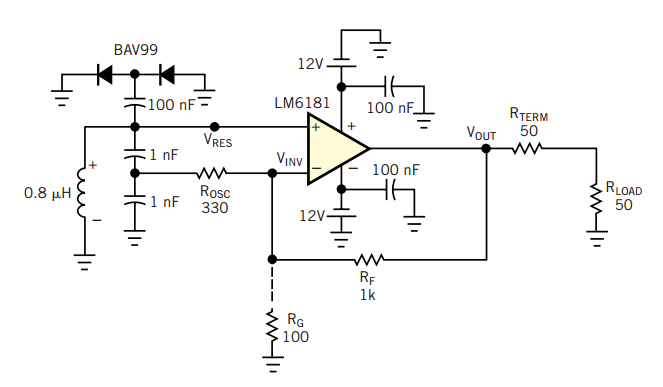
A current-feedback amplifier is a well-known component with many uses. Its basic block diagram shows that its input stage is a voltage follower in practice, a symmetrical emitter follower. The configuration samples the output current, converts it to voltage across...
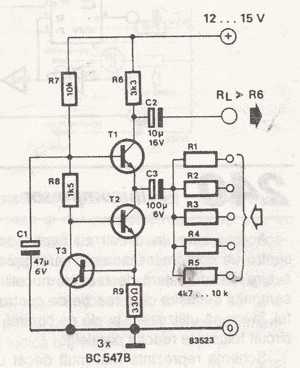
Simple mixer circuit
The simple mixer schematic is based on the common base principle, where input voltages are transformed into alternating currents that are summed to form the output.
The simple mixer circuit utilizes the common base configuration of a transistor, which is characterized...
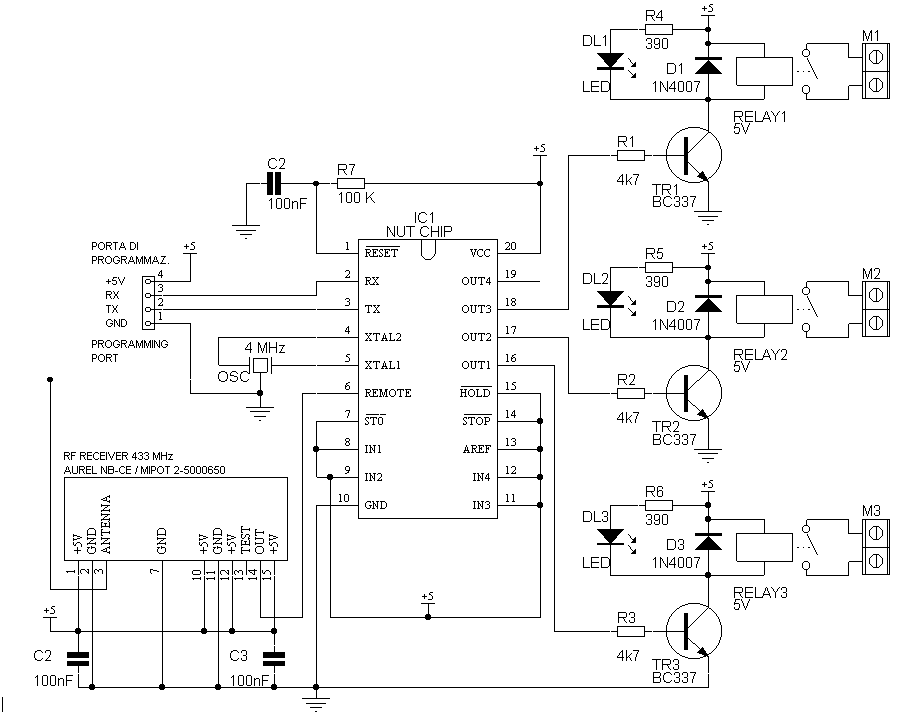
RF 433MHz - 3 channels remote control
The schematic is very simple and includes, in addition to Nutchip, with its three driving transistor and LED, the radio receiver. The data come from the OUT pin of the receiver and enter the pin REMOTE remote control. The RESET...
vehicle tracking
This project involves the design of an embedded system for tracking and positioning vehicles using the Global Positioning System (GPS) and the Global System for Mobile Communications (GSM). When a user sends a request to the number associated with the...
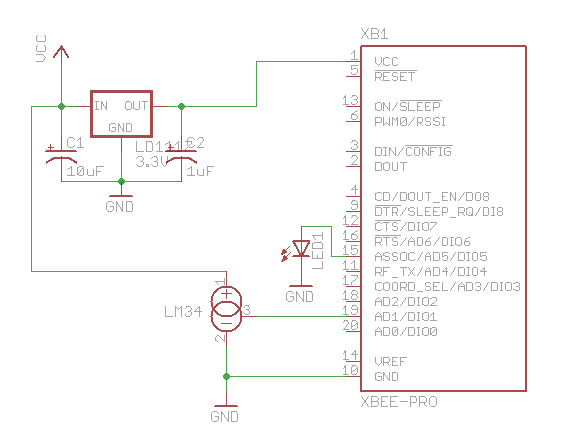
wireless temperature sensor
Here is the Arduino code for reading incoming packets from the XBee and displaying the received analog sample on the LED display. Parsing an XBee packet is complex, but it becomes manageable after studying the documentation. The code defines constants...