


the Poppet 500 milliwatt AM transmitter
#AM transmitter
#half-watt
#160 meter band
#microphone
#GQRP Club
#SPRAT
#Doug Gibson
#Steve Hartley
#RF circuit
#communication
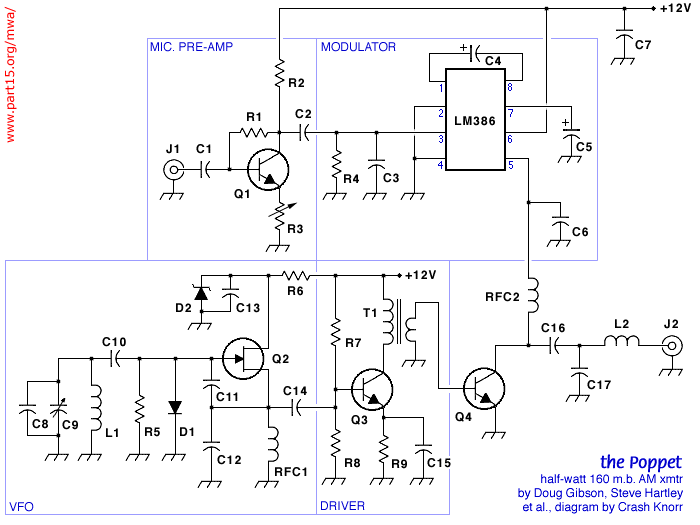
Description: The Poppet is a half-watt AM transmitter designed by Mr. Doug Gibson of England. The original design was published in issue 84 of SPRAT, the newsletter of the GQRP Club. The version presented here incorporates modifications suggested by Steve Hartley and others. Although it was designed to operate with a microphone in the 160-meter band (1800-2000 kHz), the Poppet can be easily adapted to function within the 1600-1720 kHz range of the AM broadcast band and can use a line-level input from a mixer instead of a microphone. Construction details are not critical. The LM386 and the output transistor will require heatsinks. The circuit can be assembled in a "dead bug style," with the modulator chip mounted upside-down on the copper circuit board for effective heatsinking. To modify the Poppet for neighborhood broadcasting in the 1600-1720 kHz frequency range, either increase the capacitance of C8 to lower the VFO's frequency into the broadcast band or replace the VFO with a simple crystal oscillator or PLL synthesizer. The microphone preamp stage can be omitted if the unit is used with a line-level audio source, such as a mixer or tape player.
The Poppet AM transmitter circuit is a compact and efficient design suitable for hobbyists and those interested in low-power broadcasting. The primary component of this circuit is the LM386 audio amplifier, which serves as the modulator. This chip is capable of delivering sufficient power to drive the output transistor, which further amplifies the signal for transmission. The output stage typically utilizes a transistor that can handle the required power levels, ensuring that the transmitter operates effectively within the designated frequency range.
For optimal performance, it is crucial to ensure that the LM386 and the output transistor are equipped with appropriate heatsinks to prevent overheating during extended operation. The "dead bug style" construction allows for a more compact layout and effective thermal management, as the modulator chip is mounted directly to the copper board, enhancing heat dissipation.
To facilitate operation in the AM broadcast band, the Poppet can be easily modified. Increasing the capacitance of capacitor C8 will lower the frequency of the voltage-controlled oscillator (VFO), allowing the transmitter to operate within the desired 1600-1720 kHz range. Alternatively, replacing the VFO with a crystal oscillator or a phase-locked loop (PLL) synthesizer can provide a more stable frequency source, which is particularly beneficial for consistent transmission quality.
When using the Poppet with a line-level audio source, such as a mixer or tape player, the microphone preamp stage can be omitted, simplifying the overall design. This flexibility in input options makes the Poppet a versatile transmitter suitable for various applications, including neighborhood broadcasting and experimental radio projects. Overall, the Poppet embodies a practical approach to AM transmission, combining ease of construction with the potential for significant customization.The Poppet" is a half-watt AM transmitter designed by Mr. Doug Gibson of England. The original design was published in issue 84 of SPRAT, newsletter of the GQRP Club. The version shown here incorporates changes suggested by Steve Hartley and others. Although it was designed to work with a microphone and to be used in the 160 meter band (1800-2000 kHz), the Poppet can easily be modified to work in the 1600-1720 kHz end of the AM broadcast band and work with a line level input from a mixer instead of a microphone. Construction details are not critical. The LM386 and the output transistor will need heatsinks. The circuit can be built "dead bug style" with the modulator chip stuck upside-down to the copper circuit board for heatsinking.
To modify the Poppet for neighborhood broadcasting in the 1600-1720 kHz frequency range, either increase the capacitance of C8 to bring the VFO`s frequency down into the broadcast band, or replace the VFO with a simple crystal oscillator or PLL synthesizer. The microphone pre-amp stage can be omitted if the unit is used with a line-level audio source such as a mixer or tape player.
The Poppet AM transmitter circuit is a compact and efficient design suitable for hobbyists and those interested in low-power broadcasting. The primary component of this circuit is the LM386 audio amplifier, which serves as the modulator. This chip is capable of delivering sufficient power to drive the output transistor, which further amplifies the signal for transmission. The output stage typically utilizes a transistor that can handle the required power levels, ensuring that the transmitter operates effectively within the designated frequency range.
For optimal performance, it is crucial to ensure that the LM386 and the output transistor are equipped with appropriate heatsinks to prevent overheating during extended operation. The "dead bug style" construction allows for a more compact layout and effective thermal management, as the modulator chip is mounted directly to the copper board, enhancing heat dissipation.
To facilitate operation in the AM broadcast band, the Poppet can be easily modified. Increasing the capacitance of capacitor C8 will lower the frequency of the voltage-controlled oscillator (VFO), allowing the transmitter to operate within the desired 1600-1720 kHz range. Alternatively, replacing the VFO with a crystal oscillator or a phase-locked loop (PLL) synthesizer can provide a more stable frequency source, which is particularly beneficial for consistent transmission quality.
When using the Poppet with a line-level audio source, such as a mixer or tape player, the microphone preamp stage can be omitted, simplifying the overall design. This flexibility in input options makes the Poppet a versatile transmitter suitable for various applications, including neighborhood broadcasting and experimental radio projects. Overall, the Poppet embodies a practical approach to AM transmission, combining ease of construction with the potential for significant customization.The Poppet" is a half-watt AM transmitter designed by Mr. Doug Gibson of England. The original design was published in issue 84 of SPRAT, newsletter of the GQRP Club. The version shown here incorporates changes suggested by Steve Hartley and others. Although it was designed to work with a microphone and to be used in the 160 meter band (1800-2000 kHz), the Poppet can easily be modified to work in the 1600-1720 kHz end of the AM broadcast band and work with a line level input from a mixer instead of a microphone. Construction details are not critical. The LM386 and the output transistor will need heatsinks. The circuit can be built "dead bug style" with the modulator chip stuck upside-down to the copper circuit board for heatsinking.
To modify the Poppet for neighborhood broadcasting in the 1600-1720 kHz frequency range, either increase the capacitance of C8 to bring the VFO`s frequency down into the broadcast band, or replace the VFO with a simple crystal oscillator or PLL synthesizer. The microphone pre-amp stage can be omitted if the unit is used with a line-level audio source such as a mixer or tape player.

1Watt AM CW Transmitter for 10 Meterband
This project involves constructing a simple 3-stage low-power broadcast-type circuit, utilizing a crystal oscillator integrated circuit and a collector modulated AM oscillator with an amplifier. The circuit can be connected to an electret microphone or an amplified dynamic microphone, although...
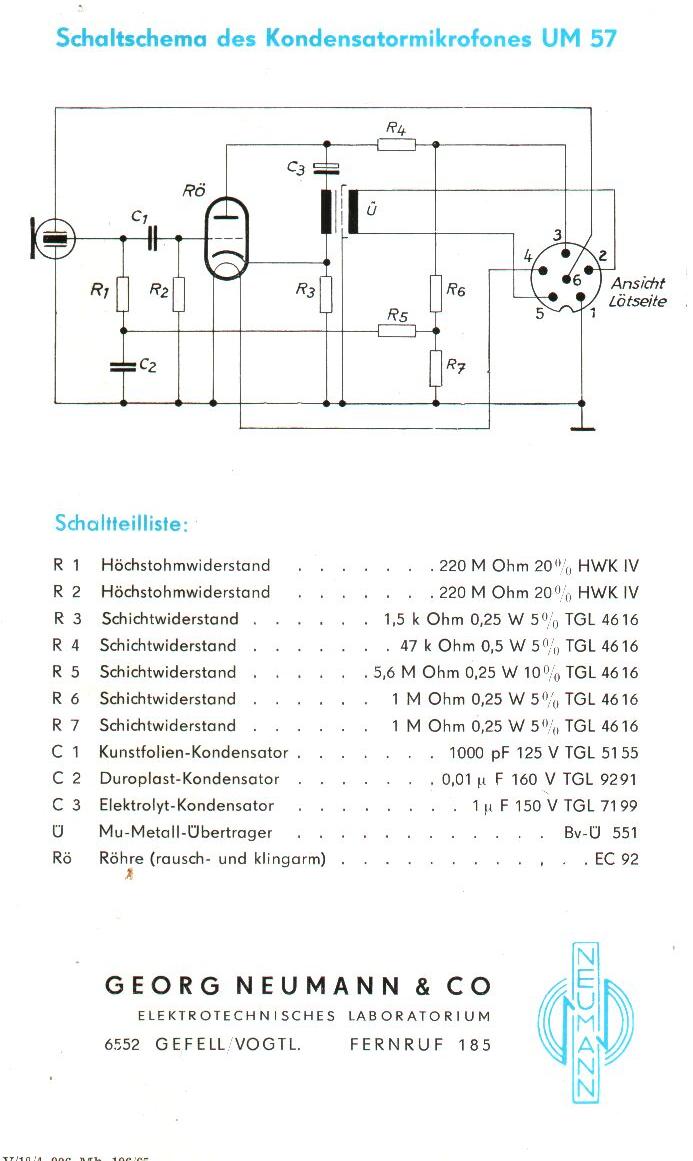
microphone Neumann UM 57
The Neumann/Gefell UM 57 is a large-diaphragm tube condenser microphone produced by the Neumann company in Gefell, Germany, now known as Microtech-Gefell. This microphone features the renowned M7 capsule from Gefell, which is a dual-diaphragm, center-terminated design with a PVC...
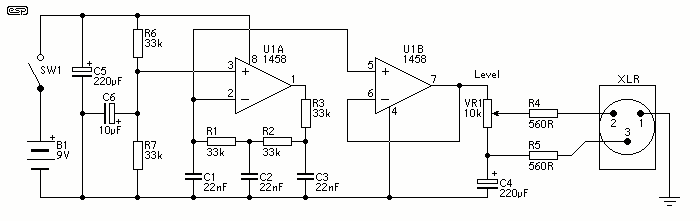
Microphone Circuit Test Oscillator
This unit would be mounted in a small plastic or preferably metal box, with a 9V battery, level control, a male XLR connector (same as on a mic) and a switch. Current drain is low, since the circuit only uses...
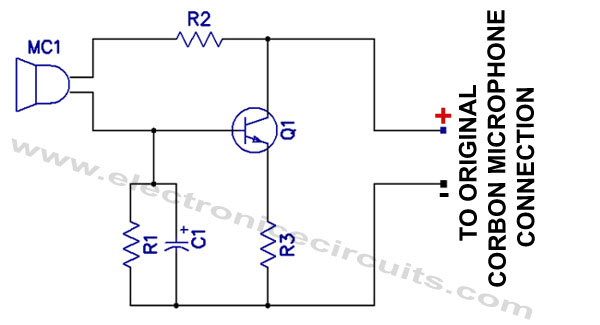
Carbon Mic Replacement To Magnetic Mike Converter Circuit
Effective pitching surpasses effective hitting, and a high-quality magnetic microphone outperforms a carbon microphone. This circuit utilizes a single transistor to convert a carbon microphone input into a magnetic microphone output. It is important to note that no ground connection...
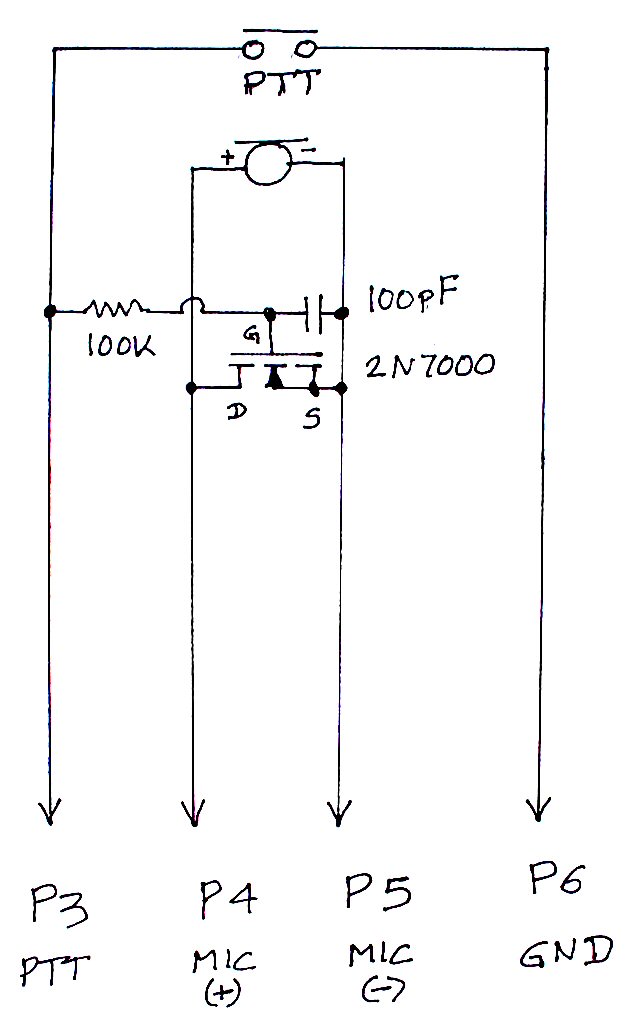
Microphone Mute circuit
The TS-440S, similar to several other radios, does not mute the microphone when utilizing the rear audio connector for digital modes. Consequently, unless the microphone is unplugged each time digital modes are used, background noise from the shack can interfere...
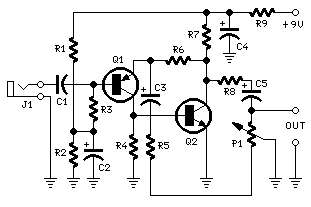
Portable Microphone Preamplifier
Cleaned Input: This circuit is mainly intended to provide common home stereo amplifiers with a microphone input. The battery supply is a good compromise: in this manner the input circuit is free from mains low frequency hum pick-up and connection...
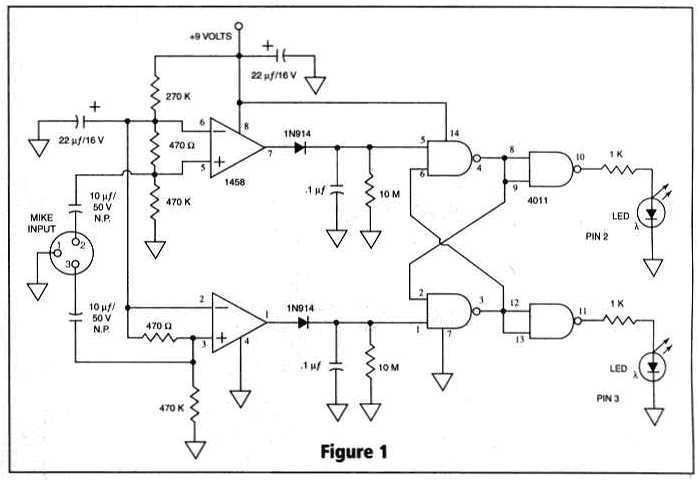
Build a Microphone Polarity Tester
Many things can go wrong in a modern recording studio, but few are as difficult to track down as reversed microphone polarity. When a microphone is placed in front of a sound source, a positive pressure on its diaphragm caused...
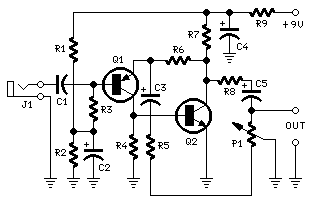
Portable Mic Preamplifier
This circuit is mainly intended to provide common home stereo amplifiers with a microphone input. Using a stereo microphone the circuit must be doubled. In this case, two separate level controls are better than a dual-ganged stereo potentiometer. Low current...
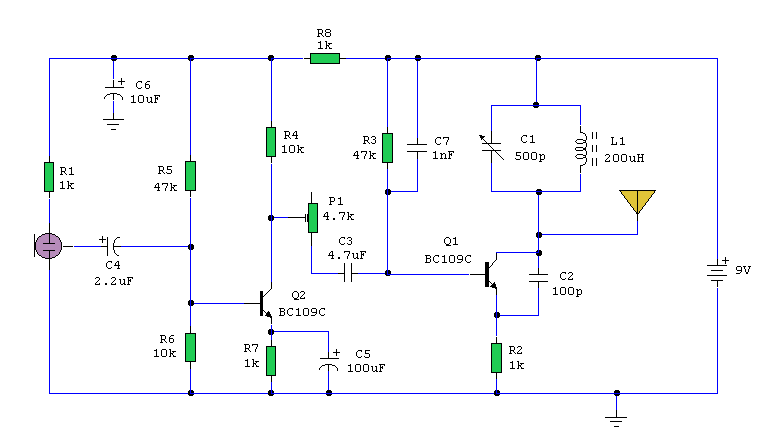
AM Transmitter
AM Transmitter. It is illegal to operate a radio transmitter without a license in most countries. This circuit is deliberately limited in power output.
An AM transmitter is designed to modulate an audio signal onto a carrier wave for the purpose...