


Video and DVD Modulator Circuit Electronic Diagram
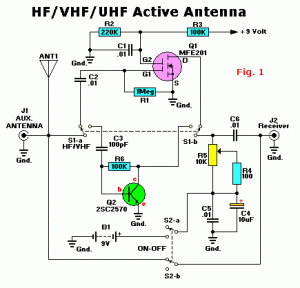
Description: The following circuit illustrates a Video and DVD Modulator in a VHF/UHF electronic diagram. Features include an oscillator that utilizes a transistor for high-frequency operation.
The video and DVD modulator circuit serves to convert video signals into a format suitable for transmission over VHF or UHF frequencies. This is particularly useful for broadcasting video content to televisions or other receiving devices that operate within these frequency ranges.
The core of the circuit typically includes a high-frequency oscillator, which can be implemented using a transistor. The oscillator generates the carrier wave necessary for modulation. In this setup, the transistor is configured to amplify the input signal and produce a stable output frequency.
The modulation process involves combining the video signal with the carrier wave. This can be achieved through amplitude modulation (AM) or frequency modulation (FM), depending on the design requirements. The modulated signal is then filtered to eliminate unwanted harmonics and noise, ensuring a clean output signal.
Additionally, the circuit may incorporate various components such as capacitors, resistors, and inductors to stabilize the oscillator, control the gain, and manage the frequency response. An output stage may be included to drive the antenna or connect to other transmission media.
Overall, this circuit provides a practical solution for transmitting video content over traditional broadcast frequencies, enabling compatibility with legacy television systems and enhancing the accessibility of video content.The following circuit shows about Video and DVD Modulator in VHF / UHF Circuit Electronic Diagram. Features: oscillator uses a transistor for high ..
The video and DVD modulator circuit serves to convert video signals into a format suitable for transmission over VHF or UHF frequencies. This is particularly useful for broadcasting video content to televisions or other receiving devices that operate within these frequency ranges.
The core of the circuit typically includes a high-frequency oscillator, which can be implemented using a transistor. The oscillator generates the carrier wave necessary for modulation. In this setup, the transistor is configured to amplify the input signal and produce a stable output frequency.
The modulation process involves combining the video signal with the carrier wave. This can be achieved through amplitude modulation (AM) or frequency modulation (FM), depending on the design requirements. The modulated signal is then filtered to eliminate unwanted harmonics and noise, ensuring a clean output signal.
Additionally, the circuit may incorporate various components such as capacitors, resistors, and inductors to stabilize the oscillator, control the gain, and manage the frequency response. An output stage may be included to drive the antenna or connect to other transmission media.
Overall, this circuit provides a practical solution for transmitting video content over traditional broadcast frequencies, enabling compatibility with legacy television systems and enhancing the accessibility of video content.The following circuit shows about Video and DVD Modulator in VHF / UHF Circuit Electronic Diagram. Features: oscillator uses a transistor for high ..
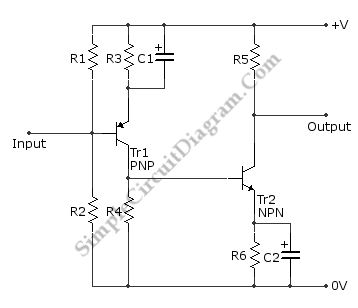
DC Coupled Transistor Amplifier
This is a directly coupled (DC) amplifier circuit. It is constructed using NPN and PNP transistors and is designed to amplify direct current (DC) signals.
The directly coupled amplifier circuit utilizes both NPN and PNP transistors to achieve its amplification. In...
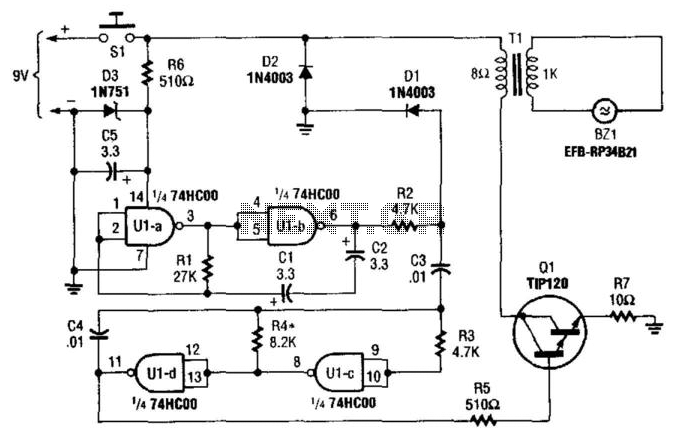
Sonic Defender
This oscillator-driver produces a loud sound of approximately 3 kHz, modulated with a 10-Hz warble. BZ1 is a Matsushita EFB-RP3. U1A generates the 10-Hz waveform that modulates the 3-kHz tone produced by U1C and U1D. Q1 drives the transducer through...
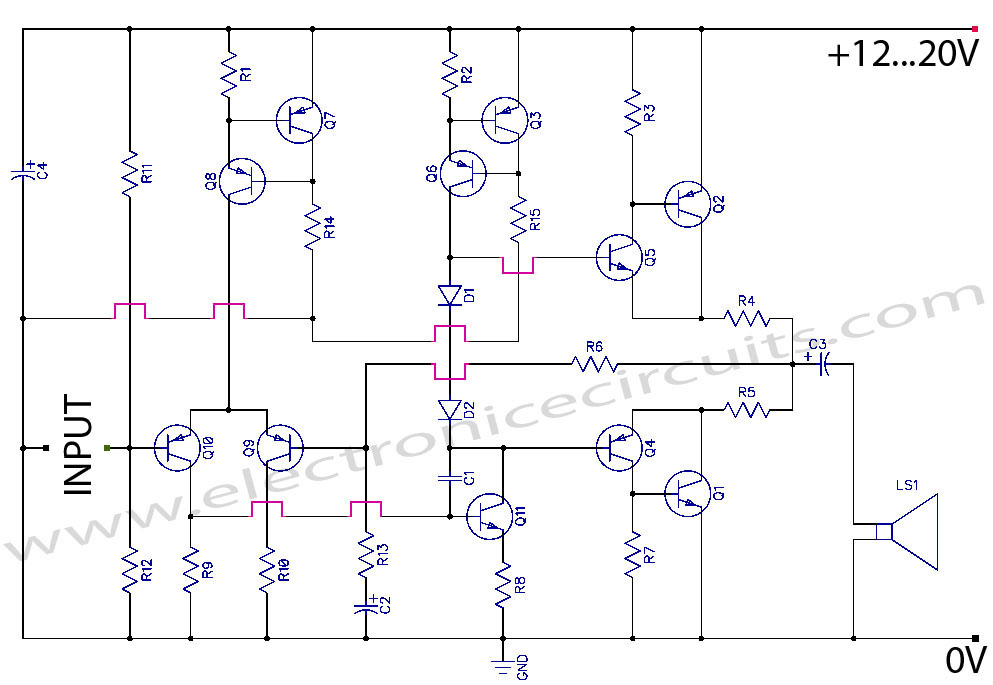
Class AB Transistor Power Amplifier
Discrete Class AB Transistor Audio Power Amplifier Circuit Diagram. This is a Class AB transistor power amplifier. It is a simple amplifier.
The discrete Class AB transistor audio power amplifier is designed to provide efficient amplification of audio signals while minimizing...
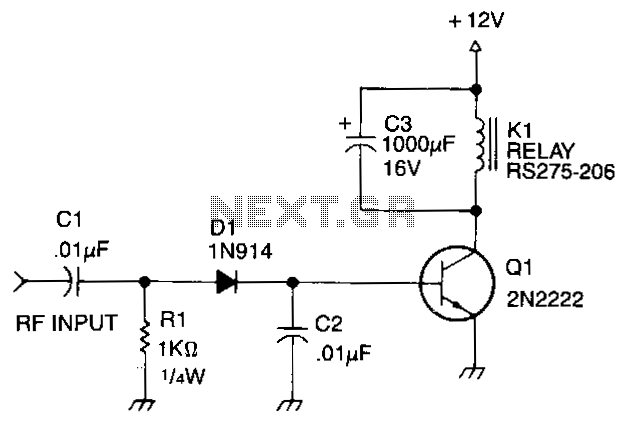
Rf-actuated-relay
Automatic antenna switching or RF power indication can be achieved with this circuit. Relay will key with less than 150 mW drive on 2 m.
The circuit designed for automatic antenna switching or RF power indication utilizes a relay that is...
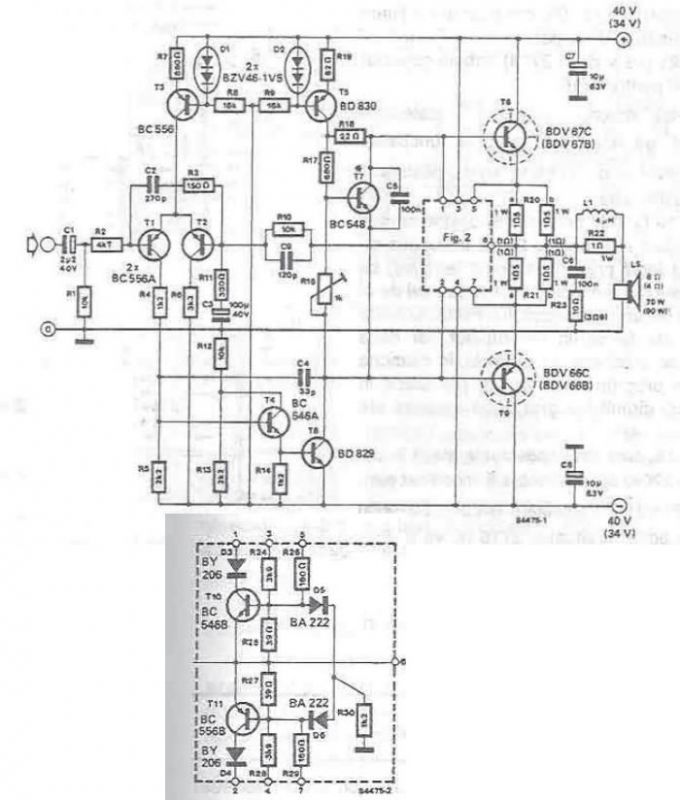
Power amplifier using transistors
A high-power audio amplifier can be designed using power transistors and other common electronic components, capable of delivering a maximum output power of 90W. When using the specified component values, it can drive speakers with a 4-ohm impedance, resulting in...
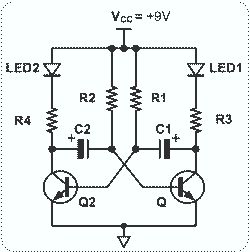
Astable Multivibrator with 2 Transistors
This circuit is straightforward and easy to construct, utilizing two transistors as active components along with several passive components such as resistors, capacitors, and two LEDs. The circuit employs the MPS2222 transistor, though any NPN type transistor can be used...
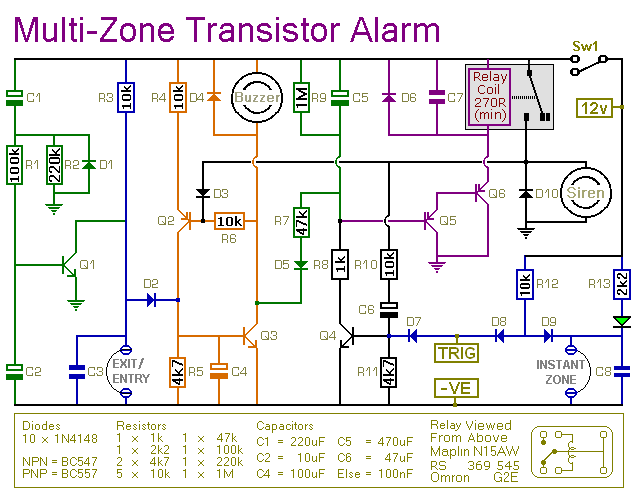
An Expandable Transistor Based Burglar Alarm circuit
This transistor-based alarm features automatic exit and entry delays, along with a timed bell cut-off and system reset. In addition to the exit/entry zone, the basic alarm board includes one instant zone, which is sufficient for many applications. However, the...
automatic dual output display circuit diagram
This circuit lights up ten bulbs sequentially, first in one direction and then in the opposite direction, creating an appealing visual effect. In this circuit, gates N1 and N2 form an oscillator. The output of this oscillator serves as a...
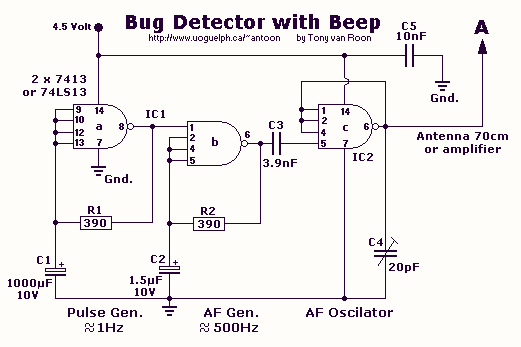
RF Bug detector
This circuit is not open for discussion. Although working perfectly, it was experimental. I will answer no emails in regards to this circuit. If you are looking for a more serious and reliable bug detector, go to the Countersurveillance Monitor...