


cellphone operated land rover connection to mobile phone problematic
#cellphone
#Nokia 2300
#MT8870
#AT89S52
#microcontroller
#DTMF
#remote control
#land rover
#earphones
#LED board
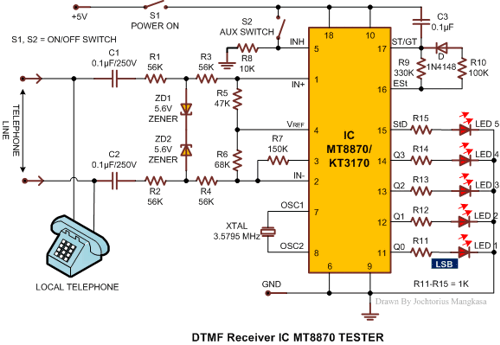
Description: The project involves using a Nokia 2300 mobile phone and its original earphones. The earphones function correctly for radio listening and phone conversations. However, the MT8870 integrated circuit does not provide output when connected to the AT89S52 microcontroller. A basic program has been written to transfer data from port 0 to port 1, where an LED board is connected. The intention is for the binary output from the MT8870 to be displayed on the LED board. Despite pressing keys, the output remains at 0000. It is recommended to first test the MT8870 receiver independently by disconnecting the microcontroller and measuring the output of the DTMF decoder with a multimeter to verify circuit functionality. Subsequently, the microcontroller side can be examined for potential issues. Additionally, an instructor has suggested modifications involving resistors and capacitors, which will be tested in hopes of resolving the problem.
The circuit under discussion involves the integration of a DTMF decoder (MT8870) with a microcontroller (AT89S52) and an LED display. The MT8870 is designed to decode Dual-Tone Multi-Frequency (DTMF) signals, which are commonly used in telephone systems. When a key is pressed on the keypad of the Nokia 2300, the corresponding DTMF tone is generated and sent to the MT8870. The MT8870 processes this signal and outputs a binary representation of the key pressed.
In this setup, the AT89S52 microcontroller is programmed to read the output from the MT8870. The microcontroller’s port 0 is connected to the output pins of the MT8870, while port 1 is connected to an LED board that visually displays the binary output. The expected behavior is that when a key is pressed, the MT8870 will output a binary value corresponding to that key, which will then be transferred to the LED board for visualization.
The issue arises when the output remains at 0000 regardless of key presses. This suggests that either the MT8870 is not receiving the DTMF signals correctly, or there is a problem in the communication between the MT8870 and the microcontroller. To troubleshoot, it is advisable to first isolate the MT8870 by disconnecting the microcontroller and using a multimeter to check the output of the MT8870. This test will confirm whether the DTMF decoder is functioning correctly.
If the MT8870 is operational, attention should then be directed to the microcontroller's programming and connections. Ensuring that the program correctly reads the output from the MT8870 and that the connections between the microcontroller and the decoder are secure is essential. The suggested changes to resistors and capacitors may also influence the performance of the circuit, particularly in terms of signal conditioning and stability.
In summary, the successful operation of this project hinges on the proper functioning of both the MT8870 and the AT89S52 microcontroller, along with appropriate connections and signal processing. Each component should be tested independently to isolate and resolve any issues present in the circuit.Using Nokia 2300 for my project and the original earphones that came with it. They work properly when listening to radio, or talking to someone over the phone. However, the MT8870 IC does not give output when I connect it to my AT89S52 microcontroller. I have written a simple program to transfer everything from port 0 to port 1 (in which an LED board is connected) - so that the corresponding output of the MT8870 (binary) will be shown on the LED board. But it continuously shows 0000, even on pressing keys. I would be better if you check just the MT8870 receiver part first, remove your microcontroller and see the output of DTMF decoder using multimeter. this will ensure that a part of your circuit is working fine. then you can check controller side if things are going wrong. Thank you everyone for your efforts! I went to my instructor and he suggested a few resistors and capacitor changes, am going to try that and hope it will work!
The circuit under discussion involves the integration of a DTMF decoder (MT8870) with a microcontroller (AT89S52) and an LED display. The MT8870 is designed to decode Dual-Tone Multi-Frequency (DTMF) signals, which are commonly used in telephone systems. When a key is pressed on the keypad of the Nokia 2300, the corresponding DTMF tone is generated and sent to the MT8870. The MT8870 processes this signal and outputs a binary representation of the key pressed.
In this setup, the AT89S52 microcontroller is programmed to read the output from the MT8870. The microcontroller’s port 0 is connected to the output pins of the MT8870, while port 1 is connected to an LED board that visually displays the binary output. The expected behavior is that when a key is pressed, the MT8870 will output a binary value corresponding to that key, which will then be transferred to the LED board for visualization.
The issue arises when the output remains at 0000 regardless of key presses. This suggests that either the MT8870 is not receiving the DTMF signals correctly, or there is a problem in the communication between the MT8870 and the microcontroller. To troubleshoot, it is advisable to first isolate the MT8870 by disconnecting the microcontroller and using a multimeter to check the output of the MT8870. This test will confirm whether the DTMF decoder is functioning correctly.
If the MT8870 is operational, attention should then be directed to the microcontroller's programming and connections. Ensuring that the program correctly reads the output from the MT8870 and that the connections between the microcontroller and the decoder are secure is essential. The suggested changes to resistors and capacitors may also influence the performance of the circuit, particularly in terms of signal conditioning and stability.
In summary, the successful operation of this project hinges on the proper functioning of both the MT8870 and the AT89S52 microcontroller, along with appropriate connections and signal processing. Each component should be tested independently to isolate and resolve any issues present in the circuit.Using Nokia 2300 for my project and the original earphones that came with it. They work properly when listening to radio, or talking to someone over the phone. However, the MT8870 IC does not give output when I connect it to my AT89S52 microcontroller. I have written a simple program to transfer everything from port 0 to port 1 (in which an LED board is connected) - so that the corresponding output of the MT8870 (binary) will be shown on the LED board. But it continuously shows 0000, even on pressing keys. I would be better if you check just the MT8870 receiver part first, remove your microcontroller and see the output of DTMF decoder using multimeter. this will ensure that a part of your circuit is working fine. then you can check controller side if things are going wrong. Thank you everyone for your efforts! I went to my instructor and he suggested a few resistors and capacitor changes, am going to try that and hope it will work!
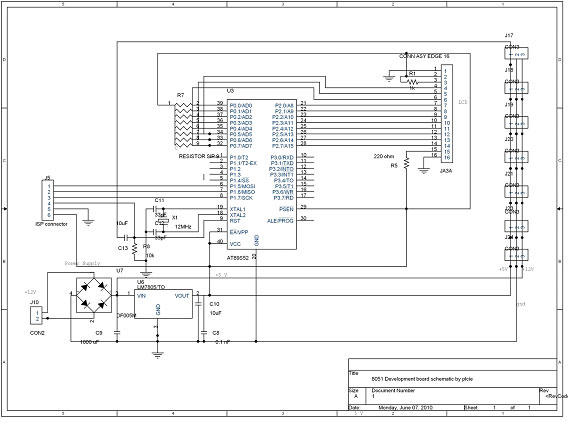
DTMF Based Robo Car Design & Circuit using 8051 Microcontroller
DTMF-based Robo Car design using the 8051 microcontroller project. This project demonstrates a method to control a domestic system using the DTMF tone generated by a telephone instrument when the user presses the keypad buttons of a mobile phone connected...
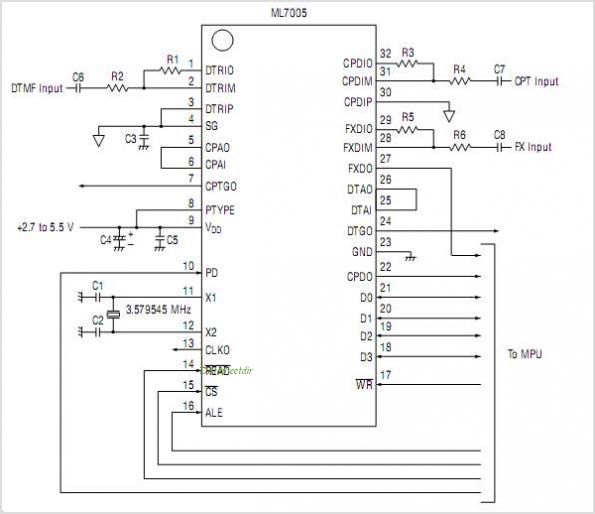
ML7005 DTMF Transceiver ML7005DTMF Transceiver
The MLX90224 series consists of dual Hall effect latches. It features two Hall effect latch functions with typical thresholds of +/- 2.0 mT. Each latch utilizes a switched silicon Hall plate for magnetic flux detection. The BOP and BRP are...
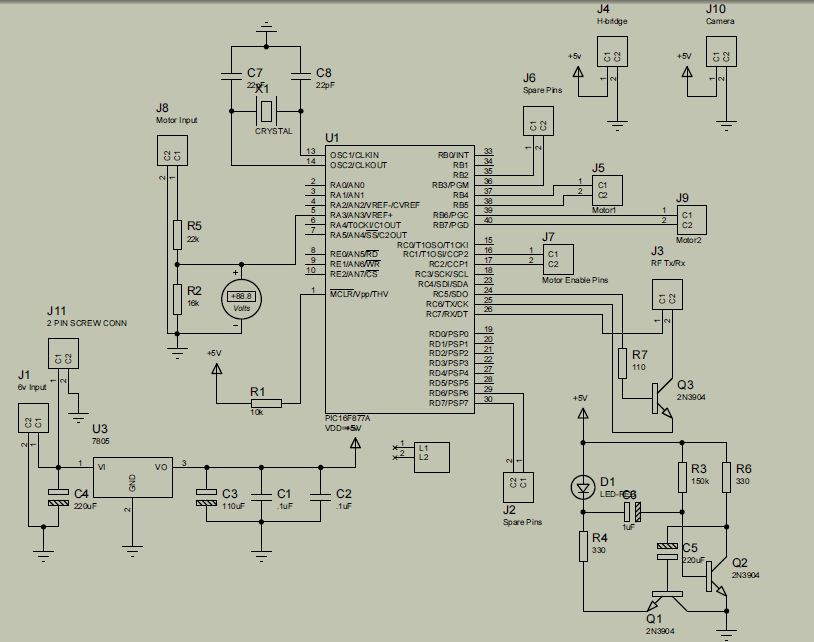
remote controlled surveillance mobile robot
The project is developed by Team Stark, with Gilbert as the leader and team members Martin and Janssen. The tasks have been divided into three parts. The first part includes camera control, login database, installer, and network setup, which was...
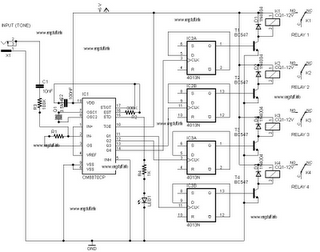
DTMF Remote Domestic System Control
The following circuit illustrates a DTMF Remote Domestic System Control Circuit Diagram. Features: DTMF signals can be transmitted over a radio to control various domestic appliances.
The DTMF (Dual-Tone Multi-Frequency) Remote Domestic System Control Circuit utilizes DTMF signaling for remote operation...
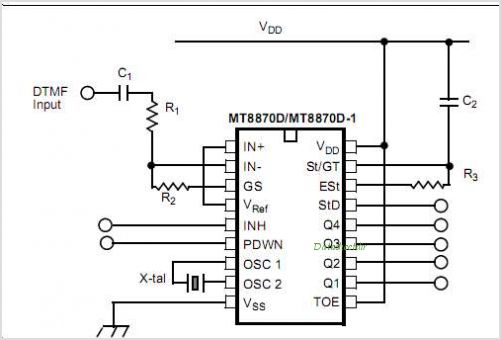
MT8870D Integrated DTMF Receiver With Enhance Sensitivity
The MT8885 is a monolithic DTMF transceiver equipped with a call progress filter. It is manufactured using CMOS technology, which ensures low power consumption and high reliability. The receiver section is designed based on the industry-standard MT8870 DTMF receiver. The...
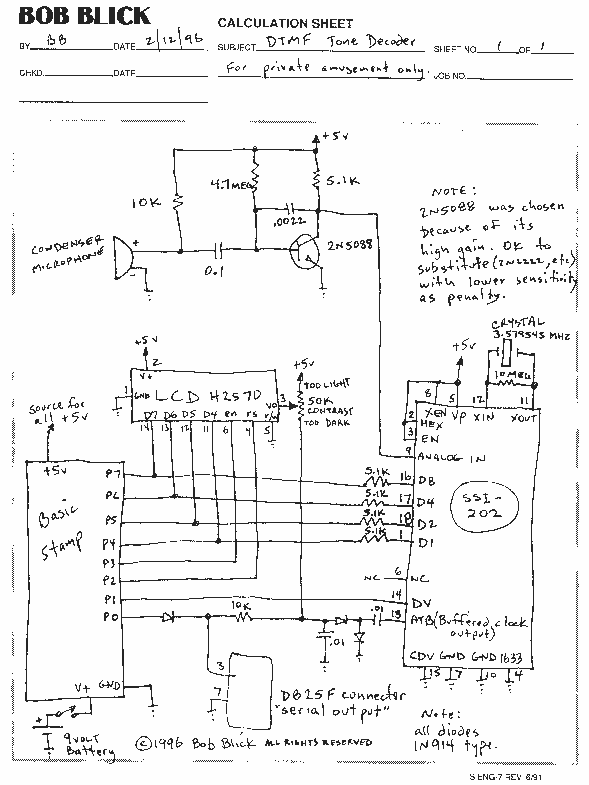
DTMF Tone Decoder
This project displays telephone numbers decoded from tones. A microphone picks up the tones, a preamplifier boosts the signals, an SSI-202 DTMF chip decodes the tones, a Basic Stamp acts as an interface to an LCD display and also provides...
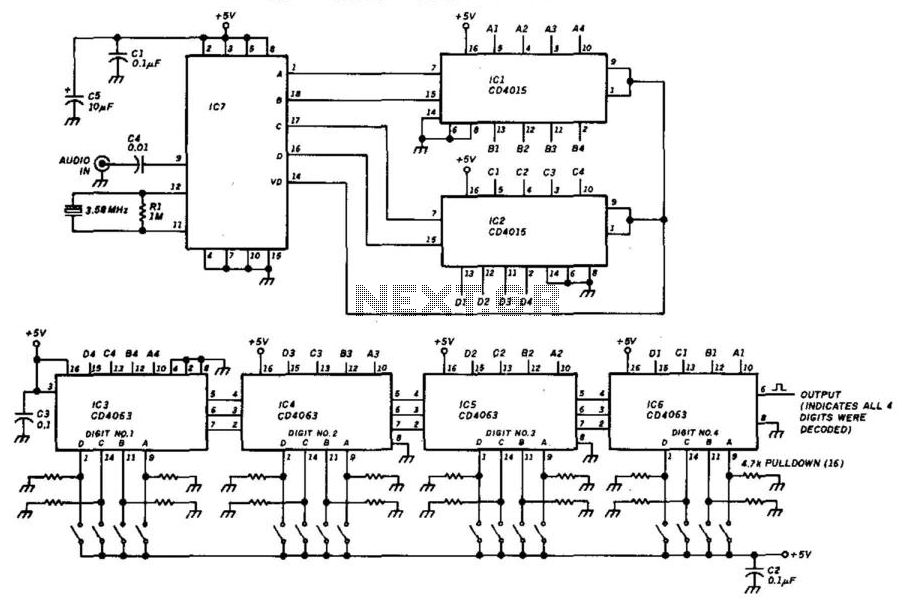
Low-Power Touch-Tone Decoder
This decoder will respond to a preselected 4-digit DTMF number. IC7 is a Radio Shack IC device (part #276-1303). The logic is all CMOS. The digits are selected by SW1 and SW2, a pair of 8-position DIP switches.
The described circuit...
DTMF COM
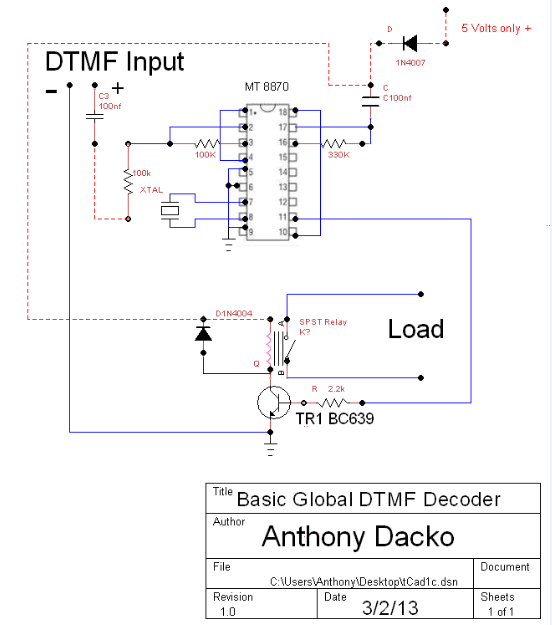
The Simple MT 8870 Decoder can be operated using any type of DTMF tones emitted from devices such as landlines, mobile phones, computers, and radio transmitters, including ham radios equipped with DTMF capabilities. This decoder can activate a relay when...
Home Automation through Cellphone Keying
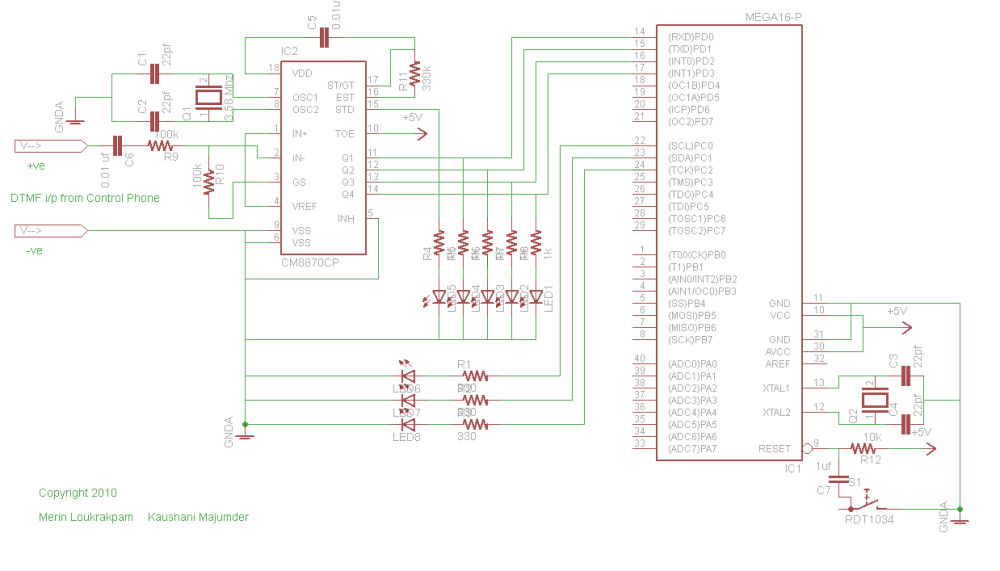
This project was developed during a Bachelor of Engineering course to enable remote control of lights and other appliances within a room. The objective was to address the common issue of forgetting to turn off devices such as fans or...