


LM567 Infrared Transmitter Circuit
#LM567
#infrared
#transmitter
#tone decoder
#audio signal
#modulation
#frequency adjustment
#T1 amplifier
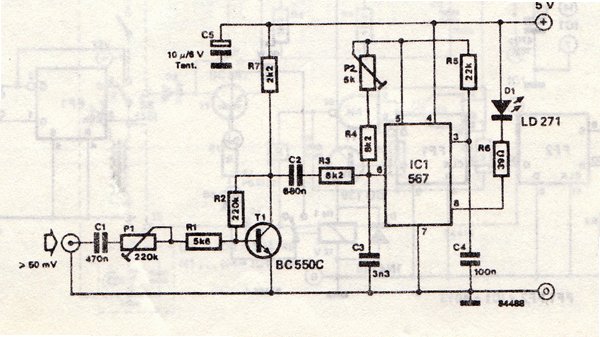
Description: The transmitter is equipped with an LM567 tone decoder circuit. An audio signal (at least 50 mV peak-to-peak) is amplified with a transistor (T1) and then used to modulate IC1. The infrared transmitter frequency is adjusted with potentiometer P2 between 25 and 40 kHz.
The circuit utilizes the LM567, a versatile tone decoder that can demodulate frequency-modulated signals. The audio input, which must be at least 50 mV peak-to-peak, is first amplified by transistor T1. This amplification stage is crucial for ensuring that the audio signal reaches sufficient levels for effective modulation. The output from T1 is then fed into IC1, which serves as the modulator for the infrared transmission.
The modulation process involves varying the frequency of the infrared light emitted by the transmitter in accordance with the amplified audio signal. The frequency of the infrared transmission can be fine-tuned using potentiometer P2, allowing for adjustments in the range of 25 kHz to 40 kHz. This tunability is essential for optimizing the transmission characteristics based on the specific application requirements, such as distance and clarity.
In terms of circuit design, it is critical to ensure that the power supply for the LM567 and T1 is stable and adequately decoupled to prevent noise from affecting performance. Additionally, the layout should minimize interference and maintain signal integrity, particularly in the modulation stage. Proper component selection for T1, such as choosing a transistor with suitable gain and frequency response, will enhance the overall performance of the transmitter.
The resulting infrared signal can be used for various applications, including remote control systems and wireless audio transmission, making this circuit design both functional and adaptable to different use cases.The transmitter is equiped with LM567, tone decoder circuit. Audio signal ( at least 50mVvv ) is amplified with T1 and then it is used to modulate IC1. Infrared transmitter frequency is adjusted with P2 between 25 and 40KHz.
The circuit utilizes the LM567, a versatile tone decoder that can demodulate frequency-modulated signals. The audio input, which must be at least 50 mV peak-to-peak, is first amplified by transistor T1. This amplification stage is crucial for ensuring that the audio signal reaches sufficient levels for effective modulation. The output from T1 is then fed into IC1, which serves as the modulator for the infrared transmission.
The modulation process involves varying the frequency of the infrared light emitted by the transmitter in accordance with the amplified audio signal. The frequency of the infrared transmission can be fine-tuned using potentiometer P2, allowing for adjustments in the range of 25 kHz to 40 kHz. This tunability is essential for optimizing the transmission characteristics based on the specific application requirements, such as distance and clarity.
In terms of circuit design, it is critical to ensure that the power supply for the LM567 and T1 is stable and adequately decoupled to prevent noise from affecting performance. Additionally, the layout should minimize interference and maintain signal integrity, particularly in the modulation stage. Proper component selection for T1, such as choosing a transistor with suitable gain and frequency response, will enhance the overall performance of the transmitter.
The resulting infrared signal can be used for various applications, including remote control systems and wireless audio transmission, making this circuit design both functional and adaptable to different use cases.The transmitter is equiped with LM567, tone decoder circuit. Audio signal ( at least 50mVvv ) is amplified with T1 and then it is used to modulate IC1. Infrared transmitter frequency is adjusted with P2 between 25 and 40KHz.
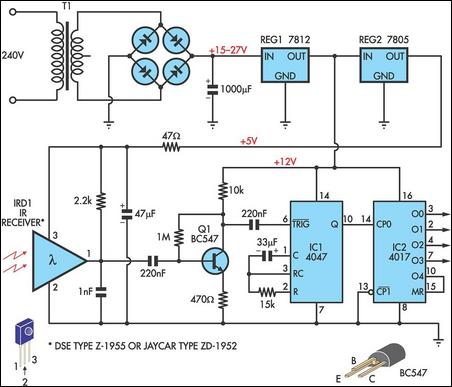
Infrared Remote Receiver Has Four Outputs
This circuit allows any infrared (IR) remote control to manage the outputs of a 4017 decade counter. It utilizes a 3-terminal IR receiver (IRD1) to capture infrared signals from the transmitter. The output from IRD1 is connected to an NPN...
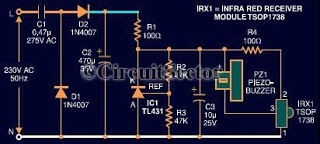
Remote Control Tester Circuit PCB
This document presents an infrared remote control tester circuit that can be constructed at a low cost. The circuit is built around the infrared receiver module TSOP1738. The state of the remote control can be observed through the sound emitted...
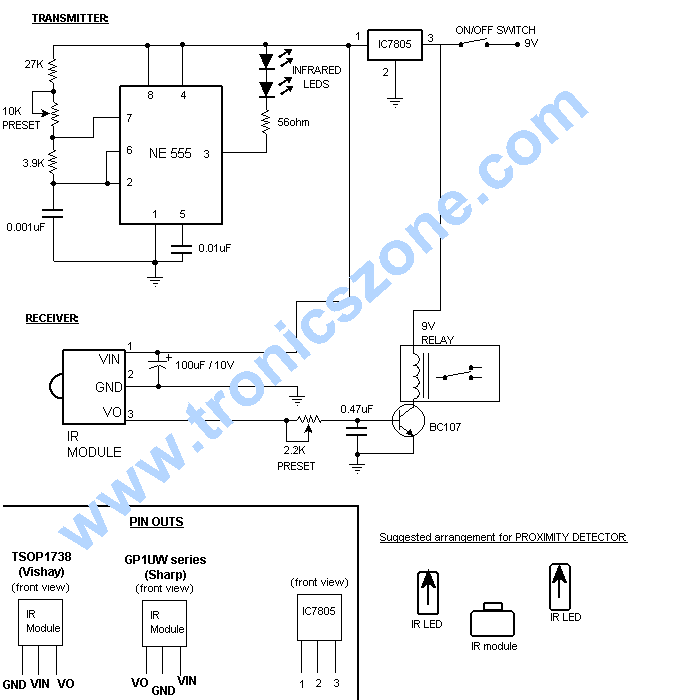
infrared IR proximity detector/ IR beam barrier circuit diagram
The circuit employs a widely used Sharp IR module (the Vishay module may also be utilized). The pin numbers indicated in the circuit pertain to both the Sharp and Vishay modules. For other modules, it is recommended to consult their...
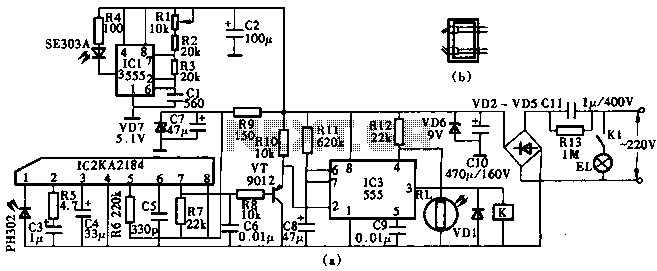
Infrared remote control dimmer light circuit diagram
This circuit utilizes the KA2184 infrared receiver ASIC for an infrared remote control dimmer light application, as depicted in the schematic. The infrared signal is generated by a pulse generator using an NE555 timer integrated circuit. The NE555 produces a...
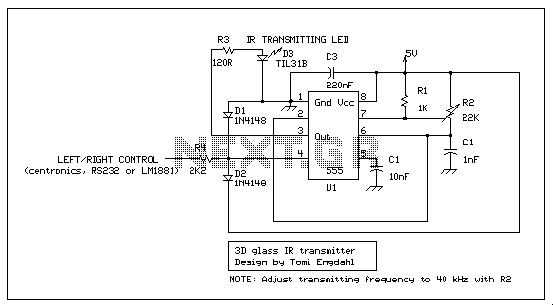
Infrared transmitter
This is an IR transmitting circuit which can be used in many projects. This IR transmitter sends 40 kHz carrier under computer control. The circuit can be controlled using any TTL or RS-232C level control signal which makes the interfacing...
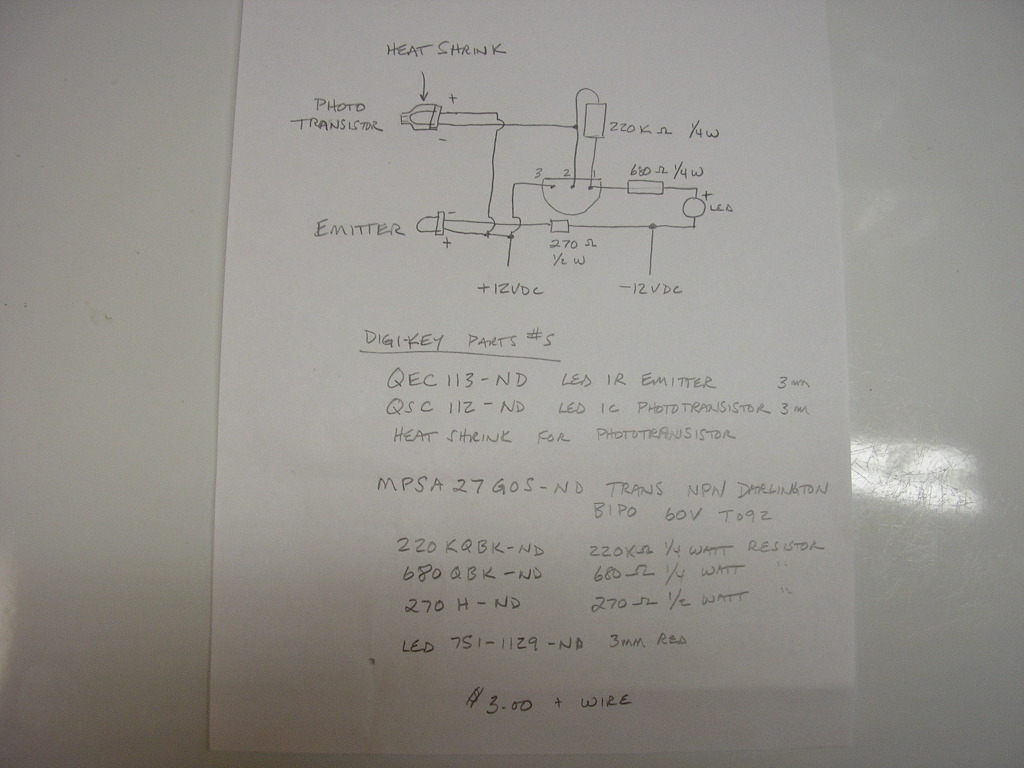
Inexpensive infrared train detector circuit
Model Railroader is the world's largest magazine on model trains and model railroad layouts. It offers assistance for both beginners and advanced enthusiasts across all model railroading scales, including layout track plans, product reviews, news, and forums.
Model Railroader magazine serves...
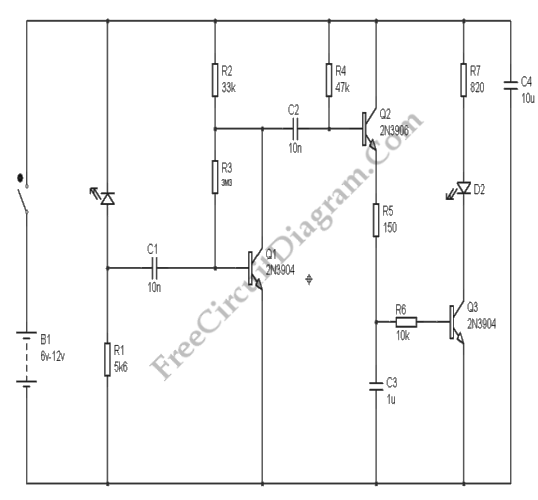
Simple IR Remote Tester
Most cases of infrared remote control failure can be identified by the absence of the pulsed transmitted infrared light. It is very rare that the...
Infrared remote controls operate by transmitting modulated infrared light signals that are detected by a corresponding...
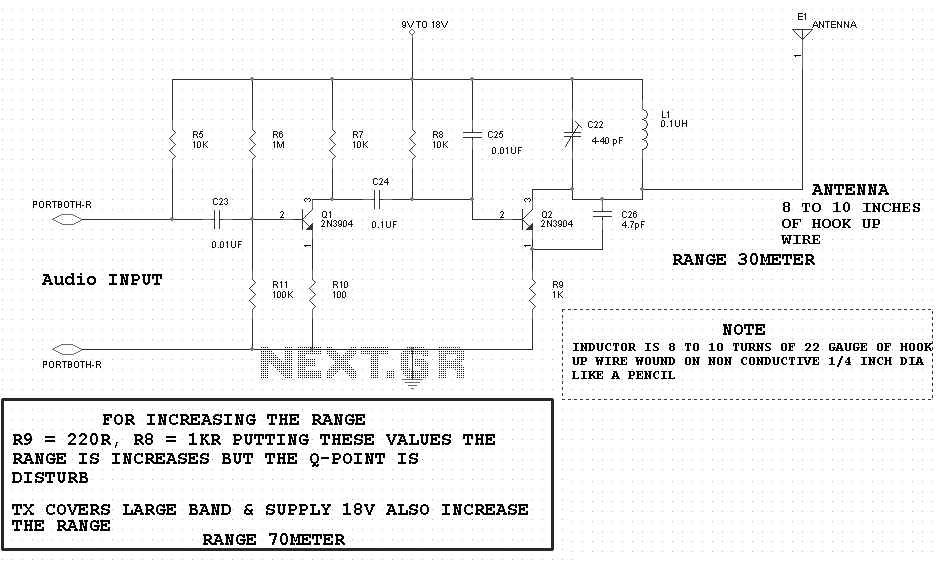
AM FM Simultaneous Transmitter Using Digital ICs
An FM and AM transmitter integrated into a compact device utilizing the CD4001 integrated circuit. It broadcasts at 20 MHz for AM and 100 MHz for FM.
The described transmitter combines both Frequency Modulation (FM) and Amplitude Modulation (AM) capabilities into...
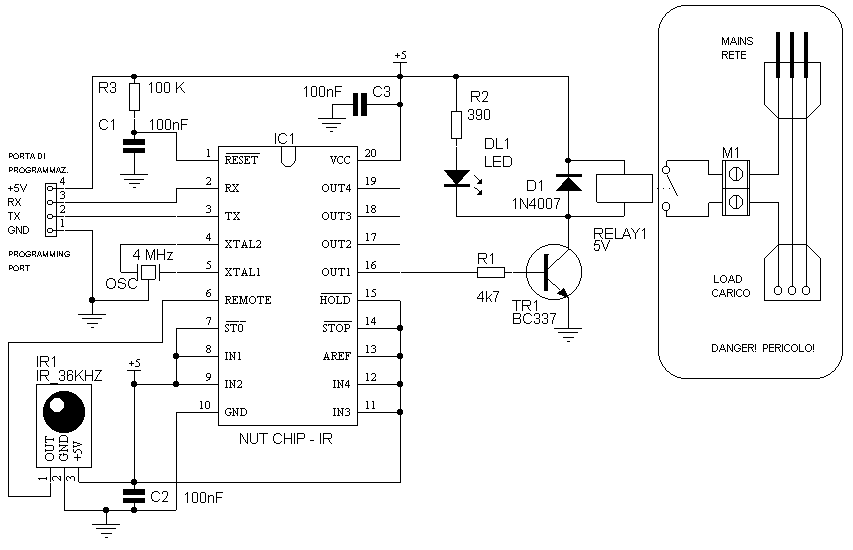
Infrared relay remote control
Having to use the infrared remote control, we will procure in addition to modulate the Nutchip infrared receiver. Do not let the name fool you, because more than one module component that looks like a large transistor. We use as...