


Appetizer Solar-Powered BEAM Robot
#solar-powered
#BEAM robot
#light-seeking
#autonomous
#schematic
#video
#educational
#renewable energy
#tiny robot
#DIY
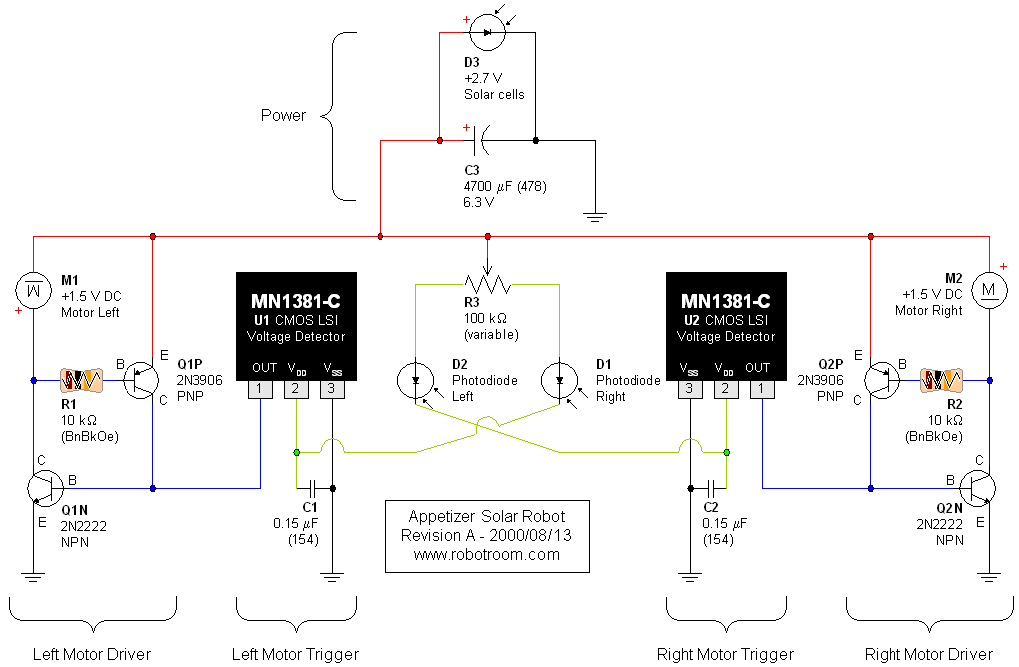
Description: A light-seeking solar-powered tiny robot based on a BEAM design. The article includes pictures, links, a video, and a schematic.
The described robot employs a BEAM (Biology, Electronics, Aesthetics, and Mechanics) design philosophy, which emphasizes simple, efficient, and often analog circuits to create lifelike behaviors. This light-seeking robot is powered by solar energy, making it an environmentally friendly project that harnesses renewable energy for operation.
The robot's core functionality revolves around its ability to detect light sources and navigate towards them. This is typically achieved using light-dependent resistors (LDRs) or phototransistors that serve as sensors. When the robot is exposed to light, the sensors detect the intensity of the light and send corresponding signals to a simple logic circuit or a series of analog components that adjust the movement of the robot's motors.
The schematic of the robot would typically illustrate the connections between the solar panel, the sensors, the motor drivers, and the control circuitry. The solar panel converts sunlight into electrical energy, which is used to power the entire system. The sensors are positioned in such a way that they can detect light from different angles, allowing the robot to determine the direction of the light source.
The movement mechanism usually consists of two or more DC motors that drive the wheels or legs of the robot. The control circuit interprets the sensor signals and adjusts the motor speeds accordingly to steer the robot towards the light. For instance, if one sensor detects more light than the other, the control circuit will slow down the motor on the side with less light, causing the robot to turn towards the light source.
In summary, this light-seeking solar-powered robot exemplifies the principles of BEAM design by integrating simple sensors and motors with solar energy, resulting in an autonomous and efficient device capable of responding to its environment. The inclusion of visual aids such as pictures and videos in the article provides a comprehensive understanding of the robot's design and functionality, while the schematic offers a clear representation of the electronic components involved in its operation.A light-seeking solar-powered tiny robot based on a BEAM design. Article includes pictures, links, a video, and a schematic..
The described robot employs a BEAM (Biology, Electronics, Aesthetics, and Mechanics) design philosophy, which emphasizes simple, efficient, and often analog circuits to create lifelike behaviors. This light-seeking robot is powered by solar energy, making it an environmentally friendly project that harnesses renewable energy for operation.
The robot's core functionality revolves around its ability to detect light sources and navigate towards them. This is typically achieved using light-dependent resistors (LDRs) or phototransistors that serve as sensors. When the robot is exposed to light, the sensors detect the intensity of the light and send corresponding signals to a simple logic circuit or a series of analog components that adjust the movement of the robot's motors.
The schematic of the robot would typically illustrate the connections between the solar panel, the sensors, the motor drivers, and the control circuitry. The solar panel converts sunlight into electrical energy, which is used to power the entire system. The sensors are positioned in such a way that they can detect light from different angles, allowing the robot to determine the direction of the light source.
The movement mechanism usually consists of two or more DC motors that drive the wheels or legs of the robot. The control circuit interprets the sensor signals and adjusts the motor speeds accordingly to steer the robot towards the light. For instance, if one sensor detects more light than the other, the control circuit will slow down the motor on the side with less light, causing the robot to turn towards the light source.
In summary, this light-seeking solar-powered robot exemplifies the principles of BEAM design by integrating simple sensors and motors with solar energy, resulting in an autonomous and efficient device capable of responding to its environment. The inclusion of visual aids such as pictures and videos in the article provides a comprehensive understanding of the robot's design and functionality, while the schematic offers a clear representation of the electronic components involved in its operation.A light-seeking solar-powered tiny robot based on a BEAM design. Article includes pictures, links, a video, and a schematic..
Video Clock Superimposer
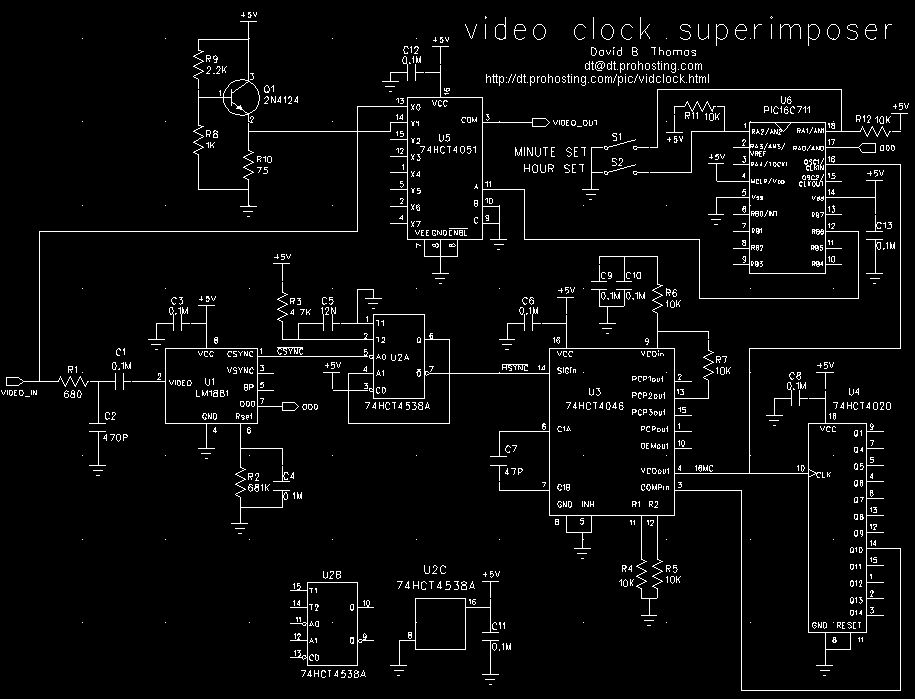
As a followup to my VCR Pong project, here is a gadget that is actually useful in the Real World! It superimposes the time of day, in "HH MM SS" format, in the bottom right-hand corner of an existing video...
Video-dc-restorer
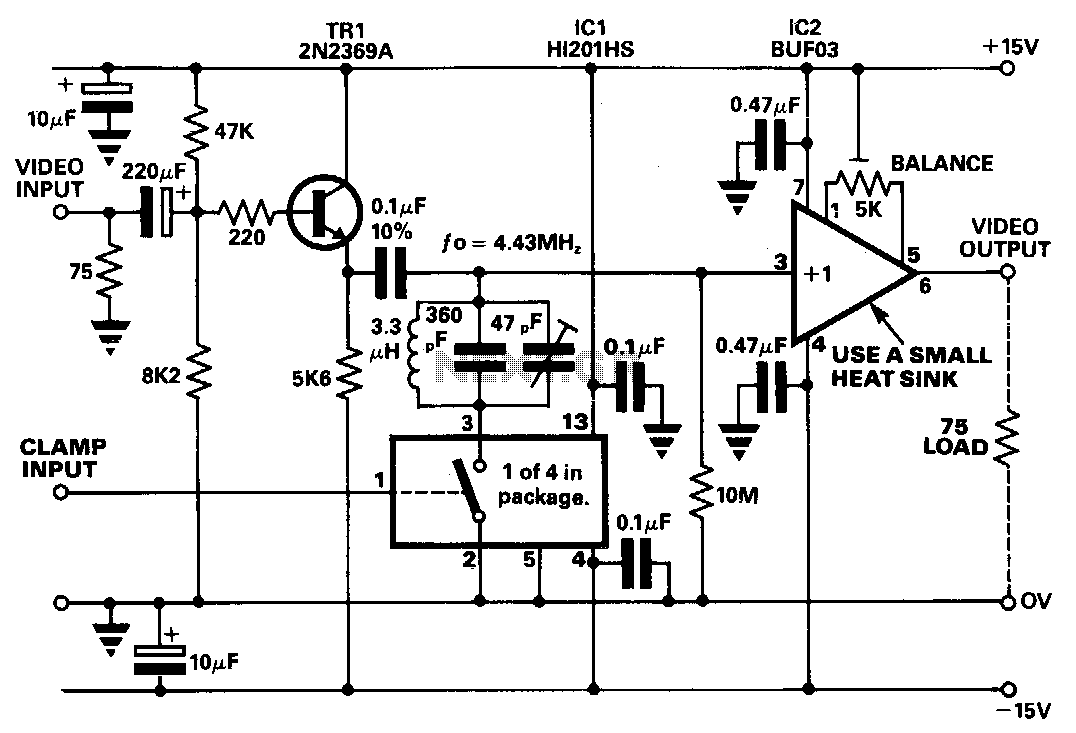
The primary requirement for efficient de-restoration is to provide a short time constant during the clamp period, while maintaining a long time constant during the active line time. The switch in the Harris HI201HS has an on-resistance of 30 ohms,...
Video Tracer For Trouble-Shooting
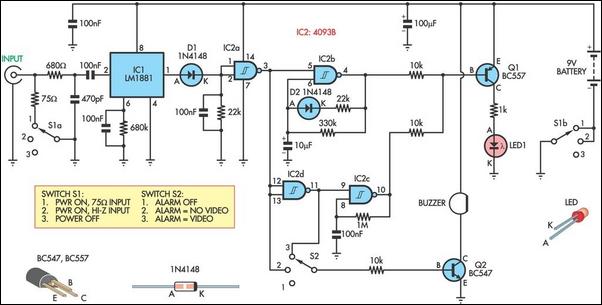
This circuit was designed to assist installers and maintainers of video systems. It primarily consists of a video sync separator (IC1) followed by a LED and buzzer driver (IC2, Q1, and Q2). When in operation, the device connects to a...
Homemade Metal Detector Kit
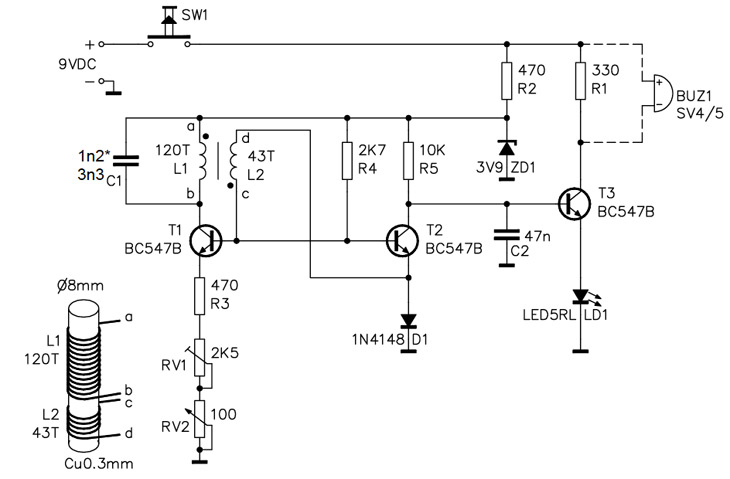
A simple home project can quickly become problematic if it encounters electric cables, gas, or water pipes, or the central heating system. Using a metal detector allows one to check for metal objects within walls, ceilings, or floors beforehand. An...
Video Clock Superimposer
As a followup to my VCR Pong project, here is a gadget that is actually useful in the Real World! It superimposes the time of day, in "HH MM SS" format, in the bottom right-hand corner of an existing video...
Video Activated Relay
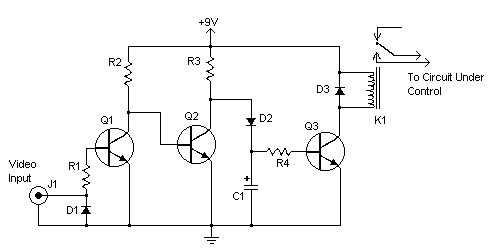
This simple circuit from the May 1996 Think Tank column of Popular Electronics activates a relay when it senses a composite video signal. This allows you to use the tuner built into your VCR to turn on and off older...
Help with a schematic please
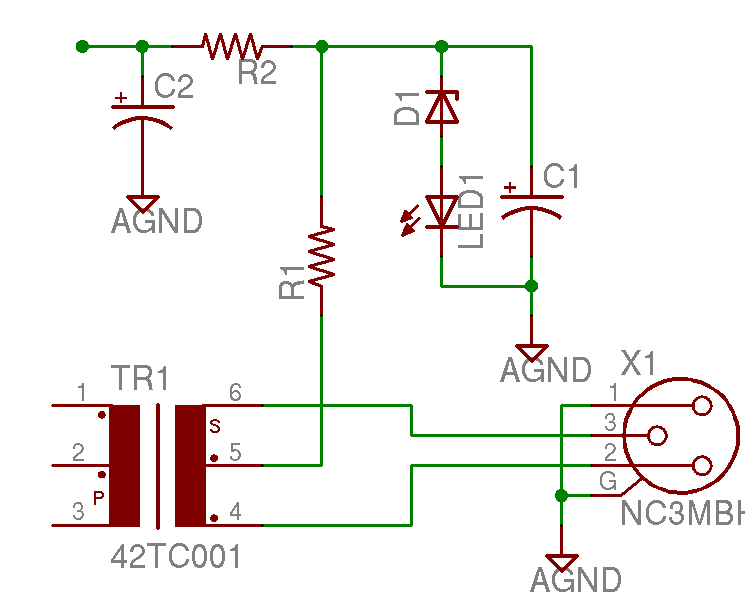
A project is underway to construct the CountryHick DI as illustrated on DIYFactory, incorporating a few minor modifications. The final design aims to be a 1U unit with four inputs.
The CountryHick DI (Direct Injection) box is a crucial tool in...
Light-seeking robot
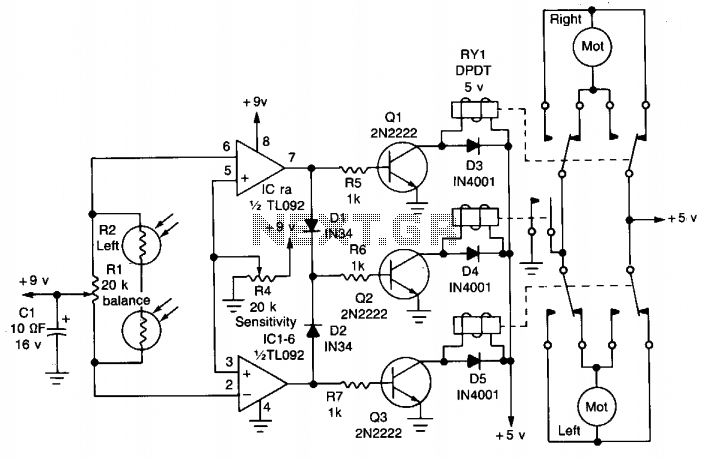
The circuit is designed to seek light, allowing a robot to follow a flashlight in a dark room. Two photocells are used to determine the direction of the robot's movement. Each photocell is connected to an operational amplifier configured as...
Low/Zero-Carbon Office
The intention is to genuinely and measurably reduce energy consumption and/or micro-generate energy, leading to a net reduction in the energy imported to a residence each year. Since 2007/2008, all office lighting has been transitioned off-grid, achieving a zero-carbon status...