


Beam-break Detector For Camera Shutter or Flash Control
#IR sensor
#beam-break detector
#camera shutter control
#flash control
#ambient light insensitive
#modulated IR beam
#Jaycar ZD-1942
#photography
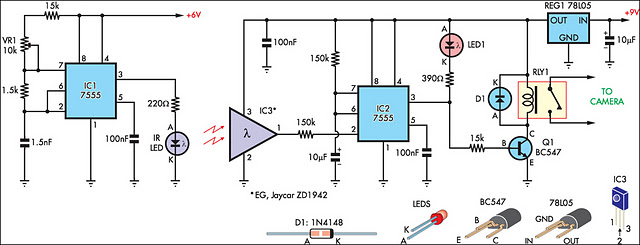
Description: This circuit serves as an alternative to the infrared (IR) beam break detector featured in the June 2009 issue of Silicon Chip. To enhance its insensitivity to ambient light, it employs a standard IR receiver integrated circuit (IC), such as the Jaycar ZD-1942. This IC provides a high output (+5V) whenever a modulated beam is detected. The IR detector (IC3) activates a LM7555 CMOS timer (IC2) operating in monostable mode. Upon interruption of the beam, IC2 is triggered, and its output at pin 3 goes high for approximately half a second. This action deactivates LED1 and activates transistor Q1 to control a 5V low-power relay. The circuit is powered by six AA batteries and a 78L05 5V voltage regulator, which is essential for the operation of the receiver IC. The IR transmitter is also based on an LM7555 (IC1), functioning in astable mode with a low duty cycle. Its frequency is adjustable to 38kHz using trimpot VR1. The IR diode used in the transmitter can be salvaged from an old remote control or purchased new. The transmitter is powered by four AA batteries. The system has a detection range of several meters and is designed to be insensitive to transmitter alignment. However, the detection window can be narrowed by positioning the detector closer to the object to be detected or by employing a baffle to limit the detection area.
This infrared beam break detection circuit is designed for applications where reliable object detection is required while minimizing the influence of ambient light. The choice of the Jaycar ZD-1942 IR receiver IC is significant due to its capability to maintain a high output signal in the presence of modulated IR light, which is essential for effective operation in various lighting conditions.
The LM7555 timer IC (IC2) operates in monostable mode, meaning it produces a single pulse output when triggered. This feature is particularly useful for applications where a brief response is needed, such as turning off an LED or activating a relay. The timing interval can be fine-tuned to suit specific requirements, allowing flexibility in the duration that the relay remains activated after the beam is interrupted.
The circuit’s power supply, utilizing six AA batteries and a 78L05 voltage regulator, ensures a stable 5V output necessary for the operation of the receiver and timer ICs. The use of a low-power relay allows for controlling higher power loads without significant power drain from the batteries, making the circuit suitable for battery-operated applications.
The transmitter circuit, also based on the LM7555, operates in astable mode, generating a continuous square wave output at a frequency set to 38kHz. This frequency is commonly used in IR remote control systems, ensuring compatibility with a wide range of IR receivers. The adjustable frequency via trimpot VR1 allows for fine-tuning of the modulation, which can help optimize performance based on specific environmental conditions.
Overall, this circuit provides a robust solution for beam break detection, with a focus on minimizing false triggers caused by ambient light and ensuring reliable operation over several meters. The design considerations, including the choice of components and the configuration of the transmitter and receiver, contribute to its effectiveness in diverse applications.This circuit is presented as an alternative to the IR beam break detector featured in the June 2009 issue (Silicon Chip). In order to make it relatively insensitive to ambient light, it uses a standard IR receiver IC such as the Jaycar ZD-1942.
This has a high output (+5V) as long as a modulated beam is detected. The IR detector (IC3) controls an LM 7555 CMOS timer (IC2) which operates in mono stable mode. When the beam is broken, IC2 is triggered and its pin 3 output goes high for about half a second. This extinguishes LED1 and turns on transistor Q1 to drive a 5V low-power relay. The circuit is powered from six AA cells and a 78L05 5V regulator (necessary for the receiver IC). The IR transmitter is also built around an LM7555 (IC1), this time operating in astable mode at low duty cycle. Its frequency is set to 38kHz with trimpot VR1. The IR diode was salvaged from a defunct remote control but these are readily available new. The transmitter is powered by four AA cells. The system has a range of several metres and while it is insensitive to the transmitter alignment, the detection window can be narrowed by placing the detector near to the object to be detected and/or using some form of baffle to restrict the window.
This infrared beam break detection circuit is designed for applications where reliable object detection is required while minimizing the influence of ambient light. The choice of the Jaycar ZD-1942 IR receiver IC is significant due to its capability to maintain a high output signal in the presence of modulated IR light, which is essential for effective operation in various lighting conditions.
The LM7555 timer IC (IC2) operates in monostable mode, meaning it produces a single pulse output when triggered. This feature is particularly useful for applications where a brief response is needed, such as turning off an LED or activating a relay. The timing interval can be fine-tuned to suit specific requirements, allowing flexibility in the duration that the relay remains activated after the beam is interrupted.
The circuit’s power supply, utilizing six AA batteries and a 78L05 voltage regulator, ensures a stable 5V output necessary for the operation of the receiver and timer ICs. The use of a low-power relay allows for controlling higher power loads without significant power drain from the batteries, making the circuit suitable for battery-operated applications.
The transmitter circuit, also based on the LM7555, operates in astable mode, generating a continuous square wave output at a frequency set to 38kHz. This frequency is commonly used in IR remote control systems, ensuring compatibility with a wide range of IR receivers. The adjustable frequency via trimpot VR1 allows for fine-tuning of the modulation, which can help optimize performance based on specific environmental conditions.
Overall, this circuit provides a robust solution for beam break detection, with a focus on minimizing false triggers caused by ambient light and ensuring reliable operation over several meters. The design considerations, including the choice of components and the configuration of the transmitter and receiver, contribute to its effectiveness in diverse applications.This circuit is presented as an alternative to the IR beam break detector featured in the June 2009 issue (Silicon Chip). In order to make it relatively insensitive to ambient light, it uses a standard IR receiver IC such as the Jaycar ZD-1942.
This has a high output (+5V) as long as a modulated beam is detected. The IR detector (IC3) controls an LM 7555 CMOS timer (IC2) which operates in mono stable mode. When the beam is broken, IC2 is triggered and its pin 3 output goes high for about half a second. This extinguishes LED1 and turns on transistor Q1 to drive a 5V low-power relay. The circuit is powered from six AA cells and a 78L05 5V regulator (necessary for the receiver IC). The IR transmitter is also built around an LM7555 (IC1), this time operating in astable mode at low duty cycle. Its frequency is set to 38kHz with trimpot VR1. The IR diode was salvaged from a defunct remote control but these are readily available new. The transmitter is powered by four AA cells. The system has a range of several metres and while it is insensitive to the transmitter alignment, the detection window can be narrowed by placing the detector near to the object to be detected and/or using some form of baffle to restrict the window.
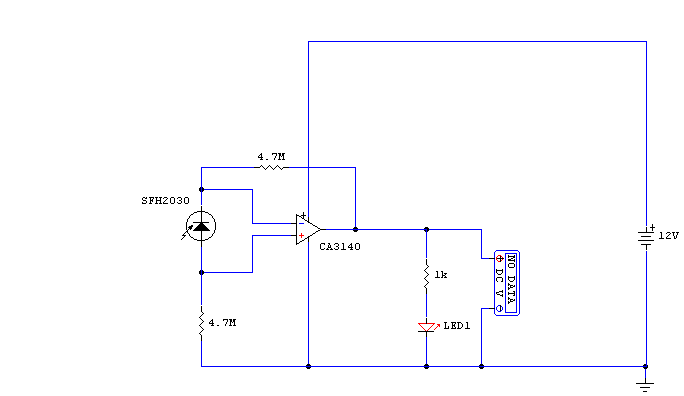
ir remote control tester
While developing an infrared (IR) extender circuit, a method was required to measure the relative intensities of different infrared light sources. This circuit is the culmination of that research. It utilizes a photodiode, specifically the SFH2030, as the infrared sensor....
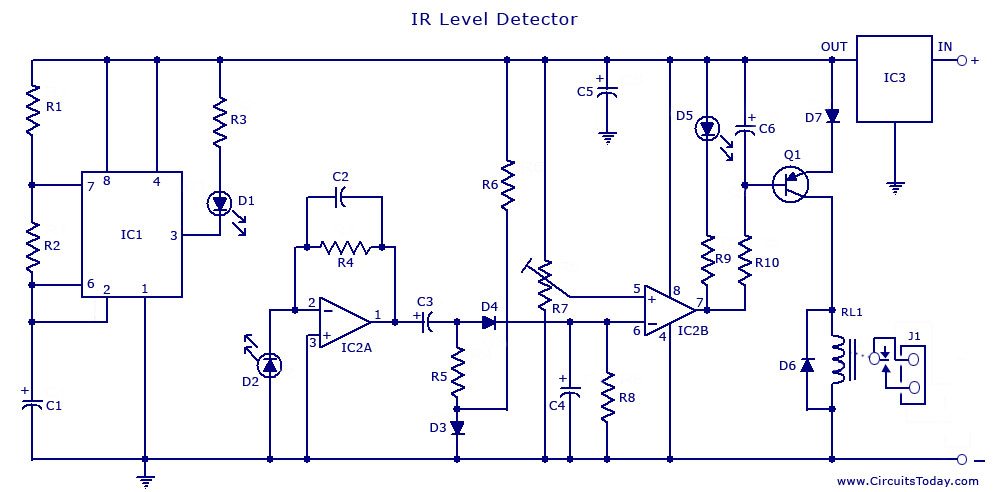
Infrared (IR) Sensor/DetectorCircuit using 555 IC
An infrared (IR) sensor or detector circuit diagram utilizing a 555 integrated circuit (IC), primarily employed as a water level or liquid level sensor and proximity detector circuit.
The described circuit employs a 555 timer IC configured in a monostable or...
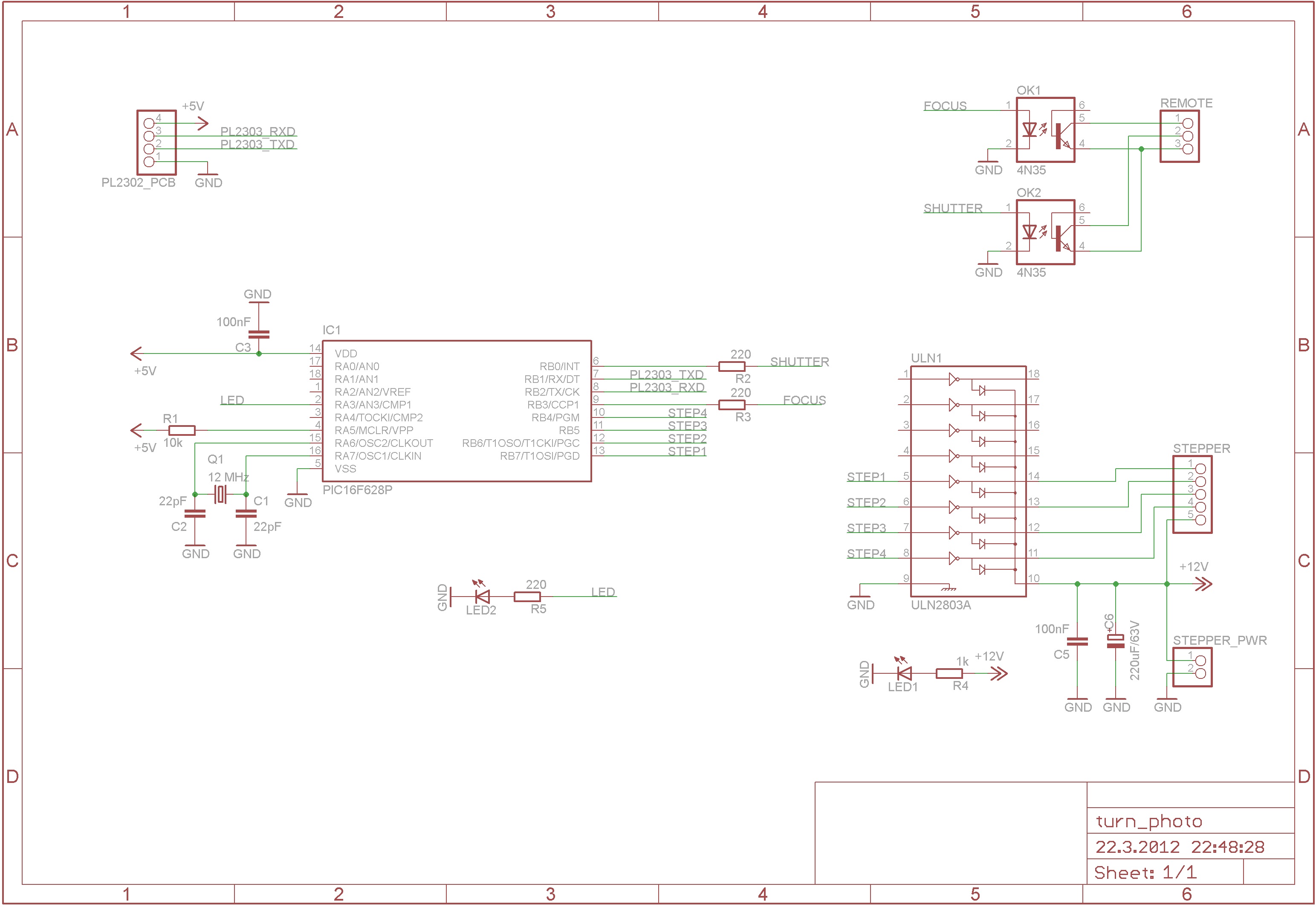
Turntable Photography Equipment
The device captures 360-degree photos, which are essentially animations made from multiple images of a product taken from different angles. It requires a controllable device that can take pictures at even intervals. As depicted in the accompanying image, a device...
Line Detector
One of the simplest methods to demonstrate the autonomous motion of a robot is by having it follow a line. There are competitions for the fastest robots or those capable of navigating complex line mazes. Lines can be high-contrast black...

remote controlled dc motor circuit
This is a simple hobby circuit for a remote-controlled toy car. The primary component utilized is the IR sensor circuit, which includes a TSOP IR receiver. This receiver allows the user to start and stop the DC motor of the...
circuit trigger camera phone pda mp3
In night photography, long exposures are common, sometimes lasting several seconds to several minutes. HDR techniques often require taking a series of nine or more photos. Holding a remote trigger for an extended period can be tedious, leading to the...
Yongnuo YN-460 Flash Remote Power Control
The YN-460 is an affordable manual-only shoe mount flash produced by the Chinese company Yongnuo. It has gained popularity within the strobist community primarily due to its low price and satisfactory performance. To adjust the flash power level, users must...
2 module ir light barrier wont run same power source
A 0.1µF capacitor and a 500µF electrolytic capacitor were connected to both the transmitter and the receiver, but the system did not function as expected. Attempts to add diodes were also unsuccessful. Clarification is needed regarding the behavior of the...
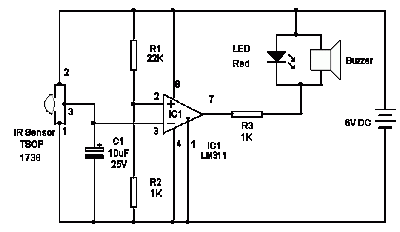
Build an IR Beam Breaker
The IR Beam Breaker Circuit Diagram is designed as an infrared beam breaking alarm suitable for use in entryways or passageways. This circuit utilizes the well-known IR sensor module TSOP 1738, which detects 38 kHz infrared pulses emitted by the...