


Geomagnetic Field Detector circuit
#geomagnetic
#field detector
#oscillator
#ferrite rod
#coil
#medium wave
#beat note
#copper shielding
#trimmer capacitor
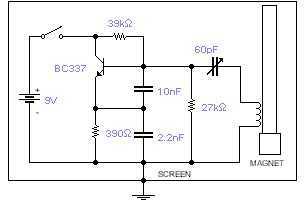
Description: This basic oscillator will detect the Earth magnetic field. The ferrite rod and coil are taken from an old Medium Wave receiver and a small magnet is glued at one end. Tune to a medium wave commercial station until you hear a beat note. Any movement of the ferrite rod will produce an audible note that depends on the prevailing Earth magnetic field. Screening is essential. Use a plastic box padded, on the inside, with copper wires running parallel to the rod and grounded in one place only. A small hole is made in the box in order to adjust the trimmer capacitor with a plastic screwdriver. An American equivalent to the BC337 could be the 2N2369A but I did not try it out.
This oscillator circuit operates based on the principle of detecting variations in the Earth's magnetic field using a ferrite rod and coil assembly. The ferrite rod serves as a magnetic core, enhancing the inductance of the coil wound around it. The coil is sourced from an old Medium Wave receiver, which is re-purposed to serve as the sensing element for the oscillator.
To assemble the circuit, a small magnet is affixed to one end of the ferrite rod. This magnet interacts with the Earth's magnetic field, and any movement of the ferrite rod will induce changes in the magnetic flux through the coil. These changes will produce variations in the oscillator's frequency, which can be heard as an audible note when tuned to a medium wave commercial station.
Proper screening is critical to the performance of this oscillator. The circuit is enclosed in a plastic box that is internally padded with copper wires. These wires should run parallel to the ferrite rod and be grounded at a single point to minimize electromagnetic interference and enhance the sensitivity of the oscillator.
A trimmer capacitor is included in the circuit to allow for fine-tuning of the oscillator frequency. A small access hole is provided in the enclosure, enabling adjustment of the capacitor using a plastic screwdriver, which prevents any potential short circuits or interference from metal tools.
For the transistor component of the circuit, the BC337 is recommended, although it can be substituted with the 2N2369A, which is an American equivalent. This transistor functions as an amplifier within the oscillator circuit, converting the oscillations produced by the coil into a signal that can be heard through a speaker or headphone.
Overall, this simple oscillator circuit offers a practical application for detecting variations in the Earth's magnetic field, making it an interesting project for electronics enthusiasts and those interested in magnetism.This basic oscillator will detect the Earth magnetic field. The ferrite rod and coil are taken from an old Medium Wave receiver and a small magnet is glued at one end. Tune to a medium wave commercial station until you hear a beat note. Any movement of the ferrite rod will produce an audible note that depends on the prevailing Earth magnetic field.
Screening is essential. Use a plastic box padded, on the inside, with copper wires running parallel to the rod and grounded in one place only. A small hole is made in the box in order to adjust the trimmer capacitor with a plastic screwdriver. An American equivalent to the BC337 could be the 2N2369A but I did not try it out.
This oscillator circuit operates based on the principle of detecting variations in the Earth's magnetic field using a ferrite rod and coil assembly. The ferrite rod serves as a magnetic core, enhancing the inductance of the coil wound around it. The coil is sourced from an old Medium Wave receiver, which is re-purposed to serve as the sensing element for the oscillator.
To assemble the circuit, a small magnet is affixed to one end of the ferrite rod. This magnet interacts with the Earth's magnetic field, and any movement of the ferrite rod will induce changes in the magnetic flux through the coil. These changes will produce variations in the oscillator's frequency, which can be heard as an audible note when tuned to a medium wave commercial station.
Proper screening is critical to the performance of this oscillator. The circuit is enclosed in a plastic box that is internally padded with copper wires. These wires should run parallel to the ferrite rod and be grounded at a single point to minimize electromagnetic interference and enhance the sensitivity of the oscillator.
A trimmer capacitor is included in the circuit to allow for fine-tuning of the oscillator frequency. A small access hole is provided in the enclosure, enabling adjustment of the capacitor using a plastic screwdriver, which prevents any potential short circuits or interference from metal tools.
For the transistor component of the circuit, the BC337 is recommended, although it can be substituted with the 2N2369A, which is an American equivalent. This transistor functions as an amplifier within the oscillator circuit, converting the oscillations produced by the coil into a signal that can be heard through a speaker or headphone.
Overall, this simple oscillator circuit offers a practical application for detecting variations in the Earth's magnetic field, making it an interesting project for electronics enthusiasts and those interested in magnetism.This basic oscillator will detect the Earth magnetic field. The ferrite rod and coil are taken from an old Medium Wave receiver and a small magnet is glued at one end. Tune to a medium wave commercial station until you hear a beat note. Any movement of the ferrite rod will produce an audible note that depends on the prevailing Earth magnetic field.
Screening is essential. Use a plastic box padded, on the inside, with copper wires running parallel to the rod and grounded in one place only. A small hole is made in the box in order to adjust the trimmer capacitor with a plastic screwdriver. An American equivalent to the BC337 could be the 2N2369A but I did not try it out.
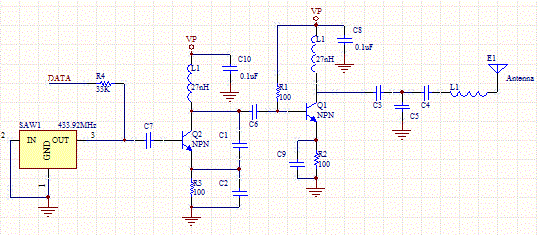
Saw Transmitter Circuit
This circuit utilizes a sawtooth oscillator along with an output amplifier that drives a transistor. The components C1, C2, and L1 are essential for the oscillator's operation, forming a tank circuit that must be tuned to the resonant frequency. Generally,...

Oscillator without a crystal
Is it possible to build an oscillator (VCO or not) without using a crystal? I built a Pixie II with a borrowed crystal, which I have since returned, and now I am inquiring about the feasibility of constructing an oscillator...

The door bell circuit
Figure 1 illustrates an economical and straightforward Gate Alarm designed to operate using a small universal AC-DC power supply. IC1a functions as a fast oscillator, while IC1b serves as a slow oscillator. These two oscillators are integrated through IC1c to...
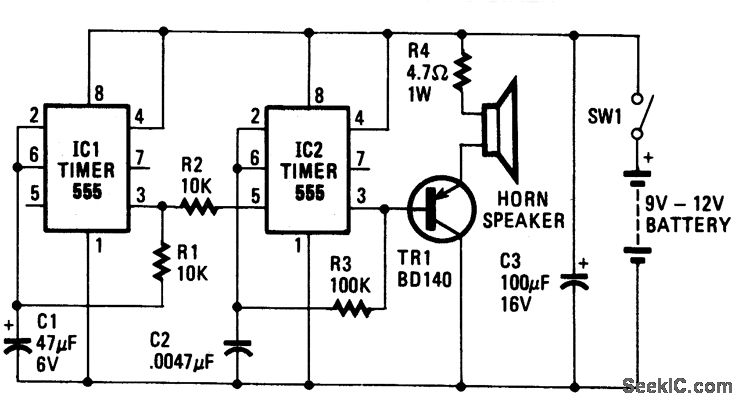
HEE HAW ELECTRONIC SIREN
The oscillator based on IC2 generates sound, with its output linked to the base of TR1, which amplifies the signal to drive the speaker. Resistor R4 is included to limit the current through TR1 to a safe level. The oscillation...
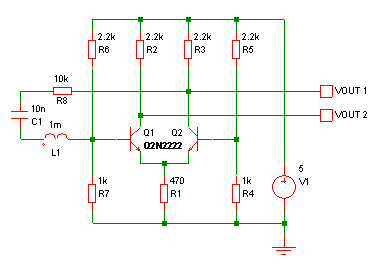
why doesnt this circuit oscillate
The buba oscillator initially failed to oscillate. The first step is to check the fundamental components, as minor errors in the values of capacitors, resistors, and inductors can significantly impact performance. It is advisable to measure component values with a...
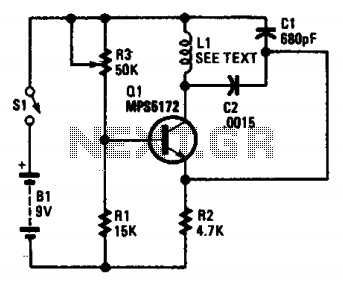
Minimal metal detector
This circuit is an oscillator with LI being a 4-inch diameter coil consisting of 35 turns of #26 magnet wire. Metal in proximity to LI will cause the oscillator to shift frequency. An AM transistor radio is used to detect...
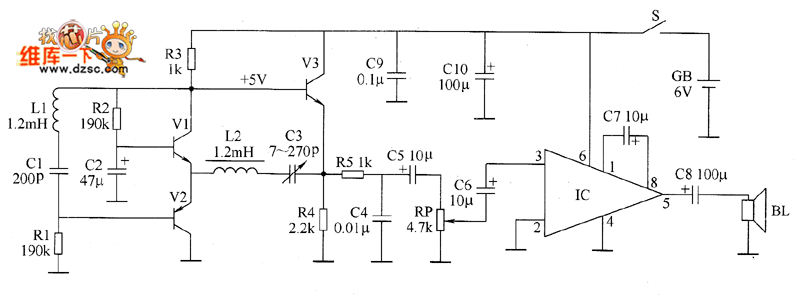
Metal detector circuit diagram 3
The metal detector consists of a probe oscillator, a reference oscillator, an audio amplifier, and various other components, as illustrated in the schematic. The probe oscillator is made up of transistors V1 and V2, a detection coil L1, a capacitor...
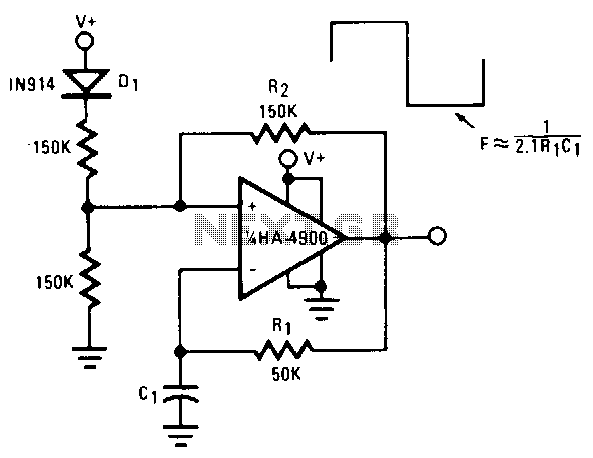
Oscillator-clock-generator
This self-starting fixed-frequency oscillator circuit provides excellent frequency stability. R1 and C1 form the frequency-determining network, while R2 delivers the regenerative feedback. Diode D1 improves stability by compensating for the difference between VaH and VsurrLY. In applications where a precision...
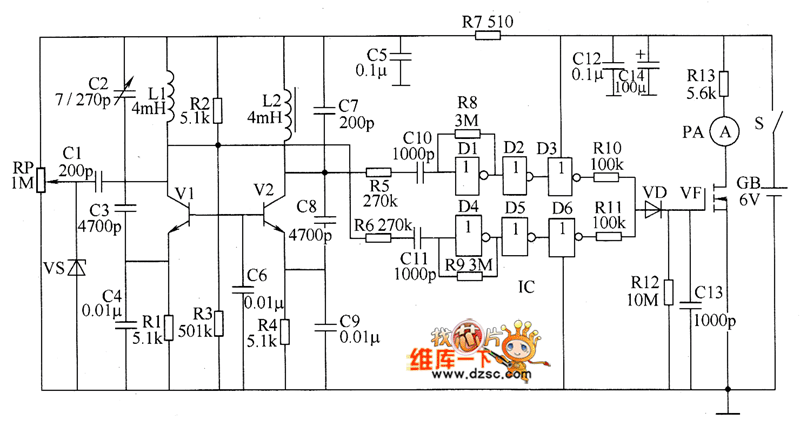
Metal detector circuit diagram 6
The metal detector circuit consists of several key components including the probe oscillator, reference oscillator, oscillation signal processor, mixing amplifier, and ammeter PA. The probe oscillator is made up of the oscillating tube VI, exploration coil L1, capacitors C1 to...