


IR-Link Temperature Sensor Allows Isolation of the Temp Sensor
#IR link
#temperature sensor
#isolation
#data transmission
#infrared
#remote sensing
#measurement
#wireless communication
#sensor circuit
#temperature monitoring
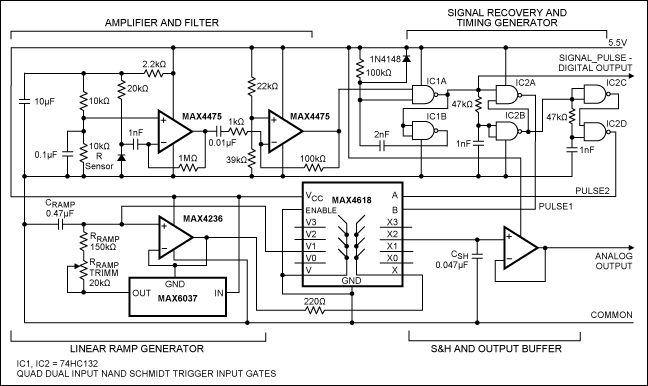
Description: A circuit is described that transmits temperature data over an IR link. This allows isolation of the temperature sensor.
The circuit operates by utilizing an infrared (IR) transmitter and receiver pair to wirelessly transmit temperature readings from a sensor to a receiving unit. The temperature sensor, which could be a thermistor or an RTD (Resistance Temperature Detector), is connected to a microcontroller that processes the temperature data. The microcontroller converts the analog signal from the temperature sensor into a digital format and encodes it for transmission.
The IR transmitter, typically an IR LED, is driven by a modulated signal generated by the microcontroller. This modulation helps to minimize interference and allows for reliable data transmission over the IR link. The encoded temperature data is transmitted in bursts, which can be demodulated and decoded by the IR receiver at the receiving end.
The IR receiver, commonly a photodiode or phototransistor, detects the modulated IR signal and converts it back into an electrical signal. This signal is then fed into another microcontroller or processing unit, which decodes the received data and displays the temperature reading on an output device, such as an LCD screen or a computer interface.
Isolation of the temperature sensor from the receiving unit is achieved through the IR communication, which eliminates the need for direct electrical connections. This design enhances safety and allows for remote monitoring of temperature in environments where electrical connections may pose a risk or where it is impractical to run wires. The circuit can be powered by batteries or a low-voltage power supply, making it suitable for portable applications. Overall, this IR temperature transmission circuit is effective for applications requiring non-contact temperature monitoring and data transmission.A circuit is described that transmits temperature data over an IR link. This allows isolation of the temperature sensor..
The circuit operates by utilizing an infrared (IR) transmitter and receiver pair to wirelessly transmit temperature readings from a sensor to a receiving unit. The temperature sensor, which could be a thermistor or an RTD (Resistance Temperature Detector), is connected to a microcontroller that processes the temperature data. The microcontroller converts the analog signal from the temperature sensor into a digital format and encodes it for transmission.
The IR transmitter, typically an IR LED, is driven by a modulated signal generated by the microcontroller. This modulation helps to minimize interference and allows for reliable data transmission over the IR link. The encoded temperature data is transmitted in bursts, which can be demodulated and decoded by the IR receiver at the receiving end.
The IR receiver, commonly a photodiode or phototransistor, detects the modulated IR signal and converts it back into an electrical signal. This signal is then fed into another microcontroller or processing unit, which decodes the received data and displays the temperature reading on an output device, such as an LCD screen or a computer interface.
Isolation of the temperature sensor from the receiving unit is achieved through the IR communication, which eliminates the need for direct electrical connections. This design enhances safety and allows for remote monitoring of temperature in environments where electrical connections may pose a risk or where it is impractical to run wires. The circuit can be powered by batteries or a low-voltage power supply, making it suitable for portable applications. Overall, this IR temperature transmission circuit is effective for applications requiring non-contact temperature monitoring and data transmission.A circuit is described that transmits temperature data over an IR link. This allows isolation of the temperature sensor..
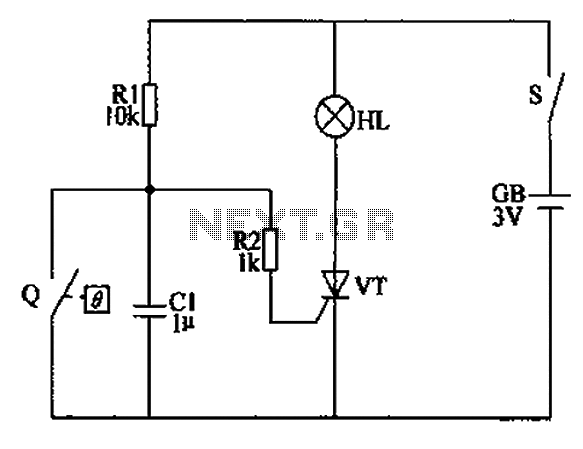
Automatic anti-frost crop controller circuit diagram
The automatic anti-frost crop controller circuit comprises an electric contact mercury thermometer (Q), a control circuit, ignition devices, and other components. The electric contact mercury thermometer features two platinum electrodes; one acts as a contact electrode inserted at the upper...
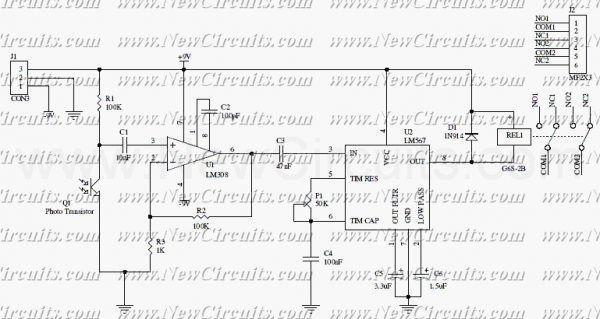
Infrared Alarm
This circuit consists of two parts, the first part will transmit a signal, and the second part will detect that signal and trigger a relay. To adjust the circuit, hold down S1 while pointing LED1 at the receiver. Adjust R6...
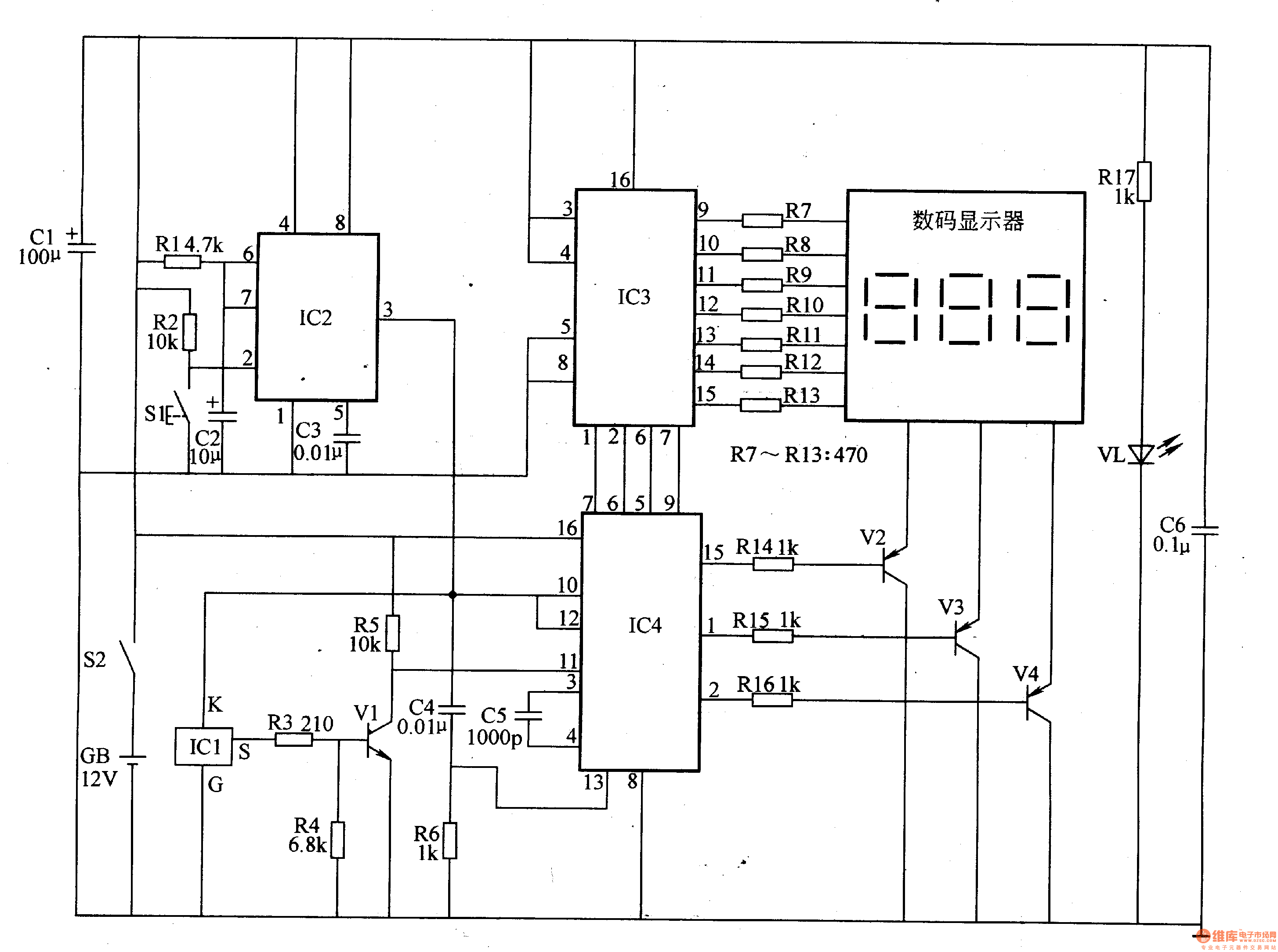
Electronic thermometer(2)
The temperature measuring range of this electronic thermometer is 0-50 degrees Celsius, with a precision of 0.1 degrees Celsius. The measurement results are intuitively displayed on a digital screen. This electronic thermometer circuit consists of a temperature detection circuit, a...
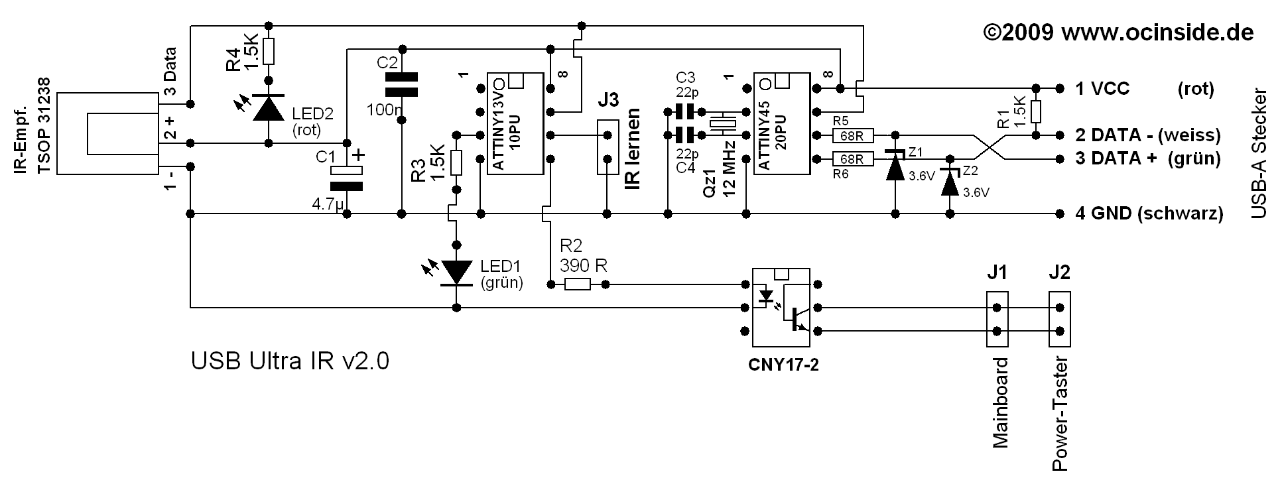
USB Ultra IR-Receiver v2.0 to PC remote control and power ON - OFF
This Atmel integrated circuit operates at a clock frequency of 12 MHz, facilitating communication between an infrared receiver and a personal computer. This setup enables the processing of signals by infrared receiver software, such as Girder. When a valid RC5...
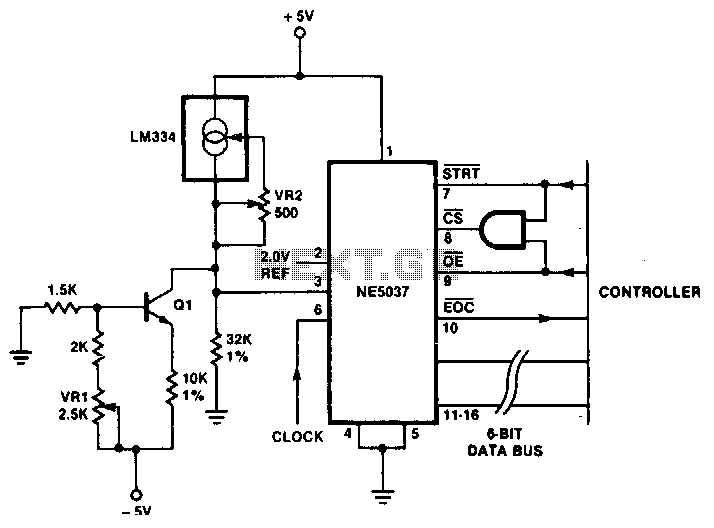
Temperature-sensor
The temperature sensor provides an input to pin 3 of the NE5037 with a sensitivity of 32 mV/°C. This 32 mV represents the value of one least significant bit (LSB) for the NE5037. The LM334 is a three-terminal temperature sensor...
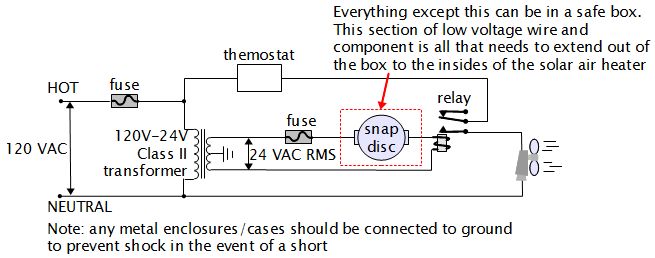
temp control circuit
For various experiments, such as solar air heaters, an automatic fan activation and deactivation system is required. A straightforward solution is to use a bimetal snap disc thermal sensor. This sensor functions as a switch that closes when a specific...
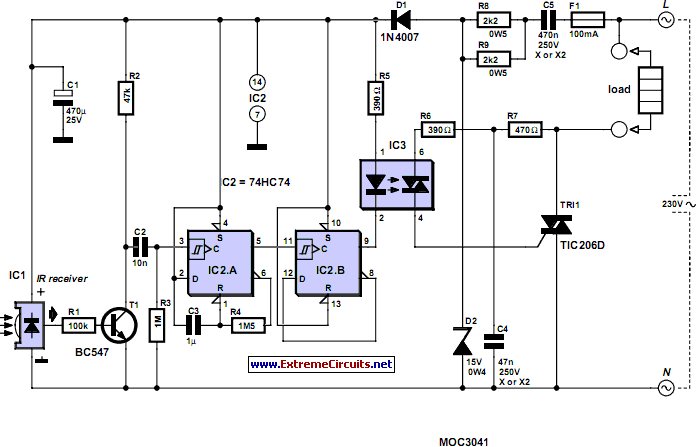
off infrared remote control schematic
According to the note on the schematic, IC-2 is a 74HC74 TTL chip. Refer to the data sheet for details regarding pins 7 and 14. The note for IC-3, located lower on the schematic, indicates it is an AC optocoupler...
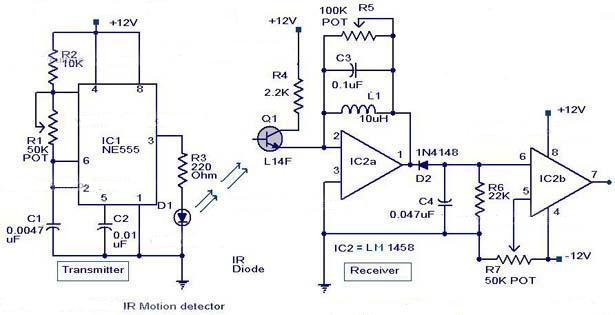
infrared motion sensor home
An infrared motion detector alarm is designed to activate whenever a person enters its infrared detection zone. This sensor detects the movement of a human body, triggering an automatic alarm. The detection zone has a horizontal coverage of 80 degrees...
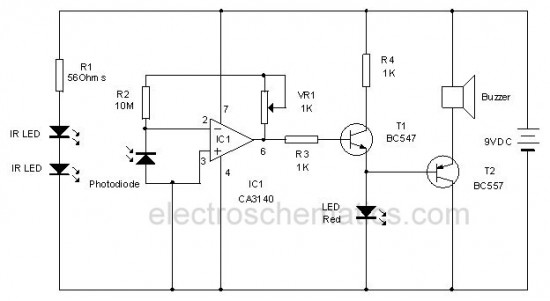
Invisible Infrared Alarm Circuit
This circuit utilizes invisible infrared light to detect the movement of individuals passing through a doorway. A short beep is produced when the infrared beam is interrupted.
The circuit operates by employing an infrared transmitter and a receiver. The transmitter emits...