


lcd thermometer circuit with lm35
#LM35
#temperature sensor
#analog output
#AT Mega8
#LCD display
#precision
#centigrade
#voltage conversion
#measurement
#thermometer
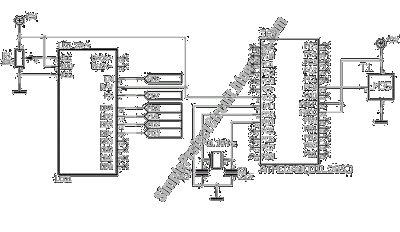
Description: The LM35 from National Semiconductor is a precision centigrade temperature sensor that provides an analog output voltage. It operates within a temperature range of -55°C to +150°C and has an accuracy of ±0.5°C. The output voltage corresponds to 10mV per degree Celsius. This output voltage is processed by the analog-to-digital converter (ADC) of the ATmega8 microcontroller, and the temperature is displayed on an LCD module. In this example, the thermometer is designed to measure temperatures from 0°C to 40°C with a resolution of 0.5°C. For Fahrenheit readings, the LM34 sensor can be utilized. The software for this project is developed using BASCOM AVR, which includes built-in commands for reading the ADC port of an AVR microcontroller. The temperature readings are presented on the LCD module as discrete values and in a bar graph format. The ATmega8 features an A/D converter capable of producing 210 = 1024 discrete values. With a 5V supply, the resolution is calculated as 5000mV/1024 = 4.8mV. Given that the LM35 outputs 10mV/°C, the resolution of the thermometer is approximately 0.5°C. The LCD module has 20 columns, where each column represents a temperature increment of 2°C on the scale from 0°C to 40°C. [Circuit's Source: National Semiconductor, Inc].
The LM35 temperature sensor is a critical component in precision temperature measurement applications. It operates based on a linear output voltage that changes with temperature, providing a simple interface for analog measurements. The sensor’s output of 10mV per degree Celsius allows for straightforward calculations when interfaced with an ADC, such as that found in the ATmega8 microcontroller.
The ATmega8 microcontroller is equipped with an integrated 10-bit ADC, which translates the analog voltage from the LM35 into digital values. This conversion process allows for a range of 0 to 1023 corresponding to the input voltage levels. With a reference voltage of 5V, each step of the ADC corresponds to approximately 4.88mV. This resolution is sufficient for the LM35’s output, ensuring that temperature changes of 0.5°C can be accurately represented.
In the setup, the temperature readings are displayed on an LCD module, which is configured to show both numerical values and a bar graph for intuitive visualization. The LCD's 20 columns allow for a clear representation of the temperature range from 0°C to 40°C, with each column indicating a 2°C increment. This visual aid enhances user experience by providing immediate feedback on temperature changes.
For applications requiring Fahrenheit readings, the LM34 sensor can be employed as an alternative, providing a similar output characteristic but calibrated for Fahrenheit scales. The BASCOM AVR programming environment simplifies the development of the control software, allowing for efficient reading and processing of the ADC values, and managing the display output on the LCD module.
Overall, this temperature measurement circuit exemplifies a practical application of analog sensors, microcontroller interfacing, and user-friendly display technology, suitable for various temperature monitoring applications.The LM35 of National Semiconductors that is used in this project is a precision centigrade temperature sensor, which has an analog output voltage. It has a range of -55 C to +150 C and an accuracy of ±0. 5 C. The output voltage is 10mV/ C. The output voltage is converted by the AD convertor of the AT Mega8. The temperature is displayed on an LCD module. This is the figure of the circuit. In this example the thermometer has a range of 0 C to 40 C and a resolution of 0. 5 C. If you want to have a read out in Fahrenheit you can use the LM34. The software for this project is written in BASCOM AVR. The BASCOM AVR compiler has build in commands for reading out the ADC port of a AVR microcontroller. The result is displayed on a LCD module in a discrete value of the temperature and in a bar-graph. The AT Mega8 has a A/D converter which can give an output of 210 = 1024 discrete values. When a 5V supply is used you have a resolution of 5000mV/1024 = 4. 8mV. Because the LM35 has a output of 10mV/C the resolution of the thermometer is 10mV/4. 8mV ~ 0. 5 C. The LCD module has 20 columns. In the scale of 0 C to 40 C every column represents 2 C. [Circuit`s Source: National Semiconductor, Inc].
The LM35 temperature sensor is a critical component in precision temperature measurement applications. It operates based on a linear output voltage that changes with temperature, providing a simple interface for analog measurements. The sensor’s output of 10mV per degree Celsius allows for straightforward calculations when interfaced with an ADC, such as that found in the ATmega8 microcontroller.
The ATmega8 microcontroller is equipped with an integrated 10-bit ADC, which translates the analog voltage from the LM35 into digital values. This conversion process allows for a range of 0 to 1023 corresponding to the input voltage levels. With a reference voltage of 5V, each step of the ADC corresponds to approximately 4.88mV. This resolution is sufficient for the LM35’s output, ensuring that temperature changes of 0.5°C can be accurately represented.
In the setup, the temperature readings are displayed on an LCD module, which is configured to show both numerical values and a bar graph for intuitive visualization. The LCD's 20 columns allow for a clear representation of the temperature range from 0°C to 40°C, with each column indicating a 2°C increment. This visual aid enhances user experience by providing immediate feedback on temperature changes.
For applications requiring Fahrenheit readings, the LM34 sensor can be employed as an alternative, providing a similar output characteristic but calibrated for Fahrenheit scales. The BASCOM AVR programming environment simplifies the development of the control software, allowing for efficient reading and processing of the ADC values, and managing the display output on the LCD module.
Overall, this temperature measurement circuit exemplifies a practical application of analog sensors, microcontroller interfacing, and user-friendly display technology, suitable for various temperature monitoring applications.The LM35 of National Semiconductors that is used in this project is a precision centigrade temperature sensor, which has an analog output voltage. It has a range of -55 C to +150 C and an accuracy of ±0. 5 C. The output voltage is 10mV/ C. The output voltage is converted by the AD convertor of the AT Mega8. The temperature is displayed on an LCD module. This is the figure of the circuit. In this example the thermometer has a range of 0 C to 40 C and a resolution of 0. 5 C. If you want to have a read out in Fahrenheit you can use the LM34. The software for this project is written in BASCOM AVR. The BASCOM AVR compiler has build in commands for reading out the ADC port of a AVR microcontroller. The result is displayed on a LCD module in a discrete value of the temperature and in a bar-graph. The AT Mega8 has a A/D converter which can give an output of 210 = 1024 discrete values. When a 5V supply is used you have a resolution of 5000mV/1024 = 4. 8mV. Because the LM35 has a output of 10mV/C the resolution of the thermometer is 10mV/4. 8mV ~ 0. 5 C. The LCD module has 20 columns. In the scale of 0 C to 40 C every column represents 2 C. [Circuit`s Source: National Semiconductor, Inc].

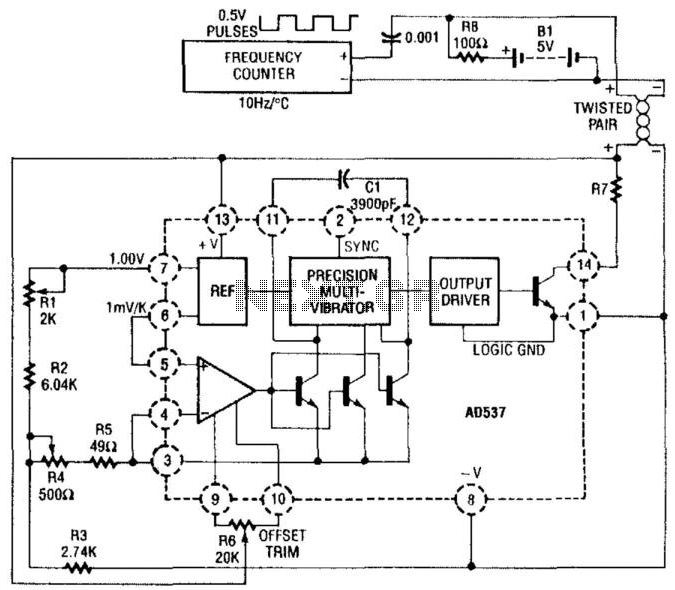
Digital Remote Thermometer
A remote sensor transmits data through the mains supply, with a temperature range of 00.0 to 99.9 °C. This circuit is designed for precise centigrade temperature measurement.
The circuit employs a remote temperature sensor that communicates its readings over the mains...
Temperature Sensor
The AD537 utilizes two reference outputs—one fixed at 1 V and the other varying with temperature at a rate of 1 mV per °K. At 0°C, the 1-V reference multiplied by 0.273 balances this voltage to produce a zero output....
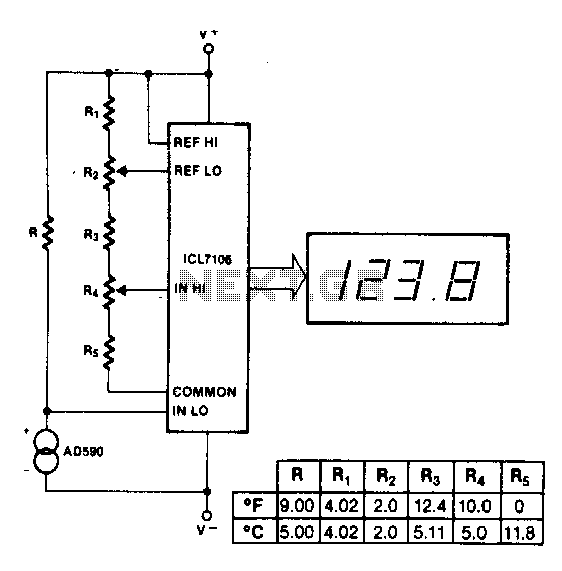
Basic digital thermometer
The maximum reading on the Celsius range is 199.9 °C, which is limited by the short-term maximum allowable sensor temperature. The maximum reading on the Fahrenheit range is 199 °F (93 °C), constrained by the number of display digits. The...
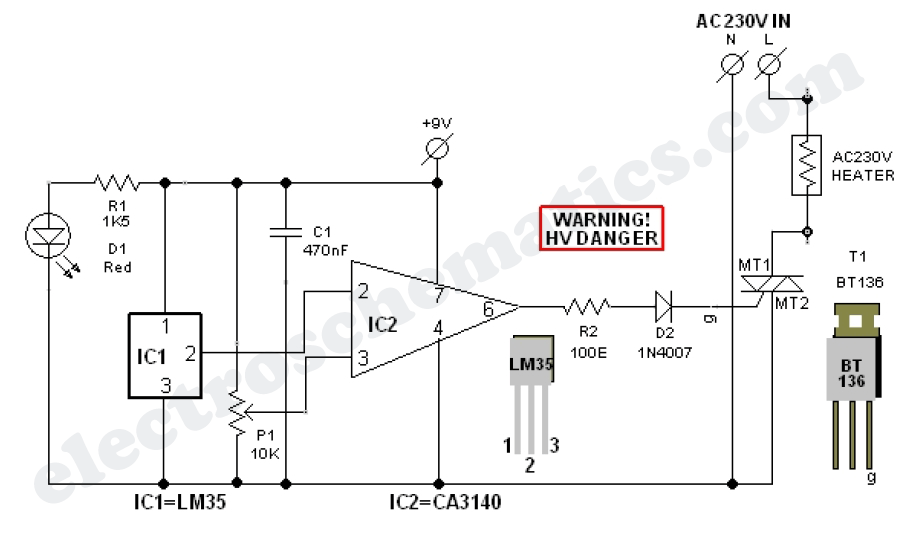
Electric AC Heater Controller Unit
The compact circuit of the electric AC heater controller is designed around the well-known 3-Pin Integrated Temperature Sensor LM35 (IC1) from National Semiconductor Corporation (NSC).
The circuit utilizes the LM35 temperature sensor, which provides an analog output voltage that is linearly...
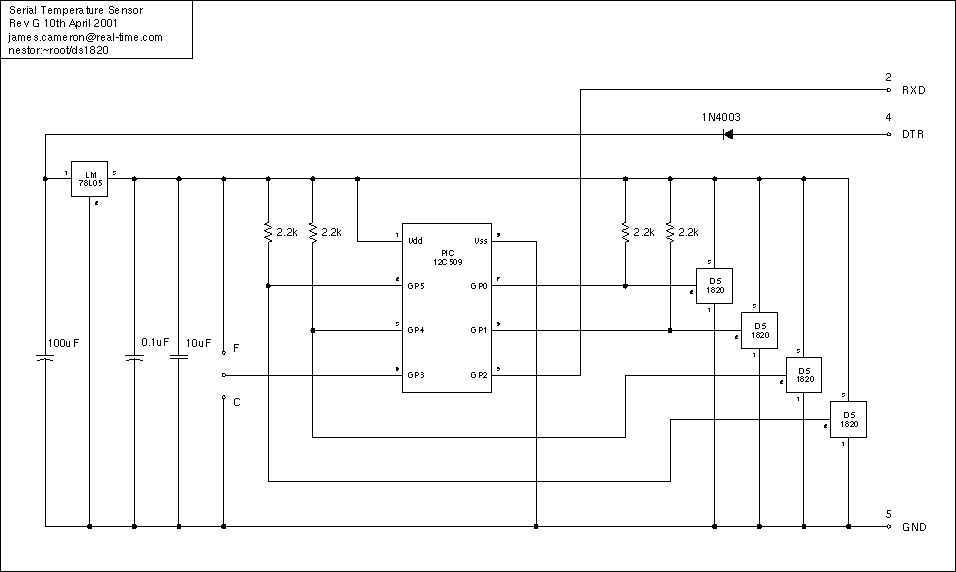
Temperature Sensor Project
Just a handful of components builds an 8-pin microcontroller based circuit for temperature logging via a serial port; small, fast, and acceptably accurate. More: provides real-time data to your computer via serial port, interfaces up to four DS1820 temperature sensors,...
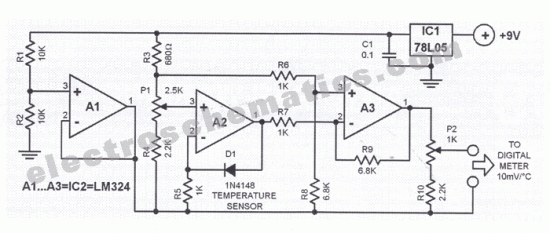
Diode digital thermometer circuit
This digital thermometer circuit diagram utilizes a standard 1N4148 diode as the temperature sensor. The temperature coefficient of the diode is -2 mV/°C.
The digital thermometer circuit leverages the characteristics of the 1N4148 diode, which exhibits a predictable voltage drop that...
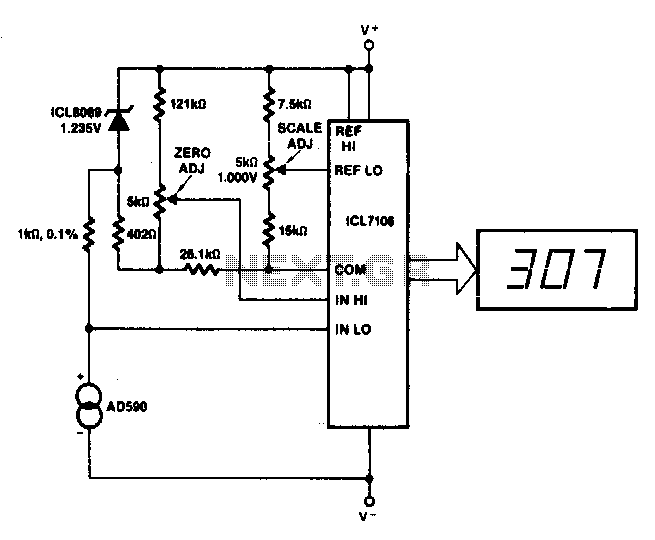
Digital thermometer with zero adjust
This circuit allows for zero adjustment as well as slope adjustment. The ICL8069 brings the input within the common-mode range, while the 5 kΩ potentiometers trim any offset at 218 K (-55 °C) and set the scale factor.
The described circuit...
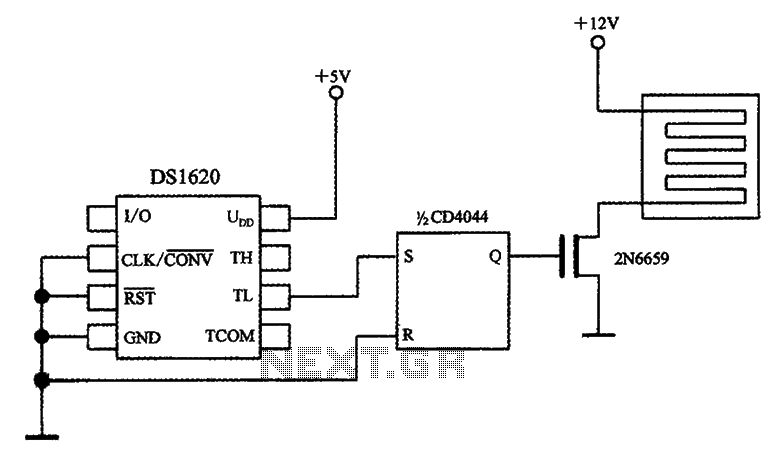
Temperature control circuit diagram with three-wire serial interface smart temperature sensors DS1620
The circuit involves a smart temperature control system utilizing DS1620 temperature sensors with a three-wire serial interface for managing a small electric heater. When the CD4044 type RS flip-flop is set to 1, the output Q becomes high, which activates...

Two-Wire Temperature Sensor
Remote temperature measurements must be connected to the relevant test instrument using a cable. Typically, a three-core cable is employed: one core for the signal and two for the power supply. If a two-core cable is necessary, one of the...