


live wire sensor
#live wire detection
#electrician tool
#safety device
#wire detector
#hidden wire sensor
#non-contact detection
#electrical safety
#home renovation
#repair tool
#voltage sensor
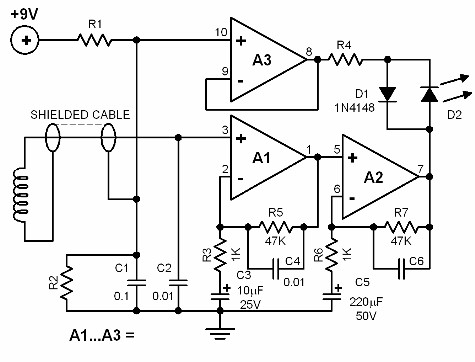
Description: This electronic device functions similarly to a metal detector but has a unique capability: it detects live electrical wires. This gadget is particularly beneficial for electricians engaged in repair or renovation tasks. The ability to locate hidden wires significantly minimizes the risk of damaging or cutting through them, ensuring a safer and more efficient job. This circuit is specifically designed to locate live wires embedded within non-metallic walls, such as concrete or wood. The current detector utilized is a standard telephone pick-up coil, which simplifies the circuit's construction compared to the process of winding a custom detector coil. The telephone pick-up coil detects the magnetic field generated by a live wire.
This device operates by utilizing the principle of electromagnetic induction. When an alternating current flows through a live wire, it produces a magnetic field around it. The telephone pick-up coil, designed to sense variations in magnetic fields, is positioned near the wall where the wires are suspected to be located. As the coil approaches the live wire, it detects the magnetic field and generates an electrical signal proportional to the field's strength.
The circuit typically consists of the following components: a power supply, a telephone pick-up coil, an amplifier, and a visual or audible indicator (such as an LED or buzzer). The power supply provides the necessary voltage to the circuit, while the amplifier boosts the signal received from the pick-up coil. The indicator provides feedback to the user, alerting them to the presence of live wires.
To enhance the functionality of the device, it may include features such as adjustable sensitivity, allowing the user to fine-tune the response to various wire depths and materials. Additionally, a multi-range switch could be implemented to adapt the device for different wall thicknesses or types of construction materials.
In terms of safety, this wire detection device is invaluable in preventing accidental contact with live electrical circuits, which can lead to serious injuries or damage. By integrating this technology into their toolkit, electricians can work more confidently and efficiently, minimizing the risk associated with electrical repairs or renovations. Overall, the design and operation of this circuit reflect a practical application of electromagnetic principles in everyday tasks.This electronic device works similar to a metal detector but it does something special: it detects live electrical wires. Such a gadget is highly useful for electricians doing repair or renovation jobs. Being able to detect hidden wires will highly reduce the risk of damaging or cutting through them thus making the job safe and fast.
This circuit is specially designed for locating live wires embedded inside non-metallic walls like concrete or wood. The actual current detector used is an ordinary telephone pick-up coil. This makes the construction of the circuit much simpler compared to winding your own detector coil. The telephone pickup coil detects the magnetic field created by a live wire.
This device operates by utilizing the principle of electromagnetic induction. When an alternating current flows through a live wire, it produces a magnetic field around it. The telephone pick-up coil, designed to sense variations in magnetic fields, is positioned near the wall where the wires are suspected to be located. As the coil approaches the live wire, it detects the magnetic field and generates an electrical signal proportional to the field's strength.
The circuit typically consists of the following components: a power supply, a telephone pick-up coil, an amplifier, and a visual or audible indicator (such as an LED or buzzer). The power supply provides the necessary voltage to the circuit, while the amplifier boosts the signal received from the pick-up coil. The indicator provides feedback to the user, alerting them to the presence of live wires.
To enhance the functionality of the device, it may include features such as adjustable sensitivity, allowing the user to fine-tune the response to various wire depths and materials. Additionally, a multi-range switch could be implemented to adapt the device for different wall thicknesses or types of construction materials.
In terms of safety, this wire detection device is invaluable in preventing accidental contact with live electrical circuits, which can lead to serious injuries or damage. By integrating this technology into their toolkit, electricians can work more confidently and efficiently, minimizing the risk associated with electrical repairs or renovations. Overall, the design and operation of this circuit reflect a practical application of electromagnetic principles in everyday tasks.This electronic device works similar to a metal detector but it does something special: it detects live electrical wires. Such a gadget is highly useful for electricians doing repair or renovation jobs. Being able to detect hidden wires will highly reduce the risk of damaging or cutting through them thus making the job safe and fast.
This circuit is specially designed for locating live wires embedded inside non-metallic walls like concrete or wood. The actual current detector used is an ordinary telephone pick-up coil. This makes the construction of the circuit much simpler compared to winding your own detector coil. The telephone pickup coil detects the magnetic field created by a live wire.

invisible broken wire detector
Portable loads such as video cameras, halogen flood lights, electrical irons, hand drills, grinders, and cutters are powered by connecting long 2- or 3-core cables to the mains plug. Due to prolonged usage, the power cord wires are subjected to...
Simplified-voltage-level-sensor
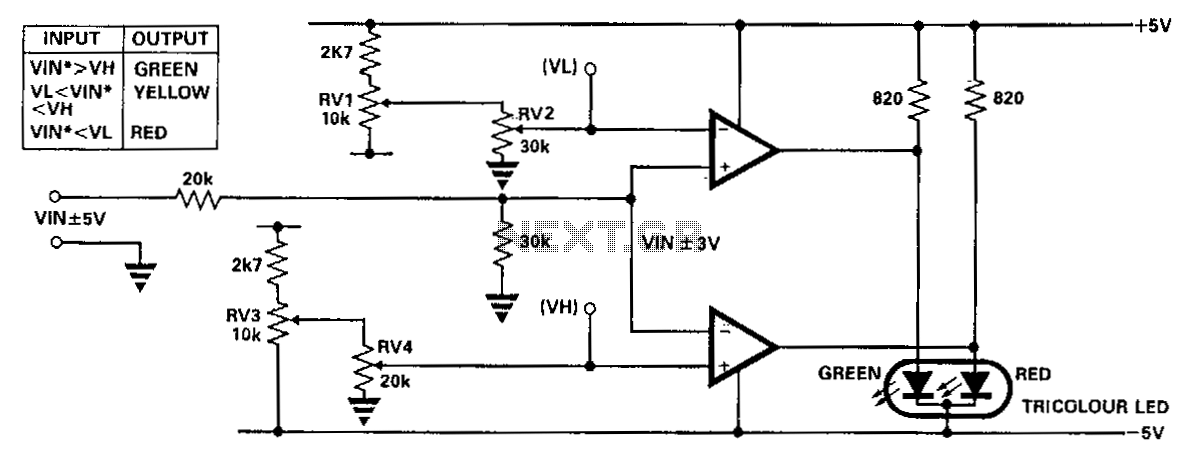
This circuit utilizes a single junction component, either one LM393 dual comparator or one LM339 quad comparator. Resistors RV1 and RV3 are responsible for establishing the full-scale reference voltage, while resistors RV2 and RV4 are used to set the switching...
Invisible Broken Wire Detector
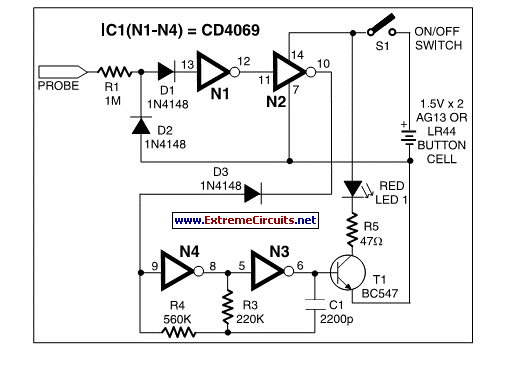
Portable loads such as video cameras, halogen flood lights, electrical irons, hand drills, grinders, and cutters are powered by connecting long 2- or 3-pin cables.
Portable electrical loads require reliable power sources for efficient operation in various applications. The devices mentioned,...
Isolated Voltage Sensor
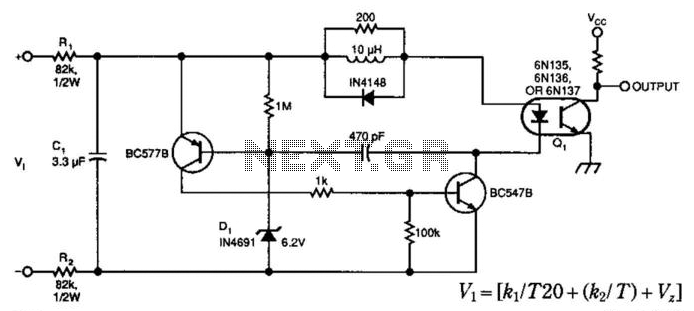
A simple voltage-controlled oscillator (VCO), coupled to instrumentation by an optoisolator, allows for the measurement of high voltages. The component values are suitable for a 0 to 600 V input range, with power dissipation in resistors RI and R2 setting...
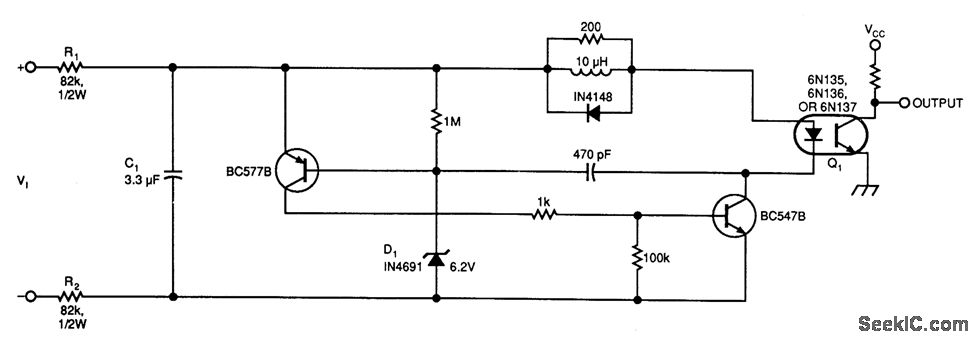
Isolated Voltage Sensor With IN4148 IC
This circuit below illustrates a simple voltage-controlled oscillator (VCO) connected to instrumentation via an optoisolator.
The voltage-controlled oscillator (VCO) circuit operates by generating a periodic waveform whose frequency is determined by an input control voltage. The primary components of this VCO...

Invisible Broken Wire Detector
Portable devices such as video cameras, halogen floodlights, electrical irons, hand drills, grinders, and cutters are powered by connecting long 2- or 3-core cables to a mains plug. Prolonged use can subject the power cord wires to mechanical strain and...