


Low humidity is a circuit diagram of CGS-H ceramic humidity sensor configuration
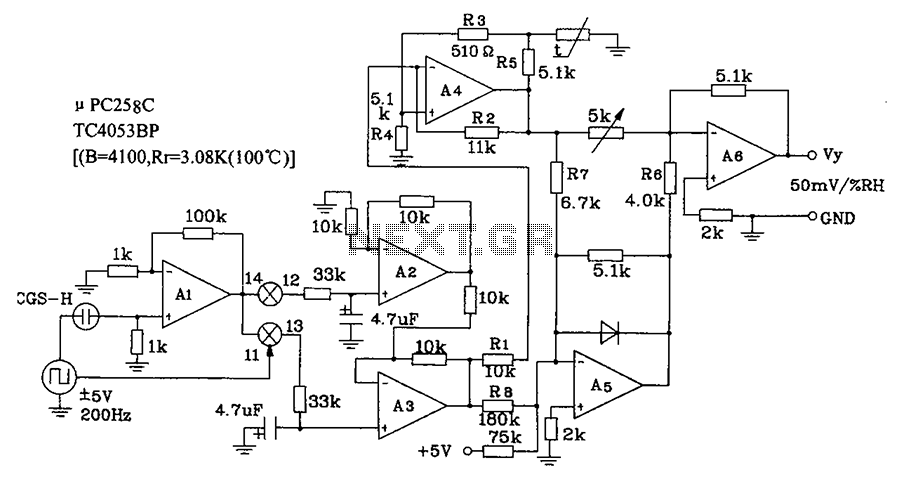
Description: CGS-H ceramic humidity sensor constructed low humidity detection circuit diagram.
The CGS-H ceramic humidity sensor is designed to detect low humidity levels within a specified range. This sensor operates on the principle of changes in capacitance that occur with variations in humidity. The circuit diagram for the humidity detection system typically includes the CGS-H sensor, a microcontroller or an operational amplifier for signal processing, and additional components such as resistors, capacitors, and possibly a display unit for output.
In the circuit, the CGS-H sensor is connected to a voltage divider configuration that allows it to convert the humidity levels into a corresponding voltage signal. This signal is then fed into an analog-to-digital converter (ADC) within the microcontroller, which interprets the data and can trigger alerts or activate other devices based on the defined humidity thresholds.
The circuit may also include a power supply section, ensuring that the sensor and associated components receive the appropriate voltage levels. Filtering capacitors are often added to stabilize the power supply and reduce noise, which can affect the accuracy of the measurements. Additionally, a pull-up or pull-down resistor may be used to ensure stable readings from the sensor.
For display purposes, an LED or an LCD can be integrated into the circuit to provide real-time feedback on humidity levels, enhancing user interaction. This comprehensive setup allows for efficient monitoring of environmental conditions, making it suitable for applications in HVAC systems, greenhouses, and various industrial processes where humidity control is critical. CGS-H ceramic humidity sensor constructed low humidity detection circuit diagram .
The CGS-H ceramic humidity sensor is designed to detect low humidity levels within a specified range. This sensor operates on the principle of changes in capacitance that occur with variations in humidity. The circuit diagram for the humidity detection system typically includes the CGS-H sensor, a microcontroller or an operational amplifier for signal processing, and additional components such as resistors, capacitors, and possibly a display unit for output.
In the circuit, the CGS-H sensor is connected to a voltage divider configuration that allows it to convert the humidity levels into a corresponding voltage signal. This signal is then fed into an analog-to-digital converter (ADC) within the microcontroller, which interprets the data and can trigger alerts or activate other devices based on the defined humidity thresholds.
The circuit may also include a power supply section, ensuring that the sensor and associated components receive the appropriate voltage levels. Filtering capacitors are often added to stabilize the power supply and reduce noise, which can affect the accuracy of the measurements. Additionally, a pull-up or pull-down resistor may be used to ensure stable readings from the sensor.
For display purposes, an LED or an LCD can be integrated into the circuit to provide real-time feedback on humidity levels, enhancing user interaction. This comprehensive setup allows for efficient monitoring of environmental conditions, making it suitable for applications in HVAC systems, greenhouses, and various industrial processes where humidity control is critical. CGS-H ceramic humidity sensor constructed low humidity detection circuit diagram .
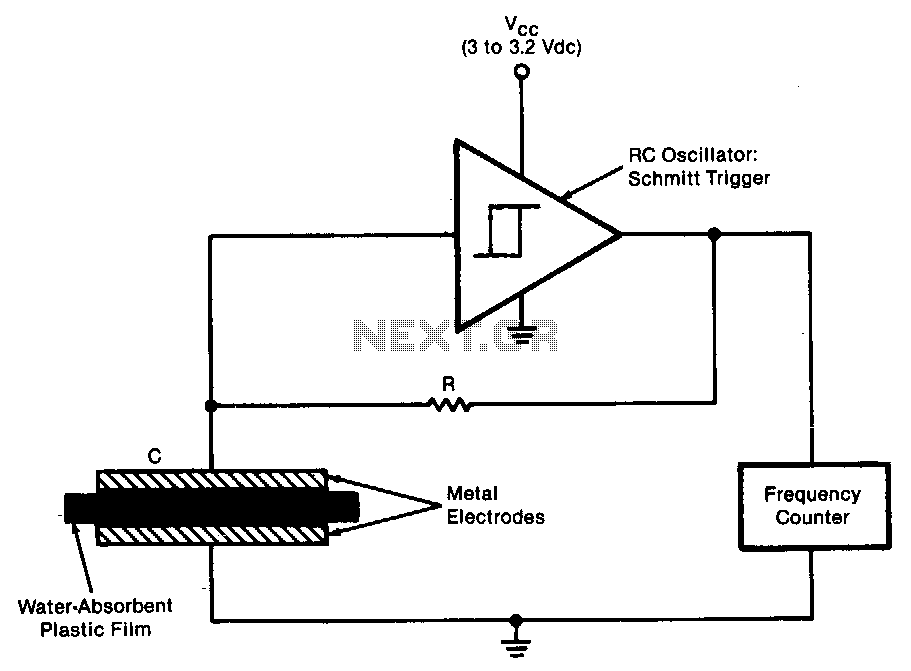
Low-cost-humidity-sensor
The sensor operates as an RC oscillator, utilizing a water-absorbent plastic film as the insulator within the capacitive element. The capacitance of this film increases with the amount of water it absorbs from the air, resulting in a reduction of...
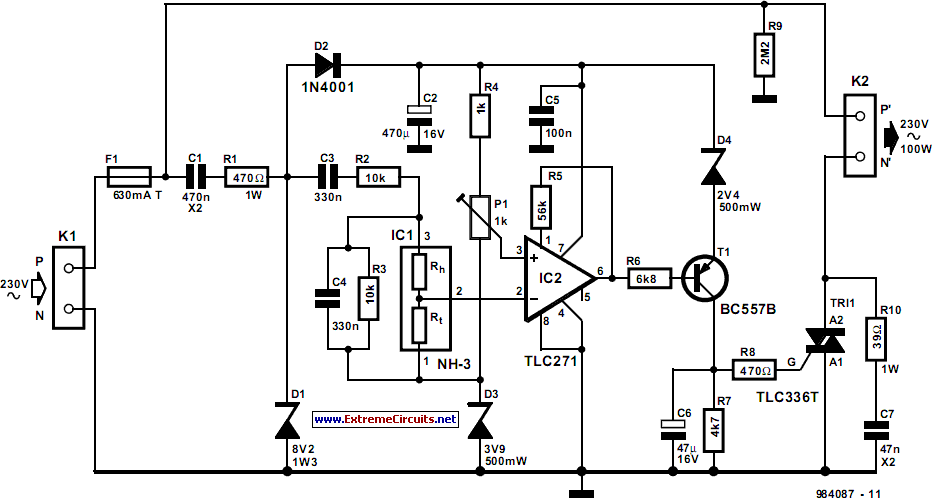
Automatic Air Humidifier
The humidifier circuit is based on a specific humidity sensor, Type NH-3 from Figaro. The circuit controls a ventilator that is part of an air humidifying system, depending on the sensor output. A triac is used to switch the ventilator...
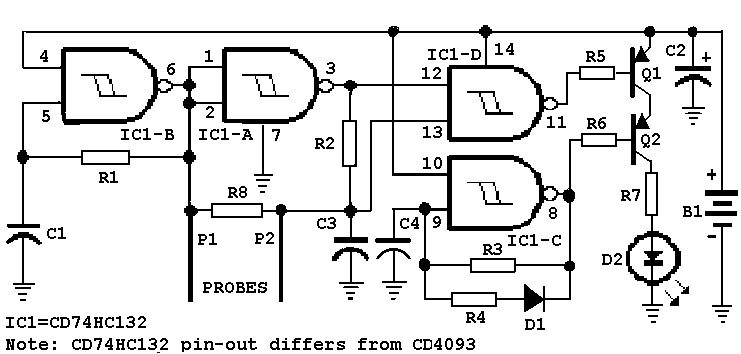
Plants Humidity Sensor
IC1D is a CMOS Schmitt trigger oscillator at about 2KHz. It starts and continues to oscillate with a supply down to 1.24V (the lowest output voltage of my LM317 variable power supply) or less. IC1A is an inverter. IC1B is...
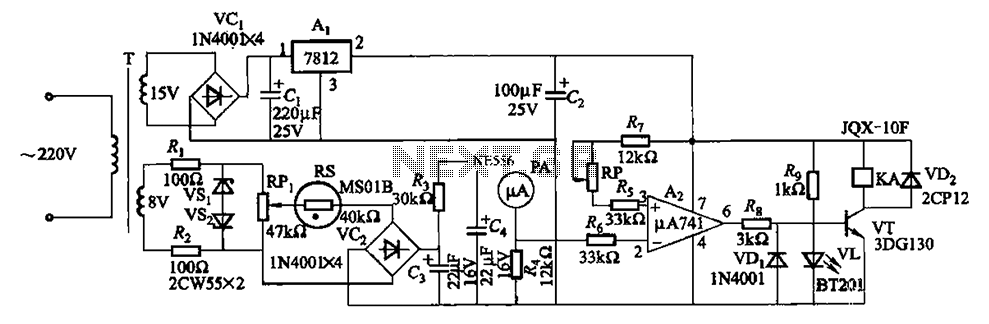
Air humidity measuring circuit 2
The humidity alarm system is based on integrated circuits and relays, utilizing the pA741 circuit. The MS01 employs a wet-type humidity resistance element as a probe. When the humidity exceeds a predetermined value, specifically set at 6 feet high, relay...
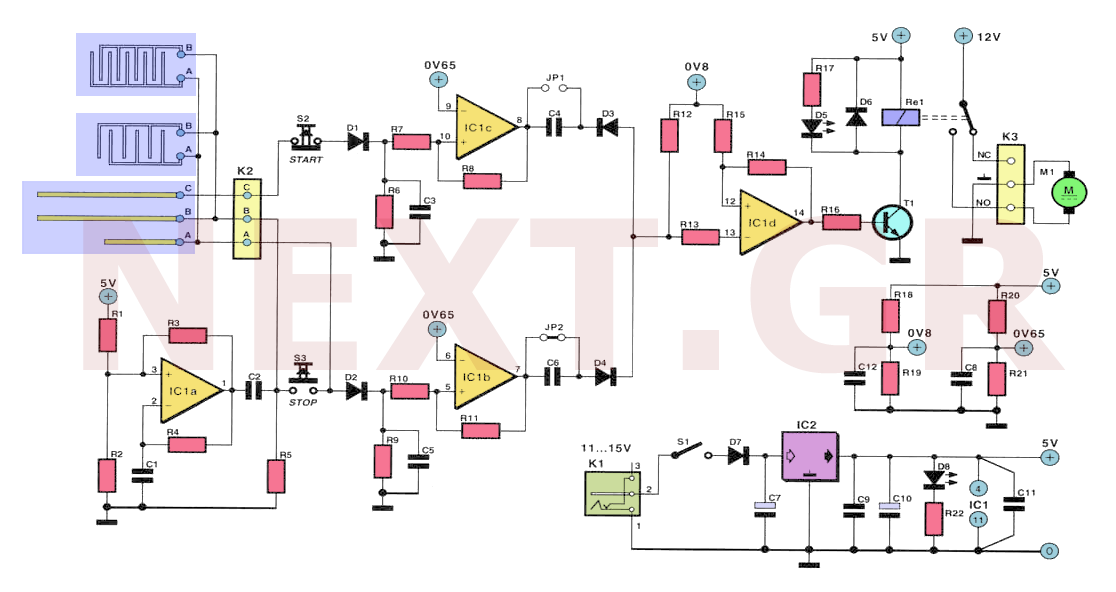
Fully automatic watering circuit for flower pots
Often, for various reasons, individuals forget or are unable to water the plants in their homes. Many humidity sensor units merely alert users with a beeping sound or a flashing light when the pot requires watering. However, what if one...
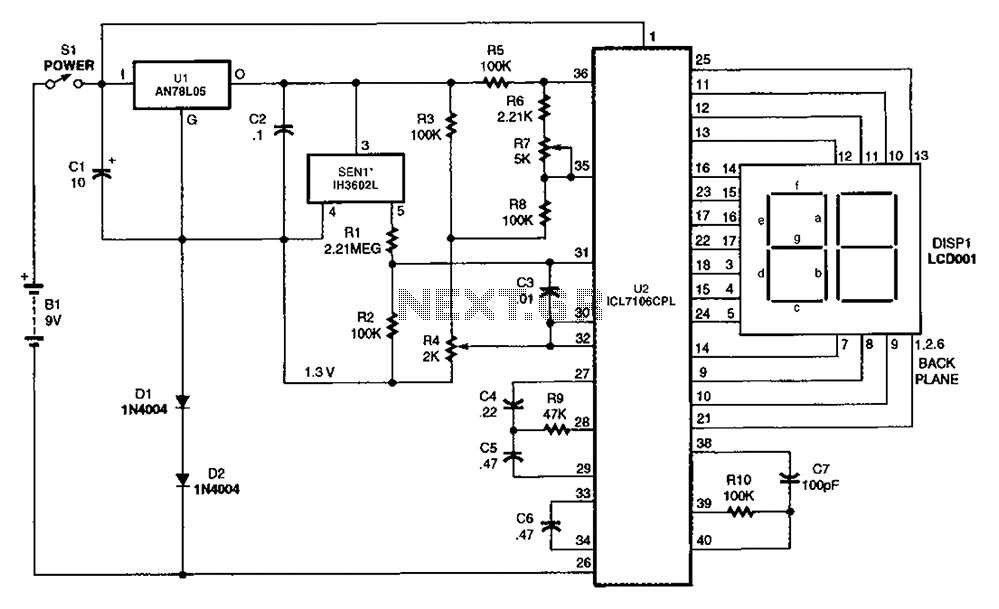
Relative humidity digitizer circuit diagram
The output DC voltage of sensor SEN1 changes linearly in response to variations in relative humidity. This DC voltage is routed through resistors R1 and R2 to the analog-to-digital (A/D) converter chip U2. Resistor R4 is connected to ground, while...
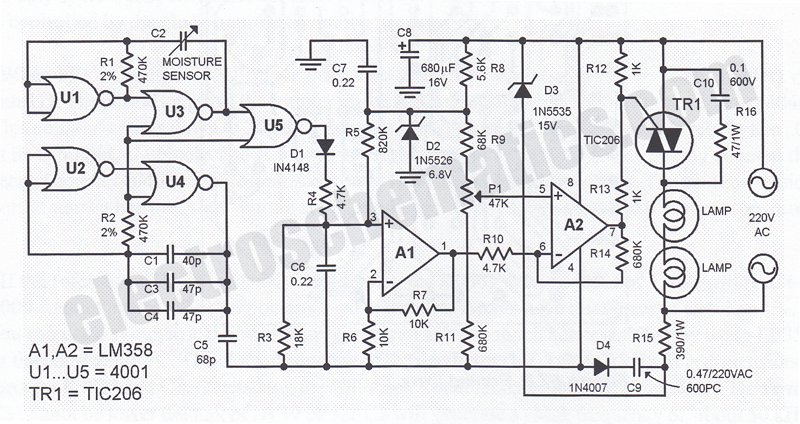
Humidity Control Switch Circuit
This humidity-controlled switch circuit activates and deactivates an electrical load, such as a heater, based on the moisture content in the surrounding air.
The humidity-controlled switch circuit employs a humidity sensor to detect changes in moisture levels in the environment. The...
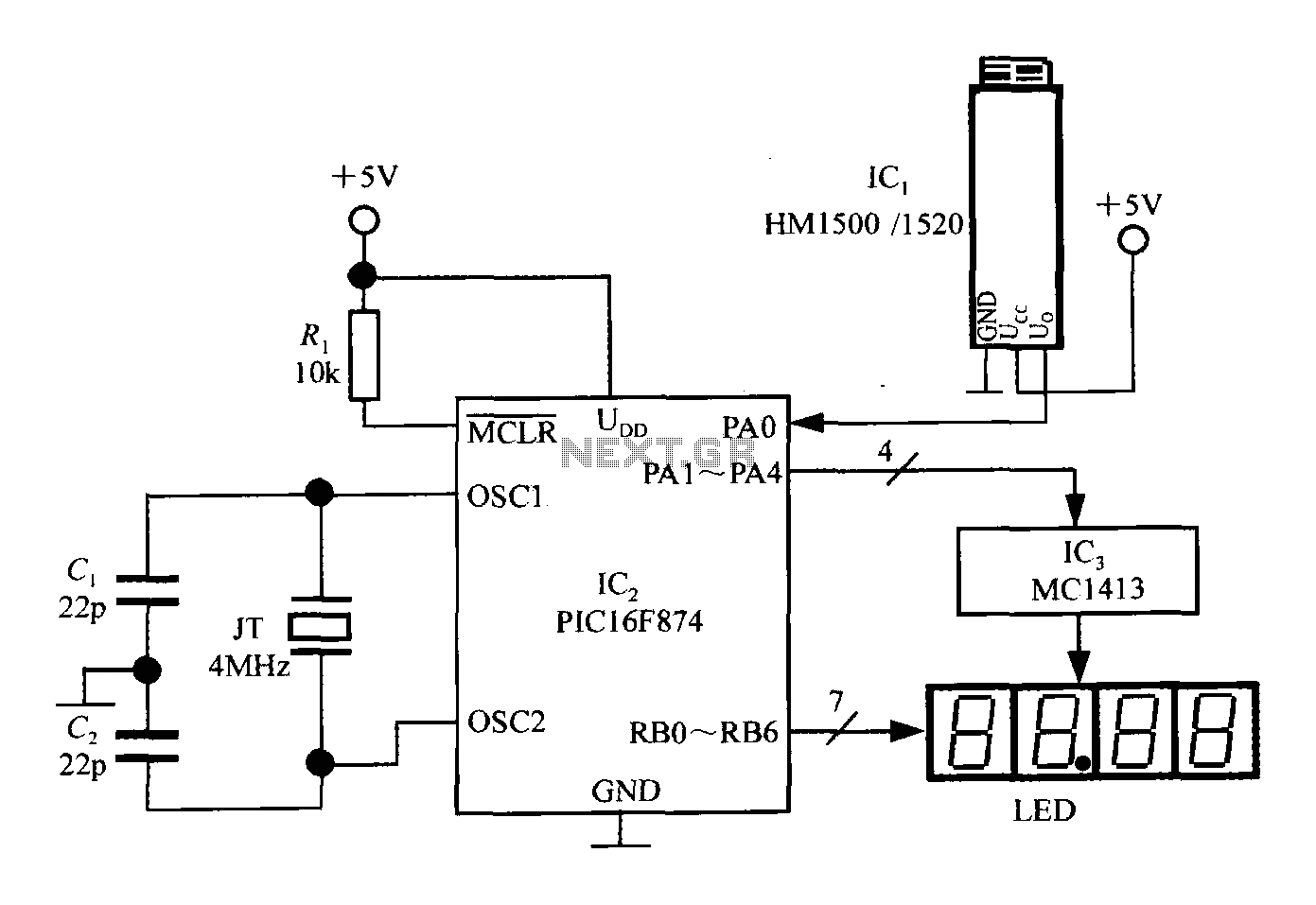
Voltage output humidity sensor meter circuit HM1500 / 1520 with microprocessor PIC16F874
An intelligent humidity meter circuit utilizing the HM1500/1520 humidity sensor and a microcontroller configuration. The circuit operates on a +5V power supply and incorporates four common cathode LED digital displays. It employs three integrated circuits: IC1 is the HM1500/1520 humidity...
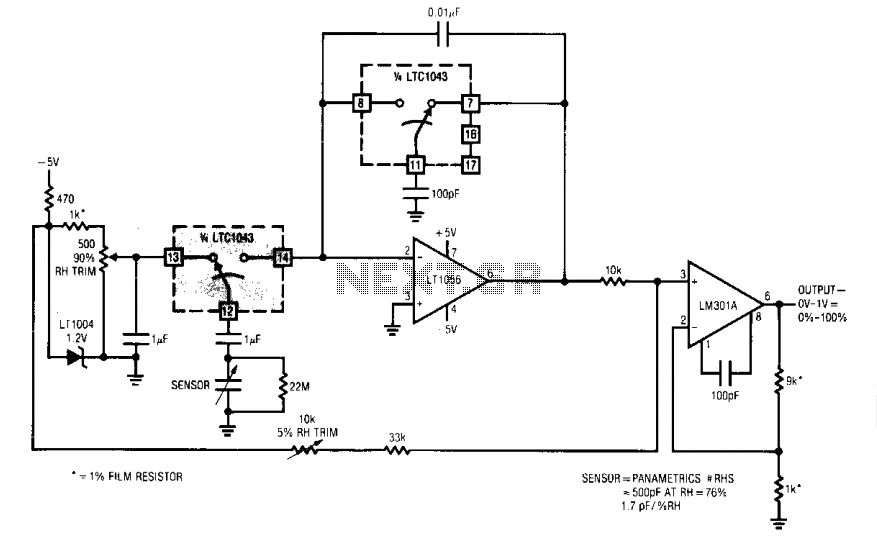
humidity sensor circuit II
When the 14B-12B pair opens, 12B is connected to Al's summing point via 13B. The sensor now discharges into the summing point through the 1 µF capacitor. Since the charge voltage is fixed, the average current into the summing point...