


Moisture Detector
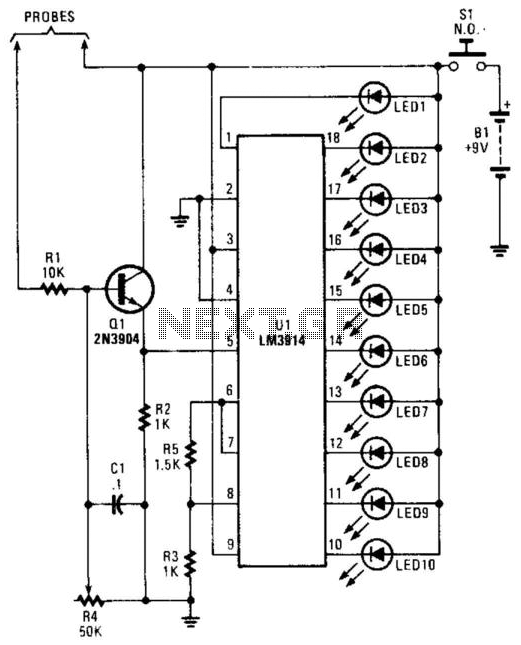
Description: A bar-graph LED driver is utilized to control 10 LEDs, providing a relative indication of moisture levels. The moisture probes are connected in such a way that the electrical conductivity resulting from moisture tends to forward bias transistor Q1, generating a DC voltage at pin 5 of integrated circuit U1 that is proportional to the leakage current. Ideally, the probes should be constructed from stainless steel.
The bar-graph LED driver circuit is designed to visually represent moisture levels through the illumination of ten individual LEDs arranged in a linear configuration. Each LED corresponds to a specific range of moisture levels, allowing for an intuitive understanding of the moisture content in the environment.
In this circuit, moisture probes act as sensors, detecting the presence of moisture based on their electrical conductivity. When moisture is present, it decreases the resistance between the probes, allowing a small leakage current to flow. This current forward biases transistor Q1, which is an essential component of the circuit. The forward biasing of Q1 allows current to pass through, influencing the voltage levels at pin 5 of the operational amplifier or microcontroller (U1). The voltage at this pin is directly proportional to the amount of leakage current, thus providing a measurable output that correlates with moisture levels.
For optimal performance, the moisture probes should be made of stainless steel due to its corrosion resistance and durability in moist environments. This material choice enhances the longevity of the probes and ensures accurate readings over time.
The overall design may include additional components such as resistors and capacitors to condition the signals and stabilize the operation of the LED driver. The bar-graph display can be designed to light up sequentially, with more LEDs illuminating as moisture levels increase, providing a clear visual representation of the current moisture status. This functionality is particularly useful in applications such as soil moisture monitoring, industrial processes, and environmental sensing.
In summary, the bar-graph LED driver circuit effectively utilizes moisture probes and a transistor to provide a clear visual indication of moisture levels, with stainless steel probes ensuring durability and reliable performance. A bar-graph LED driver is used to drive 10 LEDs to give a relative indication of moisture. The moisture probes are connec ted so that electrical conductivity due to moisture tends to forward bias Ql, providing a dc voltage at pin 5 of Ul that is proportional to leakage current. Ideally, the probes should be made of stainless steel.
The bar-graph LED driver circuit is designed to visually represent moisture levels through the illumination of ten individual LEDs arranged in a linear configuration. Each LED corresponds to a specific range of moisture levels, allowing for an intuitive understanding of the moisture content in the environment.
In this circuit, moisture probes act as sensors, detecting the presence of moisture based on their electrical conductivity. When moisture is present, it decreases the resistance between the probes, allowing a small leakage current to flow. This current forward biases transistor Q1, which is an essential component of the circuit. The forward biasing of Q1 allows current to pass through, influencing the voltage levels at pin 5 of the operational amplifier or microcontroller (U1). The voltage at this pin is directly proportional to the amount of leakage current, thus providing a measurable output that correlates with moisture levels.
For optimal performance, the moisture probes should be made of stainless steel due to its corrosion resistance and durability in moist environments. This material choice enhances the longevity of the probes and ensures accurate readings over time.
The overall design may include additional components such as resistors and capacitors to condition the signals and stabilize the operation of the LED driver. The bar-graph display can be designed to light up sequentially, with more LEDs illuminating as moisture levels increase, providing a clear visual representation of the current moisture status. This functionality is particularly useful in applications such as soil moisture monitoring, industrial processes, and environmental sensing.
In summary, the bar-graph LED driver circuit effectively utilizes moisture probes and a transistor to provide a clear visual indication of moisture levels, with stainless steel probes ensuring durability and reliable performance. A bar-graph LED driver is used to drive 10 LEDs to give a relative indication of moisture. The moisture probes are connec ted so that electrical conductivity due to moisture tends to forward bias Ql, providing a dc voltage at pin 5 of Ul that is proportional to leakage current. Ideally, the probes should be made of stainless steel.
Fading LEDs
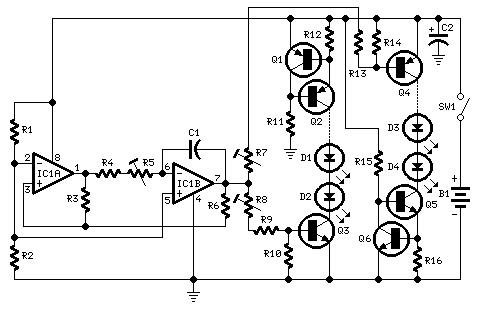
This circuit operates two LED strips in pulsing mode, i.e. one LED strip goes from off state, lights up gradually, then dims gradually, etc. while the other LED strip does the contrary. Each strip can be made up from 2...
Using white LEDs
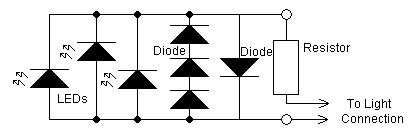
The yellow LEDs are on a small PCB, which are easy to remove. On the PCB there are 3 yellow LEDs and 4 diodes. Pictures of the PCB can be seen here: Top-side - Bottom-side. The schematic is as follows:...

reverse engineer a LED light bulb
Approximately one month ago, an attempt was made to reverse engineer a low-cost LED color-changing light bulb. With assistance, the circuit has been mapped out, and control over the bulb has been established. However, several aspects of this device remain...
LED Indicator Light Circuit diagram
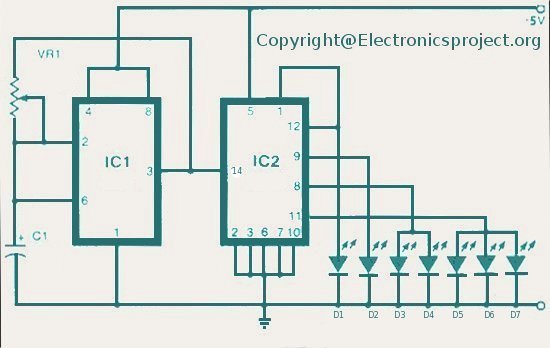
The LED indicator in this project can be used for bike indicators or car direction indicators. A 555 timer and a BCD 7490 are utilized along with several resistors, exceeding 100 in total across various electronic projects.
The circuit employs a...
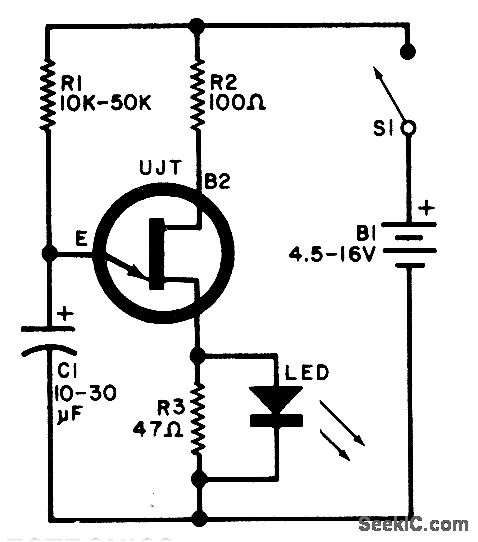
LED FLASHER USES UJT
A relaxation oscillator is employed to flash an LED in the base circuit. Capacitor C1 is charged gradually through resistor R1 by the power supply and is then discharged intermittently through resistor R3 and the LED by the Unijunction Transistor...
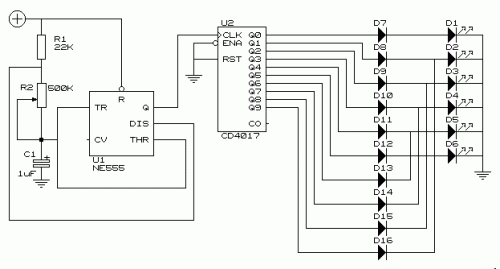
Knightrider lights for model cars
This simple circuit drives six LEDs in a "Knightrider scanner mode." Power consumption primarily depends on the type of LEDs used, especially if a 7555 (555 CMOS version) is utilized.
The circuit operates by sequentially illuminating the LEDs to create a...
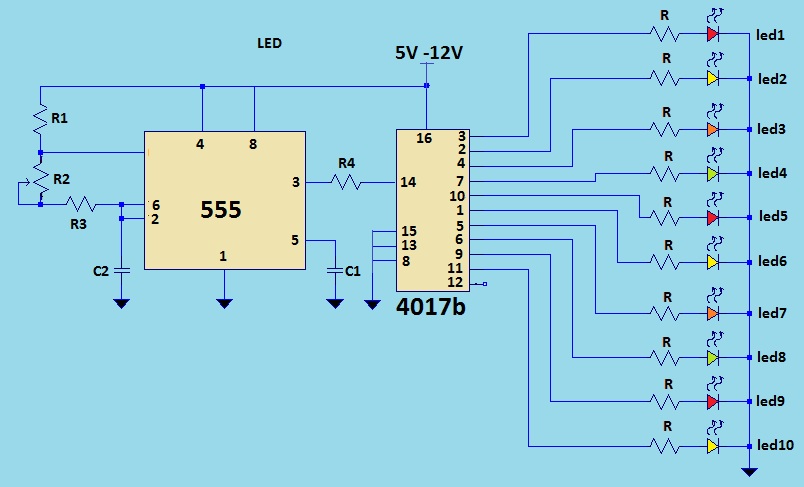
LED light chaser using 4017
This is a LED sequencer circuit where 10 LEDs light up and turn off sequentially, creating a chasing effect. This simple circuit is suitable for designing lighting decorations on Christmas trees. It can also be used for lighting animations by...
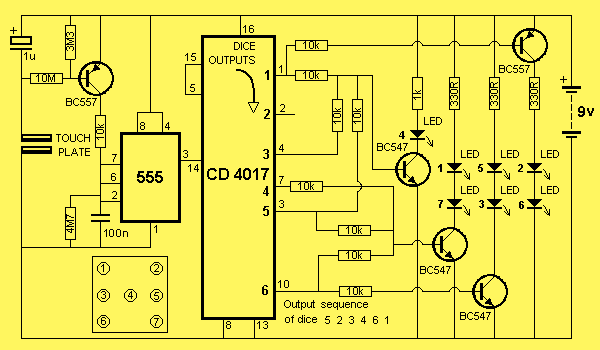
LED Dice schematic
This project has two advantages over previous dice circuits. It produces a realistic readout as well as a slow-down feature. These combine to make it one of our most popular games projects. As can been seen in the photo, the...
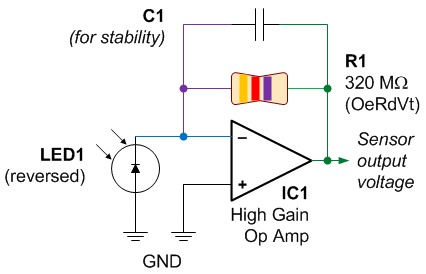
Color Sensor from a Reversed LED and Op Amp
One of the first lessons that electronics students learn is that an LED emits light when current flows through it. However, it is also true that when an LED is connected in reverse, it can generate a current flow when...