


Portable alcohol detector alarm circuit
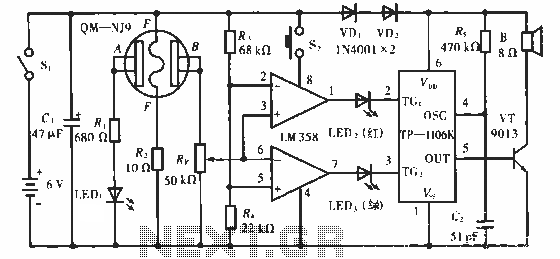
Description: The QM-NJ9 is an alcohol sensor that detects the presence of alcohol by measuring the resistance values between points A and B. When alcohol is detected, the resistance decreases, leading to an increase in potential at point B. As the concentration of alcohol rises, the potential at point B also increases. This voltage signal is output through a sensitivity adjustment potentiometer, which slides the arm to adjust the resistance, and is then fed into a dual voltage comparator, specifically the LM358, at pins 3 and 6.
The QM-NJ9 alcohol sensor operates on the principle of resistive sensing, where the sensor's resistance changes in response to the presence of alcohol vapors. The sensor consists of a sensitive material that reacts chemically with alcohol, resulting in a change in its electrical resistance. The circuit is designed to monitor this change in resistance and convert it into a measurable voltage signal.
The adjustment potentiometer allows for calibration of the sensor's sensitivity, enabling the user to set a threshold level for alcohol detection. The output voltage from the potentiometer is fed into the LM358 dual voltage comparator, which is configured to compare the sensor's output voltage against a reference voltage. The LM358 is a versatile operational amplifier that can be used in various configurations, including as a comparator.
In this application, the comparator's output can be used to trigger additional circuitry, such as an alarm or indicator light, when the alcohol concentration exceeds a predefined level. The use of the LM358 allows for precise monitoring and response to changes in alcohol concentration, making the circuit suitable for applications such as breath analyzers or alcohol detection systems in vehicles.
Overall, the QM-NJ9 alcohol sensor circuit provides a reliable method for detecting alcohol levels, with adjustable sensitivity and the capability to interface with other electronic components for further processing or alerting functionalities.Circuit works: QM-NJ9 is alcohol sensor. QM-NJ9 contact after the odor of alcohol, the resistance value A, B between the reduced potential accounting point rise. The more alcohol concentration, the higher the B point potential. This signal voltage by a sensitivity adjustment potentiometer output Rp slide arm out, was added to a dual voltage comparator LM358 3,6 feet.
The QM-NJ9 alcohol sensor operates on the principle of resistive sensing, where the sensor's resistance changes in response to the presence of alcohol vapors. The sensor consists of a sensitive material that reacts chemically with alcohol, resulting in a change in its electrical resistance. The circuit is designed to monitor this change in resistance and convert it into a measurable voltage signal.
The adjustment potentiometer allows for calibration of the sensor's sensitivity, enabling the user to set a threshold level for alcohol detection. The output voltage from the potentiometer is fed into the LM358 dual voltage comparator, which is configured to compare the sensor's output voltage against a reference voltage. The LM358 is a versatile operational amplifier that can be used in various configurations, including as a comparator.
In this application, the comparator's output can be used to trigger additional circuitry, such as an alarm or indicator light, when the alcohol concentration exceeds a predefined level. The use of the LM358 allows for precise monitoring and response to changes in alcohol concentration, making the circuit suitable for applications such as breath analyzers or alcohol detection systems in vehicles.
Overall, the QM-NJ9 alcohol sensor circuit provides a reliable method for detecting alcohol levels, with adjustable sensitivity and the capability to interface with other electronic components for further processing or alerting functionalities.Circuit works: QM-NJ9 is alcohol sensor. QM-NJ9 contact after the odor of alcohol, the resistance value A, B between the reduced potential accounting point rise. The more alcohol concentration, the higher the B point potential. This signal voltage by a sensitivity adjustment potentiometer output Rp slide arm out, was added to a dual voltage comparator LM358 3,6 feet.
Freezer meltdown alarm
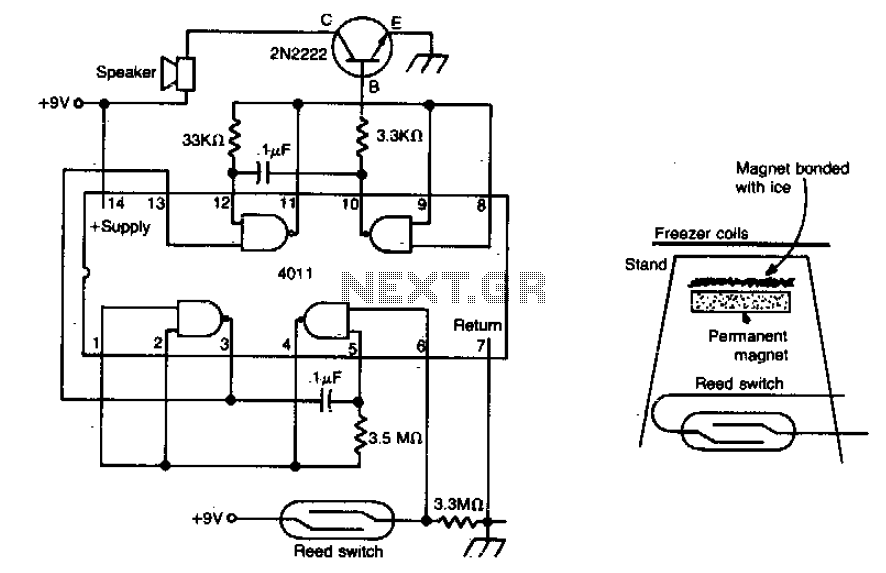
The meltdown consists of a magnet secured to a small stand by ice. A reed switch is positioned beneath the magnet. When the ice melts, the magnet drops onto the switch, closing it and completing the alarm circuit.
The described circuit...
Car Speed limit Alarm
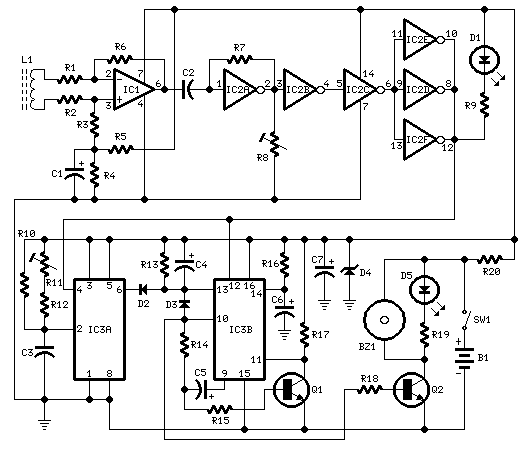
This circuit has been designed to alert the vehicle driver that he has reached the maximum fixed speed limit (i.e. in a motorway). It eliminates the necessity of looking at the tachometer and to be distracted from driving. There is...
Simple Safety Circuit Circuit
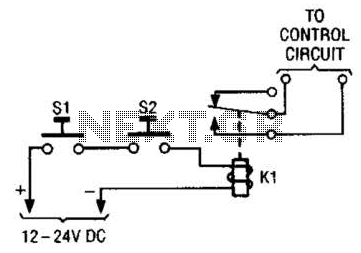
The simple two-hand safety control switch consists of two pushbutton switches connected in series; both must be depressed to energize the relay.
The two-hand safety control switch is designed to enhance safety in applications where the operation of machinery or equipment...
Personal Alarm
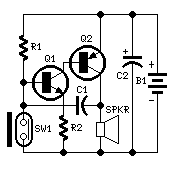
This circuit, enclosed in a small plastic box, can be placed into a bag or handbag. A small magnet is placed close to the reed switch and connected to the hand or the clothes of the person carrying the bag...
Multi Loop Parallel Alarm Circuit
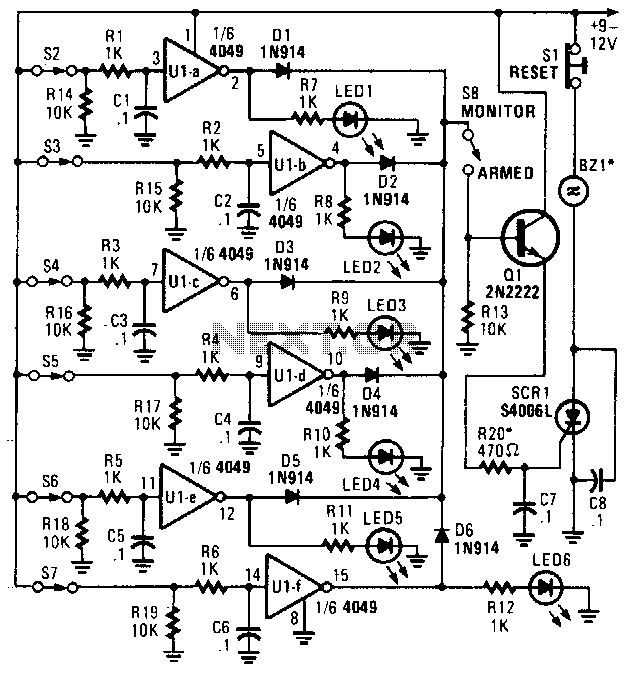
This alarm features status LEDs connected to each inverter output, which indicate the status of the corresponding sensor. S8 is utilized to monitor the switches through the LEDs or to activate an alarm using Q1 and SCR1. Additionally, BZ1 should...
Two HiJack Alarms
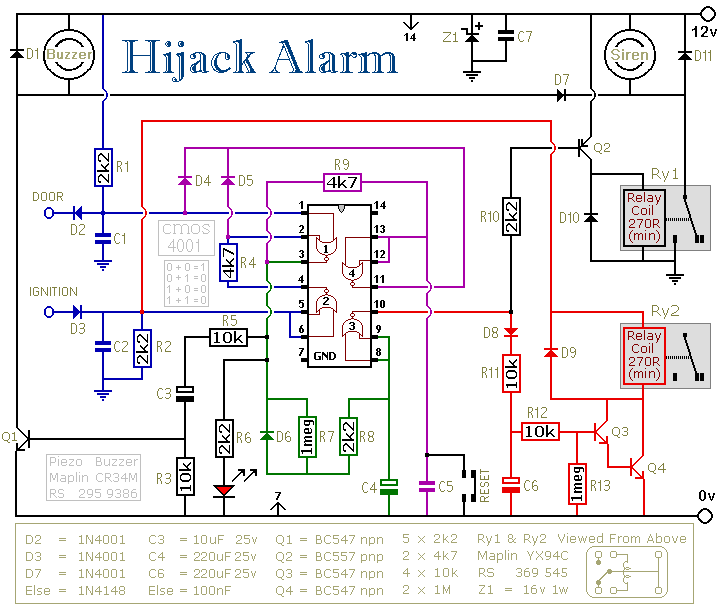
The first circuit was designed for the situation where a hijacker forces the driver from the vehicle. If a door is opened while the ignition is switched on - the circuit will trip. After a few minutes delay - when...
Alarm interface circuit
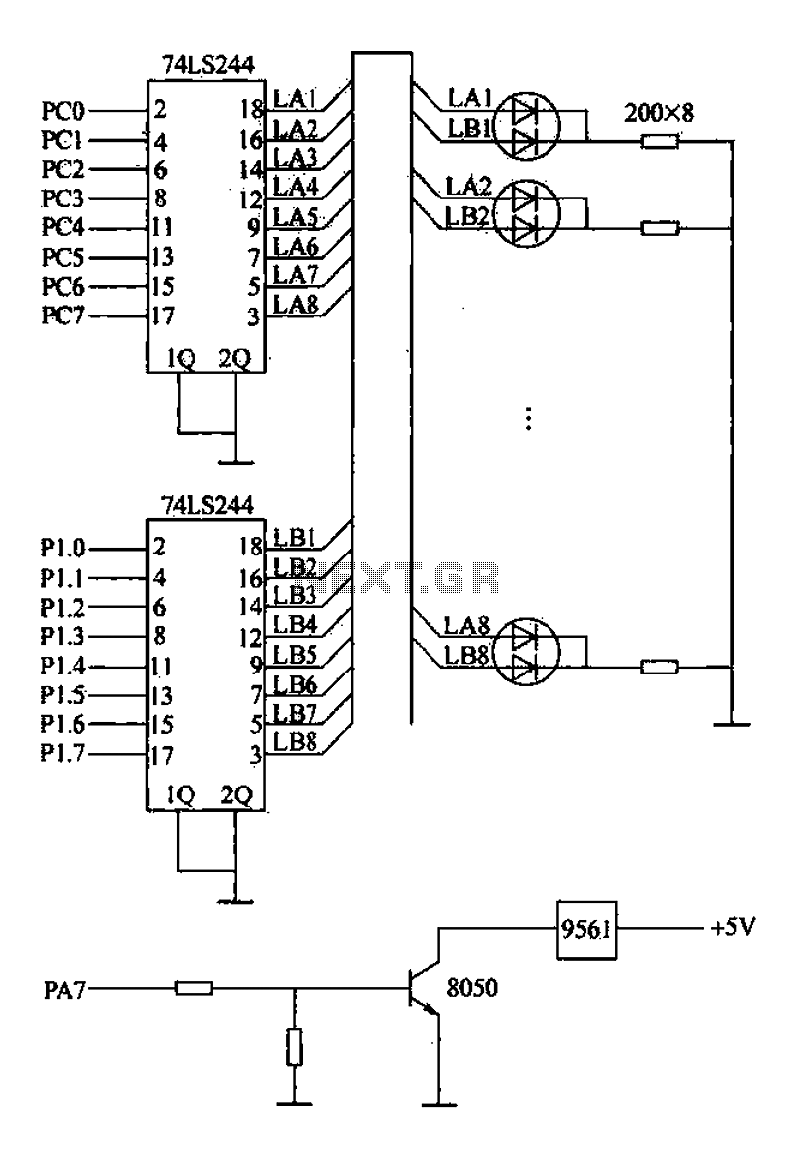
Alarm interface circuitry featuring a two-color light-emitting diode (LED) display. When LAi is at a high level and LBi is low, the green LED lights up; conversely, if LAi is low and LBi is high, the red LED lights up....
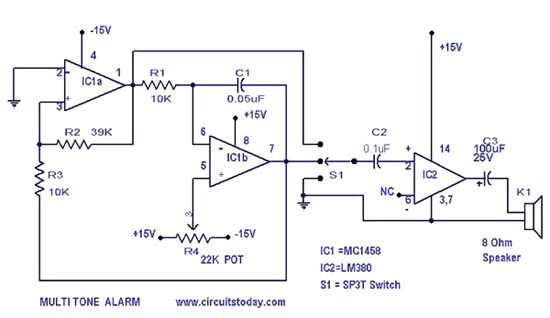
Simple Alarm circuit
A simple alarm circuit with a diagram and schematic that generates a multi-tone sound. This alarm circuit is suitable for use in burglar alarms and sirens and is designed using dual op-amps MC1458 and LM380.
The described alarm circuit utilizes dual...
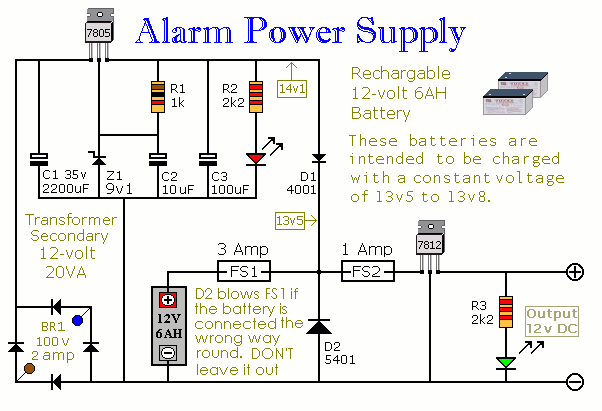
Alarm Power Supply
This power supply is suitable for a modular burglar alarm but can also serve other applications. It is designed to provide a 12-volt output with a current capacity of up to 1 amp. In case of mains failure, the backup...