


Resistance Thermometer Current Loop Transmitter
#RTD
#temperature sensor
#current loop
#NTC
#PTC
#resistance thermometer
#measurement
#instrumentation
#industrial
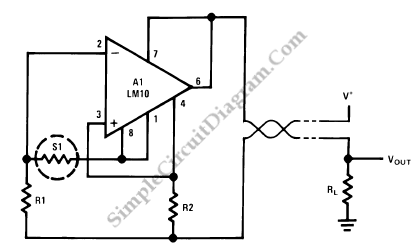
Description: A resistance temperature sensor (RTD, resistive temperature device) is available in two types: NTC (negative temperature coefficient) and PTC (positive temperature coefficient).
Resistance Temperature Detectors (RTDs) are essential components in temperature measurement systems. They operate on the principle that the electrical resistance of certain materials changes with temperature. In the case of NTC sensors, the resistance decreases as the temperature increases, making them suitable for applications requiring precise temperature monitoring in a decreasing resistance scenario. Conversely, PTC sensors exhibit an increase in resistance with rising temperature, which can be advantageous for over-temperature protection and applications where a positive response to temperature changes is necessary.
RTDs are typically constructed from pure metal, such as platinum, which provides a stable and repeatable resistance-temperature relationship. The sensor's resistance is characterized by a linear response over a specific temperature range, often from -200°C to +850°C for platinum RTDs. This linearity allows for straightforward calibration and integration into various electronic systems.
The implementation of RTDs in circuit design often requires careful consideration of the measurement circuit configuration. A common approach is to use a Wheatstone bridge circuit to enhance measurement accuracy and minimize the effects of lead resistance. This configuration allows for precise detection of the small changes in resistance that occur with temperature variations. Additionally, signal conditioning circuits, such as operational amplifiers, may be employed to amplify the output signal from the RTD for further processing.
In summary, the choice between NTC and PTC sensors depends on the specific application requirements, including the desired response to temperature changes, the range of temperature to be measured, and the necessary accuracy. Proper integration and circuit design are crucial to fully leverage the capabilities of RTDs in temperature sensing applications.Resistance temperature sensor (RTD, resistive temperature device) comes in NTC (negative temperature coefficient) and PTC (positive temperature coefficient)..
Resistance Temperature Detectors (RTDs) are essential components in temperature measurement systems. They operate on the principle that the electrical resistance of certain materials changes with temperature. In the case of NTC sensors, the resistance decreases as the temperature increases, making them suitable for applications requiring precise temperature monitoring in a decreasing resistance scenario. Conversely, PTC sensors exhibit an increase in resistance with rising temperature, which can be advantageous for over-temperature protection and applications where a positive response to temperature changes is necessary.
RTDs are typically constructed from pure metal, such as platinum, which provides a stable and repeatable resistance-temperature relationship. The sensor's resistance is characterized by a linear response over a specific temperature range, often from -200°C to +850°C for platinum RTDs. This linearity allows for straightforward calibration and integration into various electronic systems.
The implementation of RTDs in circuit design often requires careful consideration of the measurement circuit configuration. A common approach is to use a Wheatstone bridge circuit to enhance measurement accuracy and minimize the effects of lead resistance. This configuration allows for precise detection of the small changes in resistance that occur with temperature variations. Additionally, signal conditioning circuits, such as operational amplifiers, may be employed to amplify the output signal from the RTD for further processing.
In summary, the choice between NTC and PTC sensors depends on the specific application requirements, including the desired response to temperature changes, the range of temperature to be measured, and the necessary accuracy. Proper integration and circuit design are crucial to fully leverage the capabilities of RTDs in temperature sensing applications.Resistance temperature sensor (RTD, resistive temperature device) comes in NTC (negative temperature coefficient) and PTC (positive temperature coefficient)..
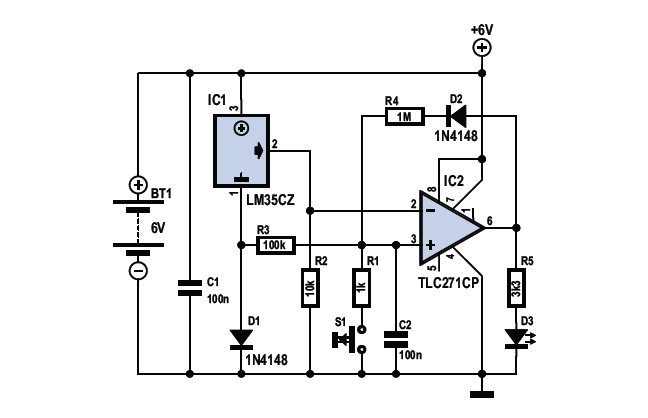
Audio Schematic Frost Detector Temperature Sensor
To determine whether it is freezing, one needs to measure the temperature accurately. This requires a reliable temperature sensor. The LM35CZ sensor, which operates within a range of -40 to 110 °C, is suitable for this purpose. It is relatively...
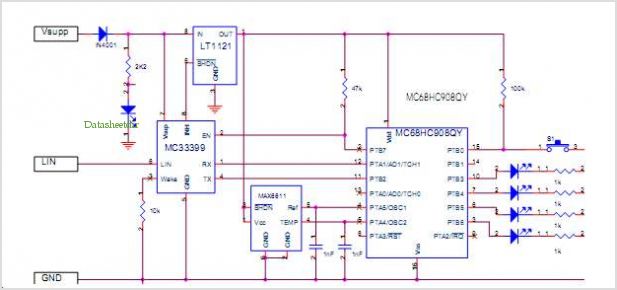
Lin Temperature Sensor Using The Mc68hc908qt/qy Mcu
The LinkSwitch-LP family is designed to replace inefficient line frequency linear transformer-based power supplies with output powers less than 2.5 W in applications such as cell/cordless phones, PDAs, digital cameras, and portable audio players. LinkSwitch-LP may also be used as...
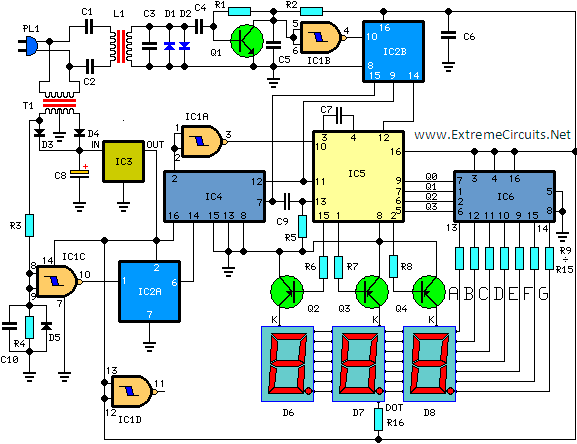
digital remote thermometer
This circuit is designed for precise measurement of temperature in degrees Celsius. It includes a transmitter section that converts the output voltage from the sensor, which is proportional to the temperature being measured, into a frequency signal. This frequency signal...
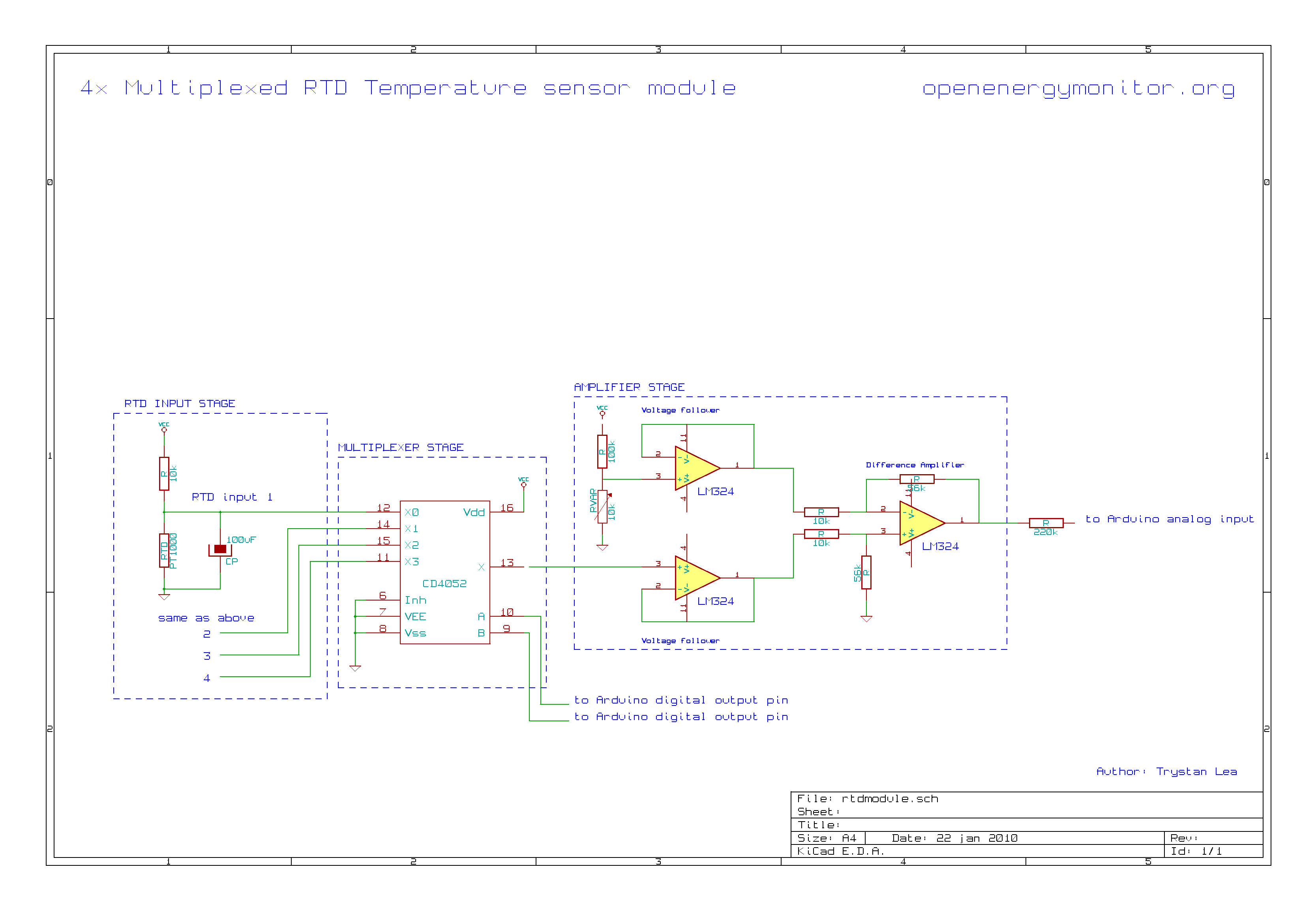
rtd temperature sensing
More:
The input data contains a brief description section followed by an empty "More" section. There is no additional information provided to elaborate on.
In the context of electronic schematics, a description typically outlines the purpose and functionality of the circuit....
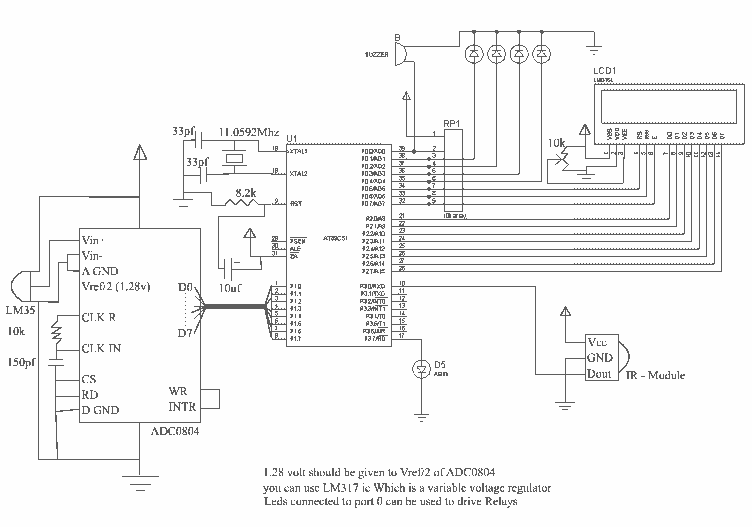
IR auto digital thermostat
This circuit measures temperature in Celsius scale and displays it on an alphanumeric LCD screen. When temperature rises to 40°C, an alarm is activated and at the same time a relay is also activated which drives a fan to keep...
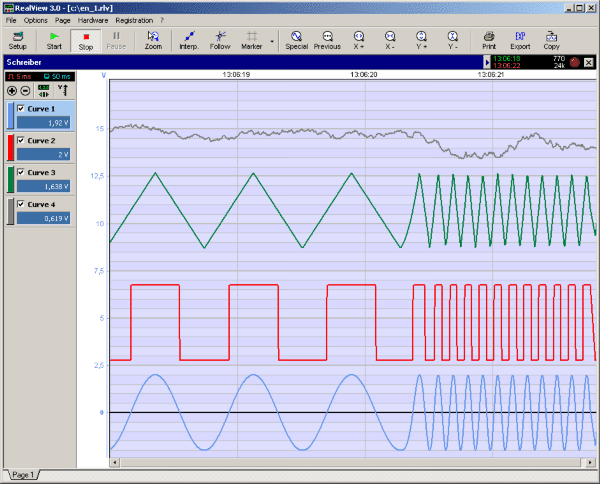
RealView 2.0
RealView is a measurement application, which records and plots measured values from analogue hardware devices in real-time. Several curves can be plotted into a single diagram. Several diagrams can be arranged on one or more pages if necessary. Plot options...
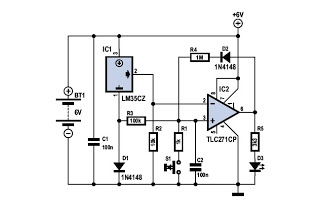
Frost Detector Temperature Sensor Circuit
To determine whether it is freezing, it is necessary to measure the temperature accurately using a reliable temperature sensor. The LM35CZ, which operates between -40 to 110 °C, has been chosen for this purpose. This sensor generates an output voltage...
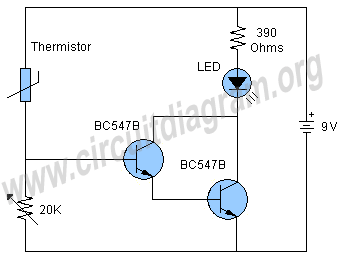
temperature sensor circuit
The schematic presented is a project for a simple temperature sensor circuit, also referred to as a heat sensor circuit, which activates an LED in response to heat. The circuit is straightforward to construct and requires only a few components....
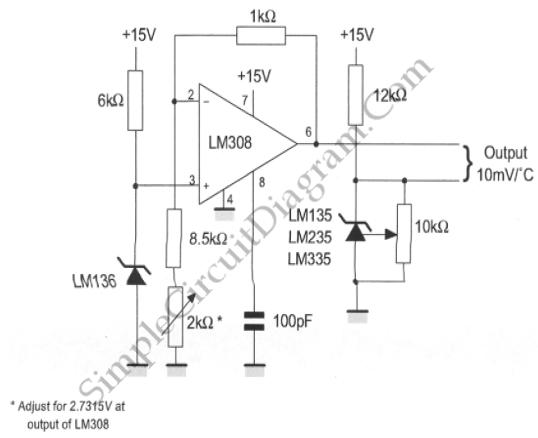
LM135/235/335 Centigrade Thermometer
The LM135/235/335 temperature sensor is designed for ease of absolute temperature reading, providing all positive values for any frequency. This is why a voltage of 2.7315V is observed at 0 degrees.
The LM135/235/335 series of temperature sensors are precision devices that...