


Toxic gas detector
#toxic gas
#gas sensor
#TGS812
#Figaro Engineering
#SCR
#voltage divider
#sensitivity control
#semiconductor
#safety
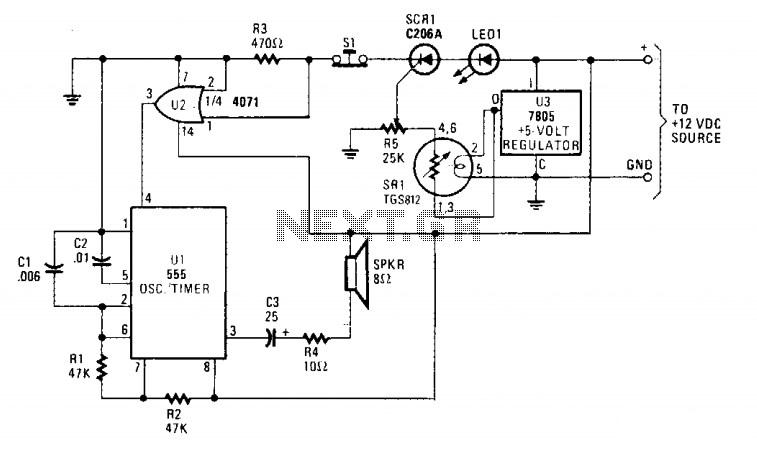
Description: The primary component in the circuit is the SRI, a TGS812 toxic gas sensor produced by Figaro Engineering Inc. This gas-sensitive semiconductor functions as a variable resistor when exposed to toxic gases, resulting in a decrease in electrical resistance as gaseous toxins are absorbed by the sensor surface. A 25,000-ohm potentiometer (R5) is connected to the sensor, serving multiple roles: it acts as a load, creates a voltage-dividing network, and provides sensitivity control, with its center tap linked to the gate of SCR1. When toxic fumes interact with the sensor, the reduction in electrical resistance allows current to flow through the load (potentiometer R5).
The voltage generated across the wiper of R5, which connects to the gate of SCR1, activates the SCR, allowing it to conduct. Once SCR1 is conducting, it supplies a 1-volt supply for the semiconductor components of the TGS812, even though a 10-volt supply is recommended, which effectively reduces the standby current. A 7805 voltage regulator is employed to provide the necessary 5 volts for the heater and semiconductor elements.
The circuit leverages the properties of the TGS812 sensor to detect the presence of toxic gases, utilizing the SCR for efficient switching. The potentiometer (R5) is crucial for adjusting the sensitivity of the sensor, allowing for fine-tuning based on environmental conditions. The integration of the 7805 regulator ensures that the circuit operates within safe voltage levels, providing stable power to the heater and semiconductor elements, essential for the sensor's operation. The design emphasizes low power consumption, particularly during standby, while ensuring reliable detection of toxic gases. This configuration is particularly useful in safety applications where monitoring air quality and detecting hazardous gases is critical.The major device in the circuit is SRI (a TGS812 toxic-gas sensor manufactured by Figaro Engineering Inc.) The gas-sensitive semiconductor (acting like a variable resistor in the presence of toxic gas) decreases in electrical resistance when gaseous toxins are absorbed from the sensor surface. A 25,000 ohm potentiometer (R5) connected to the sensor serves as a load, voltage-dividing network, and sensitivity control and has its center tap connected to the gate of SCR1.
When toxic fumes come in contact with the sensor, decreasing its electrical resistance, current flows through the load (potentiometer R5). The voltage developed across the wiper of R5, which is connected to the gate of SCR1, triggers the SCR into conduction. With SCR1 now conducting, pin 1-volt supply for the semiconductor elements of the TGS812 in spite of the suggested 10 volts, thus reducing the standby current.
A 7805 regulator is used to meet the 5-volt requirement for the heater and semiconductor elements.
The voltage generated across the wiper of R5, which connects to the gate of SCR1, activates the SCR, allowing it to conduct. Once SCR1 is conducting, it supplies a 1-volt supply for the semiconductor components of the TGS812, even though a 10-volt supply is recommended, which effectively reduces the standby current. A 7805 voltage regulator is employed to provide the necessary 5 volts for the heater and semiconductor elements.
The circuit leverages the properties of the TGS812 sensor to detect the presence of toxic gases, utilizing the SCR for efficient switching. The potentiometer (R5) is crucial for adjusting the sensitivity of the sensor, allowing for fine-tuning based on environmental conditions. The integration of the 7805 regulator ensures that the circuit operates within safe voltage levels, providing stable power to the heater and semiconductor elements, essential for the sensor's operation. The design emphasizes low power consumption, particularly during standby, while ensuring reliable detection of toxic gases. This configuration is particularly useful in safety applications where monitoring air quality and detecting hazardous gases is critical.The major device in the circuit is SRI (a TGS812 toxic-gas sensor manufactured by Figaro Engineering Inc.) The gas-sensitive semiconductor (acting like a variable resistor in the presence of toxic gas) decreases in electrical resistance when gaseous toxins are absorbed from the sensor surface. A 25,000 ohm potentiometer (R5) connected to the sensor serves as a load, voltage-dividing network, and sensitivity control and has its center tap connected to the gate of SCR1.
When toxic fumes come in contact with the sensor, decreasing its electrical resistance, current flows through the load (potentiometer R5). The voltage developed across the wiper of R5, which is connected to the gate of SCR1, triggers the SCR into conduction. With SCR1 now conducting, pin 1-volt supply for the semiconductor elements of the TGS812 in spite of the suggested 10 volts, thus reducing the standby current.
A 7805 regulator is used to meet the 5-volt requirement for the heater and semiconductor elements.
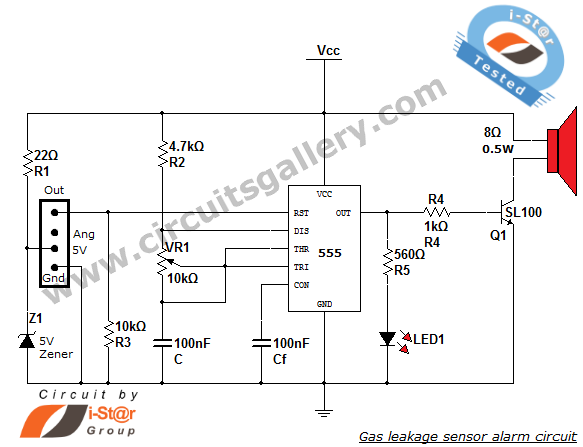
Gas Leakage Sensor Alarm Circuit Engineering Project using 555 Timer and MQ6 SEN 1327 Gas Sensor Module
This article discusses a home security alarm circuit designed to detect LPG gas leakage. The circuit utilizes a gas sensor module, SEN 1327, which incorporates a QM 6 gas sensor. The output signal from this gas sensor module is used...
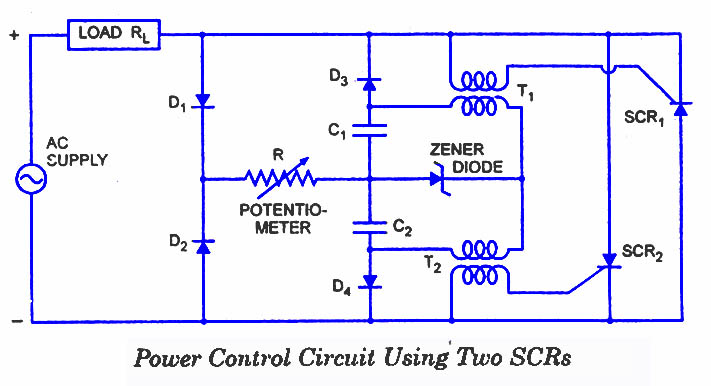
SCR Applications
The ability of an SCR to control large currents to a load using a small gate current makes the device highly useful in switching and control applications. Several potential applications for the SCR include power control, switching, zero-voltage switching, over-voltage...
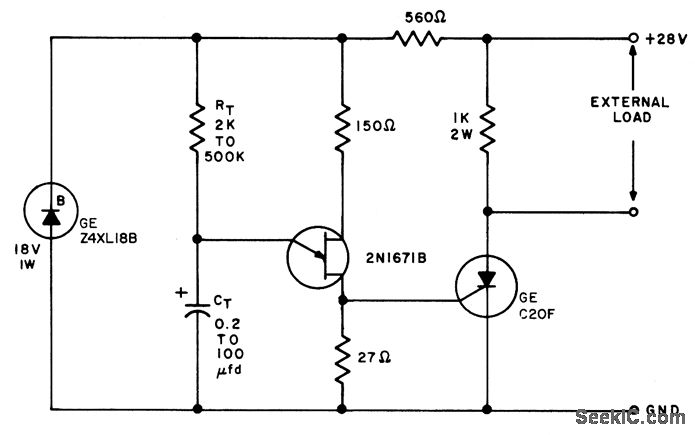
SCR UJI TIME DELAY
The timing interval is initiated by applying power and is determined by the resistor-capacitor (RT-CT) combination. At the end of the interval, a unijunction transistor triggers a silicon controlled rectifier (SCR) to apply nearly the full supply voltage to the...
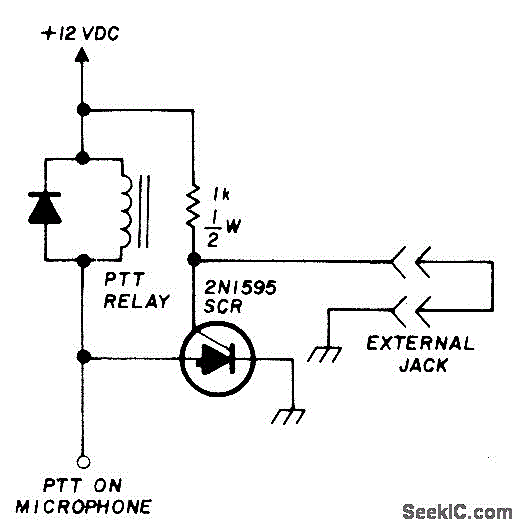
SCR_LATCH
Activates a mobile transceiver or other mobile equipment when power is applied, especially if the external circuit is interrupted during theft. The transmitter will then emit an unmodulated carrier signal even if the Push-To-Talk (PTT) switch is disconnected or turned...
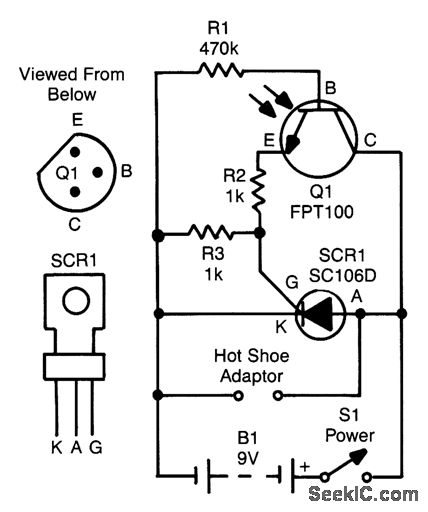
SLAVE FLASH TRIGGER
The SCR is connected across the trigger circuit of the flash gun. In its normal state, the SCR remains off, allowing the flash gun to charge to its trigger voltage. A phototransistor, Q1, monitors the light level. When a high-intensity...
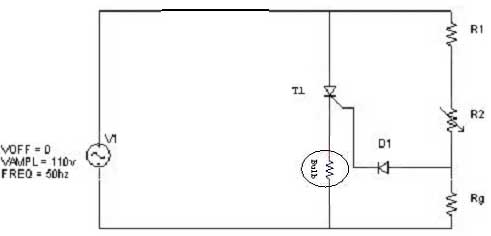
triggering circuit
Simple resistor and diode combinations are used to trigger and control silicon-controlled rectifiers (SCRs) across the full 180-degree electrical range, exhibiting reliable performance at commercial temperatures. These circuits function optimally when SCRs possess relatively high gate sensitivities. In this configuration,...
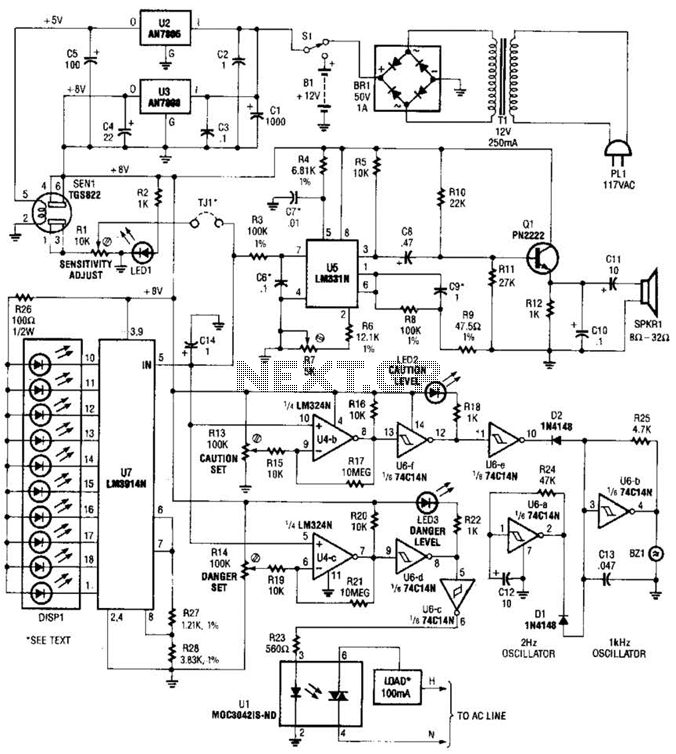
Explosive Gas Detector Circuit
A gas sensor (TGS823 from Allegro Electronics, Cornwall Bridge, CT 06754) conducts in the presence of explosive gases. U5 is a voltage-to-frequency converter that produces a frequency proportional to the sensor conductance. The output frequency ranges from 100 Hz in...
Simple Safety Circuit Circuit
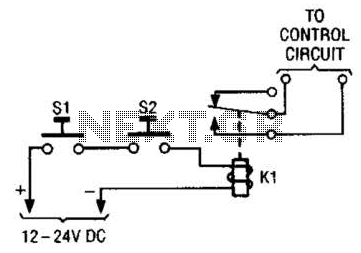
The simple two-hand safety control switch consists of two pushbutton switches connected in series; both must be depressed to energize the relay.
The two-hand safety control switch is designed to enhance safety in applications where the operation of machinery or equipment...
Scr-tester
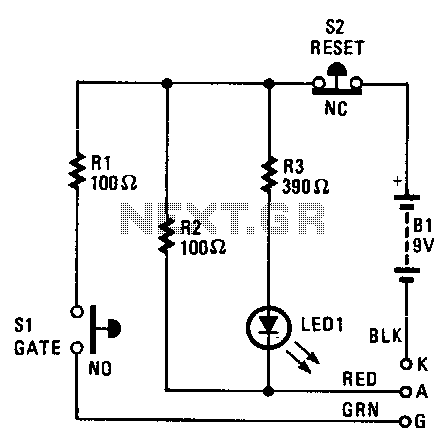
The cathode, anode, and gate of the Device Under Test (DUT) are connected to the unit's K, A, and G terminals, respectively. Pressing switch S1 supplies a gate current to the DUT, triggering it to turn on. Resistor R1 limits...