


Darlington phototransistor type light-triggered circuit diagram of a switching application
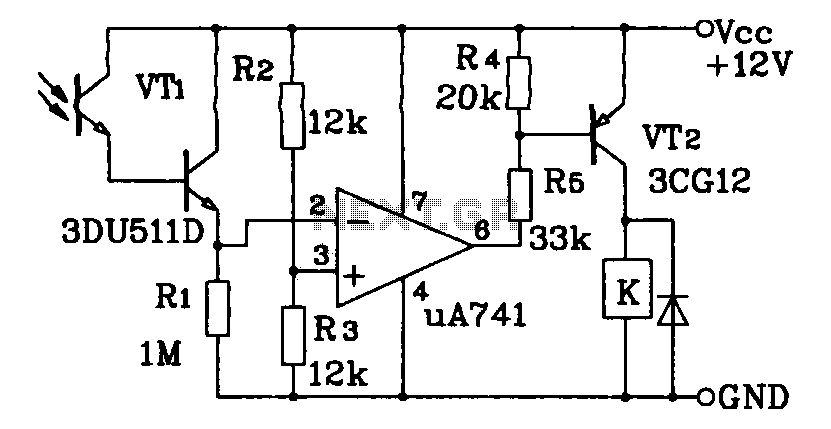
Description: This circuit application utilizes a Darlington phototransistor for light-triggered switching. The design incorporates a Darlington phototransistor and an operational amplifier (op-amp), allowing the circuit to respond to very faint light levels. The circuit can be modified to trigger in darkness by swapping the positions of R1 and the photodiodes or by reversing the inverting and non-inverting inputs of the op-amp.
The described circuit leverages the high sensitivity of a Darlington phototransistor, which is capable of amplifying weak light signals significantly. The operational amplifier serves to further enhance the signal processing, enabling the circuit to detect and respond to minimal light levels effectively.
In the standard configuration, the phototransistor is positioned to receive light, with the output connected to the op-amp configured as a comparator. The reference voltage at the non-inverting input of the op-amp is set to a level that determines the threshold for switching. When the light intensity exceeds this threshold, the op-amp outputs a high signal, activating the connected load.
For applications requiring the circuit to trigger in the absence of light, modifications can be made. By swapping the positions of R1 and the photodiodes, the circuit can be inverted. Additionally, reversing the inputs of the op-amp will alter the behavior, allowing it to activate when the light level drops below a certain point, effectively creating a dark-triggered switch.
This flexibility makes the Darlington phototransistor switching circuit suitable for various applications, including automatic lighting systems, security alarms, and light-sensitive controls. The ability to fine-tune the sensitivity and response characteristics through component selection and configuration further enhances its versatility in electronic design.Darlington phototransistor type light-triggered switching circuit application As a result of the sub-type Darlington phototransistor and the op amp, so very faint light can fli p the circuit. When the position of R1 and photodiodes swap, or op amp inverting and non-inverting input reversed position, you can put this circuit modified to trigger the opening dark.
The described circuit leverages the high sensitivity of a Darlington phototransistor, which is capable of amplifying weak light signals significantly. The operational amplifier serves to further enhance the signal processing, enabling the circuit to detect and respond to minimal light levels effectively.
In the standard configuration, the phototransistor is positioned to receive light, with the output connected to the op-amp configured as a comparator. The reference voltage at the non-inverting input of the op-amp is set to a level that determines the threshold for switching. When the light intensity exceeds this threshold, the op-amp outputs a high signal, activating the connected load.
For applications requiring the circuit to trigger in the absence of light, modifications can be made. By swapping the positions of R1 and the photodiodes, the circuit can be inverted. Additionally, reversing the inputs of the op-amp will alter the behavior, allowing it to activate when the light level drops below a certain point, effectively creating a dark-triggered switch.
This flexibility makes the Darlington phototransistor switching circuit suitable for various applications, including automatic lighting systems, security alarms, and light-sensitive controls. The ability to fine-tune the sensitivity and response characteristics through component selection and configuration further enhances its versatility in electronic design.Darlington phototransistor type light-triggered switching circuit application As a result of the sub-type Darlington phototransistor and the op amp, so very faint light can fli p the circuit. When the position of R1 and photodiodes swap, or op amp inverting and non-inverting input reversed position, you can put this circuit modified to trigger the opening dark.
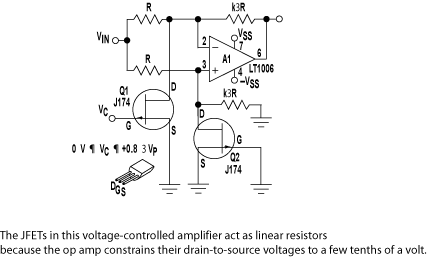
Op Amp And Two JFETs Form A Voltage-Controlled Amplifier
A simple linear voltage-controlled amplifier can be constructed with one operational amplifier (op amp) and two junction field-effect transistors (JFETs). This amplifier can achieve an 80-dB dynamic control range with less than ±0.2% linearity error for 0 V.
The described circuit...
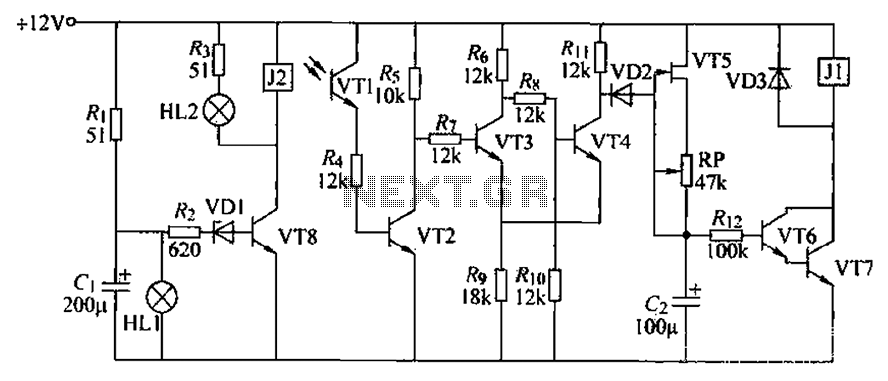
Blocking material monitoring circuit
A blocking material monitoring circuit is presented. When the optical path is obstructed by the material, the phototransistor VT1 turns off, which subsequently turns off transistors VT2, VT3, and VT4. This arrangement is coupled to a flip-flop configuration. When the...
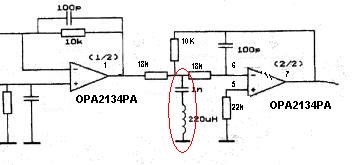
Marantz CD63 KI op amp circuit
Can someone explain why there is an LC filter in the op-amp circuit? Additionally, are there any modifications that can be made to enhance the sound quality?
The presence of an LC filter in an operational amplifier (op-amp) circuit serves several...
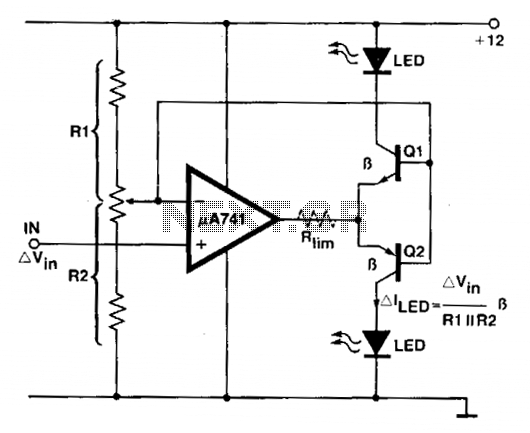
Voltage comparator circuit
An operational amplifier (op amp) is utilized as a comparator and as a current sink for an LED. The output voltage of the amplifier varies by approximately 1.4 V based on the direction of the current. At any given moment,...
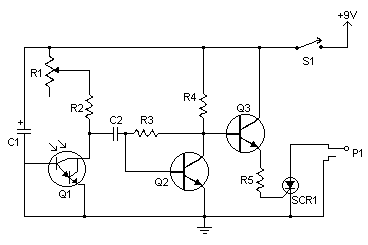
Flash Slave Trigger
Flash slaves are utilized to enhance a primary flash unit by adding one or more supplementary flash units. The slave trigger detects the initial flash through a phototransistor and subsequently activates the additional flashes with a delay of a few...
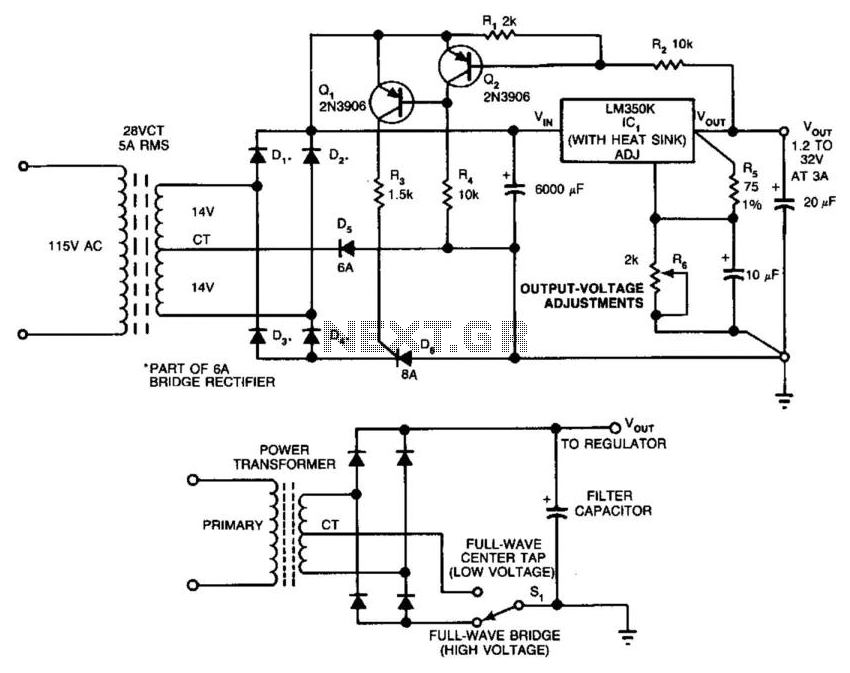
Switching Improves Regulator Efficiency
In this circuit, a full-wave bridge is switched to a full-wave center tap to reduce regulator dissipation. SCR D6 switches between configurations. When D6 is off, the circuit is an FWCT rectifier using D1, D2, and D5. It applies 17...
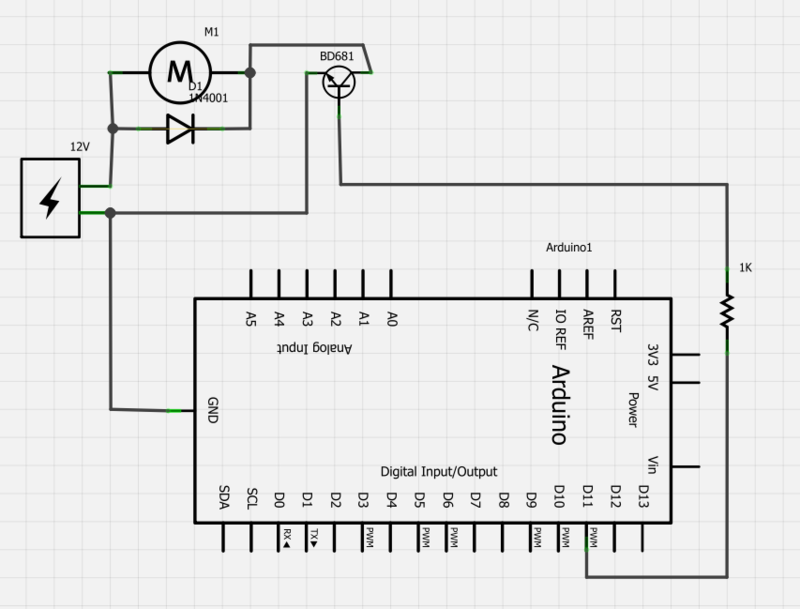
transistors Having difficulties using a darlington (BD681) to drive a 12V fan from an Arduino
Power a 12V fan using a Darlington transistor to control the speed from an Arduino. When wired as described, nothing happens even though a PWM signal is being sent. It is suggested to edit the question and ensure the current...
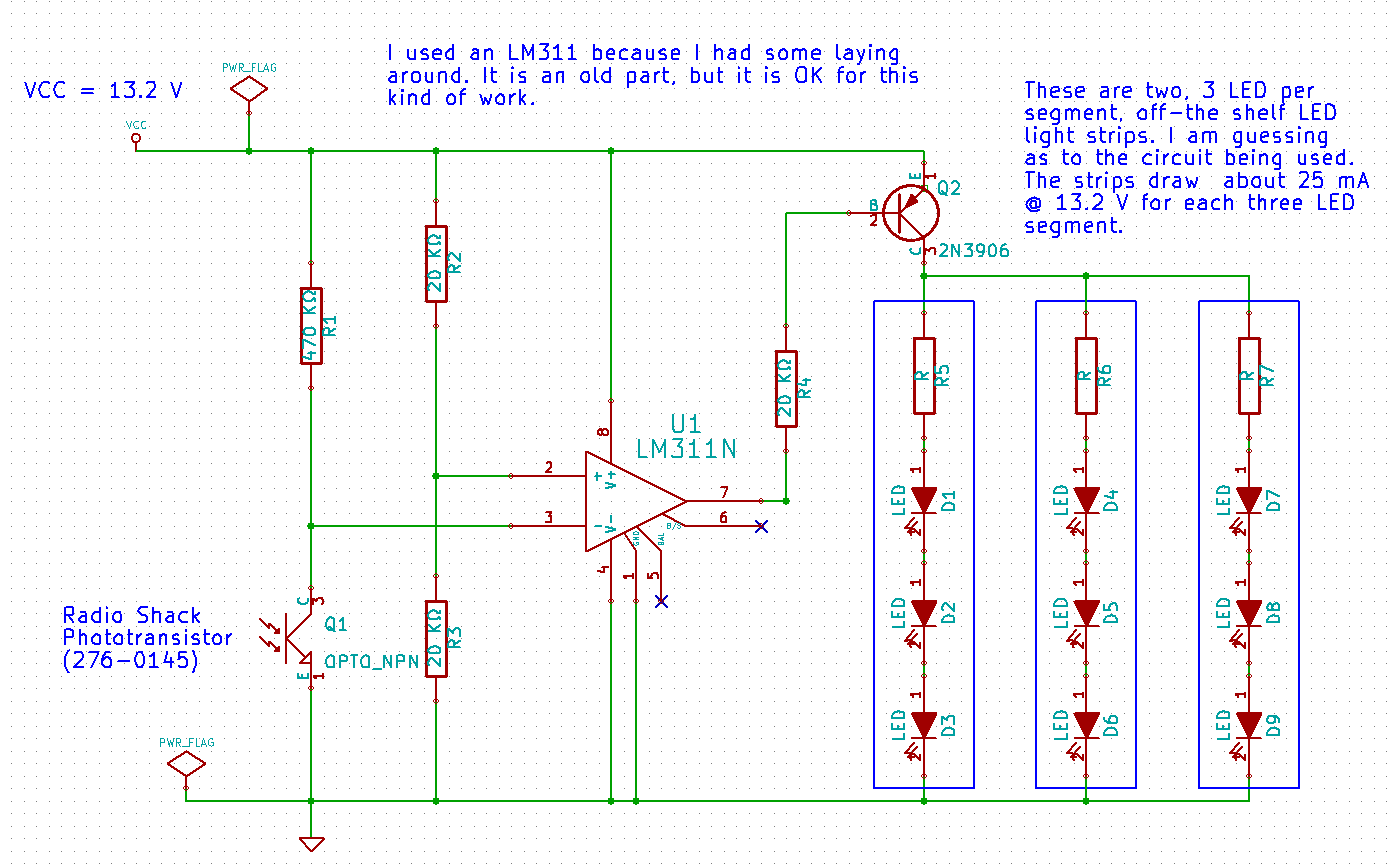
lighting and designing with phototransistors
Several individuals have mentioned that the house number is difficult to read at night. The number comprises four digits mounted on a structural column that supports a section of the roof. In response to these concerns, a request has been...
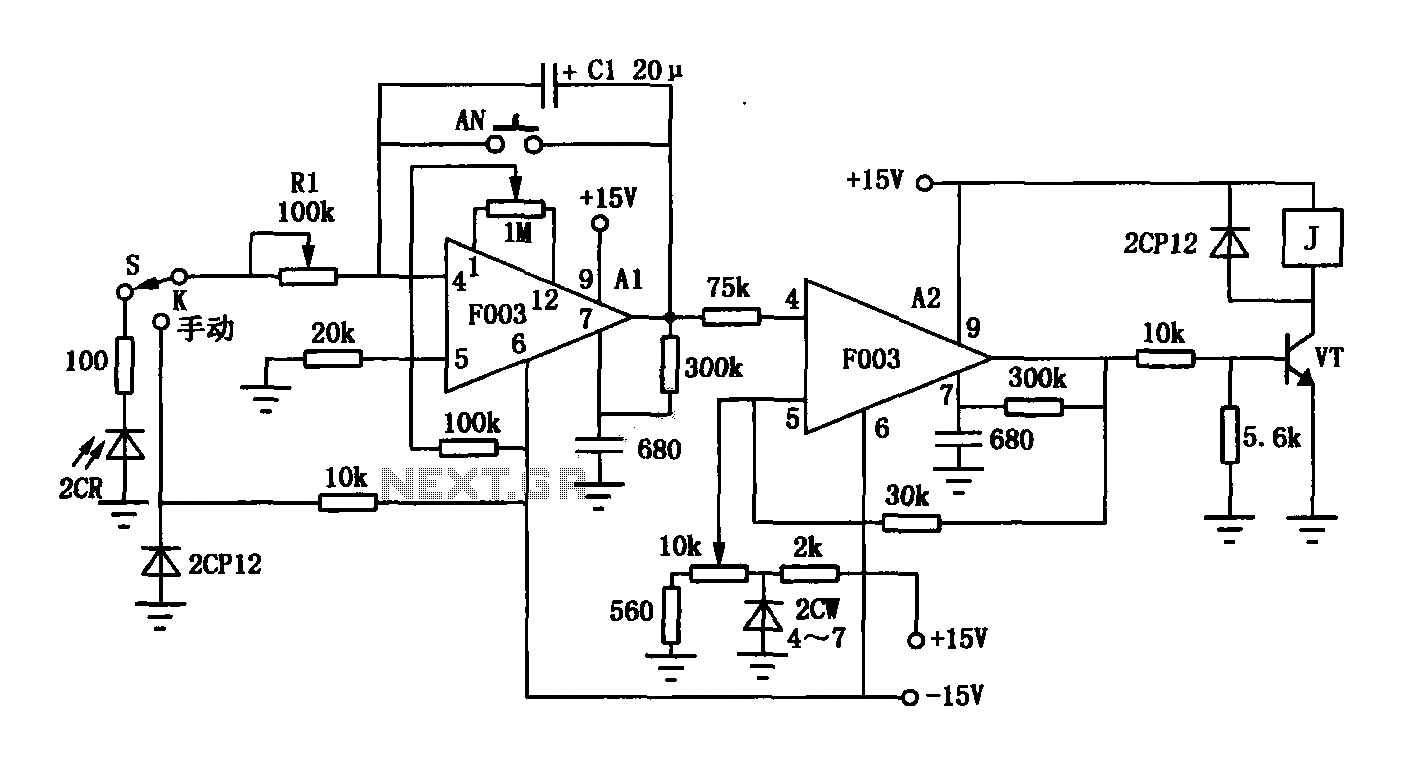
Op amp F003 composition of automatic exposure timer circuit
The F003 circuit is a versatile photographic component that functions as an operational amplifier amplifying automatic timer circuit. The operational amplifier A1 serves as an integrator, while operational amplifier A2 is configured as a comparator. A 2CR silicon photocell generates...