


DW16M-630 type DC excitation switch control circuit
#DC excitation
#switch control
#power operation
#AC power
#DC power
#control circuit
#electrical switch
#excitation switch
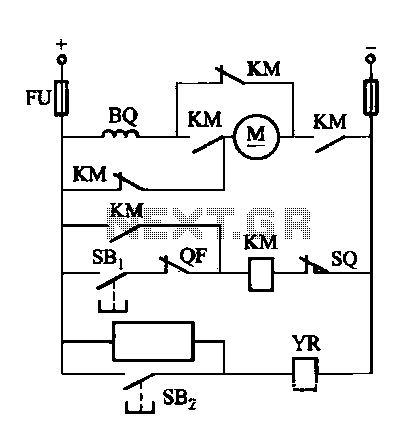
Description: The DW16M-630 type excitation switch operates with both DC and AC power. The circuit for DC operation is illustrated in Figure 7-60, while the circuit for AC operation is shown in Figure 7-61. The BQ single-phase series motor M features a series winding, which connects to the terminal switch. KM represents the closing contactor, R denotes the resistance, YR is the trip coil (shunt release), and QF is the export circuit breaker with a normally closed auxiliary contact.
The DW16M-630 excitation switch is designed to facilitate the control and management of electrical circuits in both direct current (DC) and alternating current (AC) applications. The DC circuit configuration, as depicted in Figure 7-60, typically includes components such as a power source, the excitation switch, and load elements that are optimized for steady-state performance. The operational characteristics of the DC circuit ensure that the excitation switch can effectively manage the power flow, providing reliable and consistent operation for connected devices.
In contrast, the AC circuit configuration shown in Figure 7-61 incorporates various components that cater to the unique characteristics of alternating current. The BQ single-phase series motor M is a critical element, featuring a series winding that enhances its performance by allowing for efficient torque generation. The terminal switch connects the motor to the excitation switch, enabling seamless operation.
The closing contactor, represented by KM, plays a vital role in controlling the power supply to the motor. When activated, it establishes a connection that allows current to flow to the motor, initiating its operation. The resistance component, denoted as R, is used to limit the current and protect the circuit from overloads, ensuring the longevity of the system.
The trip coil, represented by YR, serves as a shunt release mechanism that can quickly disconnect the circuit in the event of an overload or fault condition. This feature enhances the safety of the system by preventing potential damage to the components. Additionally, the QF export circuit breaker includes a normally closed auxiliary contact, which provides an extra layer of protection by ensuring that the circuit remains closed until a fault is detected, at which point it will open to interrupt the current flow.
Overall, the DW16M-630 excitation switch is an essential component in managing both DC and AC powered systems, providing flexibility and reliability in various applications. Its design incorporates key safety features and operational controls that enhance the performance and protection of electrical circuits.DW16M-630 type excitation switch operation with DC power and AC power operation of the two, the former circuit is shown in 7-60 J, the latter circuit shown in Figure 7-61: figu re, BQ single-phase series motor M the series winding, so the terminal switch. KM is closing contactor, R is the resistance. YR for the trip coil (shunt release), QF export circuit breaker normally closed auxiliary contact.
The DW16M-630 excitation switch is designed to facilitate the control and management of electrical circuits in both direct current (DC) and alternating current (AC) applications. The DC circuit configuration, as depicted in Figure 7-60, typically includes components such as a power source, the excitation switch, and load elements that are optimized for steady-state performance. The operational characteristics of the DC circuit ensure that the excitation switch can effectively manage the power flow, providing reliable and consistent operation for connected devices.
In contrast, the AC circuit configuration shown in Figure 7-61 incorporates various components that cater to the unique characteristics of alternating current. The BQ single-phase series motor M is a critical element, featuring a series winding that enhances its performance by allowing for efficient torque generation. The terminal switch connects the motor to the excitation switch, enabling seamless operation.
The closing contactor, represented by KM, plays a vital role in controlling the power supply to the motor. When activated, it establishes a connection that allows current to flow to the motor, initiating its operation. The resistance component, denoted as R, is used to limit the current and protect the circuit from overloads, ensuring the longevity of the system.
The trip coil, represented by YR, serves as a shunt release mechanism that can quickly disconnect the circuit in the event of an overload or fault condition. This feature enhances the safety of the system by preventing potential damage to the components. Additionally, the QF export circuit breaker includes a normally closed auxiliary contact, which provides an extra layer of protection by ensuring that the circuit remains closed until a fault is detected, at which point it will open to interrupt the current flow.
Overall, the DW16M-630 excitation switch is an essential component in managing both DC and AC powered systems, providing flexibility and reliability in various applications. Its design incorporates key safety features and operational controls that enhance the performance and protection of electrical circuits.DW16M-630 type excitation switch operation with DC power and AC power operation of the two, the former circuit is shown in 7-60 J, the latter circuit shown in Figure 7-61: figu re, BQ single-phase series motor M the series winding, so the terminal switch. KM is closing contactor, R is the resistance. YR for the trip coil (shunt release), QF export circuit breaker normally closed auxiliary contact.
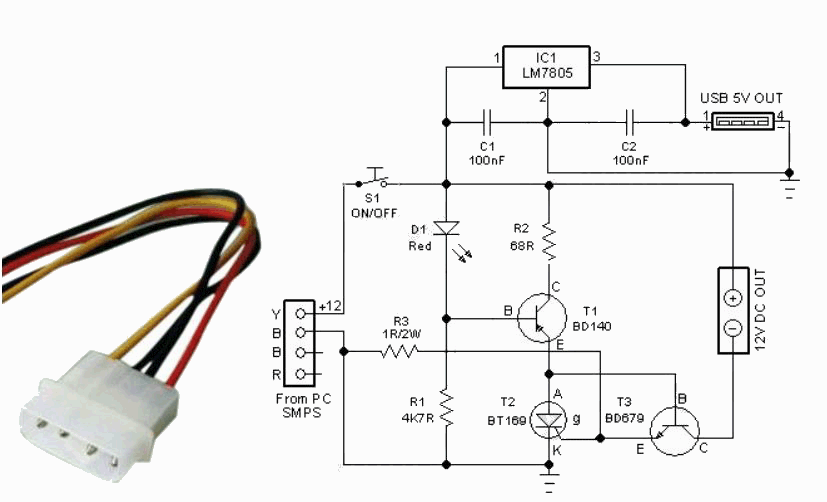
pc power box with e fuse
This compact circuit is designed to eliminate the clutter of surplus small AC mains adapters from a desktop environment. The circuit functions as a smart DC power box.
The circuit operates by consolidating multiple AC to DC power conversions into a...
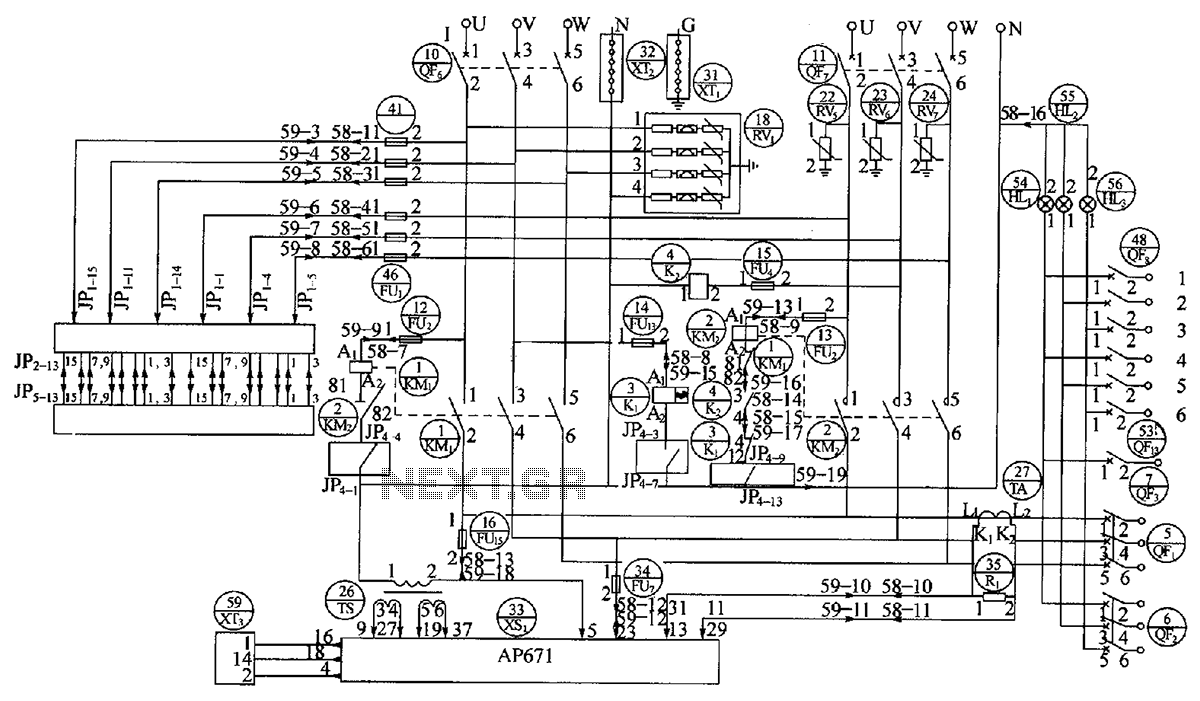
DUM23-48 300II AC power distribution unit electrical schematic diagram
The OBO V20C functions as a lightning protection module, capable of handling a maximum lightning damage current of 40 kA. It includes a relay (k), a contactor (KM), a fuse (FU), and traffic lights (HL).
The OBO V20C lightning protection module...
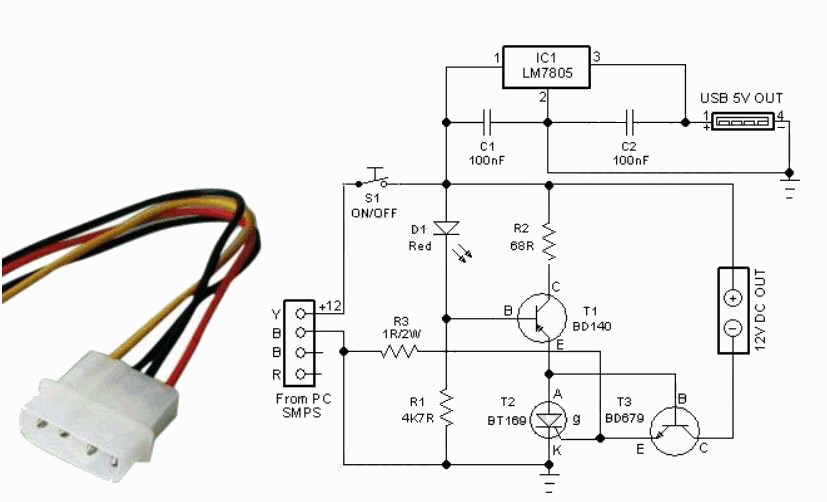
PC Power Box with E fuse
This circuit helps eliminate surplus small AC mains adapters from a desktop. It is a practical DC power supply box powered directly by the SMPS of a desktop PC. The output provides regulated, clean, and protected +12VDC. Additionally, a USB...
Eggs warming control circuit
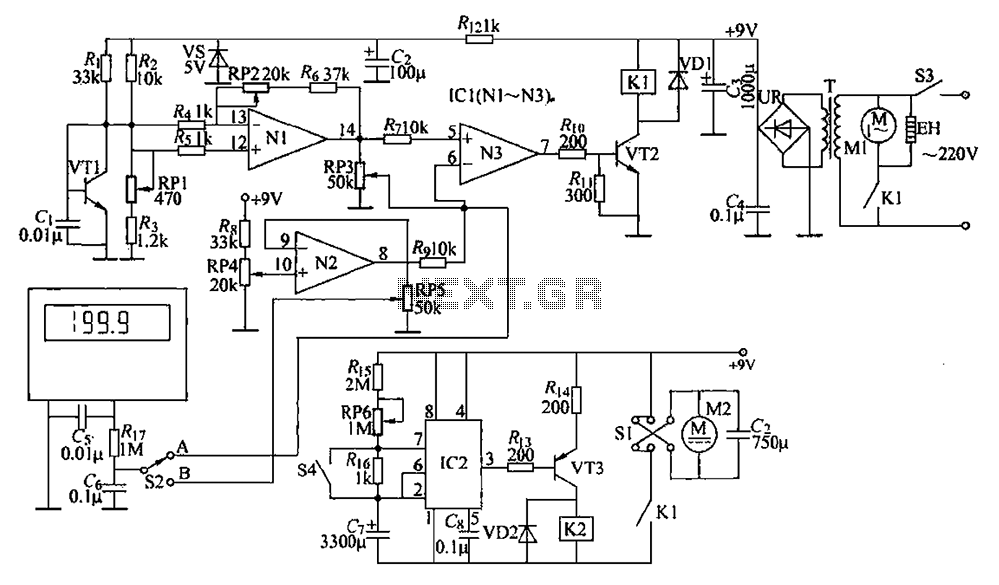
The circuit is illustrated. It includes a DC power circuit with a power switch (S3) that converts 220V AC voltage through a buck converter (T), a rectifier (UR), and filter capacitors (C3 and C4) to generate a +9V output. This...
AC Power Monitor
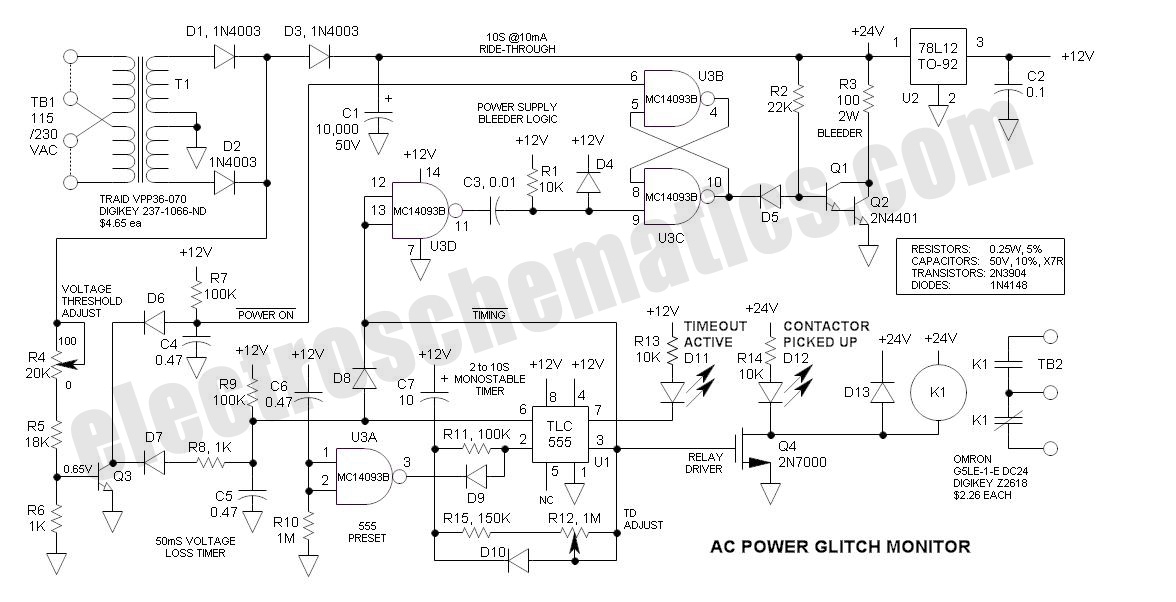
This AC Power Monitor continuously monitors the AC power line voltage for both under-voltage conditions and missing cycles. When it detects a total of 5 or 6 consecutive missing half-cycles (50ms, 50/60Hz), it activates a relay and initiates a timer....
AC Power Monitor Circuit
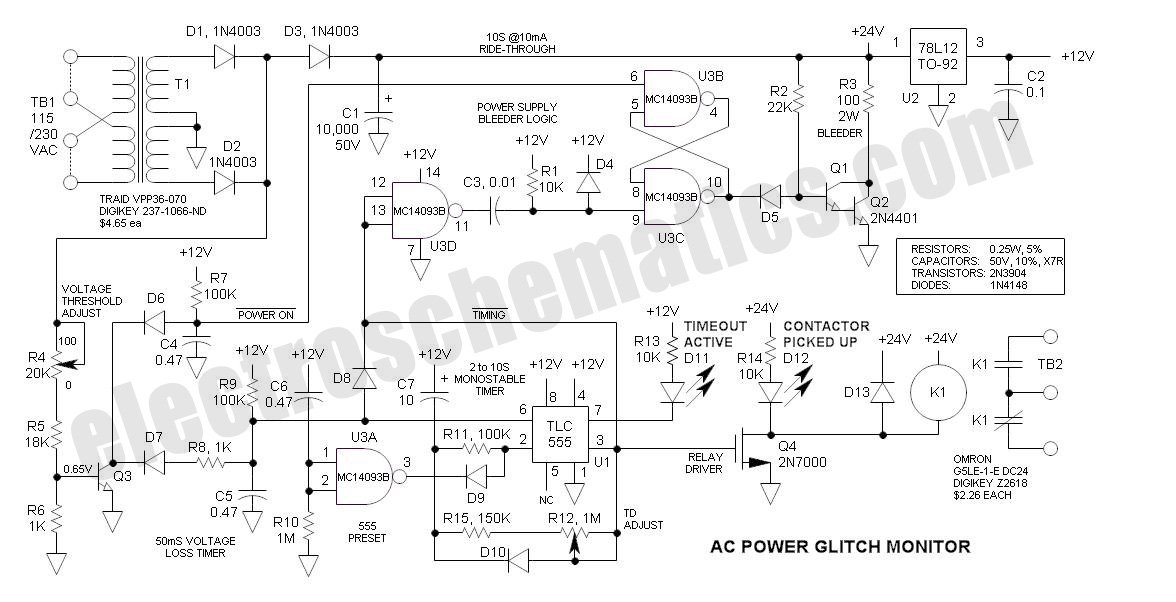
This AC Power Monitor continuously monitors the AC power line voltage for under-voltage conditions and missing cycles. When it detects a total of 5 or 6 consecutive anomalies, it triggers an alert.
The AC Power Monitor is designed to provide real-time...
build a power supply using a dc adapter
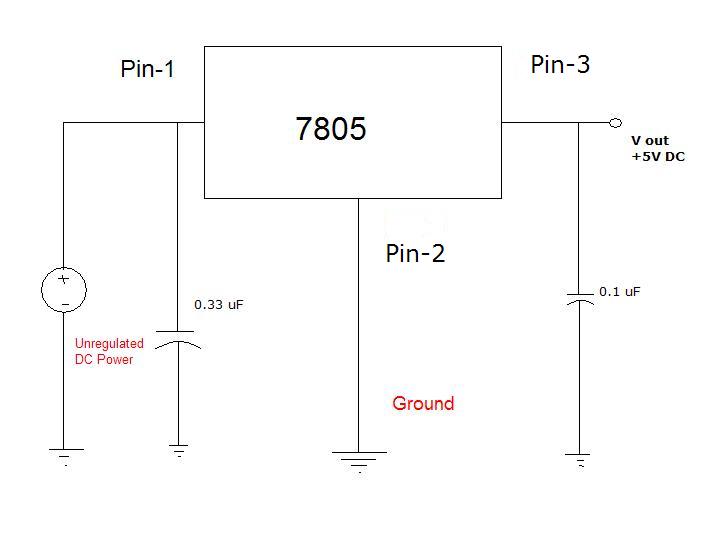
Many different devices require DC power and thus need an I.T.E power supply. I.T.E stands for "Information Technology Equipment." An example of such a device is an iPod speaker system that is no longer functional, which originally came with a...
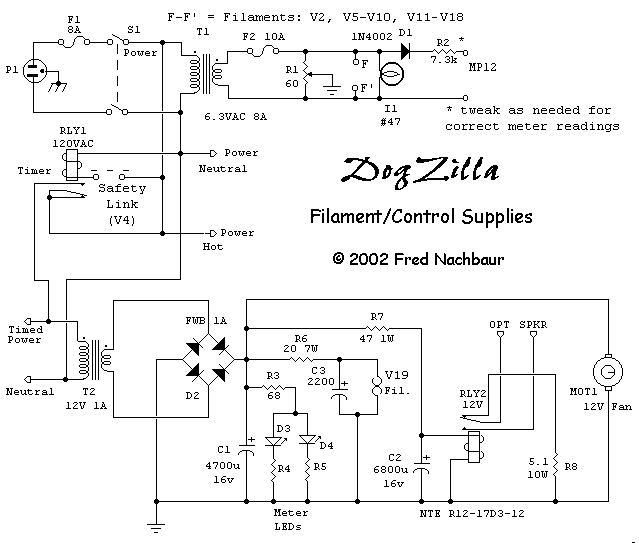
Filament and Control Power Supplies
AC power is supplied through AC Fuse F1 and Power On/Off switch S1 to a 6.3V filament transformer T1. An additional safety feature, Fuse F2, is included, as a short circuit to the filament transformer may not trigger the main...
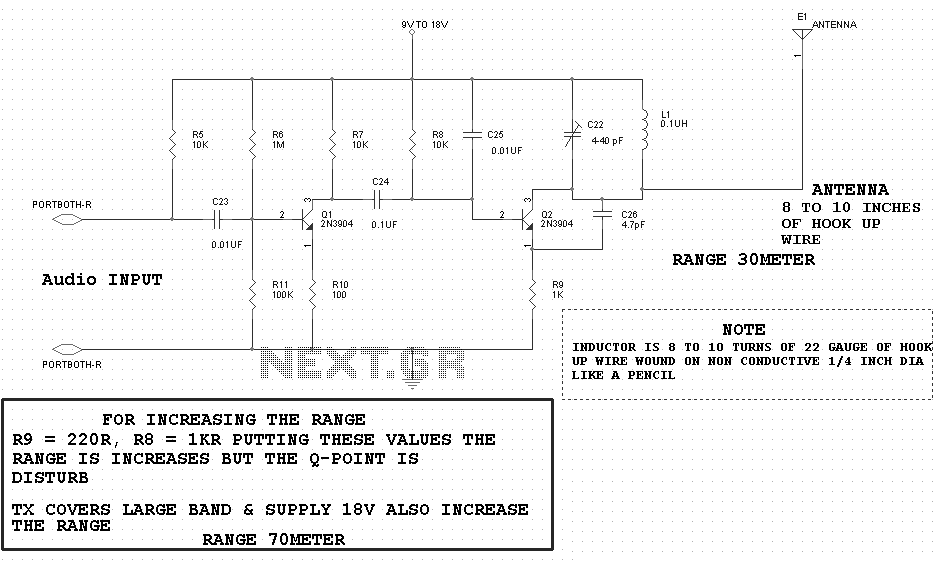
project Huminator
The orange lines represent the positive voltage, while the yellow lines indicate the negative voltage, commonly referred to as ground. Wiring can be accomplished by soldering components directly to wires or by utilizing a small piece of perfboard or circuit...