


What should I take in account when using a more powerful triac
#triac
#heater control
#nichrome wire
#high current
#mains voltage
#power switching
#thermal management
#load handling
#AC control
#safety considerations
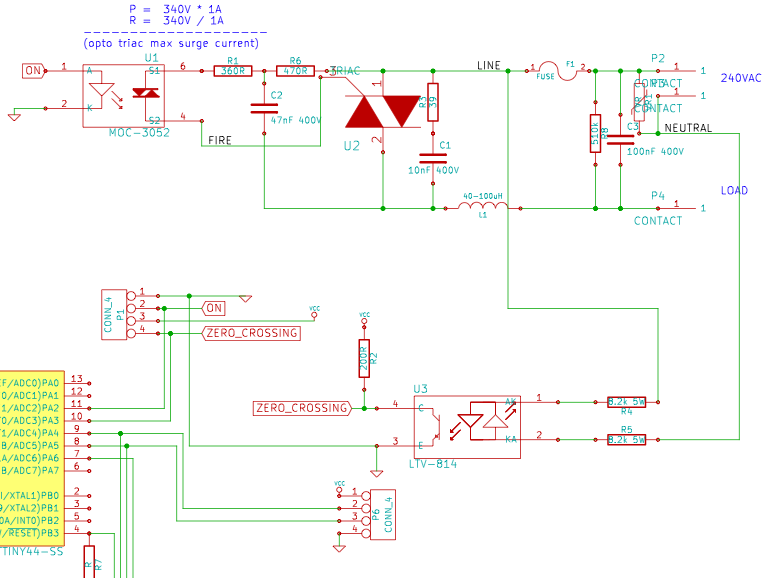
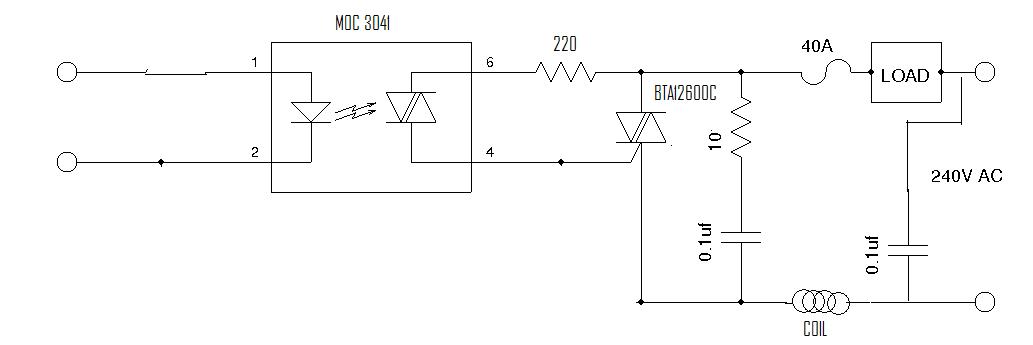
Description: The resistance of the heater is constructed using 9 Ω nichrome wire with a diameter of 3 mm. When supplied with 240V (rms) voltage, this configuration results in a current of 25A (rms). Access to a mains line that can deliver 30A suggests that, theoretically, the heater can operate at full load. However, practical limitations may prevent this from being achieved, yet the intention is to design a unit capable of such operation in theory if required.
The heater's design incorporates a nichrome wire element, renowned for its high resistivity and ability to withstand high temperatures, making it suitable for heating applications. The 9 Ω resistance value indicates that the wire is optimized for efficient heat generation when subjected to the specified voltage. The diameter of 3 mm contributes to the wire's mechanical robustness while ensuring adequate surface area for heat dissipation.
To calculate the power output of the heater, the formula P = V × I can be applied, where P is the power in watts, V is the voltage in volts, and I is the current in amperes. In this case, with V at 240V and I at 25A, the power output can be calculated as follows:
P = 240V × 25A = 6000W
This indicates that the heater is capable of generating up to 6000 watts of thermal energy under ideal conditions. However, it is important to consider the efficiency of the system, as factors such as heat losses and the thermal resistance of the surrounding environment may reduce the actual output.
For safety and performance, the circuit design should include appropriate overcurrent protection, such as circuit breakers or fuses rated slightly above the expected load. Additionally, thermal management should be considered, including the use of heat sinks or insulative materials to prevent overheating of surrounding components.
In terms of circuit configuration, a simple series circuit can be employed, connecting the heater directly to the mains supply. However, the incorporation of a control mechanism, such as a relay or a solid-state switch, can enhance functionality by allowing for temperature regulation and automated operation. A thermostat can be integrated to monitor the temperature and adjust the power supplied to the heater accordingly, ensuring optimal performance while preventing overheating.
Overall, the design should be robust, with careful attention to the wire gauge, insulation materials, and thermal management strategies to ensure safe and efficient operation of the heater in practical applications.The resistance of my heater is made of 9$Omega$ 3mm diameter nichrome wire. On 240V(rms) voltage this makes 25A(rms) current. I have an access to a mains line capable of delivering 30A, so in theory I will be able to drive heater at full load. In reality I probably won`t, but nevertheless, I want to build a unit that could do that in theory if
needed.
The heater's design incorporates a nichrome wire element, renowned for its high resistivity and ability to withstand high temperatures, making it suitable for heating applications. The 9 Ω resistance value indicates that the wire is optimized for efficient heat generation when subjected to the specified voltage. The diameter of 3 mm contributes to the wire's mechanical robustness while ensuring adequate surface area for heat dissipation.
To calculate the power output of the heater, the formula P = V × I can be applied, where P is the power in watts, V is the voltage in volts, and I is the current in amperes. In this case, with V at 240V and I at 25A, the power output can be calculated as follows:
P = 240V × 25A = 6000W
This indicates that the heater is capable of generating up to 6000 watts of thermal energy under ideal conditions. However, it is important to consider the efficiency of the system, as factors such as heat losses and the thermal resistance of the surrounding environment may reduce the actual output.
For safety and performance, the circuit design should include appropriate overcurrent protection, such as circuit breakers or fuses rated slightly above the expected load. Additionally, thermal management should be considered, including the use of heat sinks or insulative materials to prevent overheating of surrounding components.
In terms of circuit configuration, a simple series circuit can be employed, connecting the heater directly to the mains supply. However, the incorporation of a control mechanism, such as a relay or a solid-state switch, can enhance functionality by allowing for temperature regulation and automated operation. A thermostat can be integrated to monitor the temperature and adjust the power supplied to the heater accordingly, ensuring optimal performance while preventing overheating.
Overall, the design should be robust, with careful attention to the wire gauge, insulation materials, and thermal management strategies to ensure safe and efficient operation of the heater in practical applications.The resistance of my heater is made of 9$Omega$ 3mm diameter nichrome wire. On 240V(rms) voltage this makes 25A(rms) current. I have an access to a mains line capable of delivering 30A, so in theory I will be able to drive heater at full load. In reality I probably won`t, but nevertheless, I want to build a unit that could do that in theory if
needed.
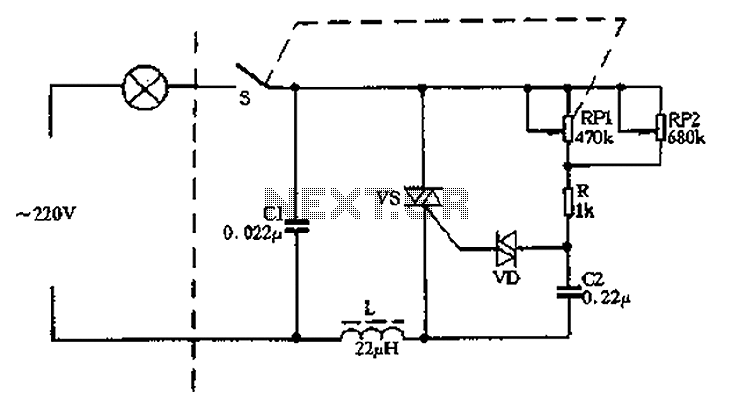
Stepless triac dimmers
A closed light switch S allows 220V AC to flow through resistors RP1 and RP2, charging capacitor C2. When the voltage across C2 reaches the breakover voltage of the diac VD, the diac and triac activate sequentially, energizing the controlled...
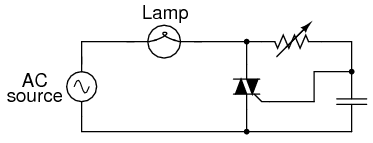
The TRIAC
SCRs are unidirectional current devices, making them suitable for controlling direct current (DC) only. When two SCRs are connected in a back-to-back parallel configuration, they can be utilized for specific applications.
SCRs, or Silicon Controlled Rectifiers, are semiconductor devices that act...
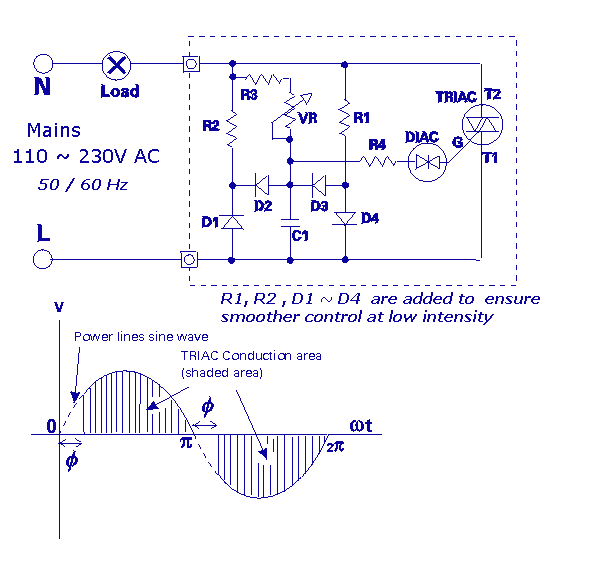
ES-150
A light dimmer that utilizes a TRIAC and DIAC to control the brightness of light bulbs. It is based on a standard dimmer circuit, with several additional components included to eliminate flickering at low light levels. This design performs better...
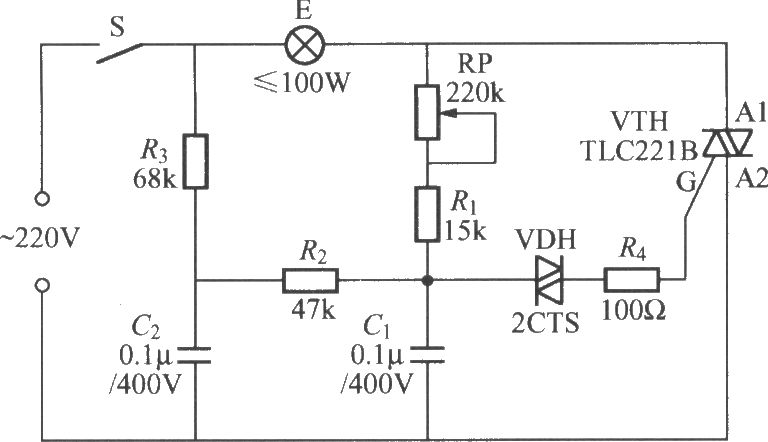
TRIAC dimmer light circuit with dual time constant
To address the lag and light transition issues, a Triac dimming light circuit featuring a dual time constant can be employed. This circuit enhances the resistor-capacitor network formed by R3 and C2. The reduced charge on capacitor C1 can be...
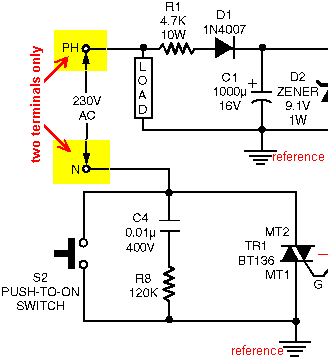
how trigger bt136
A problem was encountered while designing a circuit in which a BT136 TRIAC needs to be triggered by a half-rectified current of 30 mA at approximately 6V. The TRIAC is not triggering as expected. Additionally, the trigger circuit is consuming...
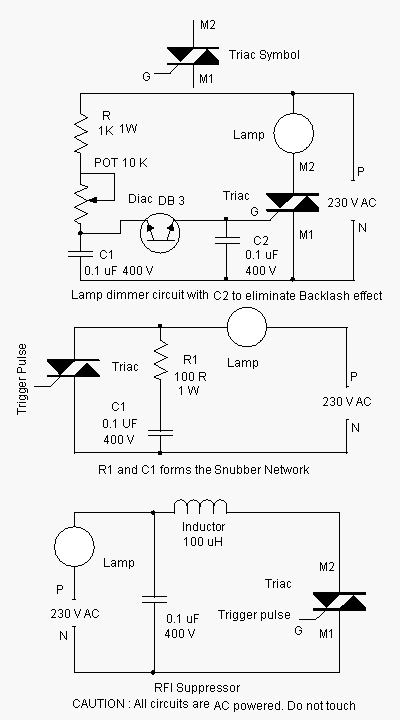
Triac Optimization Circuits Schematic Diagram
Advanced power control systems utilize electronic components such as thyristors for power switching, motor control, and other applications. These systems are involved in inverter design, lamp dimming, and speed control of motors. Triacs are the most commonly used semiconductor devices...
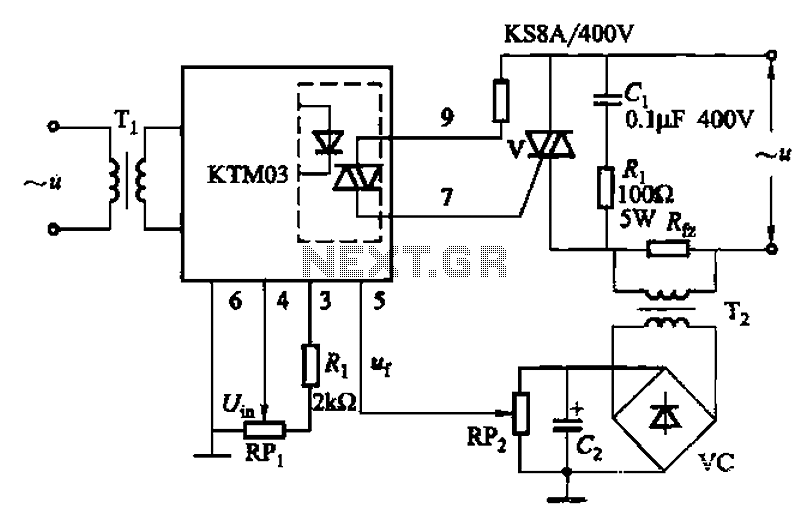
KTM03 type of circuit for controlling the triac
An adjustment potentiometer (RP) is utilized to set the voltage across the load resistor (Rfz) to a predetermined value. The real-time closed-loop control is achieved through the potentiometer (RPz). Open-loop control is functional as long as the feedback voltage (Uf)...
Troubleshooting a Triac Motor Control Circuit
Even though the power was off, there was AC present at the handle plug, and a short circuit occurred. Upon disassembly, a blown transistor was discovered. An attempt was made to fix the issue, but after one month and over...
Triac regulation of mains voltage
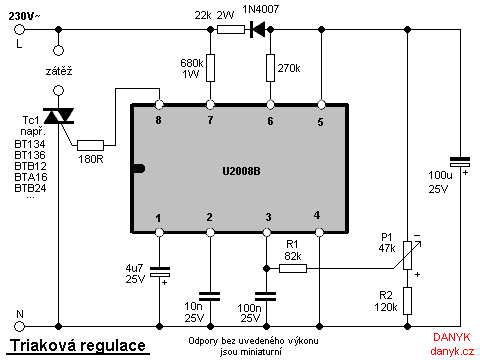
Triac regulation is designed to control the power of mains appliances. It can adjust the brightness of incandescent light bulbs, halogen lamps, dimmable energy savers, heaters, and other thermal devices, as well as regulate motors. The power can be easily...