


45 Years Anniversary of Walter Bruchs PAL Color Television
#PAL
#television
#Walter Bruch
#color TV
#broadcast
#video signal
#German invention
#Funkgeschichte
#wireless history
#anniversary
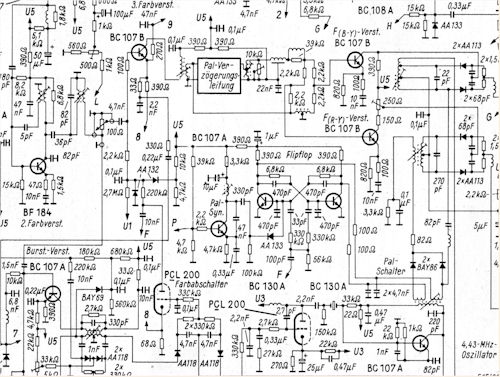
Description: This article commemorates the 45th anniversary of the invention of PAL in 2008 and expresses appreciation for the contributions of German television pioneer Prof. Dr. Eng. Walter Bruch, often referred to as "Papa PAL," "Mister PAL," or simply "PAL pal" among colleagues. Originally written in German for the magazine Funkgeschichte (Wireless History) No. 174 in October/November 2007 by Wolfgang Scheida, and published by the Society of Friends of Wireless History, it reflects on the significance of the PAL color television standard. The introduction of this standard marked a pivotal moment for European technological advancement and economic impact, warranting celebration by television historians. The narrative recalls the event when West German Foreign Minister Willy Brandt symbolically initiated the PAL era by pressing a red start button at the International Radio Exhibition on August 25, 1967, in West Berlin. As post-war Europe faced a potential saturation of black-and-white television receivers by the late 1960s, efforts to introduce color television began in 1956. The adoption of a common 625-line television standard by countries like Great Britain and France marked the first steps toward this goal. Over time, competing standards were phased out, including the obsolete 405-line and the inefficient 819-line systems, which disappeared by the mid-1980s. The success of PAL can largely be attributed to Walter Bruch's innovation and determination, who had been a leading development engineer at Telefunken since 1950, working on the first post-war television sets.
Walter Bruch's early fascination with television began in 1925, spurred by theoretical publications from early pioneers. His experiments in receiving mechanically-scanned television broadcasts started in 1929. After studying electrical technology and earning a mechanical engineering degree, Bruch's career was influenced by significant figures in television technology during the 1930s. His roles included serving as a technician and cameraman for television demonstrations during the Berlin Radio Exhibition and the 1937 World’s Fair in Paris. His wartime work included constructing a closed-circuit television system at Peenemuende for controlling V2 rocket launches, as well as developing television transmission systems for aircraft and radar technologies. Post-war, he contributed to the development of the 625-line television standard and various UHF projects under Soviet supervision.
The PAL (Phase Alternating Line) system, developed by Walter Bruch, was a significant advancement in color television technology. It was designed to minimize color distortion and provide a stable image, making it particularly suitable for broadcast television. The PAL system operates by alternating the phase of the color signal, which helps to correct color errors that may occur during transmission. This innovation allowed for the widespread adoption of color television across Europe and contributed to the standardization of television broadcasting. The impact of PAL is still felt today, as it laid the groundwork for subsequent developments in television technology, reinforcing the importance of Walter Bruch's contributions to the field. The legacy of PAL continues to influence modern television standards and practices, highlighting the enduring significance of this technological milestone.This article celebrates in 2008 the 45 Years of the invention of PAL as well as to give an appriciation to the german television pioneer Prof. Dr. Eng. Walter Bruch, known as Papa PAL, Mister PAL or even among us collegues PAL pal . This document was first composed in German for the German magazine Funkgeschichte (Wireless-History) No.
174 Octob er/November 2007, written by Wolfgang Scheida and published by Gesellschaft der Freunde der Geschichte des Funkwesens Society of Friends of Wireless History. Follow me now as we celebrate in 2008 the 45th anniversary of the invention of PAL and express our appreciation to German television pioneer Prof.
Dr. Eng. Walter Bruch, known as Papa PAL, Mister PAL, or even among us colleagues as our PAL pal. The 40th anniversary of PAL color television is a major event. The introduction of this color televisionstandard was a milestone for European technical innovation and economic influence a milestone that television historians want to celebrate one last time. Let`s go back now to the time when the West German foreign minister and vice chancellor Willy Brandt (the former major of Berlin) symbollicaly pushed the red start button at the International Radio Exhibition on August 25th, 1967 in the western part of divided Berlin.
Initially, the world of colorized television looked quite simple. In postwar Europe, a saturation of the black and white television receiver market appeared likely to occur by the end of the 1960s especially in England. For this reason, efforts were begun from 1956 [1] onward to bring color to television screens in the old world.
The first steps toward this goal were already taken when a common 625 line television standard was adopted in countries like Great Britain and France. After a long period of dual standards, competing standards were dropped one by one, including their low definition prewar 405 line system as well as their expensive and inefficient high resolution 819 line standard.
Both of these old standards were finally gone by the mid 1980s. The fact that everything turned out differently was thanks to the innovation, perseverance, and influence of one man Walter Bruch (7B)who had been working since 1950 as a leading developement engineer at Telefunken where he started development of the first post-war TV (17B) sets. A Short Biography [3][8]:Already in 1925 as a schoolboy, Walter Bruch (1908 1990) was fascinated by theoretical publications on television (from early pioneers like Korn & Prof.
Dieckmann). These publications motivated him to start his own experiments to receive mechanically-scanned television transmissionsbroadcast from Berlin-Witzleben in 1929. Later he studied electrical technology in Midweida/Sachsen, and earned a degree in mechanical engineering.
During the economic depression of the 1930s, his career in Berlin was further influenced by the well-known television work byDenes von Mihaly, Manfred von Ardenne, and by Urtel and Schroeter at Telefunken. His job assignments included, for example, serving in 1936 as a technician and cameraman for thetelevision gun in the Olympic Stadiumand for public television demonstrationsat the Berlin Radio Exhibition.
He served again in this role at the World`s Fairin Paris in 1937. Wartime orders led him to construct and maintain a closed-circuit television systemat Peenemuende (secret military rocket test site in northern Germany), which was used to control the launch of A4 (V2) rockets. He also worked on TV transmission systems for planes and radar technology using the glass delay line patented by Telefunken in 1940 and used in the Rehbock distance control unit.
After WWII he worked until the beginning of 1946 under Soviet command in a former research laboratory in Berlin, where he contributed to the development of the 625 line television standard as well as various UHF projects. Later he was once again able to assume a leadership pos
Walter Bruch's early fascination with television began in 1925, spurred by theoretical publications from early pioneers. His experiments in receiving mechanically-scanned television broadcasts started in 1929. After studying electrical technology and earning a mechanical engineering degree, Bruch's career was influenced by significant figures in television technology during the 1930s. His roles included serving as a technician and cameraman for television demonstrations during the Berlin Radio Exhibition and the 1937 World’s Fair in Paris. His wartime work included constructing a closed-circuit television system at Peenemuende for controlling V2 rocket launches, as well as developing television transmission systems for aircraft and radar technologies. Post-war, he contributed to the development of the 625-line television standard and various UHF projects under Soviet supervision.
The PAL (Phase Alternating Line) system, developed by Walter Bruch, was a significant advancement in color television technology. It was designed to minimize color distortion and provide a stable image, making it particularly suitable for broadcast television. The PAL system operates by alternating the phase of the color signal, which helps to correct color errors that may occur during transmission. This innovation allowed for the widespread adoption of color television across Europe and contributed to the standardization of television broadcasting. The impact of PAL is still felt today, as it laid the groundwork for subsequent developments in television technology, reinforcing the importance of Walter Bruch's contributions to the field. The legacy of PAL continues to influence modern television standards and practices, highlighting the enduring significance of this technological milestone.This article celebrates in 2008 the 45 Years of the invention of PAL as well as to give an appriciation to the german television pioneer Prof. Dr. Eng. Walter Bruch, known as Papa PAL, Mister PAL or even among us collegues PAL pal . This document was first composed in German for the German magazine Funkgeschichte (Wireless-History) No.
174 Octob er/November 2007, written by Wolfgang Scheida and published by Gesellschaft der Freunde der Geschichte des Funkwesens Society of Friends of Wireless History. Follow me now as we celebrate in 2008 the 45th anniversary of the invention of PAL and express our appreciation to German television pioneer Prof.
Dr. Eng. Walter Bruch, known as Papa PAL, Mister PAL, or even among us colleagues as our PAL pal. The 40th anniversary of PAL color television is a major event. The introduction of this color televisionstandard was a milestone for European technical innovation and economic influence a milestone that television historians want to celebrate one last time. Let`s go back now to the time when the West German foreign minister and vice chancellor Willy Brandt (the former major of Berlin) symbollicaly pushed the red start button at the International Radio Exhibition on August 25th, 1967 in the western part of divided Berlin.
Initially, the world of colorized television looked quite simple. In postwar Europe, a saturation of the black and white television receiver market appeared likely to occur by the end of the 1960s especially in England. For this reason, efforts were begun from 1956 [1] onward to bring color to television screens in the old world.
The first steps toward this goal were already taken when a common 625 line television standard was adopted in countries like Great Britain and France. After a long period of dual standards, competing standards were dropped one by one, including their low definition prewar 405 line system as well as their expensive and inefficient high resolution 819 line standard.
Both of these old standards were finally gone by the mid 1980s. The fact that everything turned out differently was thanks to the innovation, perseverance, and influence of one man Walter Bruch (7B)who had been working since 1950 as a leading developement engineer at Telefunken where he started development of the first post-war TV (17B) sets. A Short Biography [3][8]:Already in 1925 as a schoolboy, Walter Bruch (1908 1990) was fascinated by theoretical publications on television (from early pioneers like Korn & Prof.
Dieckmann). These publications motivated him to start his own experiments to receive mechanically-scanned television transmissionsbroadcast from Berlin-Witzleben in 1929. Later he studied electrical technology in Midweida/Sachsen, and earned a degree in mechanical engineering.
During the economic depression of the 1930s, his career in Berlin was further influenced by the well-known television work byDenes von Mihaly, Manfred von Ardenne, and by Urtel and Schroeter at Telefunken. His job assignments included, for example, serving in 1936 as a technician and cameraman for thetelevision gun in the Olympic Stadiumand for public television demonstrationsat the Berlin Radio Exhibition.
He served again in this role at the World`s Fairin Paris in 1937. Wartime orders led him to construct and maintain a closed-circuit television systemat Peenemuende (secret military rocket test site in northern Germany), which was used to control the launch of A4 (V2) rockets. He also worked on TV transmission systems for planes and radar technology using the glass delay line patented by Telefunken in 1940 and used in the Rehbock distance control unit.
After WWII he worked until the beginning of 1946 under Soviet command in a former research laboratory in Berlin, where he contributed to the development of the 625 line television standard as well as various UHF projects. Later he was once again able to assume a leadership pos
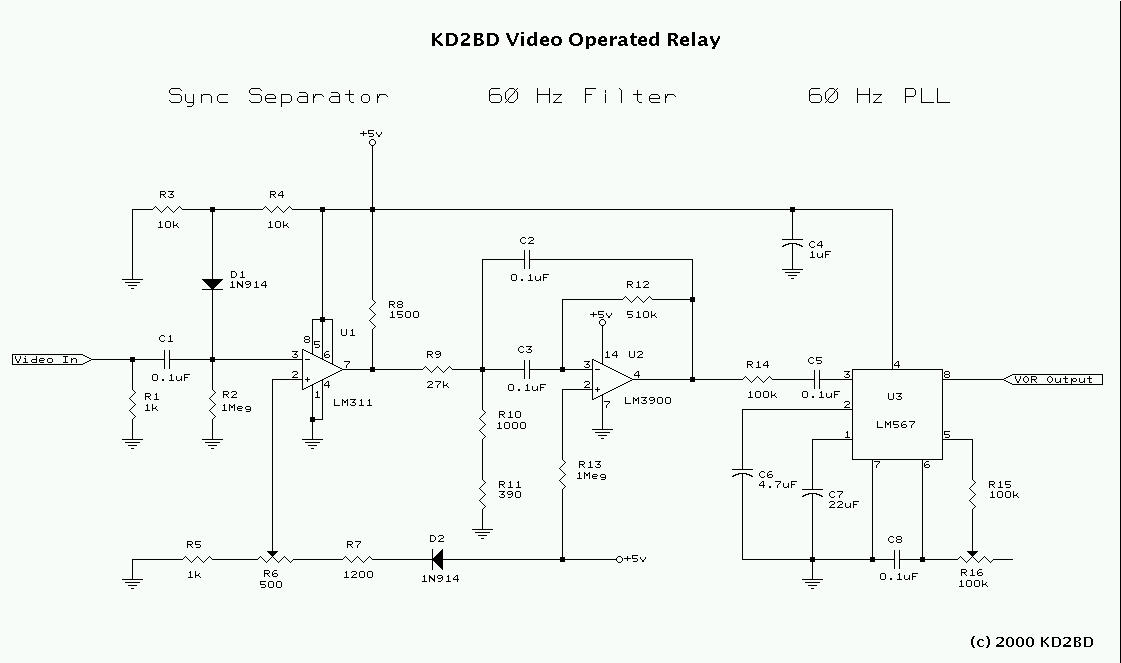
Video Operated Relay
Many Video Operated Relay (VOR) circuits have been published in recent years for use in connection with ATV repeater controllers or automatic videotape logging systems. Unfortunately, many of these circuits fail to properly detect certain video signals depending on their...
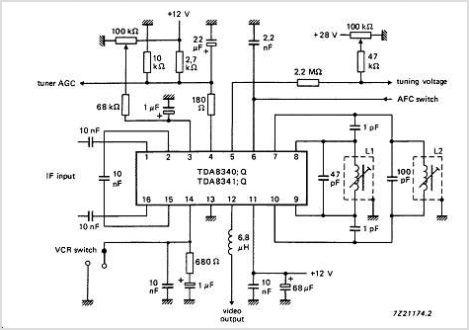
TDA8340 Television If Amplifier And Demodulator - Nxp Semiconductors
The TDA9813T is an integrated circuit designed for processing vision intermediate frequency (IF) signals and dual frequency modulation (FM) demodulation of sound. It operates with a single reference QSS-IF in television (TV) and video cassette recorder (VCR) applications, specifically supporting...
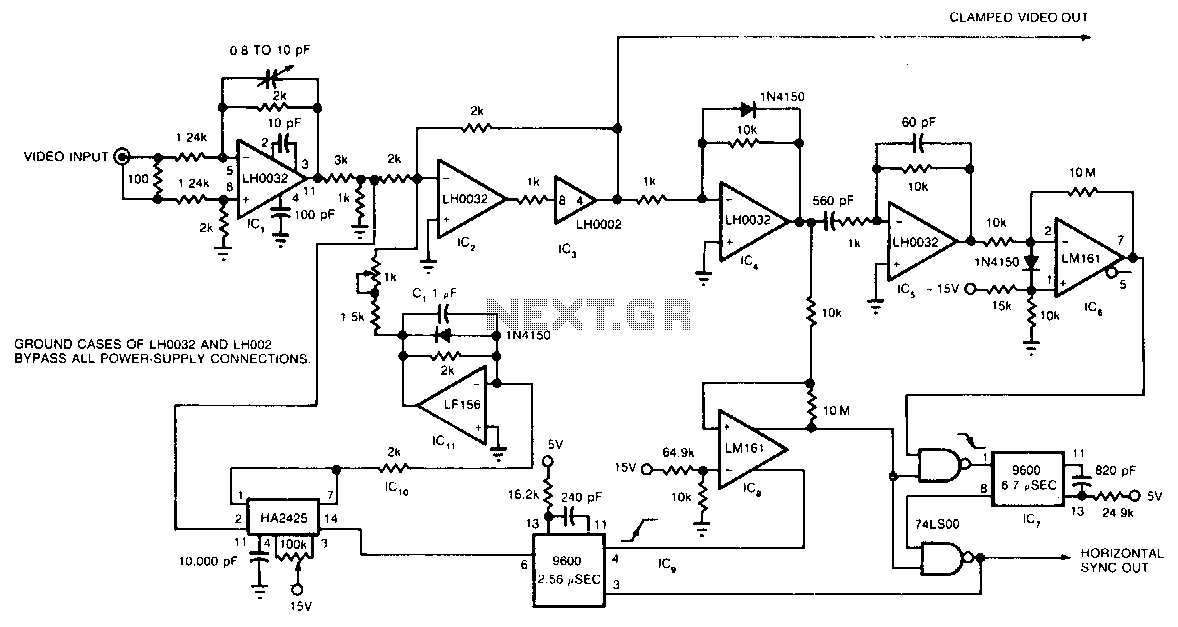
Video-signal-clamp
The circuit utilizes a track-and-hold amplifier in a closed-loop configuration to clamp the back-porch voltage of a standard video waveform to 0 V. The outputs of the circuit include a clamped composite video signal and a TTL-level horizontal blanking pulse....
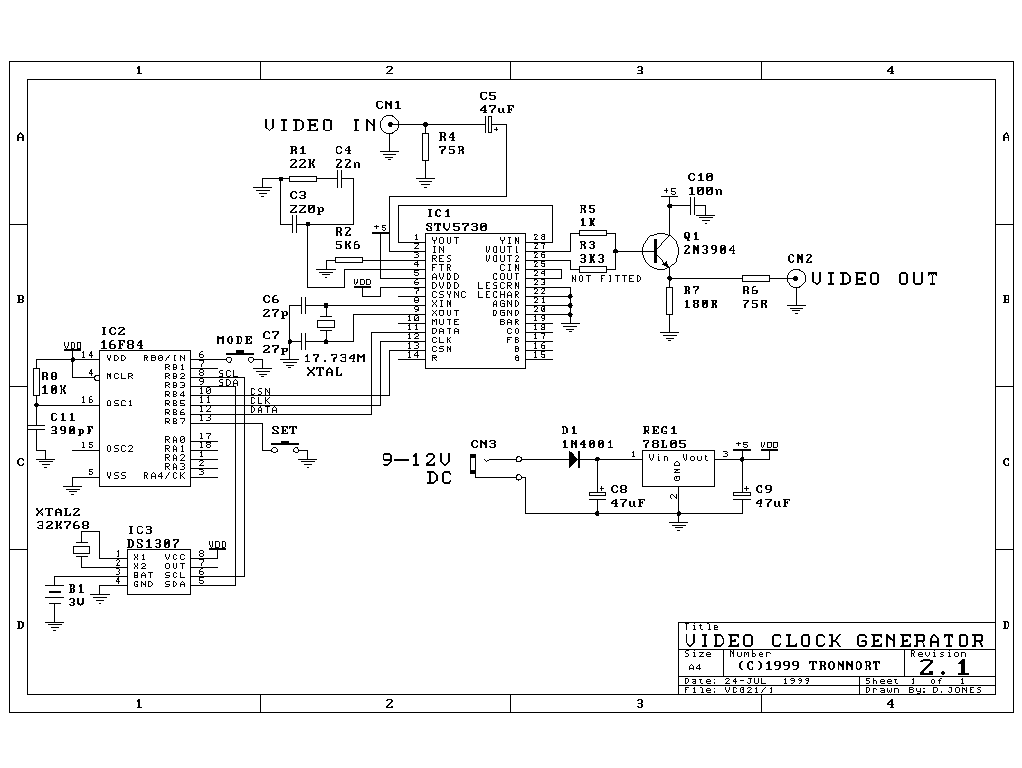
PAL/NTSC Video Time/Date Generator
The following design is capable of overlaying the time and date onto any existing PAL (or optionally NTSC) composite video signal. It is housed in a very neat and compact standard moulded casing and has standard 75ohm RCA video inputs...

1-2Mhz broadcast transmitter
T1 is a low impedance output transformer with a conversion ratio of 5000 to 8 ohms.
The low impedance output transformer, T1, is designed to match the output of an audio amplifier to the impedance of the speaker load. The specified...
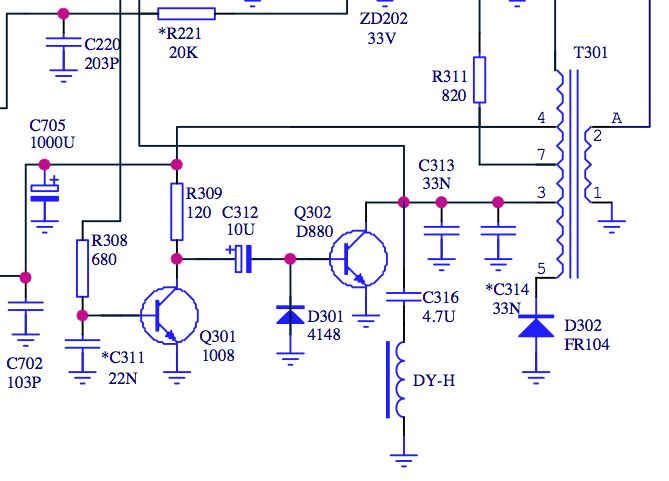
Fully Functional Television Oscilloscope
There are several Instructables and other internet-based instructions on how to modify a television set into an audio visualizer or other simple applications.
To transform a television set into an audio visualizer, a detailed understanding of both the television's hardware and...

TV as display terminal interface circuit diagram
The interface circuit is placed between the computer's standard video signal output terminal and the television. It amplifies the standard 1V (Peak-to-Peak) video signal to 3V (Peak-to-Peak). The negative feedback circuit consists of transistors T1 and T2, providing a wide...
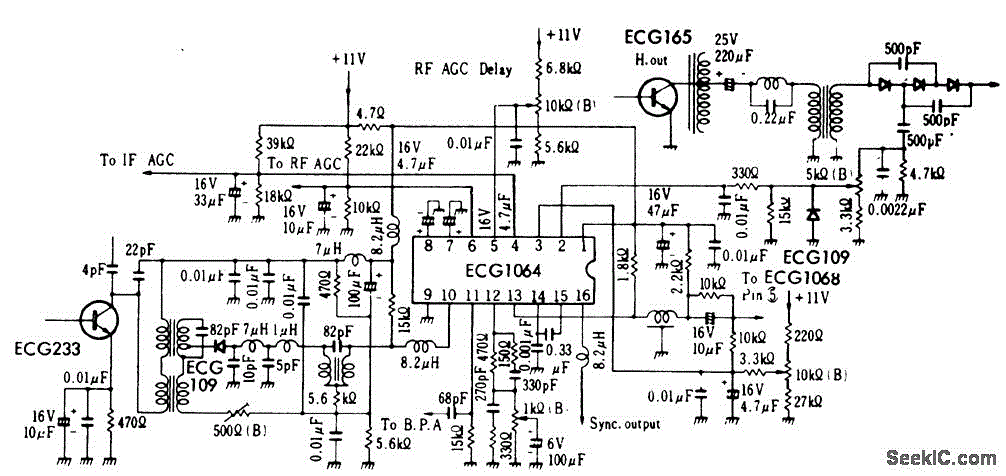
TV_video_signal_processor_circuit_1
TV video signal processor circuit. The ECG1064 chip includes a primary video amplifier, two sync pulse amplifiers, a look-out protector, a noise detector, two noise gates, an automatic gain control (AGC) detector, an intermediate frequency (IF) AGC amplifier, a base...
TV_video_signal_processor_circuit_1
TV video signal processor circuit. The ECG1064 chip includes a primary video amplifier, two sync pulse amplifiers, a look-out protector, a noise detector, two noise gates, an automatic gain control (AGC) detector, an intermediate frequency (IF) AGC amplifier, a base...