


Bell 202 and CCITT V23 Compatible FSK Modem Circuit
#FSK modem
#TCM3105
#Bell 202
#CCITT V23
#data transmission
#low power
#5V supply
#baud rate
#modem chip
#Texas Instruments
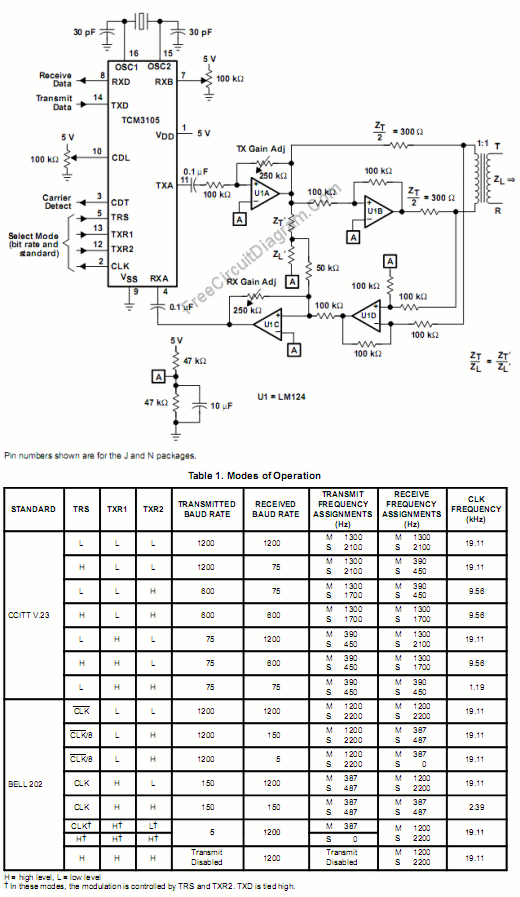
Description: The TCM3105 FSK modem chip from Texas Instruments enables the construction of a modem compatible with Bell 202 or CCITT V23 standards. This modem circuit can transmit data at baud rates of 75, 150, 600, and 1200, and receive data at baud rates of 5, 75, 150, 600, and 1200. It operates on a 5V supply and features low power consumption. An external 4.4336 MHz crystal is required between the OSC1 and OSC2 pins to run the internal oscillator. A clock signal, equal to 16 times the highest selected baud rate (for transmission or reception), is available at the CLK output pin. The baud rate and various operational modes are selected according to a specific table (a logic high represents a mark, while a logic low represents a space). All analog inputs and outputs for this modem interface must be AC coupled.
The TCM3105 modem chip serves as a versatile component for implementing frequency shift keying (FSK) modulation and demodulation, suitable for various communication applications. The device facilitates data transmission and reception across multiple baud rates, making it adaptable for different communication needs.
To ensure proper operation, the external 4.4336 MHz crystal oscillator is crucial for generating the necessary clock signal. This clock signal is derived at the CLK output pin and is essential for synchronizing data transmission and reception. The selection of baud rates is critical; the user must refer to the provided table to set the appropriate logic levels for the desired operational mode, ensuring that the modem operates efficiently and reliably.
The requirement for AC coupling of all analog inputs and outputs is significant. This design choice helps to eliminate DC offsets and ensures that the signals remain within the specified voltage range for optimal performance. Additionally, the low power consumption feature of the TCM3105 makes it suitable for battery-operated devices or applications where power efficiency is paramount.
In summary, the TCM3105 FSK modem chip is an effective solution for constructing a compatible modem circuit, leveraging its operational flexibility, low power requirements, and ease of integration into various systems.Using TCM3105 FSK modem chip from Texas Instruments, you can easily build a Bell 202 or CCITT V23 compatible modem. This modem circuit is capable transmitting the data at 75, 150, 600, and 1200 baud, and receive the data at 5, 75, 150, 600, and 1200 baud.
This circuit operate at 5V supply and has low power consumption feature. Here is the schemat ic diagram of the circuit: An external 4. 4336 MHz crystal connected between OSC1 and OSC2 pin is needed to run the internal oscillator. A clock signal equal to 16 times the highest selected bit rate (transmit or receive) is available at CLK output pin. This bit rate, or more exactly the baud rate, and the various operation mode are selected accoding to table 1( a logic high is a mark and a logic low is a space).
All analog inputs and outputs for this modem interface must be ac coupled. [Circuit`s schematic diagram source: Texas Instruments Application Notes]
The TCM3105 modem chip serves as a versatile component for implementing frequency shift keying (FSK) modulation and demodulation, suitable for various communication applications. The device facilitates data transmission and reception across multiple baud rates, making it adaptable for different communication needs.
To ensure proper operation, the external 4.4336 MHz crystal oscillator is crucial for generating the necessary clock signal. This clock signal is derived at the CLK output pin and is essential for synchronizing data transmission and reception. The selection of baud rates is critical; the user must refer to the provided table to set the appropriate logic levels for the desired operational mode, ensuring that the modem operates efficiently and reliably.
The requirement for AC coupling of all analog inputs and outputs is significant. This design choice helps to eliminate DC offsets and ensures that the signals remain within the specified voltage range for optimal performance. Additionally, the low power consumption feature of the TCM3105 makes it suitable for battery-operated devices or applications where power efficiency is paramount.
In summary, the TCM3105 FSK modem chip is an effective solution for constructing a compatible modem circuit, leveraging its operational flexibility, low power requirements, and ease of integration into various systems.Using TCM3105 FSK modem chip from Texas Instruments, you can easily build a Bell 202 or CCITT V23 compatible modem. This modem circuit is capable transmitting the data at 75, 150, 600, and 1200 baud, and receive the data at 5, 75, 150, 600, and 1200 baud.
This circuit operate at 5V supply and has low power consumption feature. Here is the schemat ic diagram of the circuit: An external 4. 4336 MHz crystal connected between OSC1 and OSC2 pin is needed to run the internal oscillator. A clock signal equal to 16 times the highest selected bit rate (transmit or receive) is available at CLK output pin. This bit rate, or more exactly the baud rate, and the various operation mode are selected accoding to table 1( a logic high is a mark and a logic low is a space).
All analog inputs and outputs for this modem interface must be ac coupled. [Circuit`s schematic diagram source: Texas Instruments Application Notes]
Low power timer switch
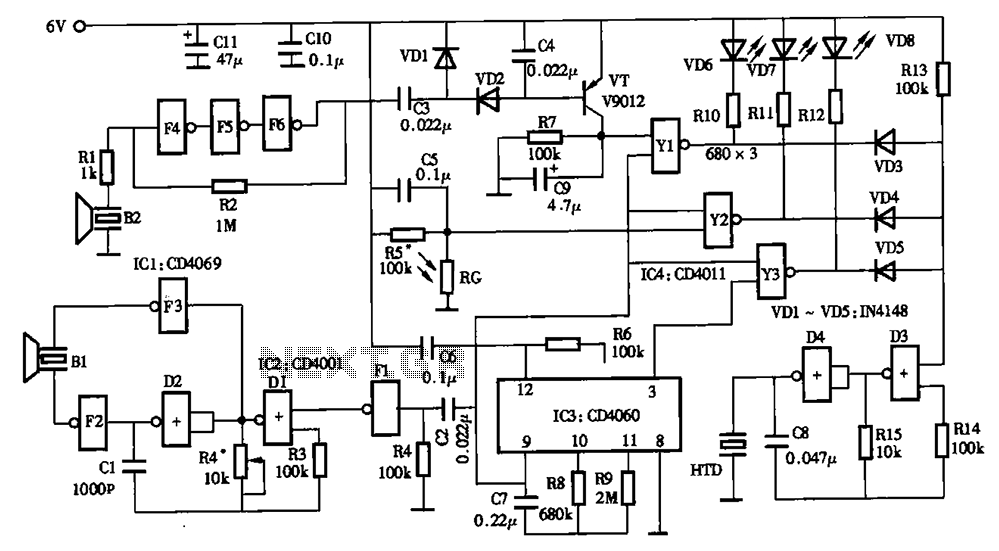
The timing circuit utilizes an electronic switch composed of F1, F2, and VT1 to reduce quiescent current to approximately 1 to 2 A with the 555 timer. Upon initial power-up, the voltage across capacitor C2 cannot instantly change, causing the...
3 KILOBAUD FULL DUPLEX FSK MODEM
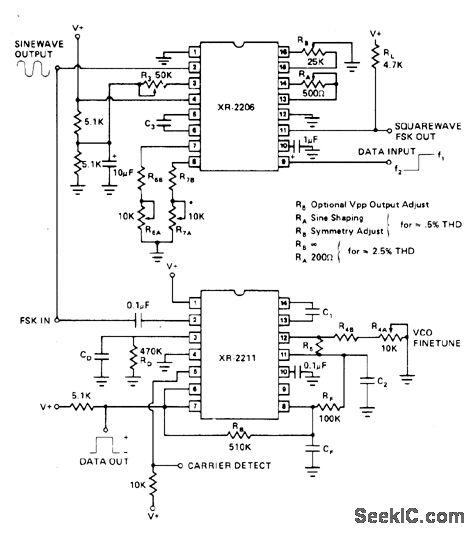
The values indicated are for a 13 kHz bandwidth, with 1070 Hz for the mark signal and 1270 Hz for the space signal. This utilizes the Exar XR-2206 function generator and the XR-2211 FSK demodulator. The report outlines the design...
Carrier-Current Receiver For Data Transmission
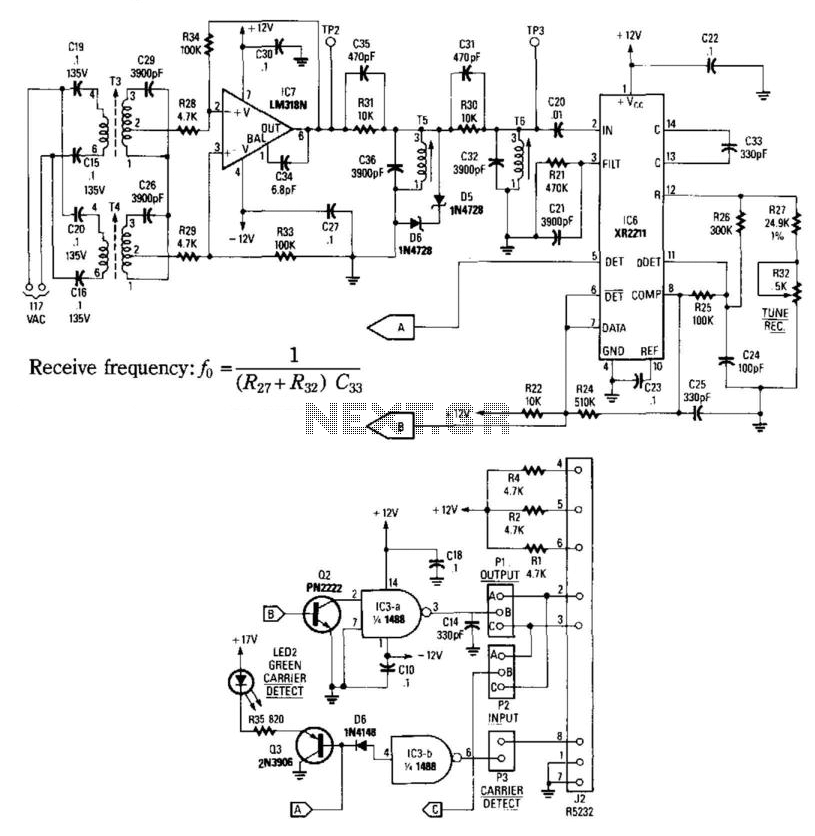
This receiver consists of an input network, amplifier IC7, FSK PLL detector IC8, and output amplifier/interface circuits Q2, Q3, IC3A, and IC3B, which include a 1488 Quad RS232 line driver for the carrier-current signal. The tuned amplifier IC7 amplifies this...
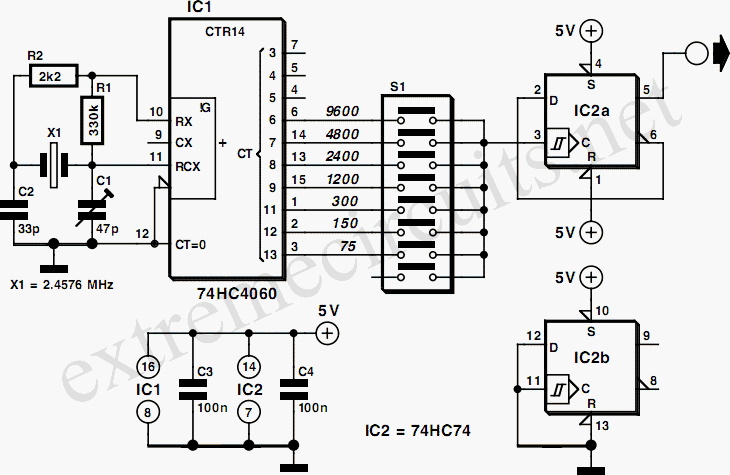
Baud Rate Generator
This article discusses the use of an RC oscillator as a baud rate generator. When calibrated accurately within a few percent using a frequency meter, the circuit performs effectively. However, it may experience some drift over time. To address this,...
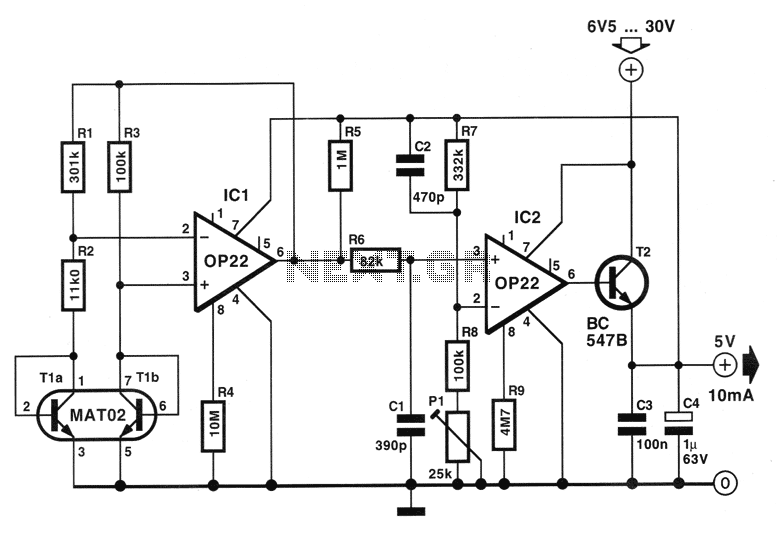
Low Power consumption 5V regulator circuit
The circuit described below is notable for its low power consumption. With a 9V input and no load at the output, it draws only 50 mA, which is significantly lower than the quiescent current of a 78L05 regulator. The circuit...
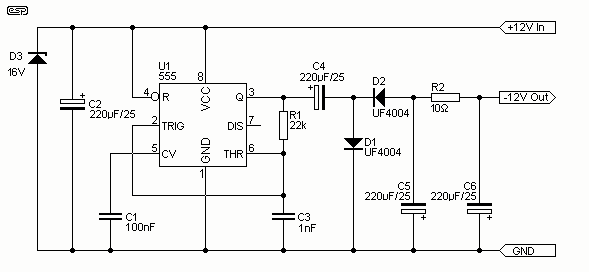
Low Power Negative Car Power Supply
I have had a lot of queries about getting a low power negative supply in cars, to power Linkwitz transform circuits and the like. There is a switchmode converter, but I must admit that it is overkill for what most...
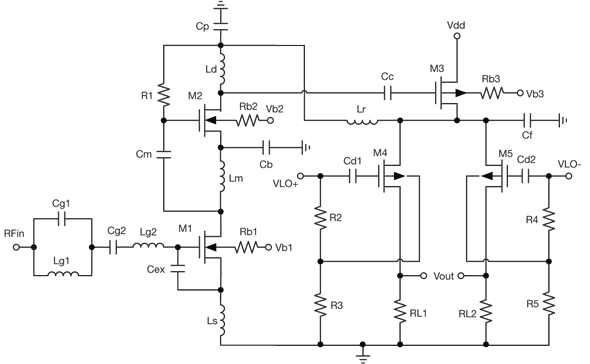
low power receiver serves multiple wireless standards
By combining a current-reuse amplifier and a switch-based mixer, a dual-band receiver front end offers excellent performance with extremely low power consumption.
The dual-band receiver front end integrates a current-reuse amplifier and a switch-based mixer to achieve high performance while maintaining...
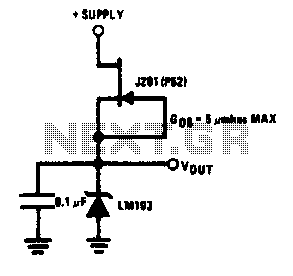
Low power regulator reference
This simple reference circuit provides a stable voltage reference that is nearly free from supply voltage noise. Typical power supply rejection exceeds 100 dB.
The described voltage reference circuit is designed to deliver a consistent output voltage while minimizing the influence...
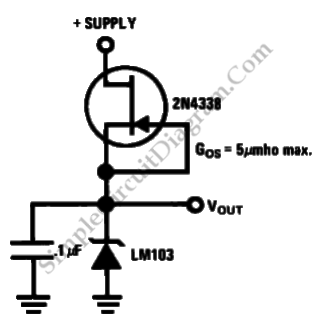
Low Power Regulator Reference
This is a simple circuit of a low-power voltage regulator reference. This circuit can produce a stable voltage reference.
The low-power voltage regulator reference circuit is designed to provide a consistent output voltage, which is crucial for various electronic applications requiring...