


Chroma-demodulator-with-rgb-matrix
#chroma demodulator
#RGB matrix
#video amps
#color difference signals
#MC1324
#signal recovery
#video processing
#demodulation
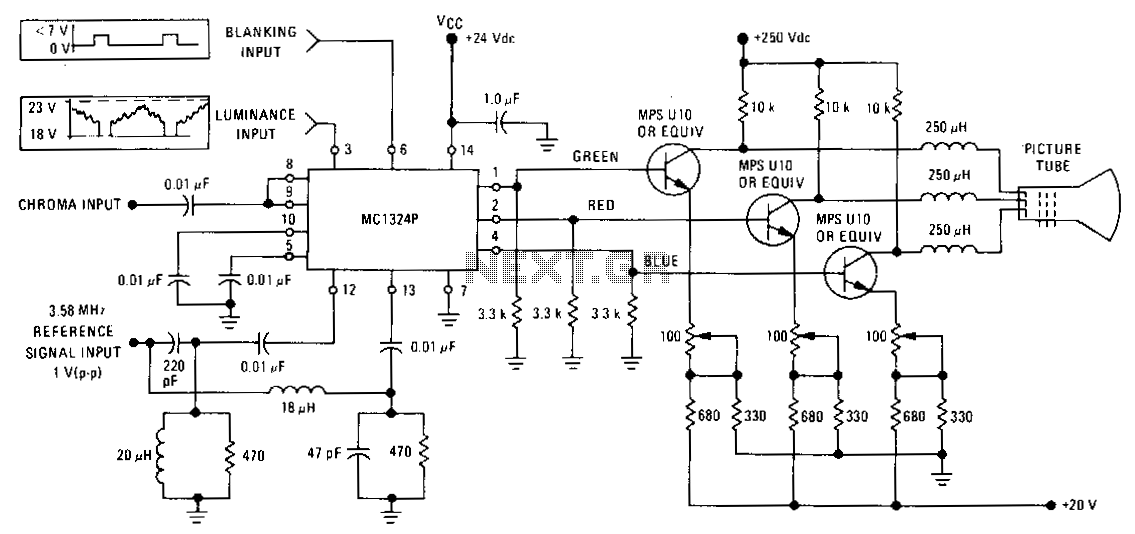
Description: The MC1324 provides chroma demodulation, recovering the R, G, and B signals to drive video amplifiers for each color difference signal. The luminance signal and chrominance signal are matrixed to obtain the R, G, and B signals.
The MC1324 is an integrated circuit designed for chroma demodulation in video processing applications. It effectively extracts the primary color signals—red (R), green (G), and blue (B)—from the composite video input. This is achieved through a series of internal processing stages that demodulate the chrominance information while preserving the luminance data.
The device operates by first separating the luminance (Y) and chrominance (C) signals from the input video. The luminance signal represents the brightness information, while the chrominance signal carries the color information. The MC1324 then utilizes matrixing techniques to combine these signals, resulting in the individual R, G, and B outputs. Each of these color difference signals is then amplified by dedicated video amplifiers, ensuring that the output levels are suitable for further processing or display.
The architecture of the MC1324 includes features such as automatic gain control (AGC) and low-noise operation, which contribute to high-quality video signal reproduction. This makes the MC1324 particularly suitable for applications in television broadcasting, video conferencing, and other multimedia systems where accurate color representation is critical.The MC1324 provides chroma demodulation recovering recooling the R, G, and B signals to drive video amps for each color difference signal. The luminance signal and chrominance signal are matrixed to get the R, G, andR signals.
The MC1324 is an integrated circuit designed for chroma demodulation in video processing applications. It effectively extracts the primary color signals—red (R), green (G), and blue (B)—from the composite video input. This is achieved through a series of internal processing stages that demodulate the chrominance information while preserving the luminance data.
The device operates by first separating the luminance (Y) and chrominance (C) signals from the input video. The luminance signal represents the brightness information, while the chrominance signal carries the color information. The MC1324 then utilizes matrixing techniques to combine these signals, resulting in the individual R, G, and B outputs. Each of these color difference signals is then amplified by dedicated video amplifiers, ensuring that the output levels are suitable for further processing or display.
The architecture of the MC1324 includes features such as automatic gain control (AGC) and low-noise operation, which contribute to high-quality video signal reproduction. This makes the MC1324 particularly suitable for applications in television broadcasting, video conferencing, and other multimedia systems where accurate color representation is critical.The MC1324 provides chroma demodulation recovering recooling the R, G, and B signals to drive video amps for each color difference signal. The luminance signal and chrominance signal are matrixed to get the R, G, andR signals.
Video Digitizer Project
This is the original Circuit Cellar ImageWise Transmitter that was initially used. The code was disassembled to capture two half-size images, allowing for the extraction of images from both the odd and even fields. Code was then written to subtract...
Video Digitizer Project
This is the original Circuit Cellar ImageWise Transmitter that was initially used. The code was disassembled to capture two half-size images, allowing for the extraction of images from both the odd and even fields. Code was then written to subtract...
Single chip TV chroma luma processor
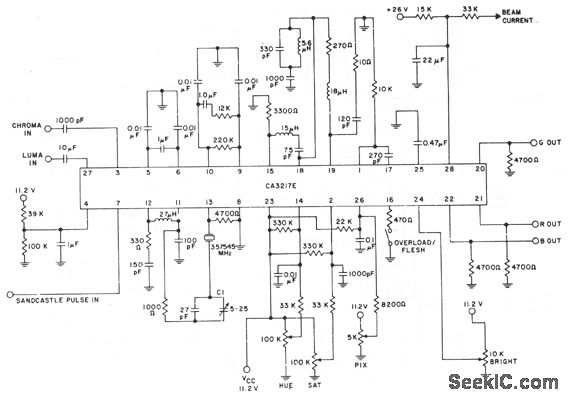
The CA3217E integrates all necessary circuit functions between the video detector and the RGB driver stages of a color television receiver. It decodes chroma signals to generate three distinct color signals, which are then combined with the luma to produce...
ARCHITECTURES FOR VIDEO PROCESSING
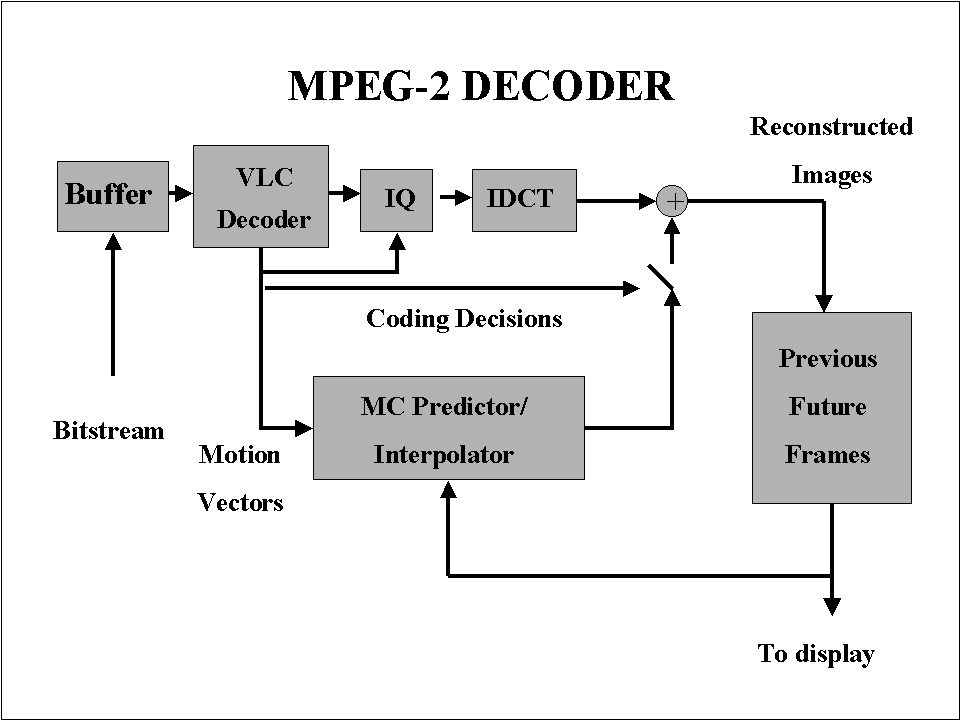
The primary inquiry to address is the contemporary understanding of video processing. Until the late 1980s, two distinct realms existed: the analog television domain and the digital computing domain. All television processing, from the camera to the receiver, relied on...