


CMX866 V.22 Bis Modem With AT Commands
#modem
#CMX866
#V.22 Bis
#AT commands
#serial bus
#telemetry
#USART
#data transmission
#telephone systems
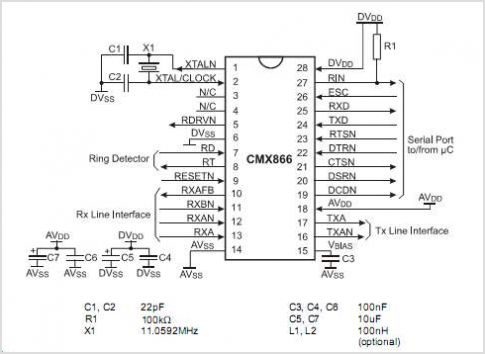
Description: The CMX867A is a multi-standard modem designed for telephone-based information and telemetry systems. Control of the device is managed through a high-speed serial bus that is compatible with various types of C serial interfaces. The data transmitted and received by the modem is also communicated over this same serial bus. The modem features on-chip programmable Tx and Rx USARTs that comply with V.14 standards, supporting asynchronous data while allowing the transmission and reception of unformatted synchronous data as 8-bit words. Additionally, it includes a high-quality DTMF decoder with robust immunity against false triggering during voice signals, along with a standard DTMF encoder. These components can alternatively be utilized to transmit and detect user-specific programmed single and dual-tone signals, call progress signals, or modem calling and answering tones, as provided by Consumer Microcircuits Limited.
The CMX867A modem serves as a versatile solution for integrating communication capabilities into various systems. Its architecture is designed to facilitate seamless interaction with telephone networks, making it suitable for applications ranging from telemetry to automated information retrieval. The high-speed serial bus not only simplifies control but also enhances data throughput, ensuring efficient communication between the modem and host systems.
The inclusion of programmable Tx and Rx USARTs allows for flexibility in data handling, accommodating both asynchronous and synchronous communication protocols. This adaptability is crucial for applications requiring diverse data formats, enabling the modem to interface effectively with different types of data sources and sinks.
The DTMF (Dual-Tone Multi-Frequency) capabilities of the CMX867A are particularly noteworthy. The high-quality DTMF decoder is engineered to minimize false detections, which is essential in voice-activated systems where accuracy is paramount. The standard DTMF encoder complements this functionality, enabling the generation of DTMF tones for various signaling purposes. Furthermore, the ability to program custom tones adds an additional layer of functionality, allowing developers to tailor the modem's responses to specific operational requirements.
Overall, the CMX867A modem is a robust component for telecommunications applications, offering advanced features that cater to the demands of modern information systems while maintaining compatibility with established communication standards.The CMX867A is a multi-standard modem for use in telephone based information and telemetry systems. Control of the device is via a simple high speed serial bus, compatible with most types of C serial Interface The data transmitted and received by the modem is also transferred over the same serial bus. On-chip programmable Tx and Rx USARTs meeting the requirements of V. 14 are provided for use with asynchronous data and allow unformatted synchronous data to be received or transmitted as 8-bit words. A high-quality DTMF decoder with excellent immunity to falsing on voice and a standard DTMF encoder are included.
Alternatively, these blocks CAN be used to transmit and detect user-specific, programmed single and dual-tone signals, call progress signals or modem calling and answering Tones By Consumer Microcircuits Limited
The CMX867A modem serves as a versatile solution for integrating communication capabilities into various systems. Its architecture is designed to facilitate seamless interaction with telephone networks, making it suitable for applications ranging from telemetry to automated information retrieval. The high-speed serial bus not only simplifies control but also enhances data throughput, ensuring efficient communication between the modem and host systems.
The inclusion of programmable Tx and Rx USARTs allows for flexibility in data handling, accommodating both asynchronous and synchronous communication protocols. This adaptability is crucial for applications requiring diverse data formats, enabling the modem to interface effectively with different types of data sources and sinks.
The DTMF (Dual-Tone Multi-Frequency) capabilities of the CMX867A are particularly noteworthy. The high-quality DTMF decoder is engineered to minimize false detections, which is essential in voice-activated systems where accuracy is paramount. The standard DTMF encoder complements this functionality, enabling the generation of DTMF tones for various signaling purposes. Furthermore, the ability to program custom tones adds an additional layer of functionality, allowing developers to tailor the modem's responses to specific operational requirements.
Overall, the CMX867A modem is a robust component for telecommunications applications, offering advanced features that cater to the demands of modern information systems while maintaining compatibility with established communication standards.The CMX867A is a multi-standard modem for use in telephone based information and telemetry systems. Control of the device is via a simple high speed serial bus, compatible with most types of C serial Interface The data transmitted and received by the modem is also transferred over the same serial bus. On-chip programmable Tx and Rx USARTs meeting the requirements of V. 14 are provided for use with asynchronous data and allow unformatted synchronous data to be received or transmitted as 8-bit words. A high-quality DTMF decoder with excellent immunity to falsing on voice and a standard DTMF encoder are included.
Alternatively, these blocks CAN be used to transmit and detect user-specific, programmed single and dual-tone signals, call progress signals or modem calling and answering Tones By Consumer Microcircuits Limited
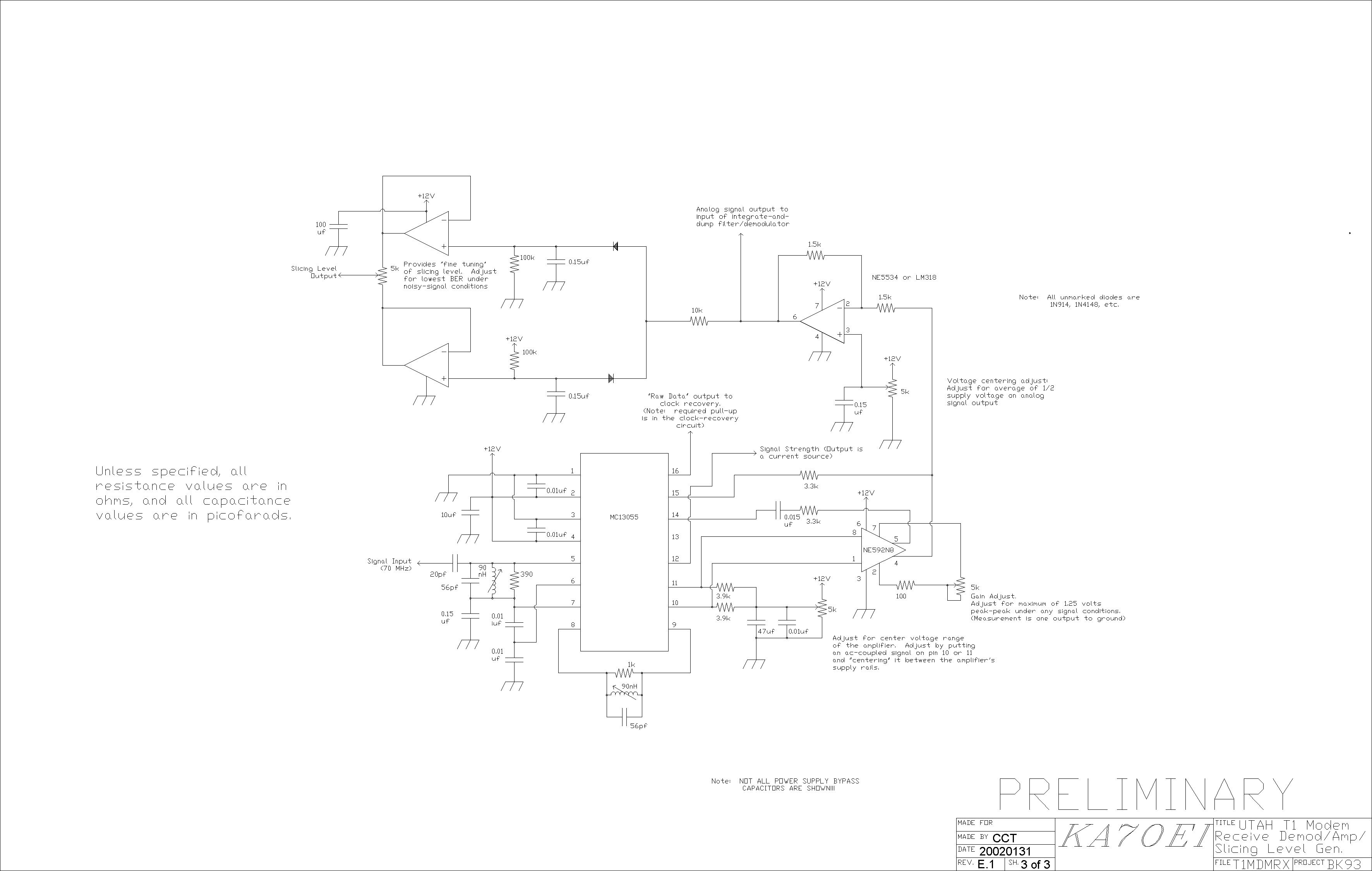
Utah T1-Rate Modem
This page provides information about the T1-rate modem designed in 1993. It is important to note that this modem is primarily useful for licensed amateur radio operators and is not suitable for general use unless operated over wires, as it...
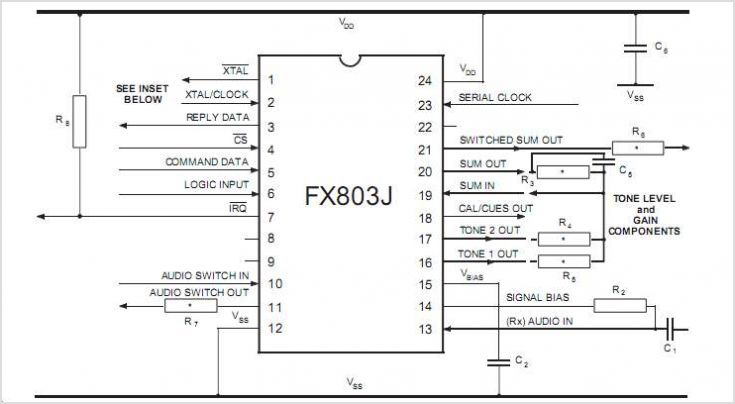
FX803 Signalling Processor
The CMX469A is a single-chip CMOS LSI circuit that functions as a full-duplex modem, supporting baud rates of 1200, 2400, or 4800. The mark and space frequencies for this modem are 1200/1800 Hz, 1200/2400 Hz, and 2400/4800 Hz, respectively. The...
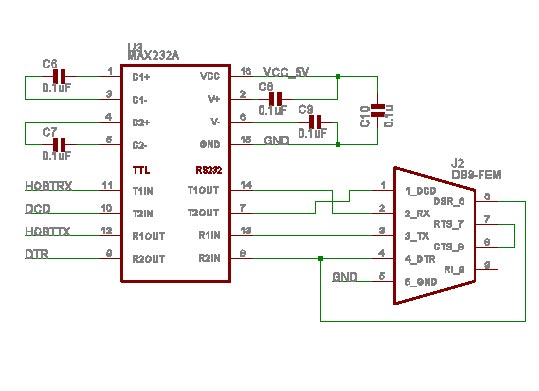
Your vending machine can talk thanks to a 5 embedded modem
Despite the remarkable growth of wireless connections, analog POTS, or "plain old telephone service," continues to excel in terms of cost and availability. Credit card terminals and home security systems are two examples of older connected devices. However, the expansion...

Carrier Current Transmitter For Data Transmission
In this circuit, data at input C is amplified by IC2 and then fed to modulator IC1. IC1 generates two frequencies, depending on the values of C5, I10, R5, Rn, and R6. The frequency f1 is generated if pin 9...
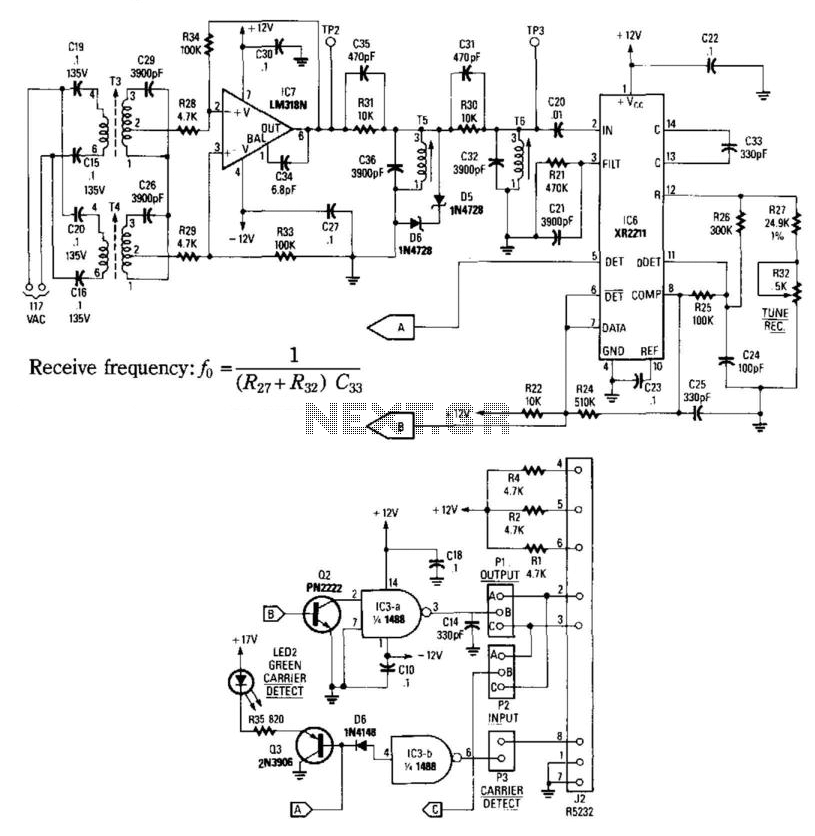
Carrier-Current Receiver For Data Transmission
This receiver consists of an input network, amplifier IC7, FSK PLL detector IC8, and output amplifier/interface circuits Q2, Q3, IC3A, and IC3B, which include a 1488 Quad RS232 line driver for the carrier-current signal. The tuned amplifier IC7 amplifies this...
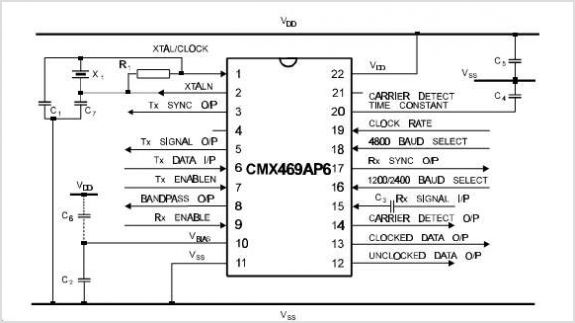
CMX469A 1200/2400/4800 Baud FFSK/MSK Modem
CMX7031Q1 is a sub-package of CMX7031. For the full description, please refer to CMX7031. The datasheet for CMX7031Q1 can be downloaded below. By Consumer Microcircuits Limited.
The CMX7031Q1 is a specialized integrated circuit designed for use in communication systems, primarily focusing...
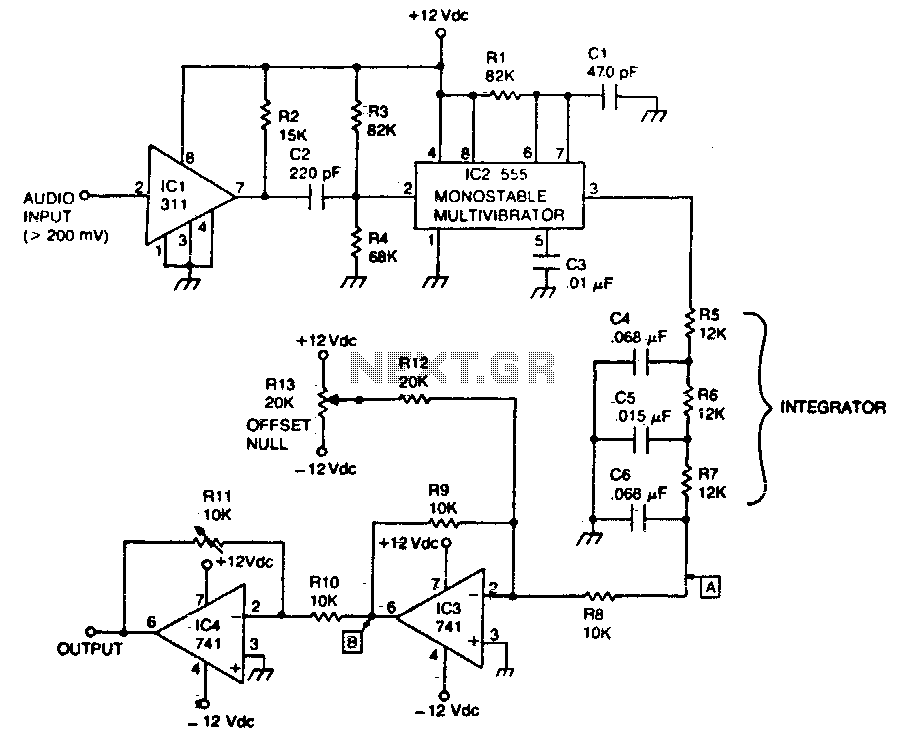
Telemetry demodulator
The circuit recovers an FM audio signal that varies from less than 1 kHz to about 10 kHz.
The circuit is designed to demodulate frequency-modulated (FM) audio signals within the frequency range of less than 1 kHz to approximately 10 kHz....
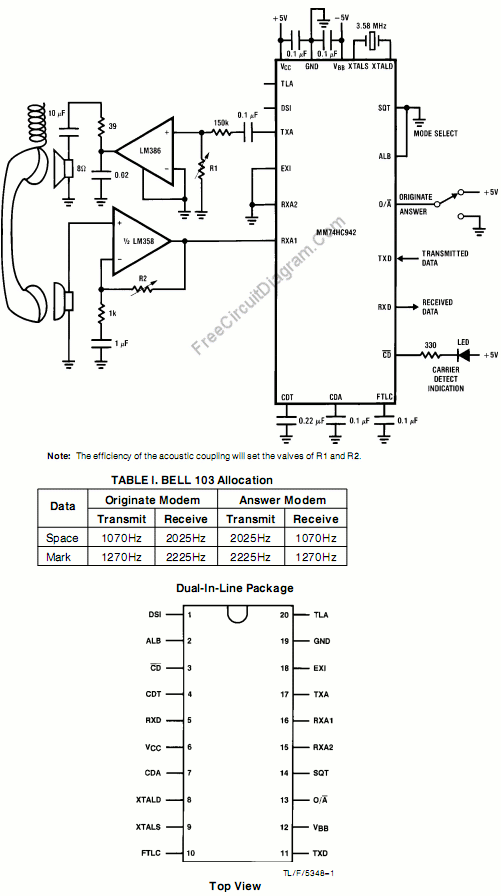
BELL 103 Compatible FSK Modem Circuit
This circuit utilizes the MM74HC942, a single-chip low-speed modem that is compatible with the Bell 103 standard. The Bell 103 modem circuit operates at a baud rate of 300.
The MM74HC942 is a versatile integrated circuit designed for low-speed data transmission,...
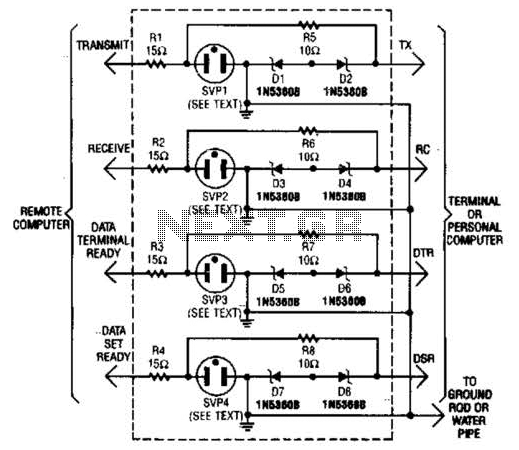
Modem/Fax Protector For Two Computers Circuit
This modem/fax protector can be utilized in telephone-line connections between a PC or a terminal and a remote computer. In this circuit, the surge voltage protectors (SVPs) are rated at 230 V. Additionally, a proper grounding is essential for optimal...