


Duplex-line-amplifier
#bidirectional amplifier
#duplex
#telephone
#negative resistance
#signal amplification
#stability adjustment
#Rl adjustment
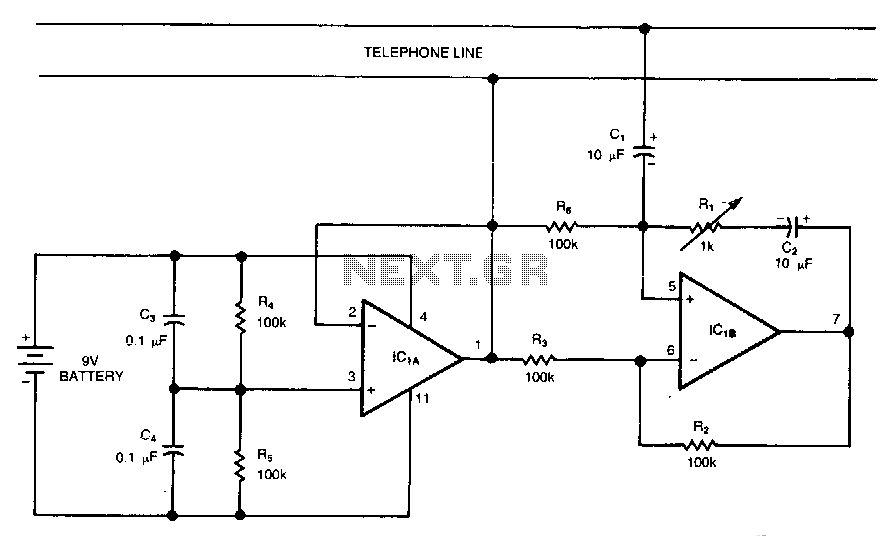
Description: This circuit is a bidirectional amplifier capable of amplifying both signals in a duplex telephone conversation. It operates on the principle of negative resistance. While such an amplifier may be prone to instability, adjusting the load resistor (Rl) can optimize amplification while maintaining circuit stability. Additionally, the LM324 operational amplifiers can be substituted with lower distortion alternatives like the LM1558, LF412, LF353, or LF442.
The bidirectional amplifier circuit is designed to enhance the clarity and quality of duplex telephone conversations by amplifying both the transmit and receive signals. The principle of negative resistance is employed to achieve this amplification, which allows for the effective amplification of signals in both directions without significant degradation.
To ensure stability during operation, the load resistor (Rl) plays a critical role. By carefully adjusting Rl, the gain of the amplifier can be maximized while preventing oscillations that could lead to instability. This adjustment is crucial in maintaining the integrity of the amplified signals.
The choice of operational amplifiers is also significant in the performance of the circuit. The LM324, while functional, may introduce unwanted distortion in the amplified signals. Therefore, replacing the LM324 with other operational amplifiers such as the LM1558, LF412, LF353, or LF442 can lead to improved linearity and reduced distortion. These alternatives are designed to provide better performance in audio applications, ensuring that the amplified signals remain faithful to the original input.
Overall, this bidirectional amplifier circuit is a versatile solution for enhancing telephone communication, leveraging the principles of negative resistance and careful component selection to achieve optimal performance.This circuit is a bidirectional amplifier that can amplify both signals of a duplex telephone conversation. It uses the principle of negative resistance. Obviously, such an amplifier could easily be unstable; however, you can adjust Rl for maximum amplification and the circuit will remain stable.
The LM324 op amps can be replaced with op amps that would distort less, such as the LM1558, LF412, LF353, or LF442.
The bidirectional amplifier circuit is designed to enhance the clarity and quality of duplex telephone conversations by amplifying both the transmit and receive signals. The principle of negative resistance is employed to achieve this amplification, which allows for the effective amplification of signals in both directions without significant degradation.
To ensure stability during operation, the load resistor (Rl) plays a critical role. By carefully adjusting Rl, the gain of the amplifier can be maximized while preventing oscillations that could lead to instability. This adjustment is crucial in maintaining the integrity of the amplified signals.
The choice of operational amplifiers is also significant in the performance of the circuit. The LM324, while functional, may introduce unwanted distortion in the amplified signals. Therefore, replacing the LM324 with other operational amplifiers such as the LM1558, LF412, LF353, or LF442 can lead to improved linearity and reduced distortion. These alternatives are designed to provide better performance in audio applications, ensuring that the amplified signals remain faithful to the original input.
Overall, this bidirectional amplifier circuit is a versatile solution for enhancing telephone communication, leveraging the principles of negative resistance and careful component selection to achieve optimal performance.This circuit is a bidirectional amplifier that can amplify both signals of a duplex telephone conversation. It uses the principle of negative resistance. Obviously, such an amplifier could easily be unstable; however, you can adjust Rl for maximum amplification and the circuit will remain stable.
The LM324 op amps can be replaced with op amps that would distort less, such as the LM1558, LF412, LF353, or LF442.
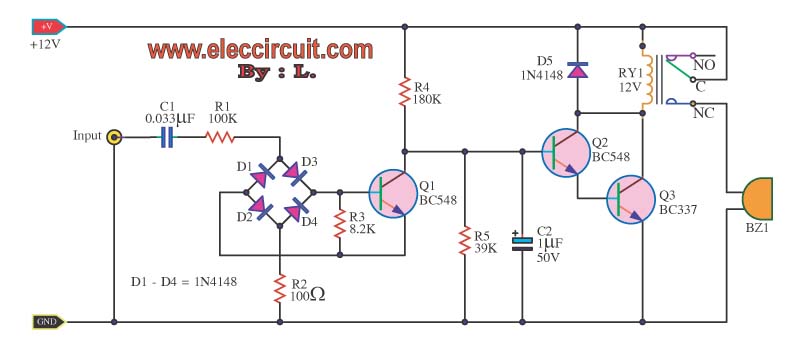
Telephone repeater circuits
The telephone repeater is a circuit designed to amplify the call signal, making it louder than the original. This circuit has been developed in response to specific requests.
The telephone repeater circuit functions by receiving the incoming audio signal from a...
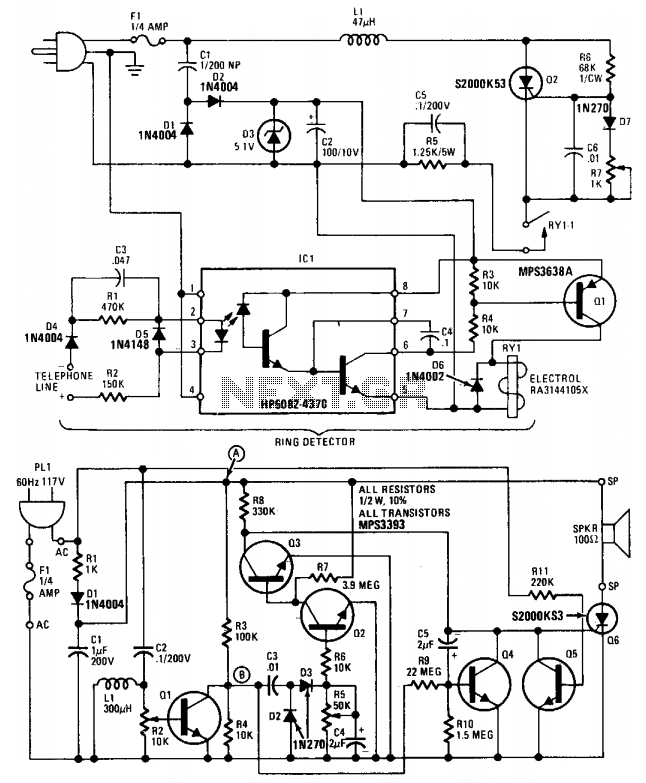
Plug-in remote telephone ringer
This device comprises a ring detector connected to the telephone line. When the telephone rings, the ring detector imposes high-frequency pulses on the AC power line. A receiver located anywhere on the same power line detects these pulses and produces...
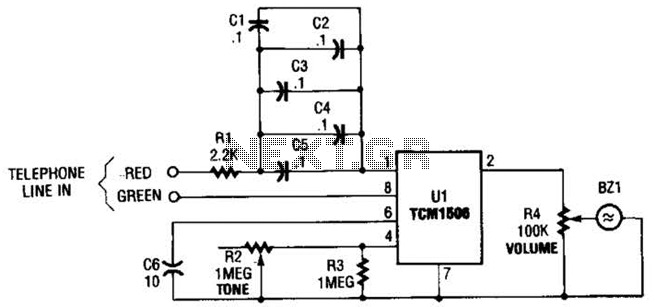
Telephone Ring Converter Circuit
The circuit utilizes the TCM1506 ring detector/driver integrated circuit, which is a monolithic IC designed to replace mechanical bells in telephones. It is powered and activated by the telephone line's ringing signal, which ranges from 40 to 150 V rms...
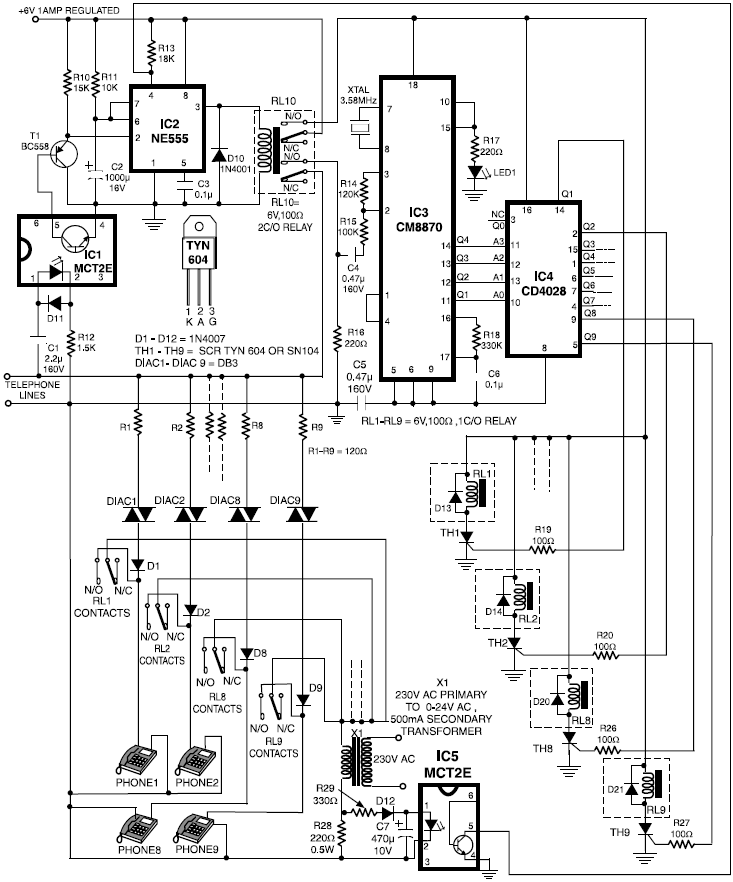
9-Line Telephone Sharer
This circuit can manage nine independent telephones using a single telephone line pair, located up to 100 meters apart for making and receiving calls while ensuring conversation privacy. It is particularly useful for multiple members residing in different rooms or...
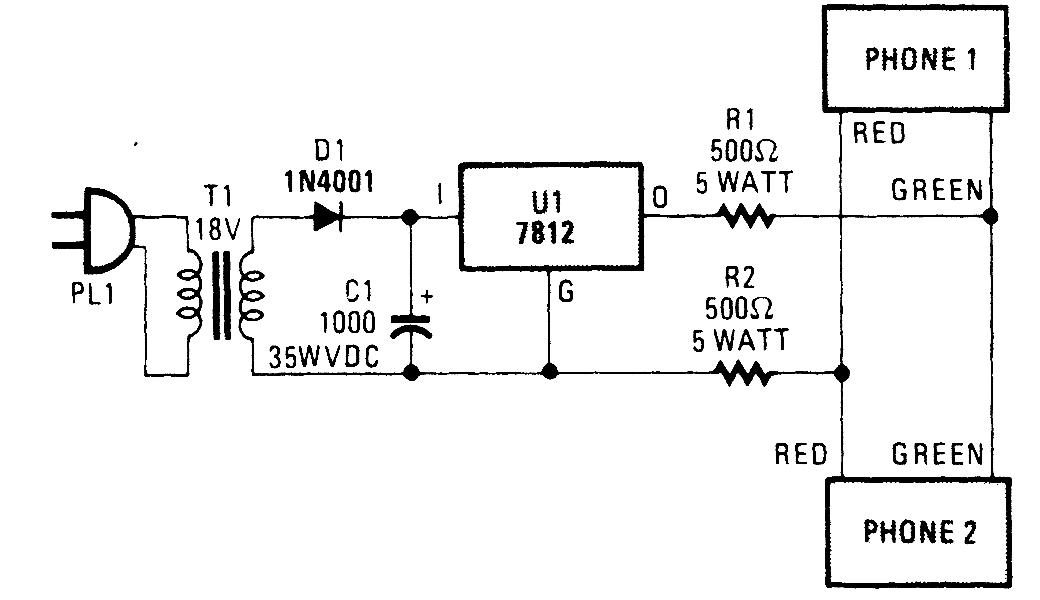
VERY SIMPLE TELEPHONE INTERCOM CIRCUIT
Tro telephones can be utilized as an intercom through the implementation of this circuit. Traditional rotary phones, particularly those that are non-electronic, may be the most effective for this purpose. Additionally, this method can also power handsets alone.
The circuit designed...
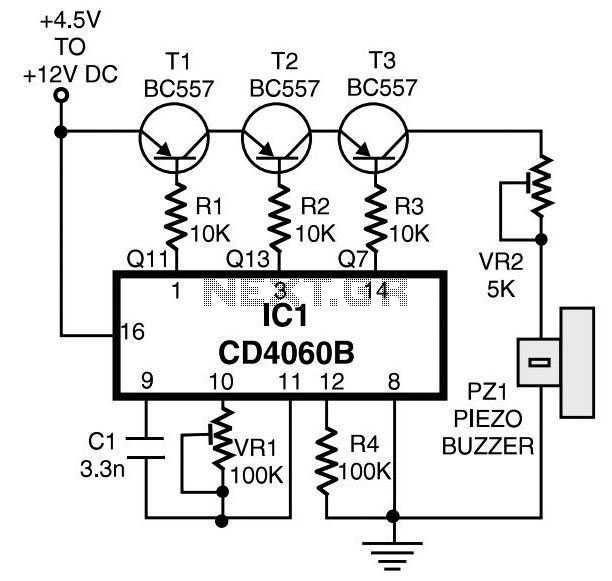
Telephone ringtone generator circuit
Join the forum discussion on this post. This is a simple home telephone ringtone generator circuit built using only a few electronic components. It generates a simulated telephone ringtone and requires only a DC supply.
The home telephone ringtone generator circuit...

Telephone Status Indicator Circuit
This simple circuit indicates the status of a phone, including Line OK, Dialing, and Call Attended. It also features a locking mechanism to block outgoing calls while allowing incoming calls, preventing misuse of the telephone. The circuit requires only a...
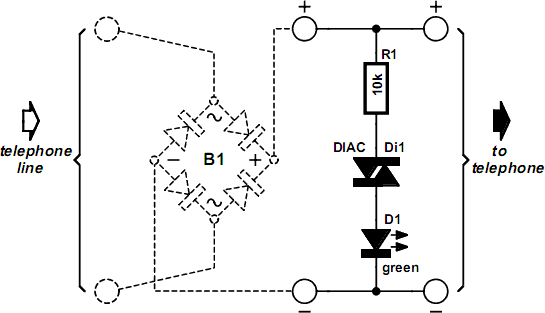
Telephone Free Indicator
Depending on local regulations and the telephone company to which one is connected, the voltage on a free telephone line can range from 42 to 60 volts. This voltage is sufficient to cause a diac to conduct, functioning similarly to...
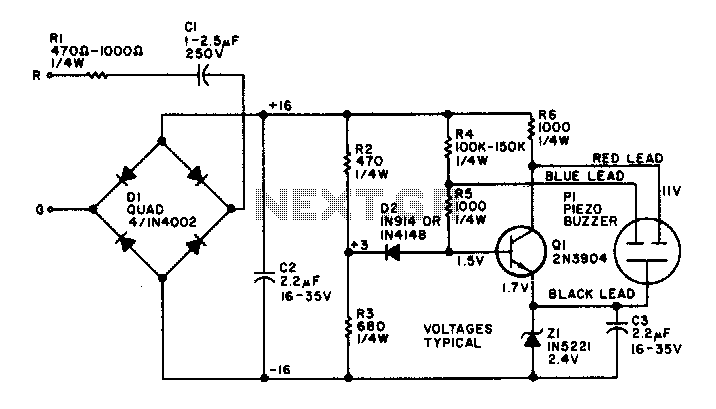
Telephone ringer piezoelectric
The electronic bell operates without a power supply. Most resistors in the circuit are not critical, although capacitor C2 and resistors R2 and R3 perform optimally at the specified values. Omitting resistor R1 will increase the volume of the ringing...