


Courtesy Lighting with 7555
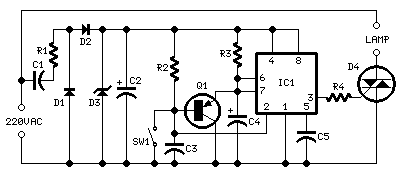
Description: This circuit is intended to let the user turn off a lamp by means of a switch placed far from bed, allowing him enough time to lie down before the lamp really switches off. 15 seconds delayed switch-off. A good idea for bedroom lamps. Obviously, users will be able to find different applications for this circuit in order to suit their needs. More: Due to the low current drawing, the circuit can be supplied from 230Vac mains without a transformer. Supply voltage is reduced to 10Vdc by means of C1 reactance, a two diode rectifier cell D1 & D2 and Zener diode D3. IC1 is a CMos 555 timer wired as a
The circuit operates by utilizing a CMOS 555 timer configured in monostable mode, which allows for a delayed switching action. When the user activates the switch (S1), it triggers the timer, initiating a countdown period of 15 seconds. During this time, the lamp remains powered on. After the countdown completes, the timer output transitions to a low state, effectively turning off the lamp.
The power supply section of the circuit is designed to operate directly from the 230Vac mains, which eliminates the need for a bulky transformer. The capacitor C1 serves as a reactance element that limits the current drawn from the mains. Following this, a full-wave rectifier composed of diodes D1 and D2 converts the AC voltage to DC voltage. The Zener diode D3 is employed to regulate the output voltage, ensuring that the CMOS 555 timer receives a stable 10Vdc supply for reliable operation.
Additional components such as resistors and capacitors associated with the 555 timer will determine the time delay. The specific values of these components must be selected to achieve the desired 15-second delay. The output from the timer can be connected to a relay or a transistor switch that controls the lamp, providing isolation from the high voltage AC circuit.
This circuit design not only enhances convenience for users but also showcases versatility, as it can be adapted for various applications beyond simply controlling a bedroom lamp. The simplicity of the design, combined with the effective use of readily available components, makes it an excellent choice for DIY electronics enthusiasts.This circuit is intended to let the user turn off a lamp by means of a switch placed far from bed, allowing him enough time to lie down before the lamp really switches off. 15 seconds delayed switch-off A good idea for bedroom lamps. Obviously, users will be able to find different applications for this circuit in order to suit their needs.
Due to the low current drawing, the circuit can be supplied from 230Vac mains without a transformer. Supply voltage is reduced to 10Vdc by means of C1 reactance, a two diode rectifier cell D1 & D2 and Zener diode D3. IC1 is a CMos 555 timer wired as a
The circuit operates by utilizing a CMOS 555 timer configured in monostable mode, which allows for a delayed switching action. When the user activates the switch (S1), it triggers the timer, initiating a countdown period of 15 seconds. During this time, the lamp remains powered on. After the countdown completes, the timer output transitions to a low state, effectively turning off the lamp.
The power supply section of the circuit is designed to operate directly from the 230Vac mains, which eliminates the need for a bulky transformer. The capacitor C1 serves as a reactance element that limits the current drawn from the mains. Following this, a full-wave rectifier composed of diodes D1 and D2 converts the AC voltage to DC voltage. The Zener diode D3 is employed to regulate the output voltage, ensuring that the CMOS 555 timer receives a stable 10Vdc supply for reliable operation.
Additional components such as resistors and capacitors associated with the 555 timer will determine the time delay. The specific values of these components must be selected to achieve the desired 15-second delay. The output from the timer can be connected to a relay or a transistor switch that controls the lamp, providing isolation from the high voltage AC circuit.
This circuit design not only enhances convenience for users but also showcases versatility, as it can be adapted for various applications beyond simply controlling a bedroom lamp. The simplicity of the design, combined with the effective use of readily available components, makes it an excellent choice for DIY electronics enthusiasts.This circuit is intended to let the user turn off a lamp by means of a switch placed far from bed, allowing him enough time to lie down before the lamp really switches off. 15 seconds delayed switch-off A good idea for bedroom lamps. Obviously, users will be able to find different applications for this circuit in order to suit their needs.
Due to the low current drawing, the circuit can be supplied from 230Vac mains without a transformer. Supply voltage is reduced to 10Vdc by means of C1 reactance, a two diode rectifier cell D1 & D2 and Zener diode D3. IC1 is a CMos 555 timer wired as a
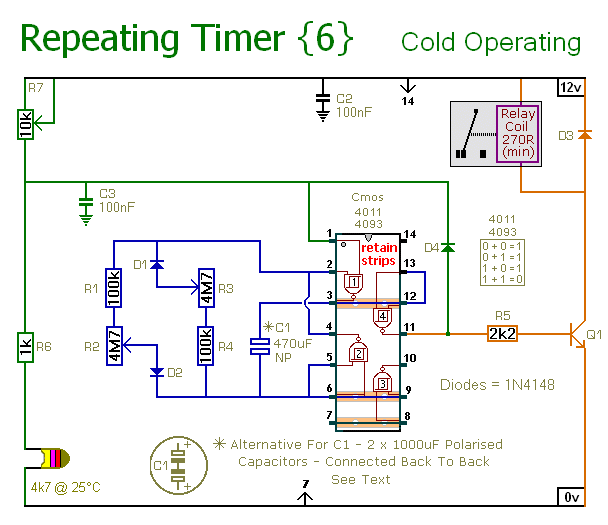
Repeating Timer 6
This circuit operates in contrast to Repeating Timer No.5. It activates only when the temperature drops below a predetermined level. The variable resistor (preset) allows for the selection of the temperature threshold at which the timer will become operational.
The described...
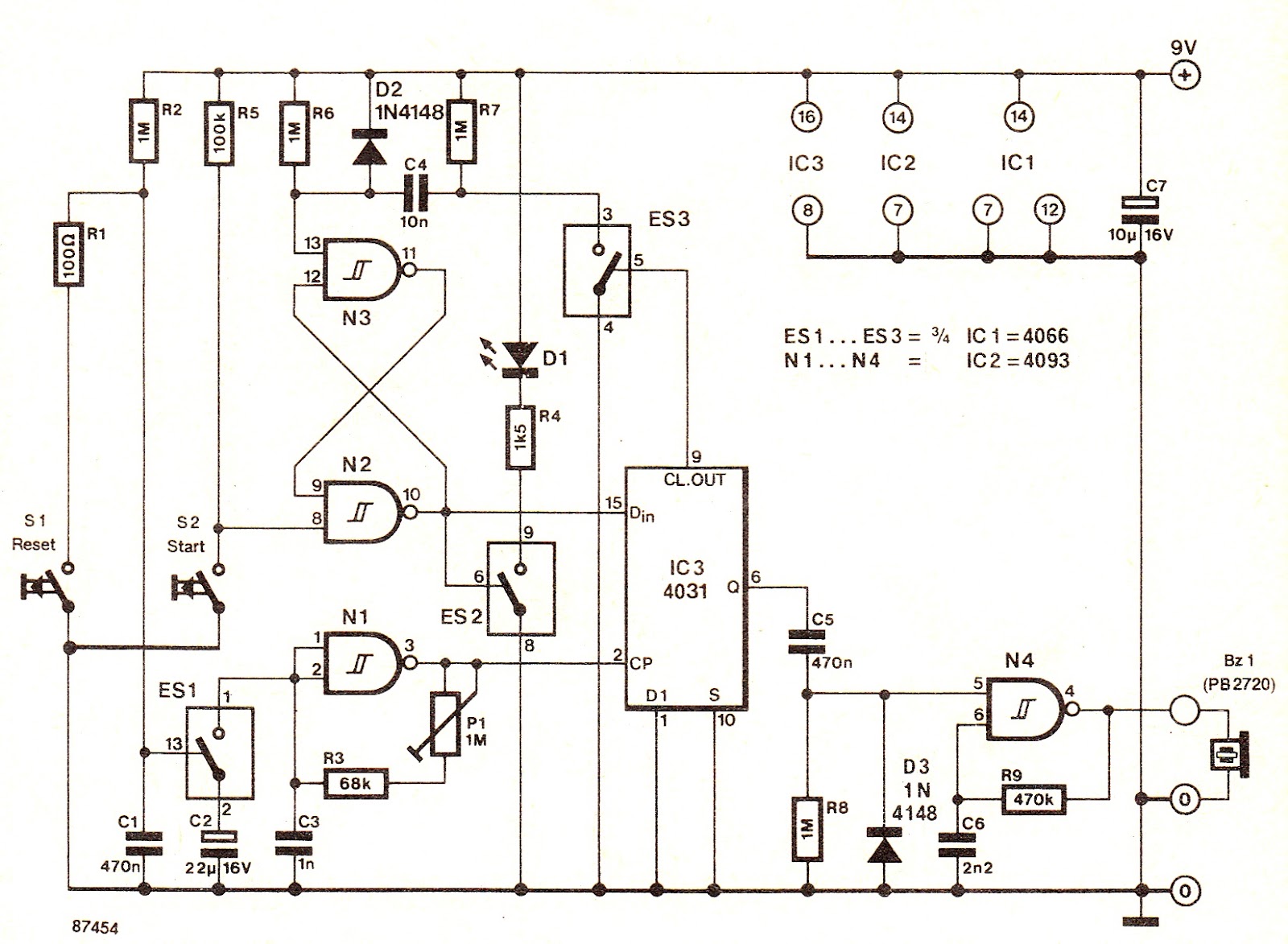
Bathroom Water Heater Timer
The electronic switch ES1 connects the frequency-determining capacitor to the input of clock oscillator N1. The logic level present at the Dm terminal of the integrated circuit is shifted to output Q at a speed defined by P1, allowing for...
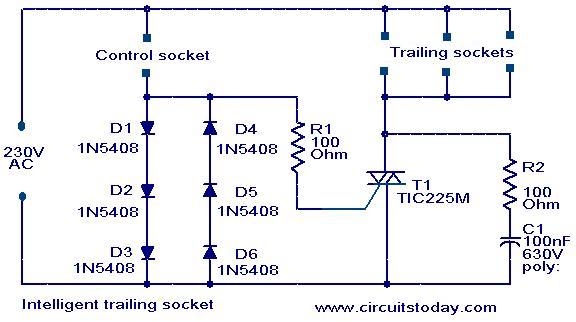
Intelligent trailing switch
This circuit is a straightforward yet effective design where devices connected to the trailing sockets will operate only when the device connected to the control socket is powered on. For instance, if a motor is connected to the control socket...
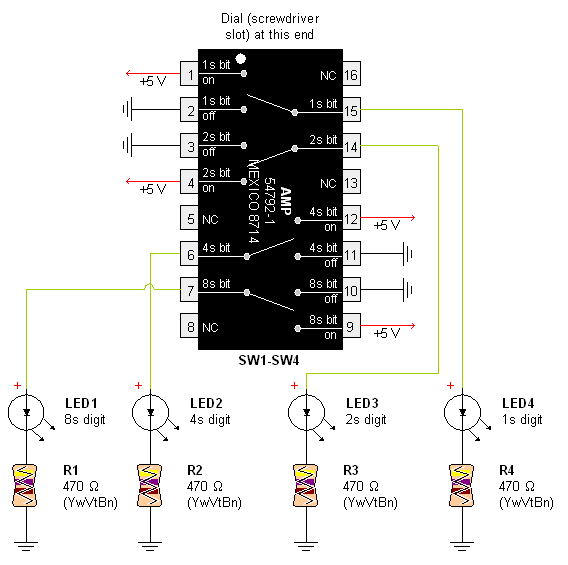
AMP Hexadecimal Rotary Switch
Pictures and a sample schematic (including pinouts) of an AMP hexadecimal (16-position) switch with a screw slot actuator.
The AMP hexadecimal switch is a 16-position rotary switch designed for applications requiring multiple selectable options. This switch features a screw slot actuator...
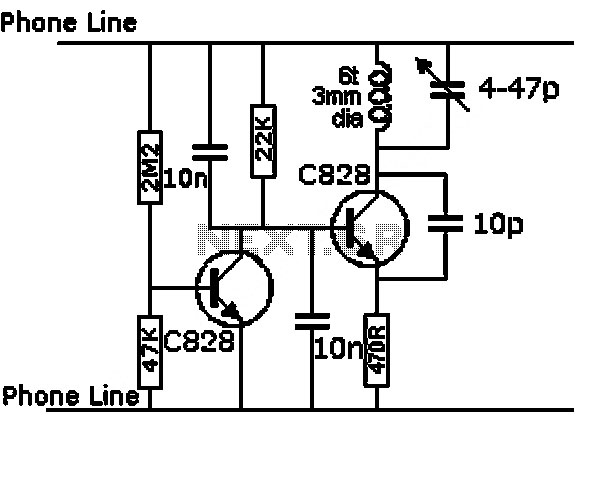
The Time Delay Circuit
The duration for which the circuit remains active is determined by the time required for the stored electrical current to leak back into the circuit, which keeps the transistor and the entire circuit energized. A resistor is present that limits...
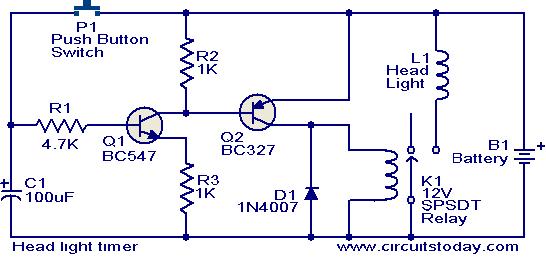
Head light timer circuit
This circuit is a compact timer that keeps the headlights of a car on for approximately 1.5 minutes before turning them off. Incorporating this circuit into a vehicle allows access to dark areas without the need to return and manually...
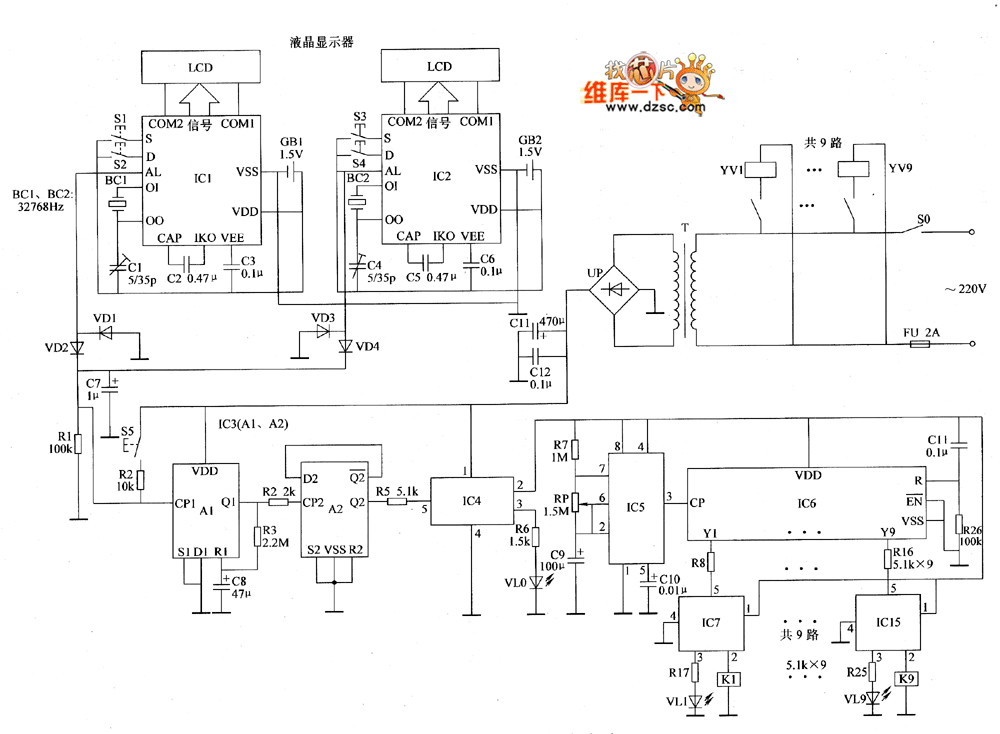
Automatic sprinkler controller circuit diagram 1
The automatic sprinkler controller circuit consists of a clock timing controller, a monostable flip-flop, a bistable flip-flop, an electronic switch, a self-excited multivibrator, a counter, a solenoid valve control circuit, and a power supply circuit. The power supply circuit includes...
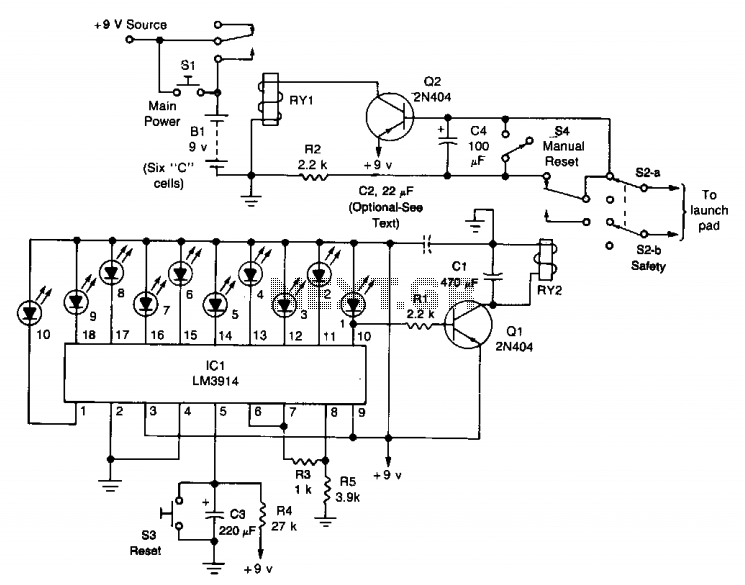
Model rocket launcher
The circuit comprises a launch timer and an automatic-off timer. Upon applying power to the integrated circuit (IC), the countdown LED sequence activates until all LEDs are illuminated. When the last LED (LED1) is fully lit, transistor Q1 enters saturation,...
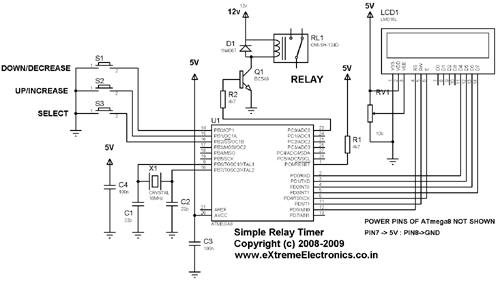
Relay Timer with ATmega8
Timers are widely used in industrial and domestic applications for automating tasks. Microcontrollers can be used to design versatile and accurate timers.
Timers play a crucial role in both industrial and domestic environments by facilitating the automation of various tasks. The...