


timed beeper
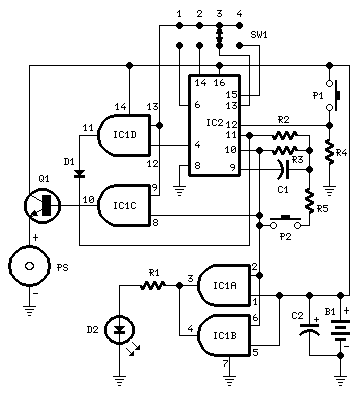
Description: This circuit is designed for alerting purposes after a specified time has elapsed. It is suitable for tabletop games that require a fixed duration to answer a question or to move a piece. In this context, it serves as a modern substitute for the traditional hourglass. It is also useful for time management when children are brushing their teeth (for at least two minutes), in the kitchen, and in various other scenarios.
The alerting circuit can be implemented using a microcontroller or a timer IC, such as the 555 timer. The circuit typically includes a timing component, such as a resistor-capacitor (RC) network, to establish the desired time interval. The microcontroller or timer IC can be programmed or configured to count down from a set time, after which it activates an output device, such as a buzzer or LED, to provide an alert.
For a simple implementation, the circuit would consist of the following components:
1. **Power Supply**: A suitable power source, typically a battery or DC power supply, to provide the necessary voltage and current for the circuit operation.
2. **Timing Component**: A resistor (R) and capacitor (C) in series to form an RC timing circuit. The time period (T) can be calculated using the formula T = R × C, where T is in seconds, R is in ohms, and C is in farads.
3. **Timer IC or Microcontroller**: A 555 timer can be configured in monostable mode to generate a single pulse after the time period has elapsed. Alternatively, a microcontroller (e.g., Arduino) can be programmed to monitor the elapsed time and trigger an output.
4. **Output Device**: A buzzer or LED to provide an audible or visual alert when the timer reaches zero. The output can be connected to the timer IC or microcontroller output pin.
5. **User Interface**: Optional buttons or switches may be included to start, stop, or reset the timer. A display, such as an LCD or seven-segment display, can be added to show the countdown time.
The circuit can be housed in a compact enclosure for portability, making it suitable for various applications, such as games, cooking timers, or educational tools for children. Proper design considerations, such as debouncing of switches and power management, should be taken into account to ensure reliable operation.This circuit is intended for alerting purposes after a certain time is elapsed. It is suitable for table games requiring a fixed time to answer a question, or to move a piece etc. In this view it`s a modern substitute for the old sandglass. Useful also for time control when children are brushing teeth (at least two minutes!), or in the kitchen, and so on..
The alerting circuit can be implemented using a microcontroller or a timer IC, such as the 555 timer. The circuit typically includes a timing component, such as a resistor-capacitor (RC) network, to establish the desired time interval. The microcontroller or timer IC can be programmed or configured to count down from a set time, after which it activates an output device, such as a buzzer or LED, to provide an alert.
For a simple implementation, the circuit would consist of the following components:
1. **Power Supply**: A suitable power source, typically a battery or DC power supply, to provide the necessary voltage and current for the circuit operation.
2. **Timing Component**: A resistor (R) and capacitor (C) in series to form an RC timing circuit. The time period (T) can be calculated using the formula T = R × C, where T is in seconds, R is in ohms, and C is in farads.
3. **Timer IC or Microcontroller**: A 555 timer can be configured in monostable mode to generate a single pulse after the time period has elapsed. Alternatively, a microcontroller (e.g., Arduino) can be programmed to monitor the elapsed time and trigger an output.
4. **Output Device**: A buzzer or LED to provide an audible or visual alert when the timer reaches zero. The output can be connected to the timer IC or microcontroller output pin.
5. **User Interface**: Optional buttons or switches may be included to start, stop, or reset the timer. A display, such as an LCD or seven-segment display, can be added to show the countdown time.
The circuit can be housed in a compact enclosure for portability, making it suitable for various applications, such as games, cooking timers, or educational tools for children. Proper design considerations, such as debouncing of switches and power management, should be taken into account to ensure reliable operation.This circuit is intended for alerting purposes after a certain time is elapsed. It is suitable for table games requiring a fixed time to answer a question, or to move a piece etc. In this view it`s a modern substitute for the old sandglass. Useful also for time control when children are brushing teeth (at least two minutes!), or in the kitchen, and so on..
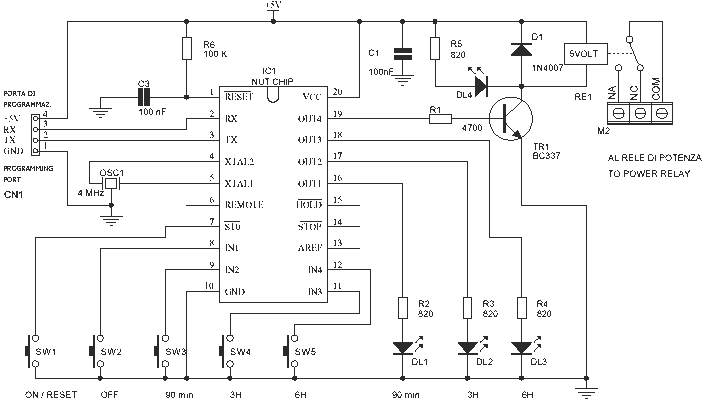
Delayed start for mains equipment
The schematic requires few components because the timer function has been incorporated by Nutchip. For once, from the start, made up of contacts of the relay RE1 connected to terminal M2. If we turn on an appliance at the end...
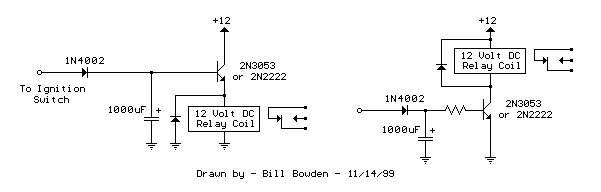
Very simple Delay circuit!
The two circuits di atas illustrate opening a relay contact a short time after the ignition or light switch is turned off. The capacitor is charged and the relay is closed when the voltage at the diode anode rises to...
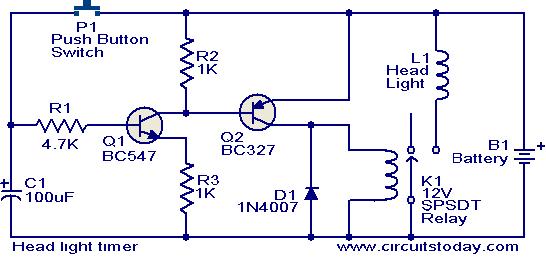
Head light timer circuit
This circuit is a compact timer that keeps the headlights of a car on for approximately 1.5 minutes before turning them off. Incorporating this circuit into a vehicle allows access to dark areas without the need to return and manually...
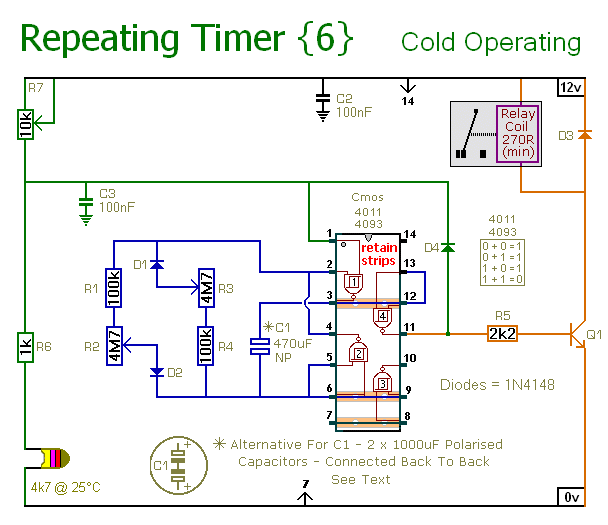
Repeating Timer 6
This circuit operates in contrast to Repeating Timer No.5. It activates only when the temperature drops below a predetermined level. The variable resistor (preset) allows for the selection of the temperature threshold at which the timer will become operational.
The described...
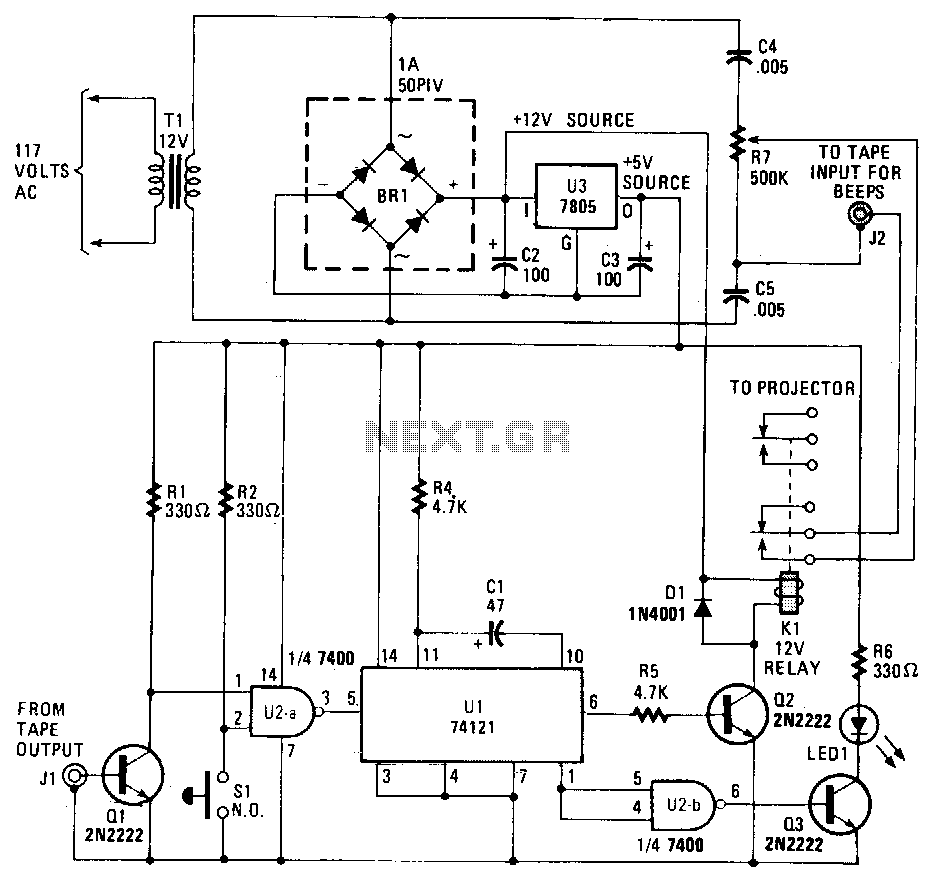
Slide-timer
This circuit records commentary and music on one track of a tape while placing beeps that signal slide changes on another track. The gate U2a triggers U1, which is configured as a timer that generates a pulse each time it...
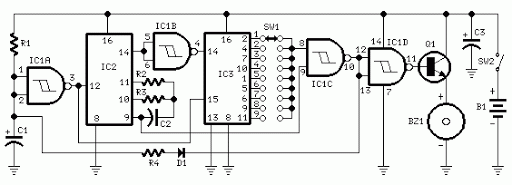
Jogging TimerCircuit
3V battery-powered circuit that emits a beep after a fixed delay of several minutes. This circuit was created in response to requests from users seeking a timer functionality.
The described circuit operates on a 3V power supply, making it suitable for...
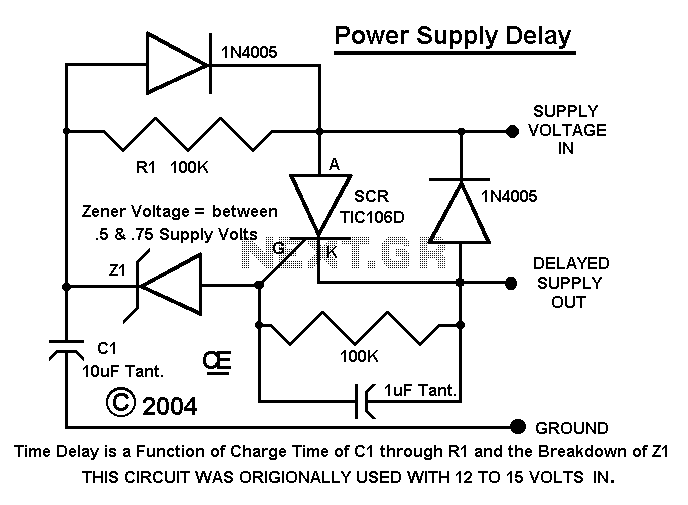
Delayed Power supply schematic
I had designed up an oscillator with a Power Output circuit. Problem was when power was applied to the entire circuit, the output of the Oscillator gave a Momentary Spike into the output circuit. Thus Driving it full on for...
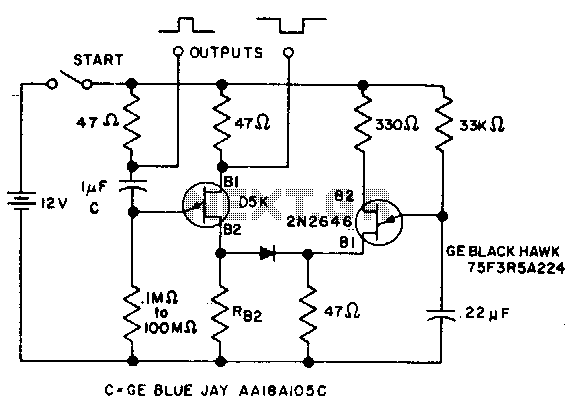
0.1 To 90 second timer
The timer interval begins when power is supplied to the circuit and ends when voltage is applied to the load. The 2N2646 transistor is utilized in the oscillator, which generates pulses to the base of the D5K. This configuration decreases...
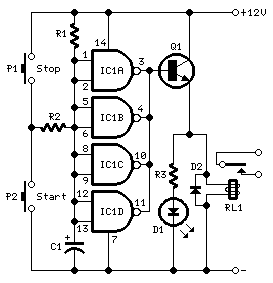
long delay timer circuit diagram
This timer was designed primarily to turn off a portable radio after a specific duration. This feature allows users to fall asleep on the beach or in a hammock, with the assurance that the radio will automatically shut off after...