


Adjustable-delay
#adjustable-delay
#monostable multivibrator
#phase delay
#pulse train
#cascaded circuits
#timer circuits
#delay circuits
#pulse spacing
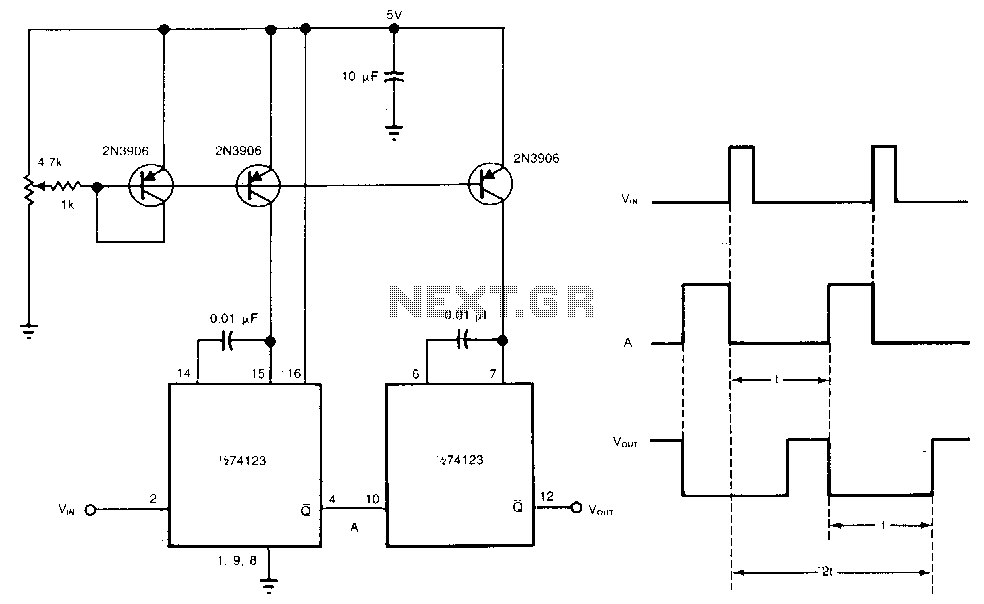
Description: It is possible to achieve over 360° of phase delay by cascading two monostable multivibrators. In a typical configuration, a single monostable multivibrator introduces a delay in a pulse train by triggering on each incoming pulse, provided it resets in time for the next pulse. However, a single monostable multivibrator can only provide a maximum phase delay of less than 360°. By utilizing a cascaded multivibrator approach, a phase delay of up to 650° can be attained, using an input pulse spacing of 200 microseconds, along with specific component values. Each input pulse triggers the circuit while allowing for adjustments in the phase delay throughout its range.
The first multivibrator triggers the second, with the reset of the second marking the total delay time. Each multivibrator introduces a delay of t microseconds, which is determined by 0.01 microfarad timing capacitors and equal charging currents sourced from a three-transistor, dual-current source configuration. The arrangement of the two multivibrators ensures that the first multivibrator resets in time to be triggered by the subsequent input pulse. Additionally, the variation of the delay time t is linear with respect to the setting of the potentiometer.
The circuit consists of two monostable multivibrators connected in series, where the output of the first multivibrator serves as the trigger input for the second multivibrator. The design employs timing capacitors rated at 0.01 microfarads, which are critical for establishing the timing intervals. The three-transistor dual-current source is configured to provide equal charging currents to both capacitors, ensuring that the timing characteristics are consistent and reliable.
In practical applications, this cascaded configuration is particularly useful in digital signal processing and timing applications where precise control over phase relationships is necessary. By adjusting the potentiometer, the user can finely tune the delay introduced by the circuit, allowing for versatile applications in synchronous systems, clock generation, and signal conditioning. The ability to achieve a phase delay exceeding 360° opens up further possibilities for complex timing adjustments in electronic systems.You can obtain well over 360° of phase delay by cascading two monostable multivibrators. In a typical configuration, a single monostable multivibrator is used to introduce delay in a pulse train; the multivibrator triggers on each incoming pulse, provided it resets in time for the next pulse. Yet even when it resets in time, the single monostable multivibrator provides a maximum phase delay of less than 360°.
However, with the cascaded-multivibrator approach, you can achieve 650° of phase delay by using an input-pulse spacing of 200 p.s for example, with the component values shown. Every input pulse will trigger the circuit while you adjust the phase delay throughout its available range.
The first multivibrator triggers the second one, whose reset marks the total delay time (21). Each introduces a delay oft p.s, based on 0.01-p.F timing capacitors and equal charging currents from the three-transistor, dual-current source. The two multivibrator arrangement allows the first multivibrator to reset in time to be triggered by the next input pulse.
Also, the variation of t is linear with the potentiometer setting.
The first multivibrator triggers the second, with the reset of the second marking the total delay time. Each multivibrator introduces a delay of t microseconds, which is determined by 0.01 microfarad timing capacitors and equal charging currents sourced from a three-transistor, dual-current source configuration. The arrangement of the two multivibrators ensures that the first multivibrator resets in time to be triggered by the subsequent input pulse. Additionally, the variation of the delay time t is linear with respect to the setting of the potentiometer.
The circuit consists of two monostable multivibrators connected in series, where the output of the first multivibrator serves as the trigger input for the second multivibrator. The design employs timing capacitors rated at 0.01 microfarads, which are critical for establishing the timing intervals. The three-transistor dual-current source is configured to provide equal charging currents to both capacitors, ensuring that the timing characteristics are consistent and reliable.
In practical applications, this cascaded configuration is particularly useful in digital signal processing and timing applications where precise control over phase relationships is necessary. By adjusting the potentiometer, the user can finely tune the delay introduced by the circuit, allowing for versatile applications in synchronous systems, clock generation, and signal conditioning. The ability to achieve a phase delay exceeding 360° opens up further possibilities for complex timing adjustments in electronic systems.You can obtain well over 360° of phase delay by cascading two monostable multivibrators. In a typical configuration, a single monostable multivibrator is used to introduce delay in a pulse train; the multivibrator triggers on each incoming pulse, provided it resets in time for the next pulse. Yet even when it resets in time, the single monostable multivibrator provides a maximum phase delay of less than 360°.
However, with the cascaded-multivibrator approach, you can achieve 650° of phase delay by using an input-pulse spacing of 200 p.s for example, with the component values shown. Every input pulse will trigger the circuit while you adjust the phase delay throughout its available range.
The first multivibrator triggers the second one, whose reset marks the total delay time (21). Each introduces a delay oft p.s, based on 0.01-p.F timing capacitors and equal charging currents from the three-transistor, dual-current source. The two multivibrator arrangement allows the first multivibrator to reset in time to be triggered by the next input pulse.
Also, the variation of t is linear with the potentiometer setting.
Precision-one-shot
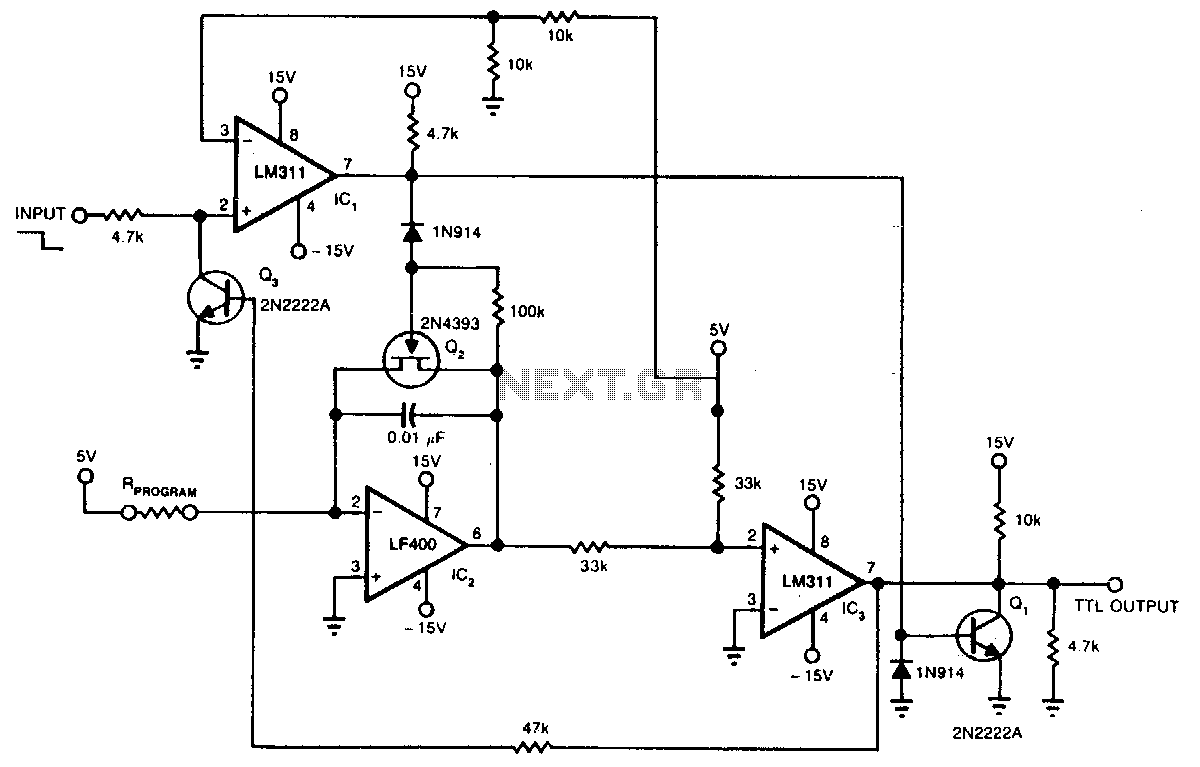
A wide-range, resistor-programmable monostable multivibrator can be configured for pulse widths ranging from 1 µs to 10 s, providing a 107:1 range. A high-to-low transition at the input causes the output of IC1 to switch low, which turns off transistors...

MC74HC4538A Dual Precision Monostable Multivibrator Retriggerable Resettable
The MC74HC4538A features a pinout identical to that of the MC14538B. Its inputs are compatible with standard CMOS outputs and, when used with pull-up resistors, they are also compatible with LSTTL outputs. This device operates as a dual monostable multivibrator.
The...
Unsteady chain circuit diagram
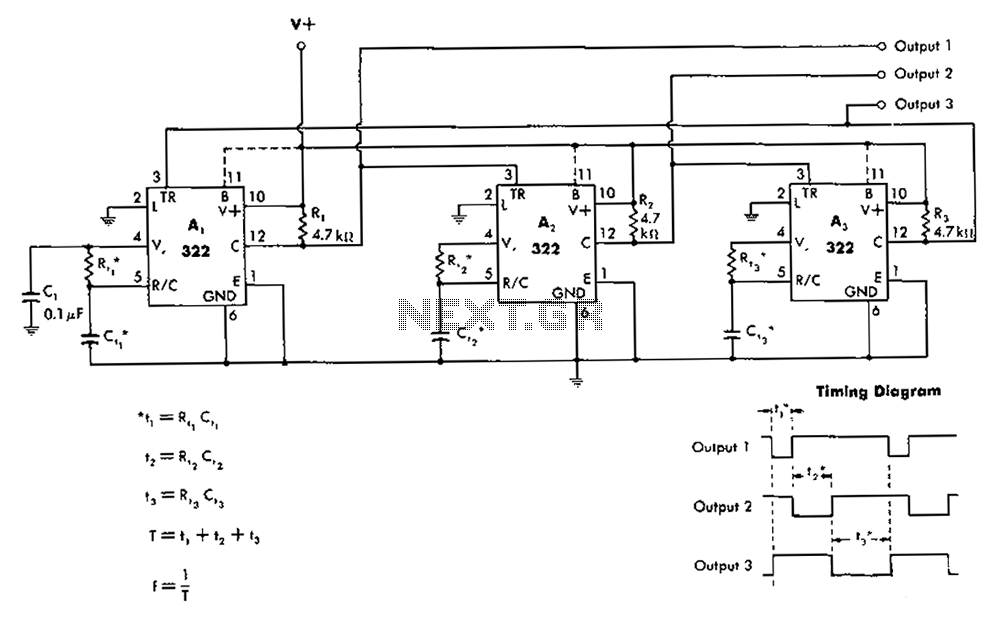
The 322 monostable multivibrator is configured in a cross-connected manner. When operating under non-steady state conditions with the oscillator Unicom, it generates a continuous timing cycle, as illustrated in the accompanying figure. T represents the total time period of three...
Precision Monostable Multivibrator Circuit
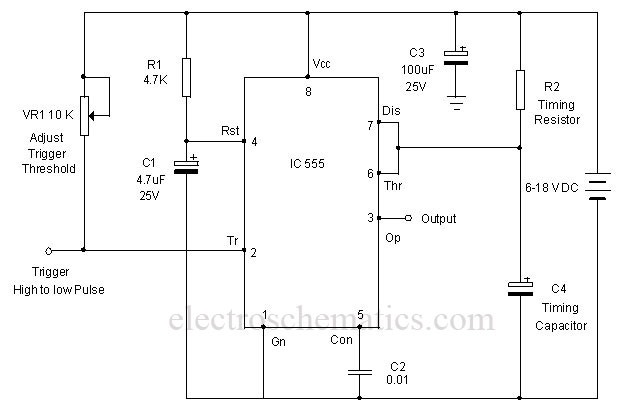
A monostable multivibrator using the IC CD4538 is a precision device that functions as a monostable/astable multivibrator and is designed to avoid false triggering. This IC is suitable for various applications requiring precise timing cycles. The CD4538 offers improved reliability...
Pulse-train-to-sinusoid-converter
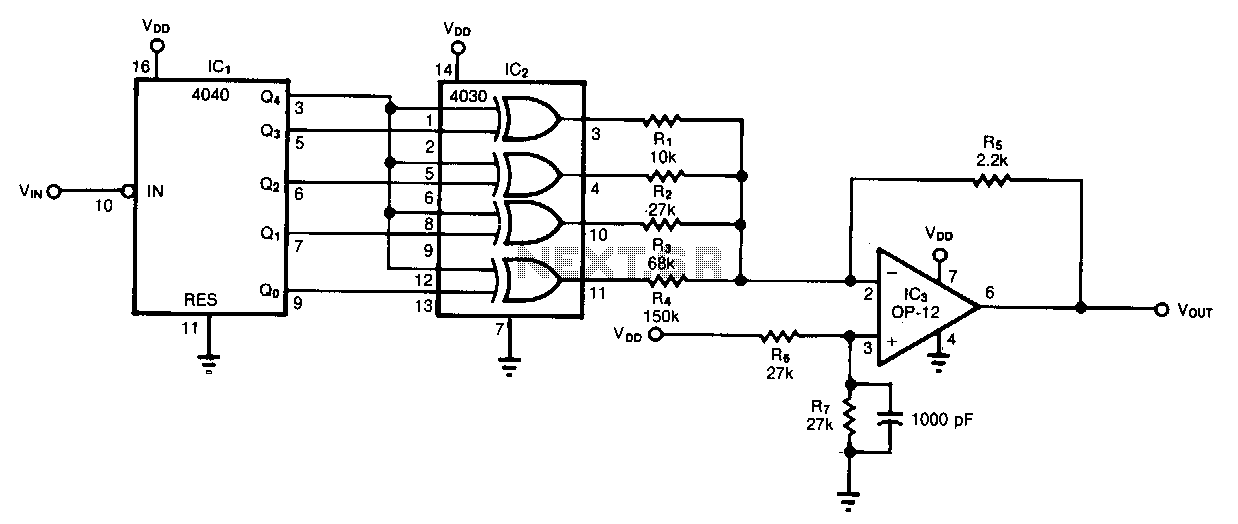
The circuit allows for the conversion of a serial pulse stream or sinusoidal input into a sinusoidal output at a frequency that is 1/32 of the input frequency. By adjusting the frequency of Vrn, an output frequency range of 107:1...
Discrete 0.5-300 ms Monostable Multivibrator
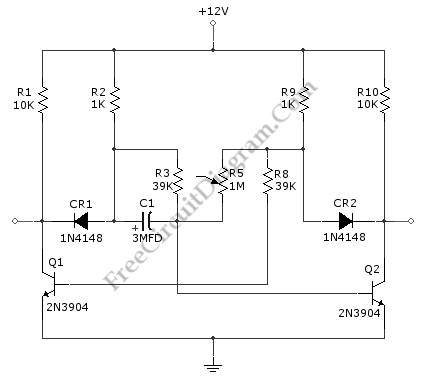
A monostable multivibrator circuit generates a fixed pulse width when triggered by an input signal. The input is connected to CR1, which should be configured as an open collector source, as TR1 will short the input to ground during the...
Pulse-Train Triggering Circuit for Power Control
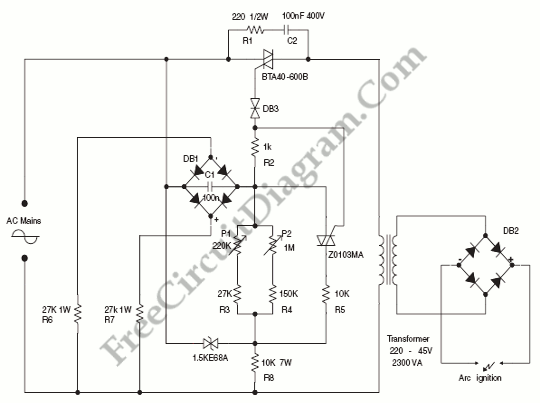
A typical circuit for welding equipment is illustrated in the following circuit diagram. The turn-on delay can be accurately controlled with Potentiometer P2, allowing for effective discharge management.
The welding equipment circuit typically incorporates several key components to ensure proper operation...
Versatile One-Shot Cpu Interface
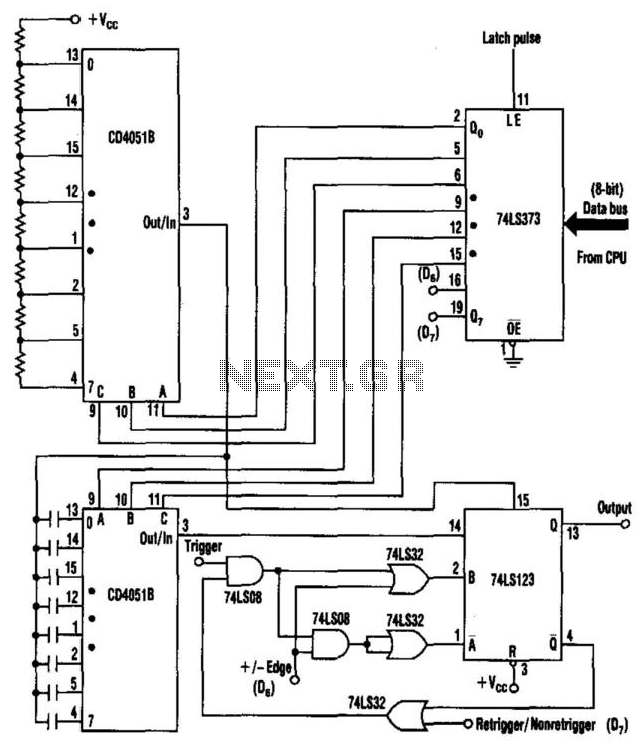
Process control applications often require a monostable multivibrator (one-shot) with a pulse width that can be selected on-the-fly. This circuit uses two CD4051B analog multiplexers to select the required timing components for the multivibrator, and hence, the pulse width. The...
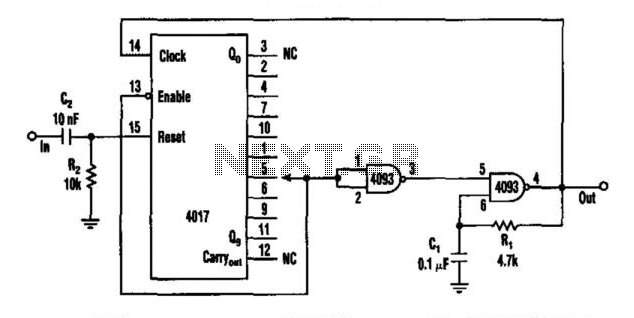
Pulse Train
This circuit features a rate multiplier utilizing a 4093 Schmitt trigger configured as an oscillator, which drives a 4017 decade counter. When a pulse is present at the input (to C2), the 4017 is reset, causing output zero to go...