


Anti-jamming circuit
#KA555
#watchdog circuit
#anti-jamming
#analog baseband
#hybrid integrated circuit
#timer
#pulse generator
#interference protection
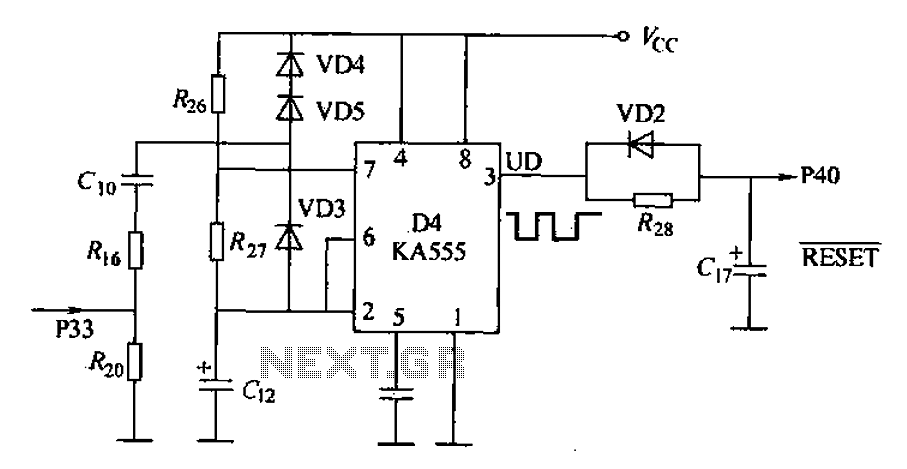
Description: Anti-jamming circuit (watchdog circuit): KA555 interference when analog baseband circuit is shown in Figure 18-14. The KA555 is a hybrid analog/digital integrated circuit. The input signal is connected to specific pins, while the power supply is 5V and the ground is connected to the integrated circuit. A transistor is connected to the discharge pin. The indirect capacitive coupling of the KA555 input pin and the capacitor (C1) through the discharge pin changes the voltage level at the output terminal. This configuration forms a multivibrator circuit with a feedback resistor (R2). Under normal operation, the microcontroller generates a timed pulsing signal, and a clamping diode (VD3) prevents oscillations. When strong interference pulses occur, the microcontroller may experience a reset. The oscillator circuit then outputs a reset signal to the microcontroller's reset pin, forcing it to restart. After analyzing the data, the microcontroller outputs instructions to maintain the air conditioner's previous state, significantly improving its resilience to interference. The troubleshooting process is very rapid, ensuring that users do not notice any disruption in the air conditioning. Additionally, there are other circuits, including a crystal oscillator circuit, over and under voltage protection circuits, a buzzer circuit, a power supply circuit, and a defrost circuit. Readers are encouraged to refer to the original circuit for further analysis.
The anti-jamming circuit described utilizes the KA555 integrated circuit, which is essential for mitigating interference in analog baseband circuits. This circuit is particularly effective in environments where signal integrity is crucial, such as in air conditioning systems. The KA555 operates as a multivibrator, utilizing feedback from a resistor (R2) to maintain stable operation under normal conditions. The configuration allows the circuit to monitor the input signal continuously.
The use of a clamping diode (VD3) is significant as it prevents unintended oscillations that could disrupt the operation of the microcontroller. In the event of strong interference, the circuit is designed to detect anomalies in the input signal, triggering a reset of the microcontroller. This reset process is critical for maintaining the operation of the air conditioning system, ensuring that it resumes its previous state without user intervention.
Additionally, the circuit incorporates various protective features, including over and under voltage protection circuits, which safeguard against power supply fluctuations that could damage sensitive components. The buzzer circuit serves as an alert mechanism, notifying users of any operational issues or failures. The defrost circuit is also vital for maintaining the efficiency of the air conditioning system in cold environments.
Overall, the design of this anti-jamming circuit exemplifies a robust approach to ensuring reliable performance in the presence of potential signal interference, enhancing the overall resilience of electronic systems in demanding applications. The integration of multiple protective features further underscores the circuit's effectiveness in maintaining operational continuity.Anti-jamming circuit (watchdog circuit): KA555 interference when analog baseband circuit shown in Figure 18-14. FIG D4 is KA555 hybrid analog/digital integrated circuits,, feet of input signal No., pin as an output signal., feet then the power 5v, O feet grounded, feet for an integrated circuit transistor connected to the discharge end. Because indirect capacitive Cl KA555 of, input pin and place :, and clz through foot discharge, changing the voltage level, the output terminal ( foot) to the input constitute a multivibrator circuit, Rza feedback resistor.
In normal operation, the microcontroller prolyl I timed pulsing signal, by clamping diode VD3 play the role of the oscillation circuit can not play vibration. Once encountered strong interference pulses, the microcontroller the phenomenon of death, immediate start-up oscillator circuit outputs a reset signal to the microcontroller s reset terminal foot, forcing the microcontroller to work again.
After analysis of the data, the microcontroller output instruction, so that the air conditioner connected to the state before the failure still continues to run, greatly improving the air conditioner s interference. This troubleshooting process time is extremely short, when users do not feel the air conditioner. 6) other circuits: In addition to the above-described circuits, as well as its crystal oscillator circuit, over, under voltage protection circuit, buzzer circuit, power supply road, defrost circuit, the reader can refer to the original circuit, self-analysis.
The anti-jamming circuit described utilizes the KA555 integrated circuit, which is essential for mitigating interference in analog baseband circuits. This circuit is particularly effective in environments where signal integrity is crucial, such as in air conditioning systems. The KA555 operates as a multivibrator, utilizing feedback from a resistor (R2) to maintain stable operation under normal conditions. The configuration allows the circuit to monitor the input signal continuously.
The use of a clamping diode (VD3) is significant as it prevents unintended oscillations that could disrupt the operation of the microcontroller. In the event of strong interference, the circuit is designed to detect anomalies in the input signal, triggering a reset of the microcontroller. This reset process is critical for maintaining the operation of the air conditioning system, ensuring that it resumes its previous state without user intervention.
Additionally, the circuit incorporates various protective features, including over and under voltage protection circuits, which safeguard against power supply fluctuations that could damage sensitive components. The buzzer circuit serves as an alert mechanism, notifying users of any operational issues or failures. The defrost circuit is also vital for maintaining the efficiency of the air conditioning system in cold environments.
Overall, the design of this anti-jamming circuit exemplifies a robust approach to ensuring reliable performance in the presence of potential signal interference, enhancing the overall resilience of electronic systems in demanding applications. The integration of multiple protective features further underscores the circuit's effectiveness in maintaining operational continuity.Anti-jamming circuit (watchdog circuit): KA555 interference when analog baseband circuit shown in Figure 18-14. FIG D4 is KA555 hybrid analog/digital integrated circuits,, feet of input signal No., pin as an output signal., feet then the power 5v, O feet grounded, feet for an integrated circuit transistor connected to the discharge end. Because indirect capacitive Cl KA555 of, input pin and place :, and clz through foot discharge, changing the voltage level, the output terminal ( foot) to the input constitute a multivibrator circuit, Rza feedback resistor.
In normal operation, the microcontroller prolyl I timed pulsing signal, by clamping diode VD3 play the role of the oscillation circuit can not play vibration. Once encountered strong interference pulses, the microcontroller the phenomenon of death, immediate start-up oscillator circuit outputs a reset signal to the microcontroller s reset terminal foot, forcing the microcontroller to work again.
After analysis of the data, the microcontroller output instruction, so that the air conditioner connected to the state before the failure still continues to run, greatly improving the air conditioner s interference. This troubleshooting process time is extremely short, when users do not feel the air conditioner. 6) other circuits: In addition to the above-described circuits, as well as its crystal oscillator circuit, over, under voltage protection circuit, buzzer circuit, power supply road, defrost circuit, the reader can refer to the original circuit, self-analysis.
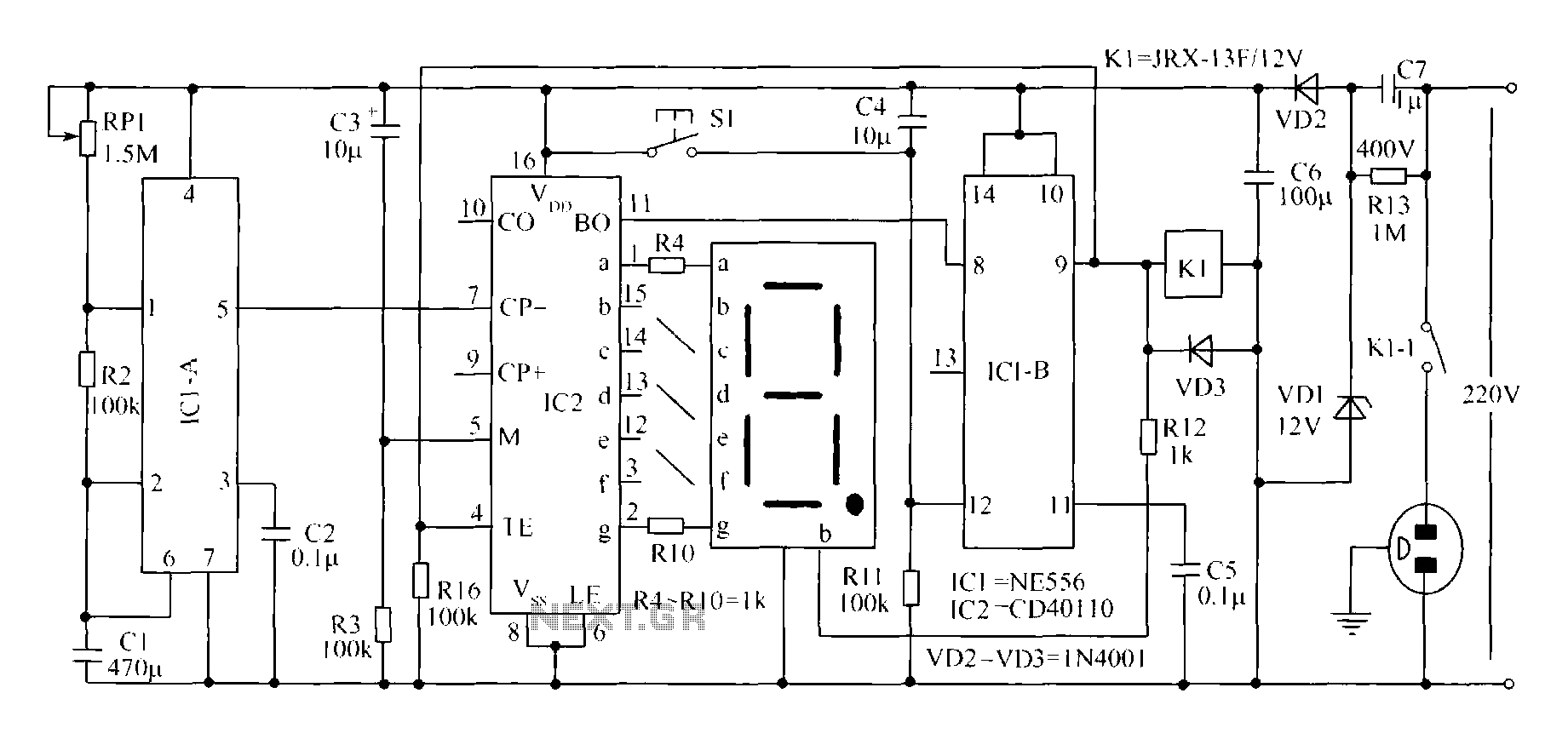
Novel circuit diagram of the timer switch
A novel timing switch circuit features a "Variable Timing" adjustment function in addition to a standard timing circuit. It also includes a countdown display feature, which indicates the remaining time of the timing circuit, making it particularly useful. The entire...
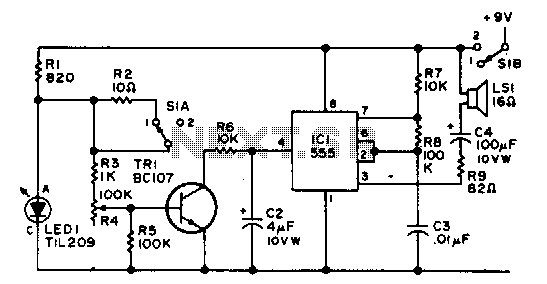
Electronic egg timer
The integrated circuit (IC) operates as an astable multivibrator that is controlled by an external transistor. S1A/B serves as the on-off toggle switch.
The astable multivibrator configuration is commonly utilized in various applications, including pulse generation, clock signals, and LED flashing...
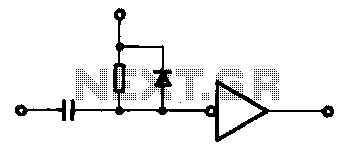
Single pulse signal generating circuit
A single pulse signal generating circuit is depicted, which utilizes switch contacts to create a digital signal for reset or stop functions. This one-shot pulse generating circuit operates as a non-synchronous differential circuit.
The single pulse signal generating circuit, commonly referred...
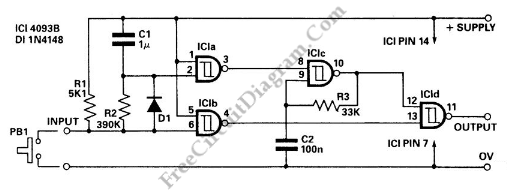
Pulse Delay Generator
This circuit is a delayed pulse generator that provides pulse rate and independent control of the initial delay. The pulse generator of this circuit is.
The delayed pulse generator circuit is designed to produce a pulse output after a specified delay,...
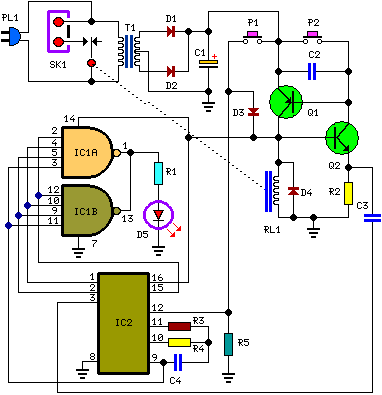
A Bedside Lamp Timer Circuit Schematic
The purpose of this circuit is to power a lamp or other appliance for a specified duration (30 minutes in this case) and then automatically turn it off. This feature is particularly useful for reading in bed at night, as...
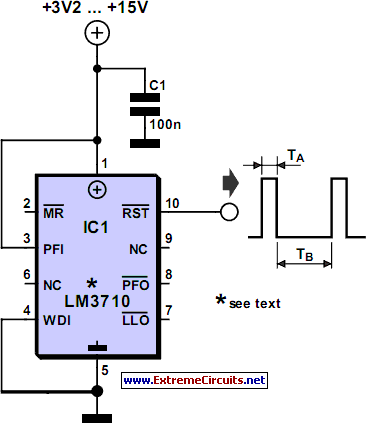
Long-Interval Pulse Generator
A rectangular-wave pulse generator with an extremely long period can be constructed using only two components: a National Semiconductor LM3710 supervisor integrated circuit (IC) and a 100-nF capacitor to suppress noise spikes. This circuit leverages the watchdog and reset timers...
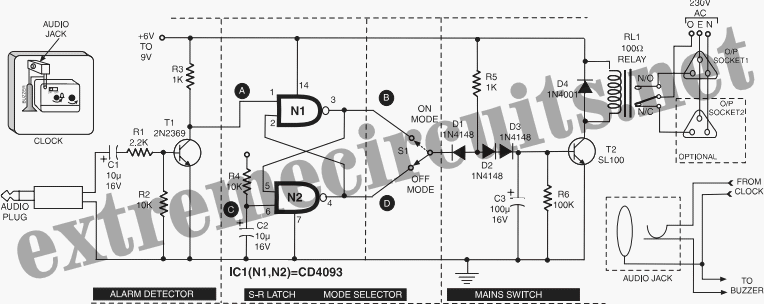
Time Switch
This circuit is specifically designed for individuals who frequently need to wake up early in the morning. Standard alarms in electronic watches are often insufficiently loud.
The circuit utilizes a high-decibel audio output mechanism to ensure that the alarm is audible...
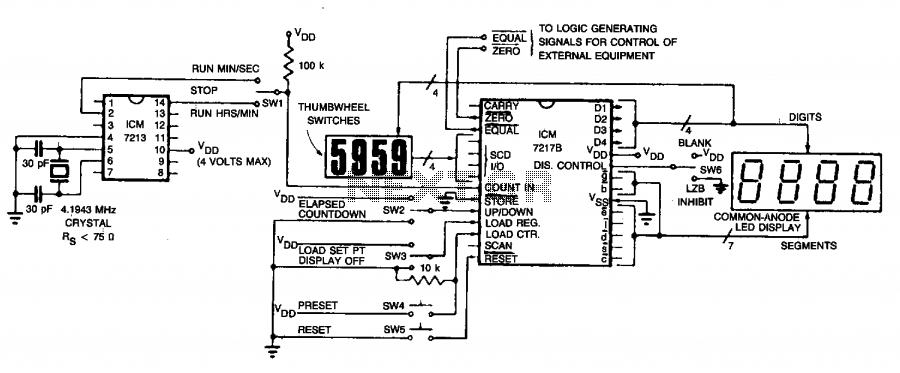
Precision time-countdown timer
The circuit employs an ICM7213 precision timebase generator with a frequency of 4.1943 MHz, which is utilized for generating pulses that are counted by an ICM7217B counter. Thumbwheel switches are incorporated to allow the user to input a starting time...
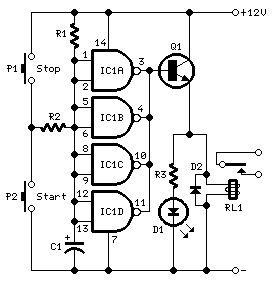
long delay timer schematics
This timer is designed to automatically switch off a portable radio after a set period, allowing users to relax without worrying about battery drain. Resistor R1 and capacitor C1 create a long time constant. When switch P2 is momentarily closed,...