


Duty-Cycle Detector

Description: This circuit monitors the duration of an incoming pulse. If the incoming pulse is shorter than the set value (VAR1), the output of U1B remains high. Values are provided for a 1 to 2 microsecond pulse.
The described circuit functions as a pulse-width discriminator, which is critical in applications where timing and pulse duration are essential for signal processing. The circuit utilizes a comparator or operational amplifier (U1B) to compare the duration of an incoming pulse against a reference value, denoted as VAR1.
In practical terms, when an incoming pulse is detected, the circuit measures the time the pulse remains high. If this duration is less than the threshold set by VAR1, the output of U1B is driven high, indicating that the pulse duration does not meet the required criteria. Conversely, if the pulse exceeds the VAR1 threshold, the output state of U1B may change, depending on the specific design of the circuit.
The circuit can be designed to accommodate various pulse widths, with specific values provided for a pulse duration ranging from 1 to 2 microseconds. This adaptability makes it suitable for a variety of applications, including digital signal processing, timing applications in microcontrollers, and pulse-width modulation systems.
To implement this circuit, it is essential to select appropriate components, including resistors and capacitors, to define the timing characteristics and ensure accurate pulse measurement. The use of hysteresis may also be considered to avoid false triggering due to noise in the incoming signal. Overall, the circuit serves as a reliable means of pulse duration detection, with potential applications in telecommunications, data acquisition systems, and other electronic devices requiring precise timing measurements. This circuit looks at the time an incoming pulse is high. If the incoming pulse is shorter than the adjusted (VAR1) pul se, the output of U1B is high. Values are shown for a 1-to 2-/as pulse.
The described circuit functions as a pulse-width discriminator, which is critical in applications where timing and pulse duration are essential for signal processing. The circuit utilizes a comparator or operational amplifier (U1B) to compare the duration of an incoming pulse against a reference value, denoted as VAR1.
In practical terms, when an incoming pulse is detected, the circuit measures the time the pulse remains high. If this duration is less than the threshold set by VAR1, the output of U1B is driven high, indicating that the pulse duration does not meet the required criteria. Conversely, if the pulse exceeds the VAR1 threshold, the output state of U1B may change, depending on the specific design of the circuit.
The circuit can be designed to accommodate various pulse widths, with specific values provided for a pulse duration ranging from 1 to 2 microseconds. This adaptability makes it suitable for a variety of applications, including digital signal processing, timing applications in microcontrollers, and pulse-width modulation systems.
To implement this circuit, it is essential to select appropriate components, including resistors and capacitors, to define the timing characteristics and ensure accurate pulse measurement. The use of hysteresis may also be considered to avoid false triggering due to noise in the incoming signal. Overall, the circuit serves as a reliable means of pulse duration detection, with potential applications in telecommunications, data acquisition systems, and other electronic devices requiring precise timing measurements. This circuit looks at the time an incoming pulse is high. If the incoming pulse is shorter than the adjusted (VAR1) pul se, the output of U1B is high. Values are shown for a 1-to 2-/as pulse.
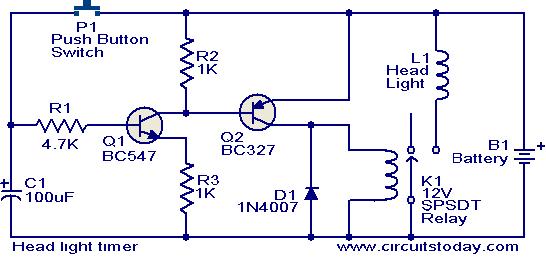
Head light timer circuit
This circuit is a compact timer that keeps the headlights of a car on for approximately 1.5 minutes before turning them off. Incorporating this circuit into a vehicle allows access to dark areas without the need to return and manually...
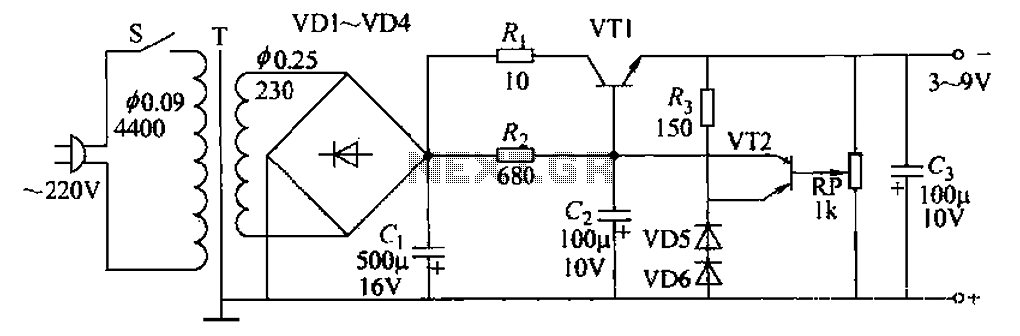
Adjustable from 3 to 9V 100mA power supply circuit
A 3-9V adjustable 100mA power supply is presented, featuring a series regulator circuit that utilizes amplifier tubes. The output voltage can be continuously adjusted between 3V and 9V, with a maximum output current of 100mA, making it suitable for powering...
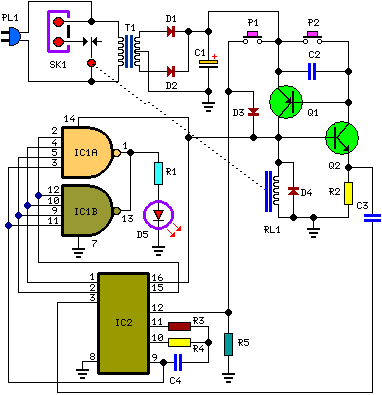
A Bedside Lamp Timer Circuit
This circuit is designed to power a lamp or other appliance for a specified duration of 30 minutes, after which it automatically turns off. It is particularly useful for nighttime reading, as it can turn off a bedside lamp if...
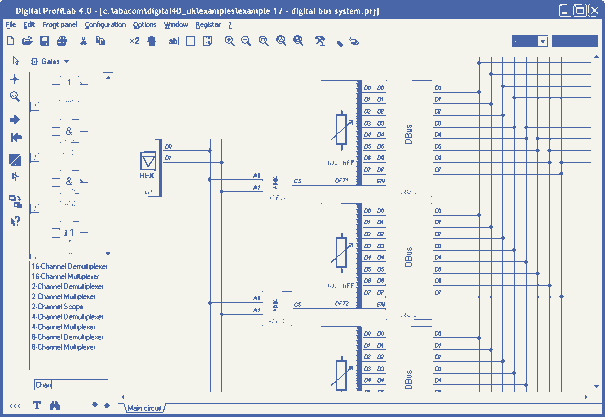
Digital-ProfiLab 4.0
Digital-ProfiLab was designed for measurement and control applications, combining features like circuit and logic simulation, front panel design, and hardware control to one powerful tool. Incoming signals from external devices may be processed and displayed. A circuit editor is used...
A Very Useful Timed Beeper Circuit Schematic
This circuit is designed for alerting purposes after a specified duration has elapsed. It is suitable for table games that require a fixed time limit to answer a question or to move a piece, serving as a modern substitute for...
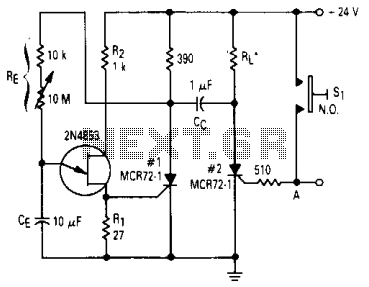
Timer circuit
After one cycle of operation, SCR1 will be activated, resulting in a low voltage being applied to the UJT emitter circuit, which interrupts the tuning function. When pushbutton SI is pressed, or a positive pulse is applied at point A,...
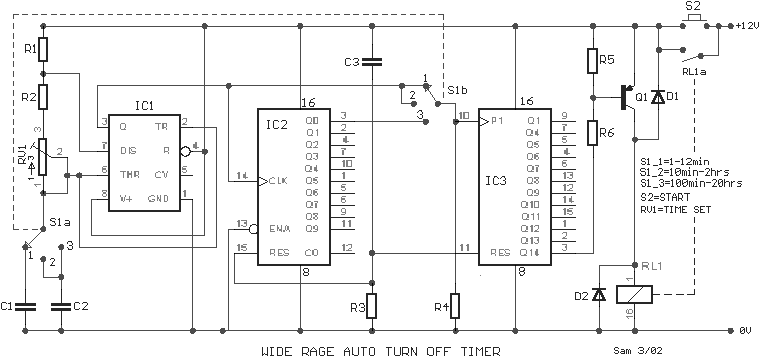
wide range timer
A wide range auto turn-off timer covering 1 minute to 20 hours in three ranges.
The auto turn-off timer is designed to provide a versatile timing solution that can be set across a broad spectrum, from a minimum of 1 minute...
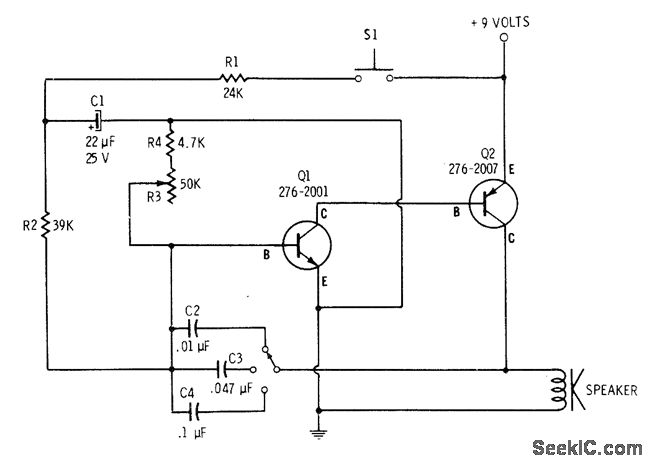
ADJUSTABLE SIREN
The tone is adjustable through a multiposition switch that changes capacitors in the oscillator circuit. The speed, or rate of frequency change, of the siren is controlled with resistor R3. A 4700-ohm resistor is placed in series with R3 to...
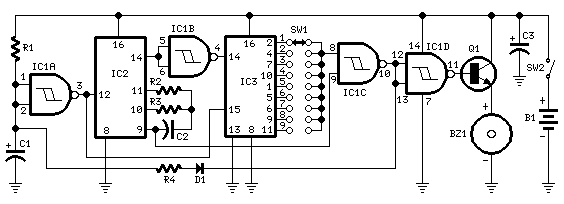
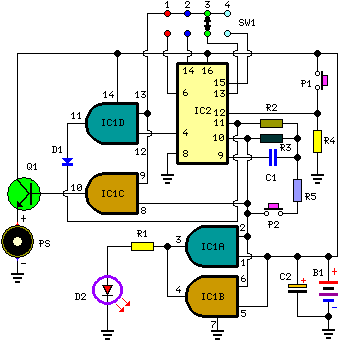
Jogging Timer
This circuit was developed in response to requests from visitors for a timer that can emit a beep after intervals of one, two, three minutes, and so forth, suitable for jogging purposes. As illustrated in the circuit diagram, SW1 is...